

Customer concentration: when one big customer becomes a risk
Customer concentration risk in a small SaaS: measure one customer’s share of MRR, stress-test losing them and shape a big deal so it stays safe.
By Sergey BruhPublished 7 min read
Customer concentration risk in a small SaaS: measure one customer’s share of MRR, stress-test losing them and shape a big deal so it stays safe.
By Sergey BruhPublished 7 min read
A free course for PMs and marketers: short lessons, real product data and exercises with instant feedback.
Start the free course6 min read
TAM SAM SOM in plain words: the three layers of market size, how to calculate each with a worked example, and when the acronym actually helps.
6 min read
How big an annual plan discount should be: compare it with what a monthly customer really pays in a year given your churn. Formula, table and example.
8 min read
SaaS valuation multiples for a small SaaS business: profit and ARR multiples, what moves them, what buyers check in due diligence and how to weigh an earn-out.
Customer concentration is how much of your revenue depends on your largest customers. It becomes a risk when losing one of them would push the business into a loss or force it to change course, usually once a single customer passes 10–20% of monthly recurring revenue, or earlier if you've built custom work just for them. To judge a big deal, calculate the customer's share of MRR, then stress-test the month after they leave: revenue without them against the costs you'll still have. Below is one offer worked through, with three ways to answer it.
Denys and Olha run FitRota, a web app for independent fitness studios: class schedules, memberships and reminders. 120 studios pay 800 UAH a month, so MRR is 96,000 UAH. Costs are 80,000 a month: 70,000 for the two founders' pay and 10,000 for tools, SMS and an accountant. Profit: 16,000 UAH a month.
A national chain of 50 studios gets in touch. Their proposal:
The integration is more than the founders can build and maintain themselves, so they would hire a contract developer for 25,000 UAH a month with three months' notice.
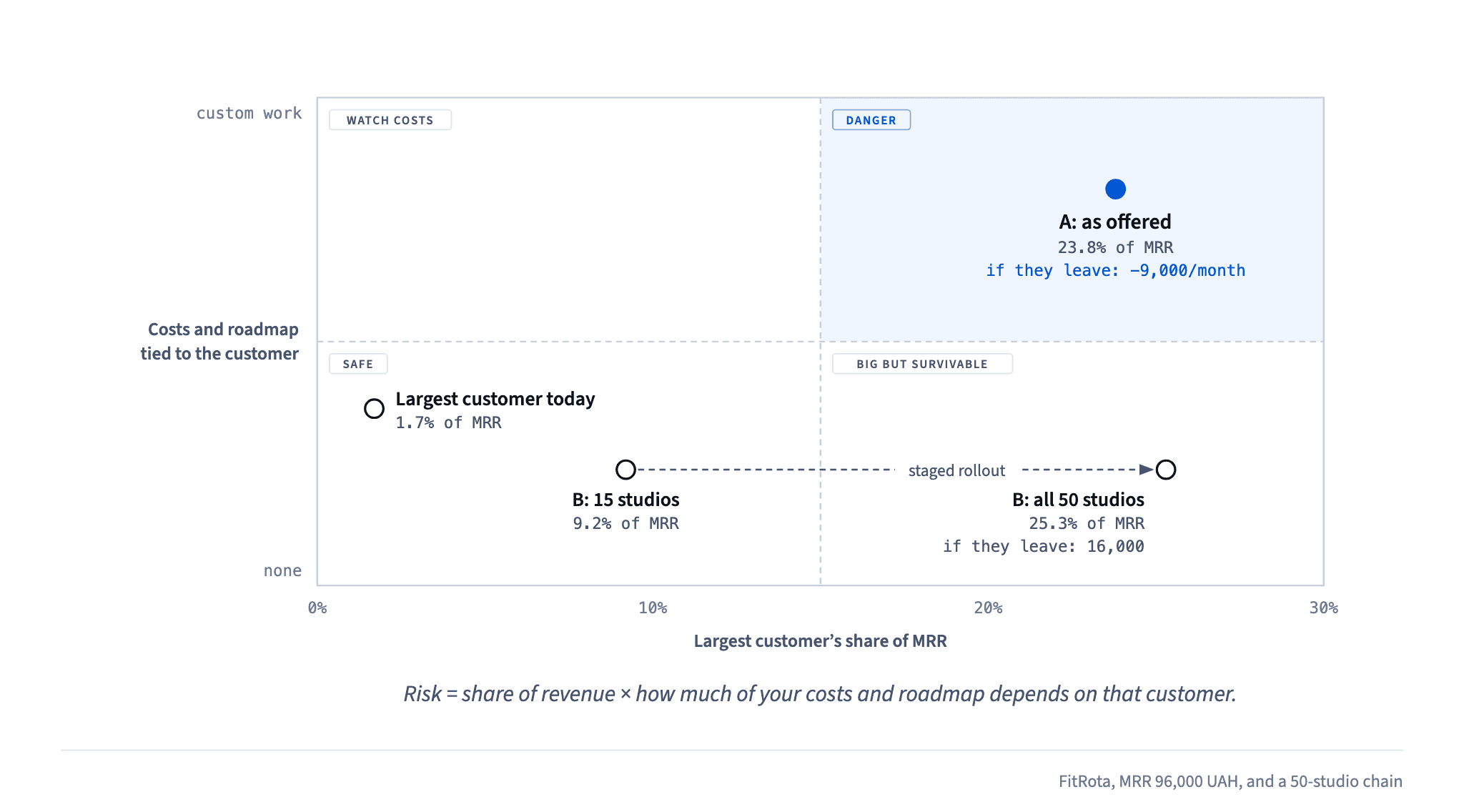
Almost a quarter of revenue from one customer. For comparison, today FitRota's biggest customer, an owner with two studios, pays 2 × 800 = 1,600 UAH: 1.7% of MRR.
With the chain, profit becomes 126,000 − (80,000 + 25,000) = 21,000 UAH, only 5,000 more than today, because the custom work eats most of the extra revenue.
Now suppose the chain leaves when the contract ends: a new manager, a merger, a cheaper supplier. The developer is still on notice for three months:
Three months of losses, 27,000 UAH in total, plus integration code that nobody else needs and somebody still has to maintain or remove. In exchange for a year of 5,000 UAH extra profit a month, the founders would take on a real chance of losing money after it.
There's a quieter cost too. While the chain pays a quarter of the bills, every one of its requests jumps the queue, and the product drifts toward one customer's needs instead of the 120 studios that chose it.
How option B is calculated: 15 × 650 = 9,750 UAH, so MRR is 105,750 and the share 9,750 / 105,750 ≈ 9.2%. With no custom work, costs stay at 80,000, so profit is 25,750. If all 50 studios join, 50 × 650 = 32,500, and profit is 128,500 − 80,000 = 48,500.
Option B is the founders' answer: the standard product at a volume price, no custom integration, a gradual rollout starting with 15 studios. By revenue share, the fully rolled-out option B is as concentrated as option A. The difference is the downside: if the chain leaves, FitRota is back where it started, not in a loss. Concentration risk is revenue share multiplied by how much of your cost base and roadmap depends on that customer.
The chain may say no to 650. That's a fine outcome too: FitRota keeps its current, healthy business.
Anyone who considers buying or investing in your company will ask for revenue by customer. A business where one customer brings a quarter of the revenue is judged partly as a bet on that customer, and the price usually falls or part of it becomes conditional on the customer staying. More on how buyers value small SaaS companies: how much a small SaaS business is worth.
In a niche with a few hundred possible customers, one chain can look like a shortcut to the next milestone. Before taking it, check whether the normal market is big enough to reach your goals without it; bottom-up market sizing shows how. If it is, the big customer is a bonus, not a lifeline, and you can afford to say no to bad terms.
It is the risk that losing one customer, or a few, would seriously damage the business. It grows with that customer's share of revenue and with the costs and product decisions made for them.
A common rule of thumb is that more than about 10% of revenue from one customer draws questions from buyers and lenders, and more than 20–25% is a serious risk. For a small company, the stress test matters more than the exact threshold.
Yes, on terms that leave you safe if they leave: standard product, a fair volume price, a staged rollout and ideally payment in advance.
Grow the rest of the customer base faster than the big customer, avoid new custom commitments, and negotiate longer contracts or annual prepayment with the largest customer while the relationship is good.
The lesson One customer too big follows two founders when a franchise asks for a special deal, with numeric exercises and a case checked by AI. It is part of the course From Idea to Profitable Product: Building Without Investors; the lesson What the business is worth shows how buyers look at the same numbers.