

How to calculate churn rate and MRR from one month of events
How to calculate churn rate and MRR from one month of subscription events: the churn rate formula, MRR churn, upgrades and annual plans, step by step.
By Sergey BruhPublished 7 min read
How to calculate churn rate and MRR from one month of subscription events: the churn rate formula, MRR churn, upgrades and annual plans, step by step.
By Sergey BruhPublished 7 min read
A free course for PMs and marketers: short lessons, real product data and exercises with instant feedback.
Start the free course6 min read
How big an annual plan discount should be: compare it with what a monthly customer really pays in a year given your churn. Formula, table and example.
7 min read
Customer concentration risk in a small SaaS: measure one customer’s share of MRR, stress-test losing them and shape a big deal so it stays safe.
Here is how to calculate churn rate: divide the customers you lost during the month by the customers you had at its start, not its end. MRR churn is the same idea in money: recurring revenue lost divided by MRR at the start. MRR itself is the sum of what every active customer pays per month, with annual plans divided by 12 and one-time fees left out. To calculate MRR and churn from real data, start from MRR at the beginning of the month and sort every event of the month into new, expansion, contraction and churned revenue. Below is one month of a small SaaS worked through line by line.
MRR (monthly recurring revenue) tells you how big the business is right now, without the noise of when invoices happened to be paid. Churn tells you how fast that business leaks. Together they answer the questions a founder asks every month: are we growing, and is the growth real or just replacing customers who left?
They are also the first two numbers anyone asks for when they consider buying or investing in the company.
DriveSlot helps driving schools schedule lessons with instructors and cars. It has three ways to pay:
On 1 March DriveSlot has 70 Basic monthly, 10 Pro monthly and 12 Basic annual customers: 92 in total.
Note the annual customers: they paid 9,000 once, but contribute 750 a month. Counting 9,000 in the month of payment would make MRR jump and fall for no real reason. Why annual plans are still worth offering, and at what discount: annual plan discount.
The March log from the payment system and the admin panel:
Two traps are in this list on purpose. A renewal of an annual plan doesn't change MRR: that school was already counted at 750 a month. And a one-time fee is revenue, but not recurring revenue.
Net new MRR is 90,300 − 86,000 = 4,300 UAH.
Check it by counting customers on each plan on 31 March: 70 Basic monthly (70 + 6 − 3 − 4 + 1), 12 Pro monthly (10 + 1 + 3 − 1 − 1) and 14 annual (12 + 2). That gives 70 × 900 + 12 × 1,400 + 14 × 750 = 90,300. The two methods agree, which is the best test that no event was missed.
Customer churn. Five schools left (four cancellations and one failed payment); 92 were there at the start.
Gross revenue churn (gross MRR churn). Revenue lost to cancellations and downgrades, divided by starting MRR:
Some teams leave downgrades out and get 5,000 / 86,000 ≈ 5.8%. Either is fine; pick one definition and keep it.
Net revenue churn. Subtract expansion from the losses:
When expansion from existing customers exceeds what you lose, net revenue churn becomes negative: the customer base grows in value even with no new sales. That's the goal, and price rises and upgrades to bigger plans are the usual way there.
A monthly number sounds small. Over a year it compounds:
At this rate DriveSlot loses about half of any group of customers within a year, and the average customer stays about 1 / 0.054 ≈ 18 months. Every month, the first 5 or so new schools only replace the ones that left. The same loss seen from the other side is retention: 94.6% of customers stay each month; the retention rate formula shows how to track it for groups of customers over time.
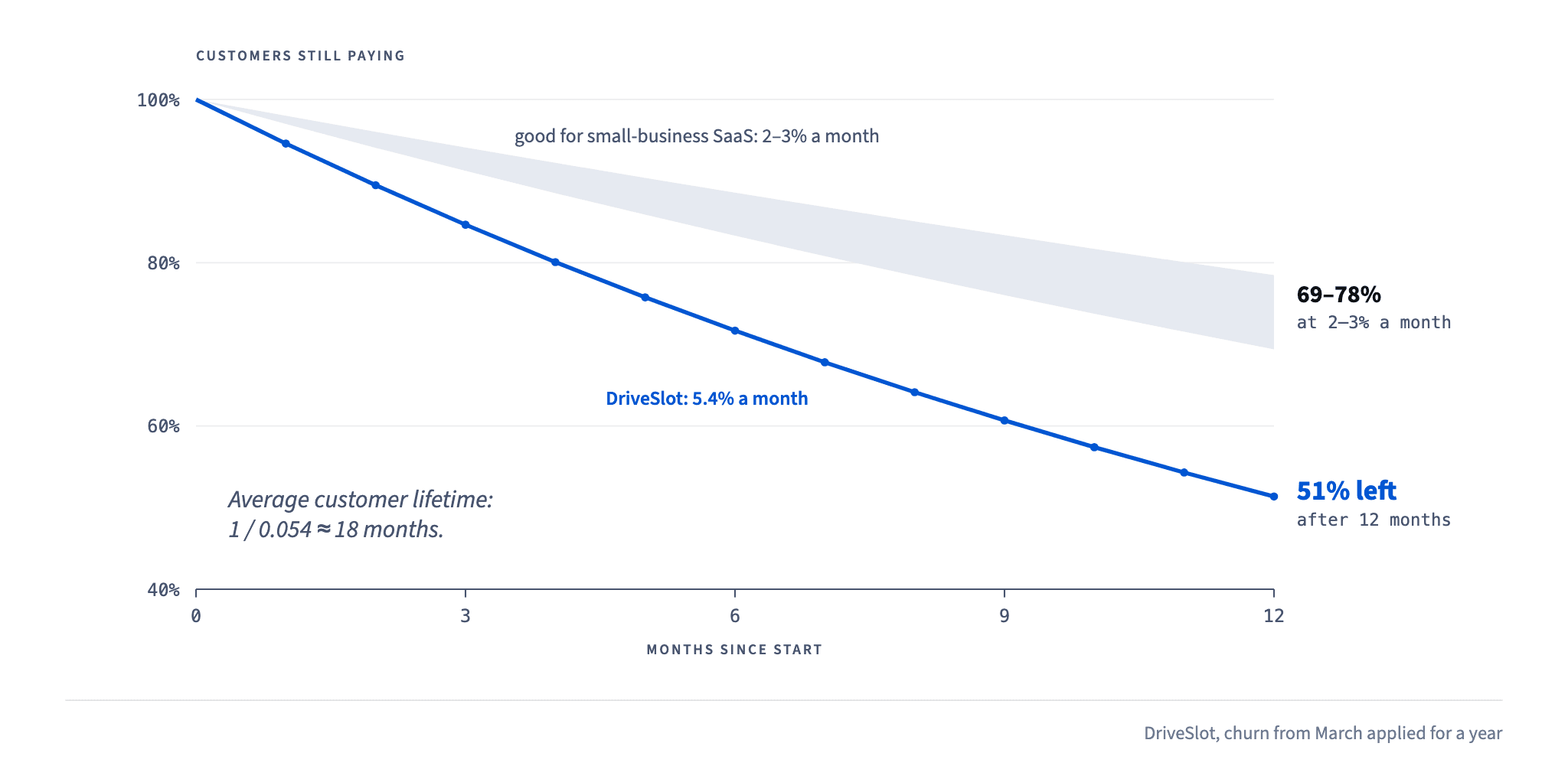
That makes the reasons for leaving worth more attention than the next marketing idea. In DriveSlot's case one of the five was a failed card: an automatic retry and a reminder email could have saved it without any product change.
Churn rate = customers lost during the period ÷ customers at the start of the period × 100%. For MRR churn, put MRR lost to cancellations (and, if you count them, downgrades) over MRR at the start. In the example: 5 ÷ 92 ≈ 5.4% customer churn and 5,500 ÷ 86,000 ≈ 6.4% gross MRR churn.
It varies by market, but for products sold to small businesses, monthly customer churn of 2–3% is good and above 5% is a sign to investigate why customers leave. Small businesses close more often than large ones, so some churn is unavoidable.
No. Count a customer in MRR from the first payment. Trial users who don't convert are a conversion problem, not churn.
They weren't in the starting count, so they don't belong in the churn rate for that month. Track them separately; many of them point to onboarding problems.
MRR shows the size of the business and churn shows how durable it is. Together they drive most of what a small SaaS is worth; see how much a small SaaS business is worth.
The lesson MRR and churn works through a month of a product for car repair shops, with numeric exercises and a practice task checked by AI. The next one, Why shops leave, is about the reasons behind the churn number. Both are part of the course From Idea to Profitable Product: Building Without Investors.