

Theory
How much is the business worth?
How much is my business worth? ARR, yearly owner earnings and a multiple: how to turn a small subscription business's numbers into a price range, what moves the multiple, and how an offer compares.
~9 min read · 9 exercises · 250 points
Before you start
Is six million a lot?
Axle Group's offer to buy GarageDesk, 4 million UAH at closing plus 2 million more if growth targets are met, is still on the table, and GarageDesk's founders are torn between two feelings: the price sounds enormous, and at night Oscar wonders whether it's cheap. Neither feeling is a number.
In this lesson you'll turn GarageDesk's numbers into a price range the way buyers of small subscription businesses do, see what moves that range up or down, and compare the offer with it.
ARR: the yearly figure buyers start from
“Six million sounds enormous” and “what if it's cheap?” are both feelings, not numbers. To judge an offer you need the figure a buyer starts from.
Buyers of small subscription businesses usually take a yearly figure and multiply it. They think in years: how much the business will bring over the years they own it, and how soon the price comes back to them. The simplest yearly figure is ARR (annual recurring revenue):
ARR = MRR × 12
GarageDesk in October: MRR 165,000 UAH.
ARR = 165,000 × 12 = 1,980,000 UAH
ARR counts only recurring subscription revenue. One-off payments, such as a setup fee or a single consulting job, don't belong in it, because a buyer can't count on them next year. Yearly plans count at their monthly equivalent, which is how they already sit inside MRR.
ARR says nothing about costs yet; a business with high revenue can still make little profit. That is why the next step checks the value a second way, on profit.
- DoARR = 165,000 × 12 = 1,980,000 UAH.
- Don'tARR = 165,000 × 12 + this year's one-off setup fees.
One-off payments aren't recurring revenue.
The valuation multiple
A valuation multiple is the number a financial figure, such as ARR or yearly profit, is multiplied by to estimate a company's price:
value ≈ ARR × revenue multiple

It isn't a law of nature. It depends on the buyer, the market and the business itself: it goes up with growth, low churn and independence from the founders, and down with risks. In this lesson we use an illustrative range of 2 to 4 times ARR for a small, profitable, growing subscription business. Real deals can land outside it, so treat it as a way to think, not a price list.
Turn it around to read an offer: multiple = price / ARR.
- Axle's total: 6,000,000 / 1,980,000 = 3.03 ≈ 3.0× ARR, the middle of the range.
- The certain part at closing: 4,000,000 / 1,980,000 = 2.02 ≈ 2.0× ARR, the bottom of the range.

The same offer looks fair or low depending on which part you divide. Always compute both.
- Do6,000,000 / 1,980,000 ≈ 3.0× ARR in total; 4,000,000 / 1,980,000 ≈ 2.0× certain.
- Don't6,000,000 / 165,000 ≈ 36×, far above the range.
Divides by MRR, not ARR.
Owner earnings: profit before the founders' pay
Revenue isn't what a buyer takes home, so check the value a second way, on profit. For a small business run by its owners, buyers often use owner earnings: the yearly profit before paying the owners anything, that is revenue minus all costs except the founders' own pay and perks. It is also called seller's discretionary earnings (SDE).
GarageDesk's monthly costs without the founders' pay are 67,000 UAH: Martha (part-time support) 16,000, Ethan (contract developer) 35,000, tools and SMS 12,000, the accountant 4,000.
- Monthly: 165,000 − 67,000 = 98,000 UAH.
- Yearly: 98,000 × 12 = 1,176,000 UAH.
Then apply an illustrative profit multiple:
value ≈ owner earnings × profit multiple
Formula: Value V as a multiple of ARR, or of E, the yearly owner earnings (profit before the founders' own pay). The multiples m are illustrative and depend on the buyer and the business. · shown above
In this lesson the illustrative range is 3 to 5 times owner earnings. Like the revenue multiple, it is a way to think, not a market rule; larger companies are more often valued on EBITDA, which counts the owners at a market salary.
The two methods measure different things, revenue and profit, so using both gives a better picture than either alone.
- Do(165,000 − 67,000) × 12 = 98,000 × 12 = 1,176,000 UAH.
- Don't(165,000 − 67,000) = 98,000 UAH of yearly owner earnings.
That's one month; multiply by 12.
Why buyers add back the founders' pay
In an owner-run business the founders decide their own pay. Nina and Oscar pay themselves 40,000 UAH a month each; they could just as well take 20,000 or 60,000. After their current pay only 165,000 − 67,000 − 80,000 = 18,000 UAH a month is left, 216,000 a year, but that figure says more about the founders' choices than about the business.
A buyer will decide who does those jobs and how much to pay. So buyers usually start from profit before the founders' pay, owner earnings, and then make their own assumptions. Using profit after the founders' current pay would value GarageDesk on 216,000 a year instead of 1,176,000, and badly undervalue it.
There is a catch, and it cuts the other way. Someone still has to do Nina's and Oscar's work: building the product, selling, deciding. The buyer may have to pay more for those roles than the founders pay themselves. That is one reason why profit multiples for small owner-run businesses stay modest, and why a business whose founders are hard to replace is worth less.
- DoOwner earnings: (165,000 − 67,000) × 12 = 1,176,000 UAH, founders' pay not deducted.
- Don'tValue on 18,000 × 12 = 216,000 UAH a year left after the founders' salaries.
Reflects the founders' own pay choice, not the business.
A range, not a magic number
A valuation built from illustrative multiples is a range, never a single exact number. Stating “GarageDesk is worth 5,880,000 UAH” sounds precise, but the precision is fake: it comes from one illustrative multiple applied to one month's figures, and a different buyer could reasonably use a different multiple.
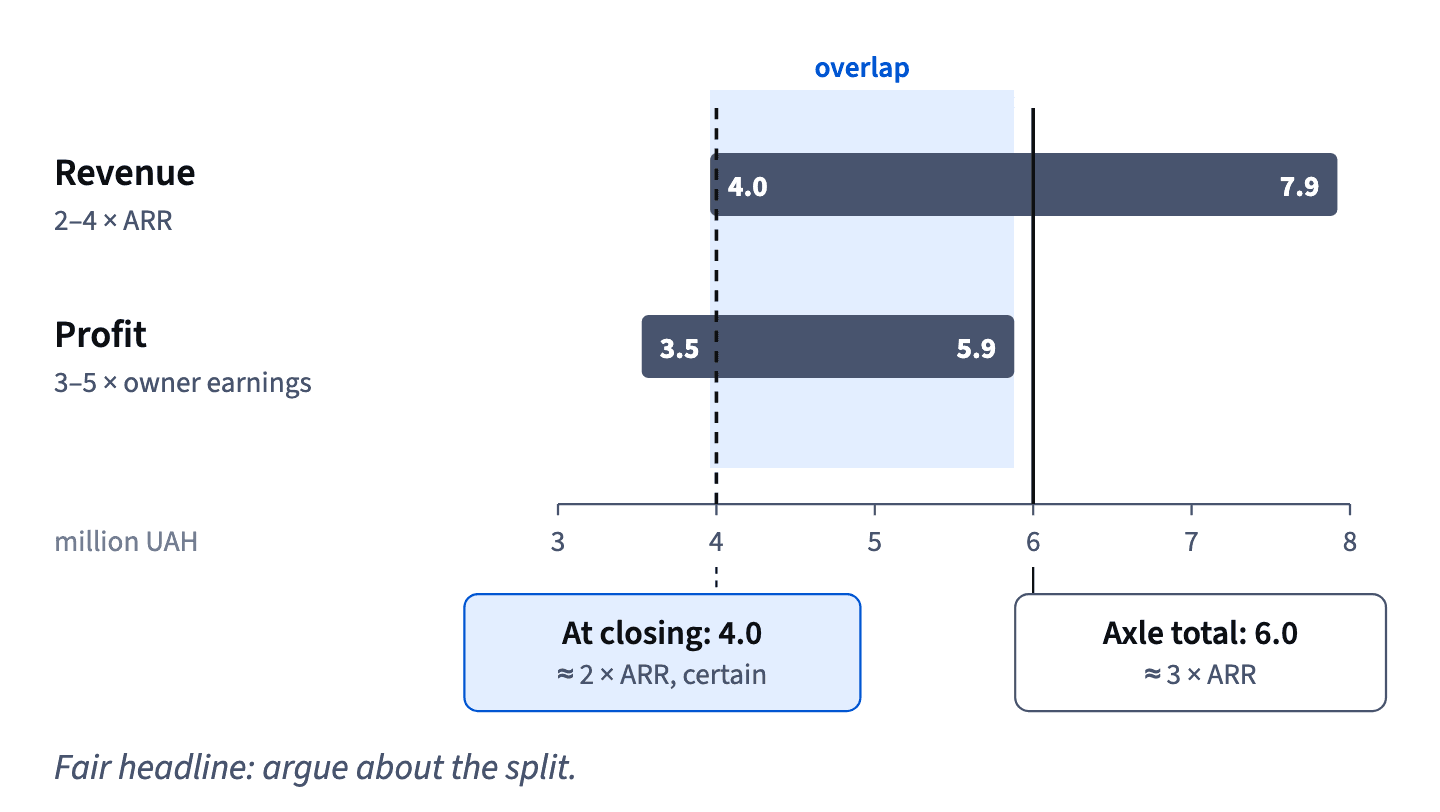
Say it as a range with its basis: “roughly 4 to 5.9 million, where the revenue and profit methods overlap”. That is honest about the uncertainty and still useful for a decision. Is the offer inside the range, below it or above it? Here, 6,000,000 in total sits right around the top, a fair headline.
A range also changes the conversation with a buyer. Instead of arguing about one figure, you point to the facts that move the business up or down the range: growth, churn, independence from the founders, a price step already announced.
Two traps to avoid: rounding the range into the single figure you like best, and treating illustrative multiples as market facts. Neither will survive a buyer's questions.
- Do“Roughly 4 to 5.9 million UAH, where both methods overlap.”
- Don't“GarageDesk is worth exactly 5,880,000 UAH.”
Fake precision from one illustrative multiple.
Four ends and the overlap
With two figures and two illustrative ranges, compute the four ends:
- 2× ARR: 2 × 1,980,000 = 3,960,000 UAH
- 4× ARR: 4 × 1,980,000 = 7,920,000 UAH
- 3× owner earnings: 3 × 1,176,000 = 3,528,000 UAH
- 5× owner earnings: 5 × 1,176,000 = 5,880,000 UAH
Revenue gives about 4 to 7.9 million, profit about 3.5 to 5.9 million. The part where both methods agree, the overlap, runs from about 3.96 to 5.88 million, roughly 4 to 5.9 million.
The overlap is the most defensible zone: a price there can be justified both on revenue and on profit. Axle's 6,000,000 in total sits right around its top, so the headline price is fair. The revenue method alone would allow up to 7.9 million, but GarageDesk's profit doesn't support that, which is a good reason not to anchor on the highest number.
Keep the arithmetic simple and visible. A buyer, a co-founder or a family member should be able to follow every step on one page.
- DoOverlap: from max(3,960,000; 3,528,000) to min(7,920,000; 5,880,000) = about 3.96 to 5.88 million.
- Don't“4× ARR gives 7.9 million, so Axle's 6 million is cheap.”
Anchors on the top of one method that profit doesn't support.
Put a number on a fact the buyer will value
Facts that raise the multiple are stronger when you translate them into money. The January price step is a good example, because it adds revenue without a single new shop.
About 60 shops still pay 600 UAH a month and move to 750 in January:
- extra MRR: 60 × (750 − 600) = 60 × 150 = 9,000 UAH;
- extra ARR: 9,000 × 12 = 108,000 UAH;
- at an illustrative 3× ARR: 108,000 × 3 = 324,000 UAH of value.
So the step alone moves MRR from 165,000 to 174,000. Shown with its working, that is a concrete argument for a better price or an easier earn-out target, not just “we're growing”.
Two honesty checks keep the argument credible. First, the multiple applies to yearly revenue: multiplying the monthly 9,000 by 3 gives 27,000 and badly understates the effect. Second, the number assumes all 60 shops stay after the price rises; a careful seller says so and points to the evidence, such as few price objections and no leavers who named price.
- Do60 × 150 = 9,000 MRR → 108,000 ARR → × 3 = 324,000 UAH.
- Don't9,000 × 3 = 27,000 UAH of value.
Applies a yearly multiple to monthly revenue.
What moves the multiple
A buyer pays for future revenue and profit, so anything that makes the future more likely raises the multiple, and anything that makes it riskier lowers it.
What pushes GarageDesk towards the top of the range:
- growth: 64 shops a year ago, 240 now;
- low churn: down to about 4% a month;
- no customer too big: the largest, the Fixpoint franchise, brings about 6.5% of MRR;
- independence from the founders: written procedures and a team, so it runs without heroics;
- clean books in a separate business account;
- a price step already announced: about 60 shops move from 600 to 750 UAH in January.
What pulls it down:
- anything that depends on one person, such as knowledge of the reminder rules that lives only in Nina's head;
- a messy contract, for example unclear ownership of code written by a contractor;
- customer concentration: one customer who could leave with a big share of revenue.
The procedures written in August now have a price tag: they are part of what makes a buyer willing to pay more.
- DoShow the buyer: 64 → 240 shops in a year, churn about 4%, largest customer about 6.5% of MRR.
- Don'tKeep how the reminder rules work only in Nina's head “because it's faster”.
A key-person risk the buyer prices in.
Ready to practise?
Answer the lesson's exercises and earn 250 points the first time you finish it.
Start the exercises