

Theory
Revenue concentration: one customer too big
A franchise of 40 shops wants a special price, custom work and its own branding. Compute the revenue concentration it would create, and answer in a way that keeps the product yours. Ends with the module case.
~9 min read · 10 exercises · 250 points
Before you start
Forty shops at once
An urgent call from GarageDesk. Victor, the owner of Fixpoint, a franchise with forty shops in three regions, wants GarageDesk in all of them, on his terms: a special price, one contract, an integration with his accounting system and the app in his company's colors. Oscar almost said yes on the phone.
This case closes the module. You'll measure how much of GarageDesk's revenue one customer would become, and answer him in a way that keeps the product yours.
A big customer's share of MRR
When a big customer appears, measure how big before you answer. The number is the customer's share of MRR:
share = the customer's MRR ÷ total MRR including that customer
Fixpoint's original offer: 40 shops at 400 UAH.
- Fixpoint's MRR: 40 × 400 = 16,000 UAH;
- new total: 37,400 + 16,000 = 53,400 UAH;
- share: 16,000 ÷ 53,400 = 0.2996 ≈ 30%.
Three hryvnias of every ten would sit under one signature.
The common slip is dividing by today's MRR (16,000 ÷ 37,400 ≈ 43%). That answers a different question, "how much bigger would we get?", and overstates the share. The share is always out of the total the customer is part of.
The opposite mistake is not computing it at all. "16,000 a month is huge!" is true and useless on its own. 30% tells you what that money buys: a customer whose decision could move almost a third of the business.
- Do16,000 ÷ (37,400 + 16,000) = 16,000 ÷ 53,400 ≈ 30%.
- Don't16,000 ÷ 37,400 ≈ 43%.
Divides by MRR without the customer, so the share is overstated.
A special price is never private
A discount for one big customer feels like a private matter between you and them. In a niche where owners talk to each other at the same parts counters and in the same groups, it isn't.
Victor asks for 400 per shop at the very moment GarageDesk is moving new shops to 750. Oscar's question says it all: what would he tell the shop across the street from a Fixpoint? That shop would pay almost twice as much for the same product, and it would hear about it.
A special price has three effects beyond the deal itself:
- it sets a new reference: other shops will ask for the same, and some will be right to;
- it undercuts the price rise: the case for 750 rests on value, and a 400 deal says the value is negotiable;
- it's hard to undo: raising one big customer's price later is a harder conversation than any you'd have with a small shop.
That's why GarageDesk's volume price is 450, a modest, explainable discount for many shops joining under one brand, not a price that tells everyone else they're overpaying.
- Do"Fixpoint shops get 450: a volume discount we can explain to anyone who asks."
- Don't"400 for Fixpoint, but we'll keep it quiet."
In a niche that talks, nothing stays quiet for long.
What a too-big customer really costs
Victor's offer comes with four costs that don't show up in "16,000 a month":
- Concentration. At about 30% of MRR, one decision by Victor could remove almost a third of revenue at once. A year later he says "add this, or we leave", and you add it. His wishes quietly become your roadmap.
- Custom work. The accounting integration is about two months of Nina's time, two months when the other 64 shops get nothing.
- A second product. A white-label version in Fixpoint's colours means two apps to maintain forever.
- A price that undercuts everyone else's. 400 per shop while new shops move to 750 invites every other shop to ask for the same.

What isn't a real risk: the technical load. Forty more shops are well within what a ready-made SMS service handles. That's the trap of big deals: the visible worry ("can we handle the volume?") is usually fine, while the real costs (control, focus, pricing) are the ones nobody puts in the spreadsheet.
- Do"30% of MRR, two months of custom work, a second app and a price below everyone else's: that's what 16,000 buys."
- Don't"The only question is whether our SMS service can handle 40 more shops."
Worries about the easy part, ignores control, focus and price.
A franchise is forty owners, not one customer
Victor speaks for Fixpoint, but look at who actually uses and benefits from GarageDesk in a franchise. Each Fixpoint shop has its own owner and its own regulars: an independent business with a few bays and repeat service work. Those owners are exactly GarageDesk's niche.
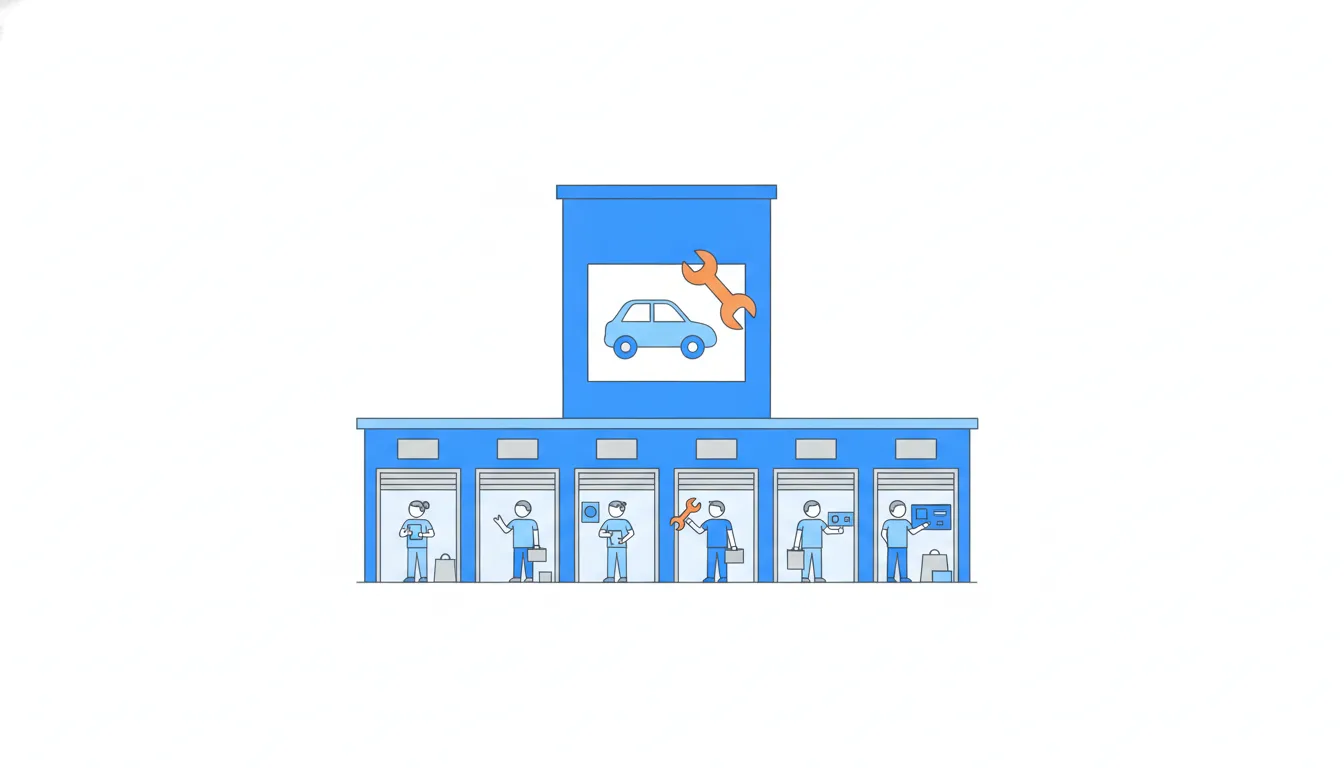
That changes the shape of the deal. Instead of one contract for forty shops, signed by one person, each shop can sign up on its own with the standard product, and Fixpoint gets a volume price. Shops join as they see results, starting with eight in December.
This has two effects:
- no single contract can take forty shops away in one day, because each shop decides for itself whether to keep paying;
- the product stays the same for Fixpoint shops and everyone else, because the deal is made with shop owners who need what GarageDesk already does.
One caution remains. Separate subscriptions don't make Victor powerless: he can still influence all Fixpoint shops at once. So for measuring concentration, shops under one decision-maker are still counted together.
- Do"Each Fixpoint shop signs up on its own, standard product, 450 a month; we start with eight."
- Don't"Fixpoint is one customer, so either Victor signs for all forty or nobody joins."
Misses the forty owners who are the real users.
A volume deal on your terms
Saying no to Victor's terms doesn't mean saying no to Fixpoint. The deal GarageDesk offers instead uses only what it already sells:
- the standard product, no custom integration, no branding;
- separate subscriptions: each shop signs up on its own;
- a volume price of 450 per Fixpoint shop, above Victor's 400 and below the new 750;
- a small start: eight shops in December; others join as they see results.
Measure the share again on the same rule, out of the total including Fixpoint:
- Fixpoint: 8 × 450 = 3,600 UAH;
- total: 37,400 + 3,600 = 41,000 UAH;
- share: 3,600 ÷ 41,000 = 0.0878 ≈ 8.8%.
From about 30% to under 9%, with no custom work and no contract that can take forty shops away in one day. The revenue is smaller, but it's revenue GarageDesk controls. And if Fixpoint's shops like the results, more will join at the same terms, which brings the share back up gradually, where it can be watched.
- Do3,600 ÷ (37,400 + 3,600) = 3,600 ÷ 41,000 ≈ 8.8%.
- Don't3,600 ÷ 37,400 ≈ 9.6%.
The same slip as before: the total must include Fixpoint.
Every no comes with an alternative
Turning down part of a big customer's request is necessary; turning it down badly loses the customer. The difference is whether the no comes with something the customer can use.
A bare no ("we don't do integrations") is accurate and closes the conversation. Victor hears that GarageDesk can't help him, and the eight-shop start never happens.
A no with an alternative works differently. First, find the need behind the request: Victor wants Fixpoint's accountant to have the shops' data without retyping it. Then offer something you already have, or can make cheaply, that meets that need: a monthly report the accountant can download. Nina estimates a day of work instead of two months.
The pattern is short:
- acknowledge the request;
- say clearly what you won't build;
- offer what you can do today for the same need.
This isn't a sales trick. It's how a small team stays one product for everyone while still treating each customer's problem as real.
- Do"We won't build a custom integration, but your accountant can download a monthly report with every shop's data from day one."
- Don't"Sorry, we don't do integrations."
Accurate, and it ends the conversation.
Answer every request with what you sell today
A big customer's list of requests deserves an answer to every item, so nobody feels brushed off. The rule is to sell what you have today, not what the customer would like you to build. Victor's four requests and GarageDesk's answers:
- All 40 shops at 400 → a volume price of 450 for each Fixpoint shop that signs up.
- One contract signed by Victor → each shop subscribes on its own, starting with eight.
- An integration with Fixpoint's accounting system → a downloadable monthly report: a day of Nina's work instead of two months.
- The app in Fixpoint's colours → the standard GarageDesk app, which the shops' customers already recognise as the shop's own reminders.
Each answer keeps one product and one price logic for all shops, while still giving Fixpoint a real reason to say yes. The report is the model: it solves the underlying need (data in the accounting system) at a fraction of the cost of the requested solution.
The customer gets a yes, just not the one they asked for.
- Do"Instead of an integration: a monthly report your accountant can download, from day one."
- Don't"Sure, we'll build the integration. Two months, no problem."
Sells what doesn't exist and pays for it with every other shop's time.
Keep the concentration line on the monthly page
A volume deal that starts small can grow back into concentration, one shop at a time. If all forty Fixpoint shops eventually join at 450 and the rest of MRR stays at 37,400:
- Fixpoint: 40 × 450 = 18,000 UAH;
- total: 37,400 + 18,000 = 55,400 UAH;
- share: 18,000 ÷ 55,400 = 0.3249 ≈ 32.5%.
That's higher than the original offer's 30%, because the rest of the base didn't grow in this example. Separate subscriptions remove the one-contract risk, but Victor can still move all Fixpoint shops at once, so count shops under one decision-maker together.
So add one line to the monthly page: the largest customer's share of MRR. A common rule of thumb for a small business, illustrative rather than a law, is to keep any one customer below about 10–20% of revenue. Above that, the customer starts running your product.
The line isn't there to stop growth. It tells you when to grow everything else faster, or to slow one customer down, before a single phone call can sink the month.
- Do18,000 ÷ (37,400 + 18,000) = 18,000 ÷ 55,400 ≈ 32.5%: time to grow the rest of the base.
- Don't"They pay separately, so Fixpoint's share is 450 ÷ 55,400 ≈ 0.8% per shop."
Splitting one decision-maker into forty small customers hides the risk.
Ready to practise?
Answer the lesson's exercises and earn 250 points the first time you finish it.
Start the exercises