

Theory
MRR calculation and monthly churn
MRR calculation when some customers pay for a year, plus new and lost MRR, monthly churn rate and revenue churn, on one real month of GarageDesk.
~9 min read · 9 exercises · 250 points
Before you start
A record month in the account
October at GarageDesk, and a new module about the numbers of a running business. Oscar has just finished his first two months full time, and he runs to you and Alex with happy news: the account received more money this month than ever, because two shops paid for a whole year at once.
In this lesson you'll learn why that number is no good for planning, and calculate monthly recurring revenue, revenue won and lost, and the monthly churn rate on one real month of GarageDesk.
Money in the bank is not MRR
Bank receipts and MRR answer different questions.
- Receipts say how much money arrived this month. They jump: in October GarageDesk's account got over 40,000 UAH because two shops paid for a whole year at once.
- MRR says what current subscriptions bring in a normal month. It moves only when customers join, leave or change plans.

The yearly payments are real money and good for the reserve. But eleven of their twelve months belong to future months. In MRR each counts as 6,000 ÷ 12 = 500 UAH a month.
Planning with receipts goes wrong both ways. In a month full of yearly payments, the business looks richer than it is, and someone hires or spends. The next month nobody pays for a year, the account looks sad, and the founders panic even though nothing bad happened.
So plan salaries, tools and goals with MRR. Use receipts for cash questions: can we pay this month's bills, how big is the reserve.
- Do"MRR is 37,400 UAH; plan November with that."
- Don't"We got over 40,000 in October, so we can afford a part-time hire."
Two one-off yearly payments mistaken for monthly income.
MRR with monthly and yearly plans
MRR (monthly recurring revenue) is what current subscriptions bring in a normal month. It's the number you plan with, because it doesn't jump when someone pays in advance.
The rule for mixed plans:
- a monthly plan counts at its monthly price;
- a yearly plan counts as its price ÷ 12, whenever it was paid.
GarageDesk on 1 October: 50 shops pay 600 UAH a month, and 8 paid 6,000 UAH for a year.
- monthly plans: 50 × 600 = 30,000 UAH;
- yearly plans: 6,000 ÷ 12 = 500 UAH a month each, so 8 × 500 = 4,000 UAH;
- MRR = 30,000 + 4,000 = 34,000 UAH.
Note that a yearly shop counts as 500, not 600: the yearly plan is cheaper per month. Counting the 8 yearly shops at 600 each would overstate MRR by 8 × 100 = 800 UAH. And counting a full 6,000 in the month it arrived would overstate it far more.
- Do50 × 600 + 8 × 6,000 ÷ 12 = 30,000 + 4,000 = 34,000 UAH.
- Don't58 × 600 = 34,800 UAH.
Treats yearly shops as if they paid the monthly price.
The MRR bridge: new and lost
Net growth hides what happened inside the month. Split the change into its parts:
MRR at the end = MRR at the start + new MRR − lost MRR
- new MRR comes from new customers (yearly plans at price ÷ 12);
- lost MRR is what the customers who stopped paying used to bring.
GarageDesk's October: nine new shops, seven monthly and two yearly; three monthly shops left (two cancelled, one card failed and was never updated).
- new MRR: 7 × 600 + 2 × 500 = 4,200 + 1,000 = 5,200 UAH;
- lost MRR: 3 × 600 = 1,800 UAH;
- end MRR: 34,000 + 5,200 − 1,800 = 37,400 UAH;
- shops: 58 + 9 − 3 = 64.
The net change is +3,400, which sounds simple. The bridge shows it's +5,200 and −1,800 happening at once. Later, when there are several plans, you add upgrades and downgrades to the bridge; with one plan, new and lost are enough.
- Do34,000 + (7 × 600 + 2 × 500) − 3 × 600 = 37,400 UAH.
- Don't34,000 + 9 × 600 − 3 × 600 = 37,600 UAH.
Counts the two new yearly shops at 600 instead of 500.
Why churn is divided by the start of the month
Churn asks: of the customers who could have left this month, what share did? The customers who could have left are the ones you had on day one.
The nine shops that joined during October were there for a few days or weeks at most. They had no real chance to leave yet. If you divide by the end-of-month count (64), you add nine customers to the bottom of the fraction who could never appear on top. The result, 3 ÷ 64 ≈ 4.7%, looks better than reality, and the faster you sign new shops, the more it flatters you.
The correct base is the start: 3 ÷ 58 ≈ 5.2%. The same logic applies to money: revenue churn divides lost MRR by MRR at the start of the month.
This matters most in exactly the months you'd want an honest number: when sales are strong. A business signing many new customers while quietly losing old ones would see its churn shrink on paper if it used the wrong base.
- DoChurn = 3 lost ÷ 58 at the start = 5.2%.
- Don'tChurn = 3 lost ÷ 64 at the end = 4.7%.
New shops in the base flatter the rate, more so when sales are strong.
Customer churn and revenue churn
Growth can hide a leak, so measure the leak directly.
- Churn (customer churn) = customers lost in the month ÷ customers at the start of the month.
- Revenue churn = lost MRR ÷ MRR at the start.
- Retention for the month = 1 − churn.
GarageDesk's October: 58 shops at the start, 3 left.
- churn = 3 ÷ 58 = 0.0517 ≈ 5.2%;
- revenue churn = 1,800 ÷ 34,000 = 0.0529 ≈ 5.3%;
- retention ≈ 94.8%.
Why is revenue churn a bit higher? All three leavers paid the full monthly 600, while the average shop brings 34,000 ÷ 58 ≈ 586 (the yearly shops pull it down). When the leavers pay more than average, revenue churn is above customer churn; when they pay less, it's below.
Keep both. Customer churn tells you how many relationships you lose; revenue churn tells you how much money walks out with them. Once GarageDesk has several plans, they can drift far apart.
- Do3 ÷ 58 = 0.0517 → 5.2% customer churn; 1,800 ÷ 34,000 → 5.3% revenue churn.
- Don't3 ÷ 64 ≈ 4.7%.
Divides by the end-of-month count, which includes nine shops that couldn't have left yet.
What cutting churn is worth
Oscar's claim, "cutting churn from 5% to 3% is worth as much as a new sales channel", can be checked with the same compounding formula.
Shops left after 12 months with no new sales = start × (1 − churn)¹².
- At 5.2%: 64 × 0.948¹² ≈ 64 × 0.527 ≈ 34 shops.
- At 3%: 64 × 0.97¹² ≈ 64 × 0.694 ≈ 44 shops.
The difference is about ten shops kept in a year from today's base alone, and more as the base grows. At 600 UAH each, ten shops are 6,000 UAH of MRR that Oscar doesn't have to sign again.

The usual slip is to subtract churn linearly: 12 × 3% = 36%, so 64 × 0.64 ≈ 41. That understates how many shops stay, just as 12 × 5.2% overstated how many leave. Compound the monthly rate.
The practical point: work on churn (fixing why shops leave) is sales work too. It just shows up as shops that don't disappear instead of shops that arrive.
- Do64 × 0.97¹² ≈ 64 × 0.694 ≈ 44 shops after a year.
- Don't64 × (1 − 12 × 0.03) = 64 × 0.64 ≈ 41 shops.
Linear subtraction ignores that each month's churn hits a smaller base.
Monthly churn compounds
"Five percent sounds small: ninety-five percent stay!" Per month, yes. But churn repeats every month on whoever is left, so it compounds like interest, in the wrong direction.
The share still there after n months with no new sales is (1 − churn)ⁿ. At 5.2%:
- after 12 months: 0.948¹² ≈ 0.53, so about 47% leave, not 12 × 5.2% ≈ 62%;
- of today's 64 shops, about 64 × 0.53 ≈ 34 remain;
- an average shop stays roughly 1 ÷ 0.052 ≈ 19 months.
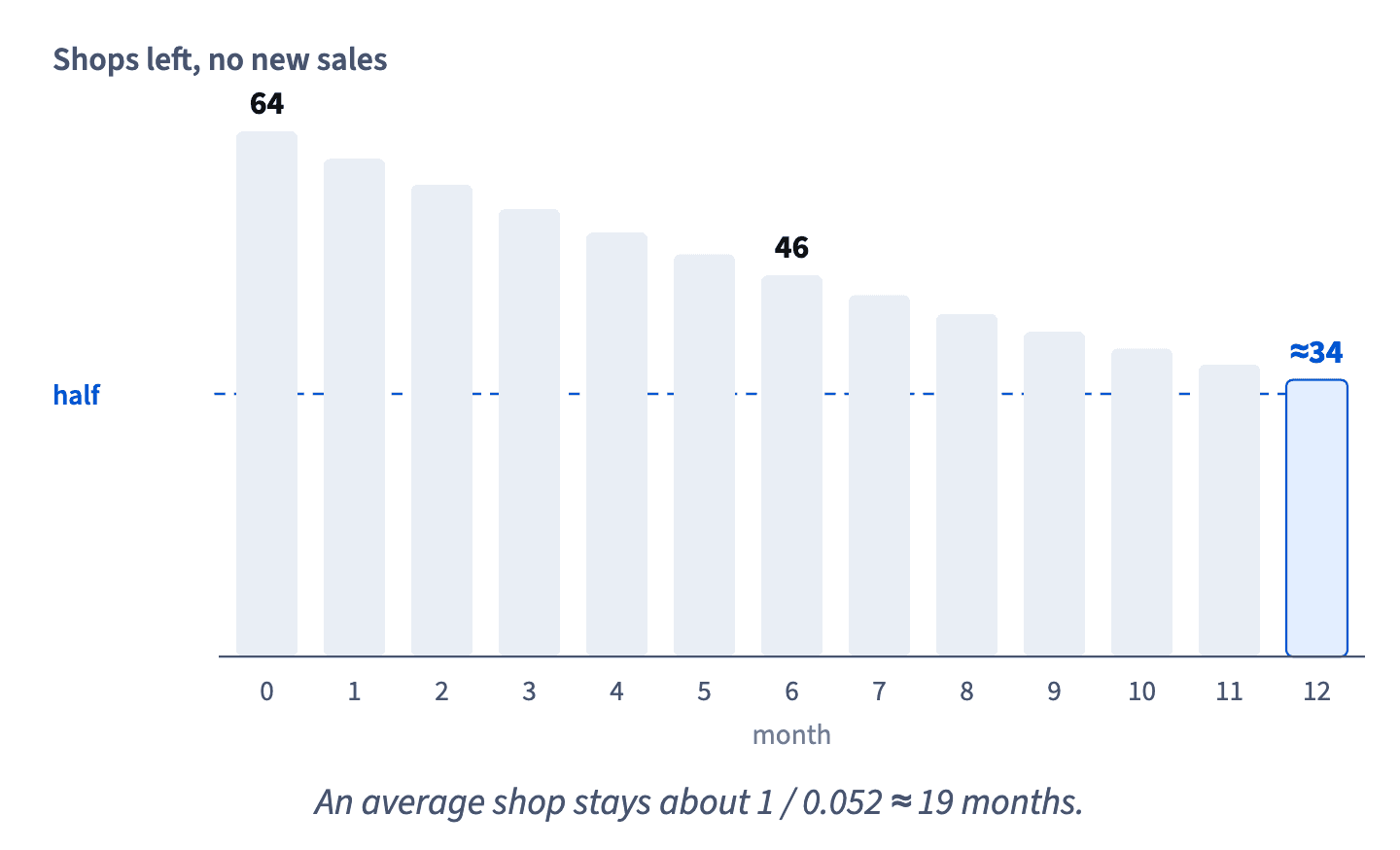
The simple sum (12 × 5.2%) overstates the loss because each month's churn applies to a smaller base. But the true figure is still alarming: almost half of the customer base gone in a year.
It also sets the sales bar. At 64 shops, 5.2% is 64 × 0.052 ≈ 3.3 shops a month, and that number grows with the base. Oscar has to sign more than three new shops a month just to stand still. That's why cutting churn is often worth as much as a new sales channel.
- Do0.948¹² ≈ 0.53 → about 47% leave in a year.
- Don't12 × 5.2% ≈ 62% leave in a year.
Applies each month's churn to the original 64, not to who is left.
Two churn numbers and a one-page report
Yearly plans make a business steadier, but they can hide a leak. A shop on a yearly plan can't leave in October; it decides once, at renewal. So October's churn of 3 ÷ 58 ≈ 5.2% mixes 50 shops that could leave with 8 that couldn't.
Look at the monthly shops alone: 3 ÷ 50 = 6%. That's the honest rate for the customers who decide every month. Report two churn numbers, all shops and monthly shops. If they drift apart, look closer before the renewals arrive, and mark the renewal months now: next March, when the first yearly shops decide, is a churn month for them.
Then make it a ritual. On the first working day of each month, one page:
- MRR at the start, new, lost, at the end;
- both churn numbers;
- the names of the shops that left.
The names matter most. The percentage says how fast the bucket leaks; the names say where the hole is, and they're the only way to find out why. Three rows today means three phone calls this week.
- Do"October: churn 5.2% (all), 6% (monthly). Left: two cancelled, one failed card. Calls this week."
- Don't"October churn: 5.2%." Nothing else.
One blended rate and no names: no way to see the hole.
Ready to practise?
Answer the lesson's exercises and earn 250 points the first time you finish it.
Start the exercises