

Leading questions: examples and how they fake validation in customer interviews
Leading questions with examples and neutral rewrites, plus four other false positives that make weak ideas look validated in customer interviews.
By Sergey BruhPublished 13 min read
A leading question is a question that hints at the answer the asker wants, such as "It's annoying when the food runs out, isn't it?". Leading questions are the most common way a customer interview produces a false positive: a signal that convinces you an idea works when it doesn't. The person agrees because agreeing is polite and easy, and you write down "confirmed". Below are examples of leading questions with a neutral rewrite for each, why they fake validation, four other false positives that travel with them, and a checklist for rephrasing your own questions.
What is a leading question?
A leading question carries its own answer. The wording, the assumption inside it or the tone makes one reply feel correct, so the answer tells you more about the question than about the person. Lawyers know the idea from courtrooms, where leading a witness is restricted for exactly this reason: the testimony stops being the witness's own.
In customer interviews and surveys, this kind of question comes in a few recognisable shapes:
- Tag questions that end with "isn't it?", "right?" or "don't you?" and ask for agreement rather than information.
- Built-in assumptions: "How much time do you lose every week reordering food?" assumes the person loses time at all.
- Loaded words: "annoying", "frustrating", "convenient" and "simple" tell the person how to feel before they answer.
- Pitch, then ask: you describe your idea with enthusiasm and then ask "What do you think?", where only one answer is polite.
- Narrow choices: "Would you prefer weekly or monthly delivery?" skips the question of whether they want delivery at all.
A neutral question does the opposite. It asks about something that already happened, uses plain words and leaves room for "no", "never" and "I don't care".
Examples of leading questions and how to rephrase them
The examples below come from customer interviews and short surveys at CatChow, an online pet-food shop exploring a subscription that delivers cat food before the bag runs out.
Two patterns repeat in the right-hand column. Each neutral question points to a past event ("last time", "last month"), and none of them mentions the idea. The bad questions vs good questions lesson drills both habits; for a full list of neutral questions grouped by purpose, see these customer interview questions.
Why leading questions create false positives in customer interviews
Twelve fans, two subscribers
Sofia, a junior product manager at CatChow, talks to 14 cat owners in three weeks and posts a summary in the team chat: "12 of 14 are positive. People love it."
Six weeks later a pilot opens, and Sofia writes to each of the twelve fans personally. Two subscribe.
The ten who didn't subscribe weren't dishonest. Most were polite, optimistic or trying to help, and the questions made that easy. The interviews never measured demand.
One call, line by line
Sofia's call with Grace, one of the twelve fans:
Sofia's note after the call: "Grace: big fan, wants reminders, will subscribe." Eight lines, zero facts.
The leading question did more damage than it seems. Grace's "yes" cost her nothing, so it carries no information, but it went into the notes as evidence of a problem. And once the conversation had a direction, everything after it followed: praise, a feature idea, a friendly promise.
Later Sofia calls Grace back with three neutral questions:
- "When did you last buy cat food?" "On Saturday, at the supermarket, with the weekly groceries."
- "When did you last run out?" "I can't remember. Not this year."
- "What would reminders let you do?" "That's for the flea drops. They're monthly and I keep forgetting. Last month I was two weeks late."
Grace has no problem with food; her problem is a monthly treatment. Bad news for the subscription, and the first real data from this call.
Four other false positives that travel with leading questions
A leading question is your own contribution to a false positive. The other four come from the person you are talking to, and a question that steers makes all of them more likely.
1. Compliments
How it sounds: "Great idea!", "I love it."
Why people say it: kindness is free. Even a sincere compliment is an opinion about the future, so it is a guess.
What to do: say thanks, write nothing down and go back to the person's life: "How do you handle this today?"
2. Fluff
How it sounds: a generic claim ("I usually buy ahead"), a future promise ("I would subscribe") or a hypothetical maybe ("I might order treats too").
Why people say it: they describe their best selves and best intentions. It isn't lying, just blurry: no date, no place, no money.
What to do: anchor the fluff to one real event: "When did you last buy food? Walk me through it." For a promise about a product that doesn't exist yet, anchor what does exist: what they pay now, whether they have ever switched shops.
3. Feature requests taken at face value
How it sounds: "You should add reminders to the app."
Why people say it: they want to help, and proposing a fix is easier than describing a problem.
What to do: write it down, keep it off the roadmap and dig for the reason: "Why do you want that?", "What would it let you do?", "How do you manage without it now?"
4. Polite non-commitment
How it sounds: "Keep me posted", "Send me the deck."
Why people say it: refusing feels rude, and these phrases end the conversation without costing anything.
What to do: propose one concrete step that costs the person time, reputation or money, the three commitment currencies: "Pre-orders are open. Shall I send you the link?" Someone who stays friendly but never commits or refuses is a zombie lead, and a pipeline full of them inflates the forecast. A real pre-order is the strongest signal of all; see how to pre-sell a product before you build it.
What you heard, what it means, what to ask next
How to avoid leading questions: a rephrasing checklist
Read each question in your script out loud and run it through these checks. If one fails, rewrite the question before the call, not during it.
- Can the person comfortably say "no" or "never"? If "no" sounds rude or odd, the question steers.
- Does it end with "right?", "isn't it?" or "don't you?" Delete the tag and turn the statement into a question about an event.
- Does it contain an emotion word? Remove "annoying", "frustrating", "easy" and "love"; let the person pick their own words.
- Does it assume a problem, a habit or a preference? Ask first whether it happens at all: "When did it last happen?"
- Does it mention your idea? Move the idea to the end of the conversation, or leave it out.
- Is it about the future? Swap "would you" for "did you" and "will you" for "when did you last".
- Did you just pitch? Any question straight after a pitch is loaded. Ask about their life instead, and talk less than they do.
The same checks work for surveys. Survey questions tilt for the same reasons, and the damage scales: a tilted question in a survey of 500 people produces 500 confident wrong answers.
Score the interview afterwards
Even with neutral questions, some false positives slip through. Right after each conversation, answer three questions from your notes. Each "yes" is one point.
- Facts about the past. Is there at least one specific event: what the person did, when and where?
- Money or time already spent. Have they paid, searched, switched or built a workaround because of this problem?
- A commitment given. Did they give you time, reputation or money: a booked follow-up with a purpose, an introduction, a pre-order?
Separately, mark the direction: do the facts support the idea or contradict it? The score says how much the interview can be trusted, not whether the answer was yes.
Sofia's three weeks, rescored from the original notes:
Eight of the 14 interviews score zero. They aren't positive, they are unknown. Four describe a problem that people already pay to solve, two show no problem, and only two contain a commitment: they came from the two people who later subscribed.
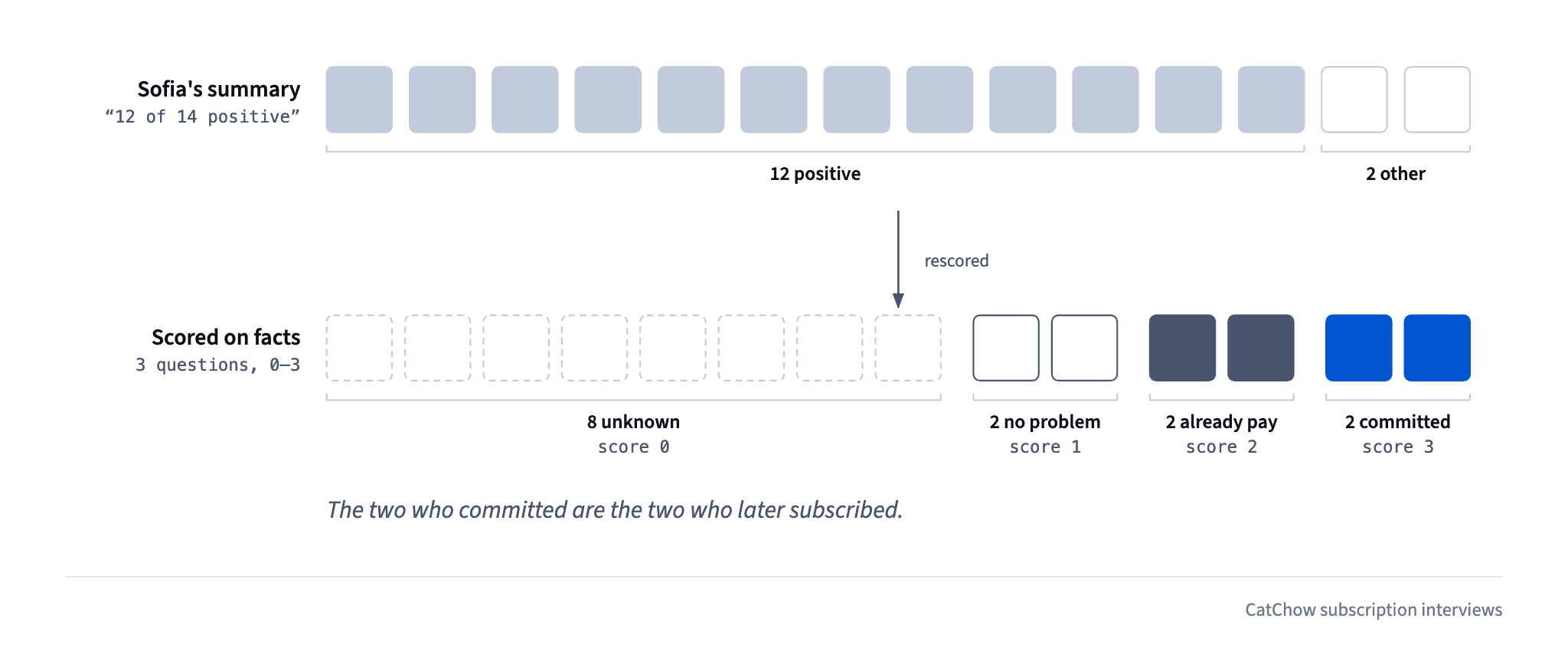
The honest report is no longer "12 of 14 positive". It is: "14 interviews. Four people have the problem and already spend money on it; two of them booked a follow-up, the other two were never asked for anything. Two have no problem. Eight are unknown, and we are calling them back."
After the callback, Grace's interview moves from 0 to 1 point and counts against the idea.
Common mistakes when you start filtering
- Counting heads. Fourteen interviews are not a survey, and "12 of 14" is not a conversion rate.
- Interrogating. Ask about the last time with curiosity, not suspicion.
- Asking for a commitment too early. First learn how the person lives with the problem, then make the offer.
- Treating "no problem" as a failed interview. It is a result, and cheaper than a failed launch.
Customer interviews are one step of customer discovery, not the whole of it: see how to validate a product idea for the steps before and after.
Key takeaways
- A leading question hints at the answer you want, so the "yes" it gets is worth nothing.
- Rephrase by asking about a past event in plain words, and leave room for "no".
- Compliments, fluff, feature requests and "keep me posted" feel like validation and cost the speaker nothing. Steering questions and pitching invite them.
- Score each interview on past facts, money or time already spent, and commitments given. An interview with no facts is unknown, not positive.
FAQ
What is an example of a leading question?
"It's annoying when the food runs out, isn't it?" It names the feeling and asks for agreement. A neutral version is "When did the food last run out? What happened next?"
Are leading questions ever useful?
Rarely in research. In sales or coaching they can steer a conversation on purpose, but whenever you want to learn what is true, an answer you suggested is evidence of nothing.
What is a false positive in a customer interview?
Anything that makes the idea look wanted without showing that it is: a "yes" to a steering question, praise, "I would buy it", an unexplained feature request, a friendly "keep me posted".
Should I never mention my idea?
Early on, keep it out: you are learning how people live with the problem. Later you have to show it, and compliments will come back. That is the moment to ask for a commitment.
Practise spotting them
In the free lesson Compliments and how to deflect them you practise on CatChow transcripts: spotting praise in notes, steering back to facts and rewriting an opener that fishes for approval. It is part of the free course Customer Development: Talking to Customers, built around questions that get honest answers.