

Pre-selling: how to pre-sell a product before you build it
Pre-selling before you write code: a one-page presell offer, a decision rule set in advance, how to ask for money and what the answers mean.
By Sergey BruhPublished 8 min read
Pre-selling means taking payment for a product before it exists, so that real money, not polite words, tells you whether to build it. To pre-sell a product, describe exactly what customers will get and when, name the price, and ask them to pay now, with a full refund if you don't deliver. Set a rule in advance for how many prepayments mean "build", and stick to it. Words like "great idea" cost nothing, so they prove nothing; a payment for something that doesn't exist yet is the strongest evidence of demand you can get before writing code. Below are the steps on one example, with the offer, the numbers and the decision.
Why pre-selling beats every other validation signal
Every validation signal has a price for the person giving it. The higher the price, the more you can trust it:
A prepayment also tests the price, the offer and your ability to sell, all at once. And it tests you: asking for money for something unfinished is uncomfortable, and you will have to do it for years.
Step 0. Make sure the problem is real
Pre-selling comes after problem conversations, not instead of them. First find people who already lose time or money on the problem and ask about their past, not about your idea. How to run those conversations: customer interview questions and how to validate a product idea.
Lena runs a small language school in Dnipro and knows the pain first hand: every month the administrator spends evenings matching group attendance against payments in a spreadsheet, and some paid lessons are never charged for. She wants to build ClassLedger, a web app for small private language schools: attendance, payments and reminders to parents in one place.
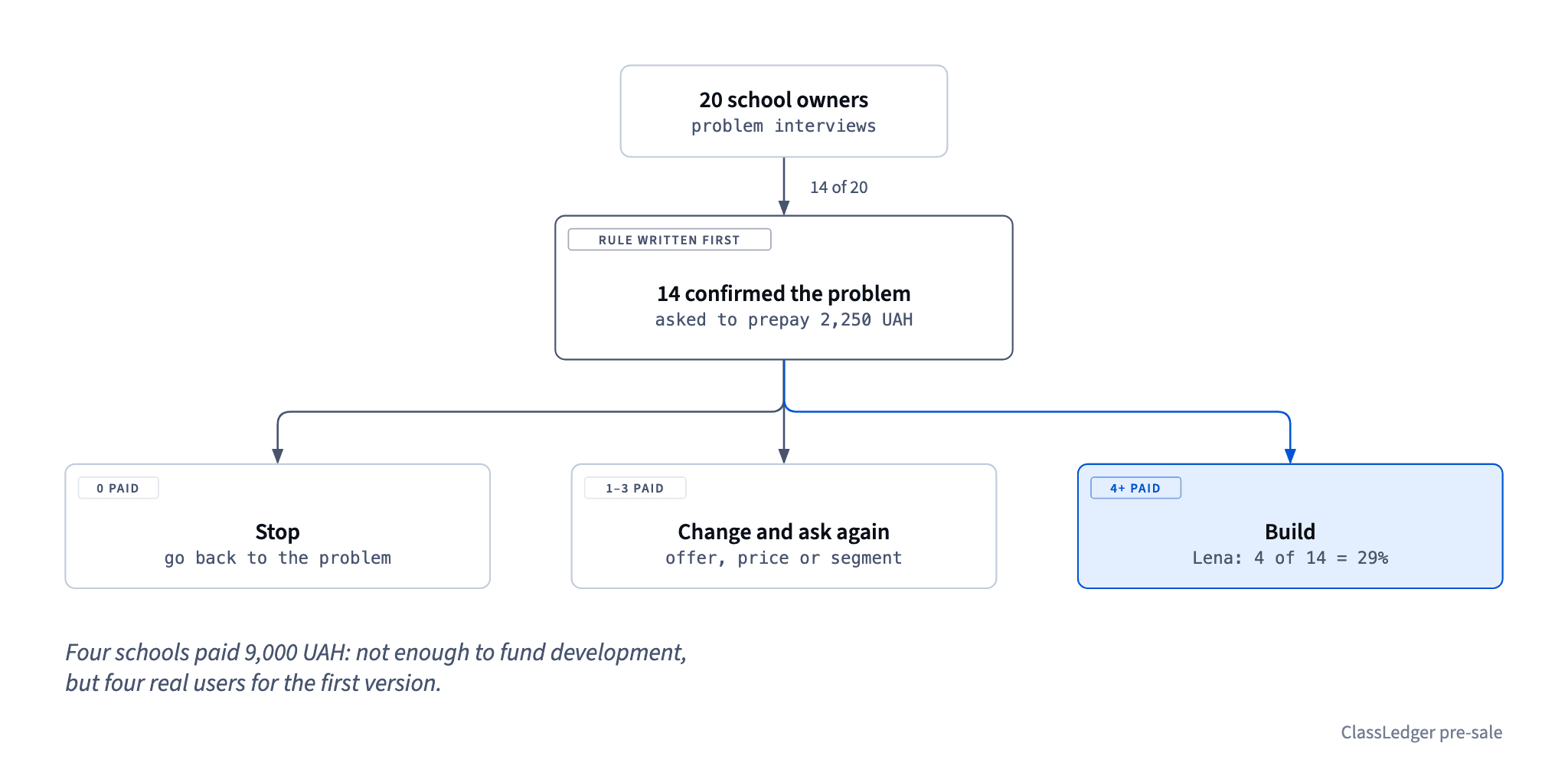
She talks to 20 school owners. 14 describe the same monthly reconciliation, and 9 of them name a cost: an administrator's overtime, lessons given but never paid for, or a bookkeeper they hired for exactly this.
Step 1. Write a one-page offer
The offer answers five questions, in plain words:
- For whom: private language schools with 3 to 15 groups.
- What they get at launch: group attendance from a phone, a list of who owes for which lessons, automatic payment reminders to parents. Nothing more is promised.
- When: launch within eight weeks, on a named date.
- The price: the regular price will be 900 UAH a month. Founding schools get 750 a month, fixed for the first year, and pay the first three months, 2,250 UAH, now.
- The risk: a full refund if the launch date is missed, no questions asked.
The discount is modest on purpose. If the pre-sale price is a fraction of the real one, a yes tells you little about demand at the real price. How to arrive at the 900 in the first place: how to price a SaaS product.
Step 2. Set the decision rule before you ask
Write the rule down before the first conversation, so a good mood or a bad week can't move it:
- 4 or more prepayments from the 14 schools that confirmed the problem → build.
- 1 to 3 → change the offer, the price or the segment and ask again.
- 0 → stop and go back to the problem.
Why 4 of 14? Lena needs a few real users to shape the first version, and fewer than 4 from the warmest possible audience would mean the problem isn't painful enough at this price. Your threshold can differ; what matters is fixing it in advance.
Step 3. Ask for the money
Lena calls or visits each of the 14 owners. She reminds them of what they told her about the problem, shows the one-page offer and a clickable mock-up, and asks directly: "Would you like to be one of the founding schools? I can send the invoice today."
Two rules for this moment:
- Ask for payment, not for an opinion. "What do you think?" invites compliments.
- Make paying easy right away. An invoice or a payment link sent during the call. "I'll think about it" at the end of a call usually means no.
Step 4. Read the results
After two weeks:
4 of 14 is 29%, and the rule says build. The 9,000 UAH collected won't fund development; that was never the point. Lena now has four schools that have paid, will use the first version and will tell her honestly what's missing.
The no's are worth a follow-up call. Three of the five already use a general CRM and don't want another tool; two have only three groups and do the reconciliation in twenty minutes. That shapes the next offer: schools with at least five groups and no CRM.
At launch the four founding schools bring 4 × 750 = 3,000 UAH a month, a small first step toward ramen profitability.
Step 5. Keep the promise
- Launch on the date. If you see you'll miss it, tell the founding customers early and offer the refund.
- Refund without arguing. A clean refund keeps your reputation in a small market where every school owner knows the others.
- Give founders a voice. A short weekly call with each founding school during the first month turns prepayments into your best source of product decisions.
Should the pre-sale include a yearly plan?
It can. Offering a year upfront at a discount next to the monthly option shows how confident each customer is, and brings more cash before launch. How large the discount should be is a calculation of its own: see how big an annual plan discount should be.
Common mistakes
- Pre-selling to strangers. Start with people who already told you about the problem; cold pre-sales measure your marketing, not the need.
- A vague promise. "A platform for schools" can't be bought. A list of three things and a date can.
- Moving the goalposts. Two prepayments against a rule of four is not "almost there".
- Treating the money as revenue. Until you deliver, it is a refundable deposit; don't spend it on anything you couldn't pay back.
- A giant discount. It buys you yeses that don't hold at the real price.
Key takeaways
- A prepayment with a refund promise is the strongest demand signal before a product exists.
- Pre-sell to people who have already described the problem, with a one-page offer: who, what, when, price, refund.
- Fix the decision rule before you ask, and follow it.
- Talk to the people who said no; their reasons shape the next offer.
FAQ
Is it legal to take money for a product that doesn't exist yet?
Yes, if you are honest about it: say the product is in development, give a launch date and promise a refund if you miss it. Take the payment against an invoice so both sides have a record, and check the rules for your tax status.
How many prepayments do I need before building?
Decide before you ask. For a B2B product sold to a narrow group, a handful of paying customers out of a dozen or so who confirmed the problem is a strong signal; zero out of a dozen is a clear answer too.
What if people want a free trial instead?
Offer a refund period instead of a free period: they pay now and can get the money back within, say, 30 days after launch. It keeps the signal honest and removes most of their risk.
Should the pre-sale price be lower than the real price?
Slightly, as a thank-you for the risk founding customers take. If the discount is large, a yes tells you little about demand at the real price.
Is pre-selling the same as a pre-order?
Close, but the goal differs. A shop takes pre-orders for a product that is already made and will ship on a date; pre-selling takes money for something you haven't built yet, to decide whether to build it at all. That is why a pre-sale needs a refund promise and a decision rule, and a pre-order doesn't.
Learn it hands-on
The lesson Prepayment as a test shows two founders writing their first offer and asking repair shop owners for money before building anything, with quizzes and a practice task checked by AI. The case The first five prepayments follows the result. Both are part of the course From Idea to Profitable Product: Building Without Investors.