

Theory
Zombie leads and “keep me posted”
How to recognise leads that never say yes or no, why they are dangerous, how to ask for a clear answer politely, how to write a follow-up email after no response, and why, early on, learning matters more than revenue.
~11 min read · 12 exercises · 250 points
Before you start
A detour to sales
A detour today at CatChow: Megan from sales has come to the product team, and to you, for help. She has seventeen “warm” leads, some since June. They all take her calls and say lovely things, and nobody buys or says no.
In this lesson you'll learn to recognise leads that never move, why they're dangerous, how to ask politely for a clear answer, and why early on learning matters more than revenue.
Zombie leads
Megan, CatChow's head of sales, has seventeen “warm” leads in her pipeline, some of them since June. They all take her calls and say lovely things. Nobody buys, and nobody says no.
Those are zombie leads: neither dead nor alive. They keep meeting you, they keep smiling, and they never move. It's the sales version of the friend zone: they like you, they just aren't going to buy.
The symptoms show up in the CRM notes:
- a third “very positive” call, and “asked me to keep them posted”;
- a request for the price list, followed by silence;
- “meeting went well, they'll think about it after the holidays”.
Compare them with leads that have actually moved. A paid deposit is a real commitment. A clear no with a reason, like an office that went remote and closed, is a closed lead, not a zombie: you know exactly where you stand.
Don't panic if most of your notes look like this. Zombies are the normal state of a young pipeline, and mostly we create them ourselves, by never asking.
- Don'tCRM note: “Third call, very positive again. Asked me to keep them posted.”
Friendly, available and going nowhere.
- DoCRM note: “Paid a 1,000 UAH deposit for the first delivery round.”
Money on the table: a lead that has moved.
Why zombies are dangerous
“But what's the harm? They're not saying no. Maybe some of them will buy one day.” Zombie leads look harmless, but they cost you twice.
Time. Every follow-up call, fresh deck and “just checking in” message for a zombie is time taken from a real customer. Seventeen zombies can quietly eat a large part of a salesperson's month.
The forecast. Seventeen warm leads look like a business. If the CEO plans hiring or a budget around them, the whole team ends up confidently wrong, and it finds out only when the quarter closes and none of them have bought.
That makes zombies a false positive on the sales side: they look like demand in every report while there's nothing behind them. And it isn't only a sales problem. Product, hiring and budget decisions all rest on the demand the pipeline seems to show.
The uncomfortable part: mostly we create zombies ourselves, because we're afraid to ask and hear no.
- Don't“17 warm leads, so we can hire two more couriers next quarter.”
Plans around demand that was never confirmed.
- Do“3 leads have committed; 14 have never been asked. Forecast on the 3.”
Separates evidence from hope.
A lead is someone who's been asked
For how many of her seventeen leads has Megan proposed something concrete they could accept or refuse? “Honestly? Maybe three. With the others we just… keep chatting.” Then she doesn't know whether the other fourteen are leads at all.
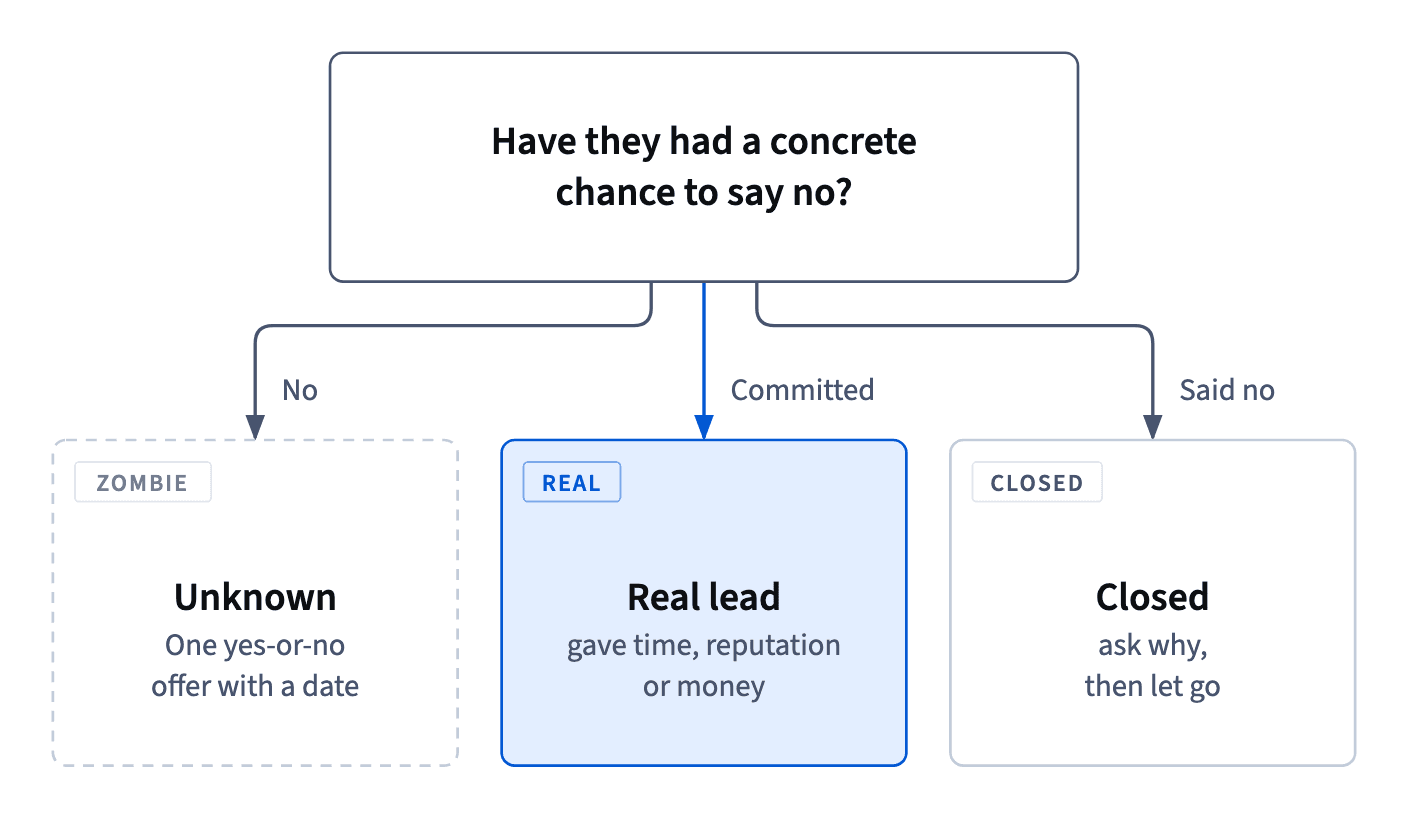
Being nice to you doesn't make someone a lead. A contact becomes a real lead only once you've given them a concrete chance to turn you down, and they've answered with something other than a smile.
That answer can be a yes, a counter-offer or a no. An office manager who's offered a pilot from 1 March and replies “Only for ten people to start. Can we do that?” is a real lead, even though she cut the pilot in half: she was asked and engaged with the terms.
Someone who likes every one of your posts, asks for the deck a second time or has had three friendly calls simply hasn't been tested yet. They might be your best customer or nobody at all, and right now there's no way to tell.
- DoOffered a pilot from 1 March, she replies: “Only for ten people to start. Can we do that?”
Asked, and answered with terms: a real lead.
- Don'tCounting a café owner who likes every CatChow post as a lead.
Free attention; she has never been asked for anything.
Politeness is not intent
Four friendly meetings prove that a prospect is polite, not that they intend to buy. Until they've had a clear chance to accept or refuse a concrete step, you simply don't know which kind of lead they are. Count someone as a qualified lead only after they've responded to a real offer, with a yes, a no or terms of their own.
Asking directly can feel like ending a friendship. It isn't: you're ending the uncertainty, not the relationship. Most people respect a straight question far more than a fifth “just checking in”.
Make this a routine, not a one-off. Pipeline hygiene means checking every lead against evidence, not hope, on a regular schedule, for example before each forecast meeting. For each lead ask two questions: what have they given up so far, and have they had a real chance to say no? Then sort them into real, zombie or closed, and decide one action per lead. A zombie gets one honest yes-or-no offer, not a fifth follow-up.
- Don'tMarking a prospect “qualified” after four friendly meetings and no offer.
Politeness logged as intent.
- DoBefore the forecast: for each lead, note what they gave up and whether they've been asked.
Pipeline hygiene: evidence, not hope.
Answering stalls
Megan doesn't want to be the pushy salesperson who corners people. She doesn't have to be. Make a concrete offer with a date, and make “no” easy to say: “It's completely fine if this isn't a priority, just tell me and I'll stop chasing you.” Most people are relieved. Zombies often hang on only because saying no feels rude, so you're giving them a polite exit.
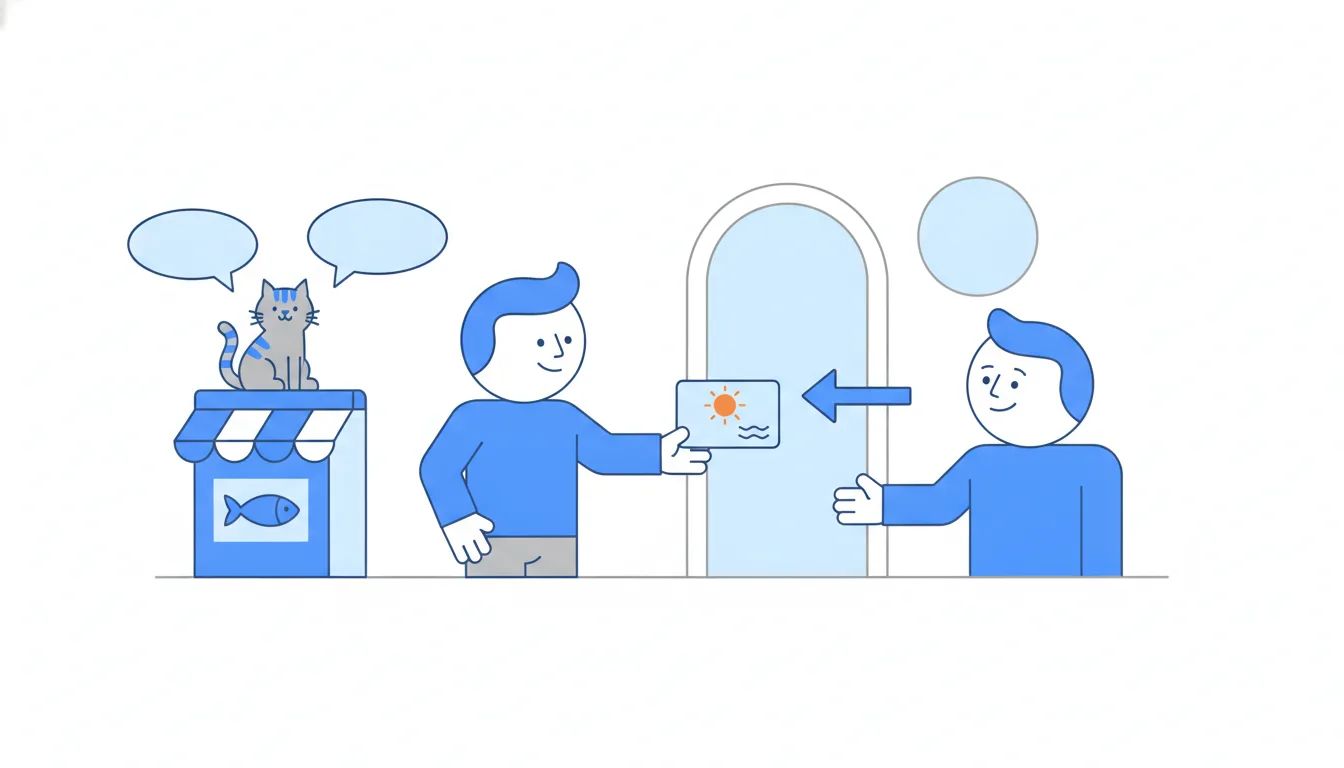
Stalls like “after the holidays”, “I need to check with my partner” or “keep me posted” are often a polite way to avoid saying no. Answer each one graciously, then turn it into something specific: a date, a person or a decision.
- “After the holidays” → “Sure. Shall we put 15 minutes in the calendar for 14 January?”
- “I'll check with my partner” → “Makes sense. Could the three of us talk on Thursday?”
- “Keep me posted” → “Is this for this quarter, or should I close it for now?”
A real lead has answers and picks an option. A zombie goes vague, and then you know.
- Do“Sure. Shall we put 15 minutes in the calendar for 14 January?”
Turns “after the holidays” into a date.
- Do“It's completely fine if this isn't a priority, just tell me and I'll stop chasing you.”
A polite exit makes an honest no easy.
- Don't“No rush at all, I'll check in again next month!”
Feeds the zombie for another month.
A waitlist is a list of maybes
Sofia has zombies too: 300 people on the waitlist on CatChow's landing page. Joining is free, one email address, so 300 signups are 300 maybes, not 300 customers.
To find out who's real, give everyone a concrete offer. Sofia emailed all 300 with a pre-order: the first box at 1,250 UAH, shipping in March. 18 people paid.
- Share: 18 ÷ 300 = 0.06 = 6%.
- Money: 18 × 1,250 = 22,500 UAH. Tiny, but real.
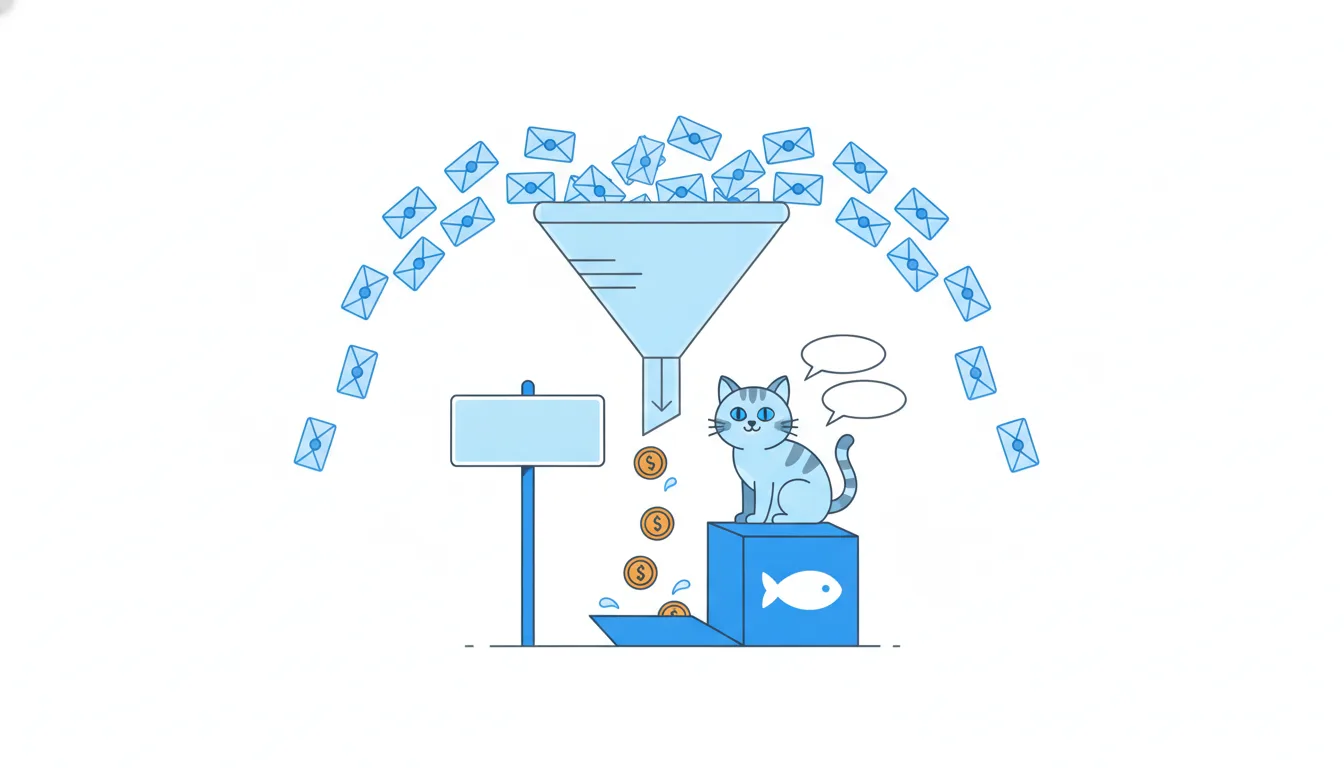
That's the first number from this list you can build on. The other 282 aren't “interested”, and they aren't rejections either: they're unknown. One email isn't enough to call the idea dead.
So the report to the CEO isn't “300 interested customers” and it isn't “only 18 care, the idea failed”. It's: 18 of 300 pre-ordered (6%, 22,500 UAH); the other 282 haven't committed, so we treat them as unknown. And a bigger waitlist wouldn't help: 3,000 free signups are just more maybes.
- Don't“300 people on the waitlist: demand is strong.”
Free signups reported as customers.
- Do“18 of 300 pre-ordered (6%, 22,500 UAH); the other 282 are unknown.”
Reports commitments and labels the rest honestly.
One offer, one date, an easy no
Jack owns the Khvostyk pet shop. Three calls with Megan since June, always “sounds great, send updates”, and she has never asked him for anything. The next message shouldn't be another update. It should contain three things:
- One concrete offer, built on what he's told you: for example, a trial shelf of CatChow in his shop for two weeks.
- A date: from 1 November, or a reply by Friday.
- An easy way to say no: “If it's not a priority right now, just tell me and I'll stop chasing.”
What stays out: the fresh deck, the list of new features, the “just checking in” and the discount. None of them asks for a decision, so they keep the zombie alive.
And if Jack says no? Then Megan gets back a few hours a month and a reason she can learn from. Both are better than a fourth “sounds great”. A message like this isn't pushy: it respects Jack's time more than another round of updates would.
- Do“Could we try a CatChow trial shelf at Khvostyk for two weeks from 1 November? If it's not a priority, just tell me and I'll stop chasing.”
One offer, one date, an easy no.
- Don't“Hi Jack, here's our updated deck with the new features. Let me know what you think!”
Asks for nothing, so the zombie lives on.
The last follow-up
The same move works when a lead goes completely silent. A follow-up email after no response isn't a fifth “just checking in”. It's one last message with one concrete offer, a date and an easy way to say no. Some teams call it a breakup email.
Sofia can send one to the 282 people who never answered her pre-order offer. Something like: last week we offered the first CatChow box for 1,250 UAH, shipping in March, and 18 cat owners have already pre-ordered. Would you like one too? Reply “yes” by Friday and we'll hold a box for you. If cat food isn't a priority right now, that's completely fine: reply “no” and we'll take you off the waitlist, with no more emails about it.
Leave out the fresh deck, the feature list and the bigger discount: they ask for nothing and answer questions nobody asked.
Every reply then sorts someone: a yes joins the 18, a no leaves the list. Whoever stays silent even after this isn't a lead, so stop counting them in the 300.
- Do“Reply ‘yes’ by Friday and we'll hold a box for you. If it's not a priority, reply ‘no’ and we'll take you off the list.”
A date and an easy no in two sentences.
- Don't“Just checking in! Here's 20% off if you're still interested.”
No decision asked, and a discount nobody asked for.
Learning over revenue
Megan's target this quarter is revenue, and pushing for a yes or no will shrink her pipeline on paper. On paper only: those deals were never there, and she'll finally see who the real customers are.
Early in a product's life, the real goal of a sales conversation is learning: which segment buys, at what price, and what gets in the way. Revenue follows from getting that right. So outcomes aren't ranked by money. A café that buys one box at half price “to help out” looks like revenue but teaches nothing. A pet shop that says no because its customers want 400 g packs, not 2 kg bags, can change the product.
When a no comes, like Jack's “honestly, we're not ready for this right now”, be glad the zombie is finally honest. But “not ready” is still vague, so don't argue with it; get curious. Ask one or two neutral questions about what's behind it, then thank him and let him go. No discount and no second pitch: a discount answers a question you haven't asked yet.
- DoA pet shop says no: “Our customers want 400 g packs, not 2 kg bags.”
A reasoned no that can change the product.
- Do“Thanks for being straight with me. What would need to change for it to make sense for you?”
Curious about the no, without trying to reverse it.
- Don't“How about 30% off? Would that change your mind?”
Answers a question nobody has asked yet.
Ready to practise?
Answer the lesson's exercises and earn 250 points the first time you finish it.
Start the exercises