

Theory
Fluff: vague answers and the say-do gap
How to spot vague answers (“I always”, “I would”, “I might”), why the say-do gap makes them useless, how to anchor them to one real past event, and how to tell complainers from customers.
~11 min read · 12 exercises · 250 points
Before you start
Olivia, take two
Back at CatChow, Sofia is still interviewing customers about the food subscription, and you're still reviewing her calls. She called Olivia back and didn't mention the subscription once, and there wasn't a single compliment. Yet her notes still feel empty.
In this lesson you'll learn to recognise answers that sound like data but describe nothing that happened, see why what people say they do drifts from what they do, and practise pulling a vague answer back to one real moment.
Three kinds of fluff
Sofia called Olivia back and didn't mention the subscription once. No compliments this time, yet her notes still felt empty. Olivia had said: “Oh, I always buy food in advance, I'm very organised about it. If there were a delivery service, I'd definitely use it. I might even order treats as well.” Nothing wrong with it, and nothing usable either.
That's fluff: answers that sound like information but describe no real event. Fluff lives in the say-do gap, the distance between what people say they do and what they actually do. Olivia's three sentences show its three forms:
- Generic claim: “I always buy in advance.” A portrait of the ideal self. Real life has exceptions, and the problem usually hides in them.
- Future promise: “I'd definitely use delivery.” The most dangerous kind, because it sounds concrete. People are hopelessly optimistic about their future selves: everyone starts the gym next Monday.
- Hypothetical maybe: “I might order treats too.” Softer still, a polite “in some other world, sure”.
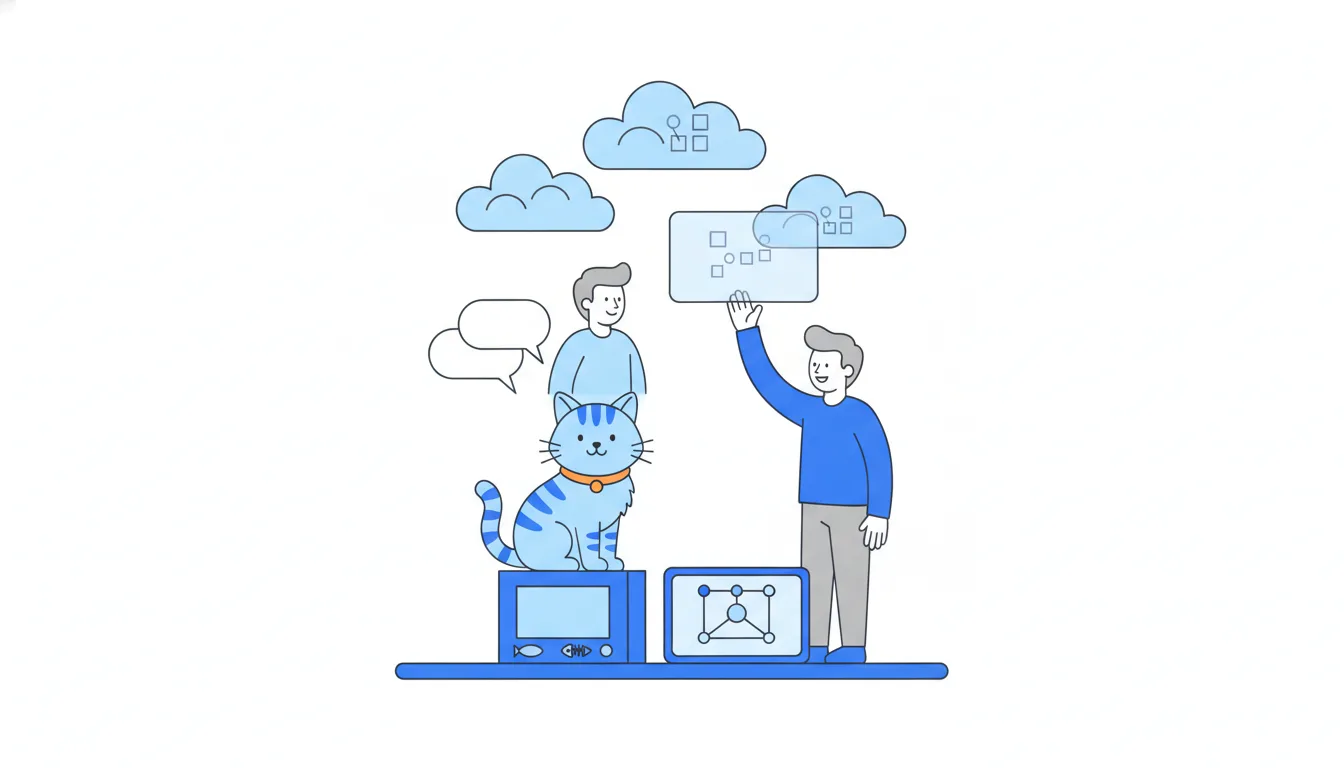
A fact from the past looks different: “Last Friday I bought a 2 kg bag at the shop by the metro.” It has a date and a place.
- Don'tNotes: “Olivia: always buys in advance, would use delivery, might add treats.”
Three kinds of fluff, zero events.
- DoNotes: “Olivia: last Friday, 2 kg bag, shop by the metro.”
A date and a place: a fact.
Spotting fluff by its words
Fluff often gives itself away through particular words. Train your ear for them, so you notice them while the customer is still talking:
- Generic: “usually”, “always”, “never”, “normally”, “every couple of weeks”.
- Future: “I'd”, “I will”, “in a heartbeat”, “if the price is right”.
- Hypothetical: “I could”, “probably”, “might”, “maybe”.
The opposite signals point to facts:
- a named day: “on Monday”, “last Sunday”;
- a specific item: “the last bag I bought”;
- an amount: “60 UAH for delivery”;
- an outcome: “so I gave it to a shelter”.
Facts don't have to be neat. “The last bag I bought, my cat refused to eat, so I gave it to a shelter” is messy, and that's good: messy past details are often exactly where the real problem shows.
All three kinds of fluff share one thing: no date, no place, no money. When you hear them, don't write them down as answers. Treat them as a cue to ask about one specific time.
- Don't“I'd switch to you in a heartbeat if the price is right.”
Future words, no event.
- Do“On Monday I ordered two bags online and paid 60 UAH for delivery.”
A day, an order and a price.
The scene test
Sorting fluff on paper is one thing. Catching it live, in the middle of a call, is harder, because fluff sounds perfectly reasonable. A quick tool for that is the scene test: can you picture one specific moment, as if it were a short video clip?
A real event usually comes with:
- a day: “last Thursday after work”;
- a place: “the pet shop on Shevchenko Street”;
- often a number: “a 4 kg bag for 820 UAH”.
If you can see the scene, it's a fact. If you can't, it's fluff, whether it's a generic claim, a future promise or a hypothetical maybe.
The trickiest case is a habit dressed up in detail: “Every couple of weeks I grab a bag somewhere near work, usually on the way home.” It sounds rich: a route, a rhythm, a place. But there's no single moment to picture, only a routine, and “usually” is the giveaway. A vividly described routine is still a routine.
When the scene test fails, don't challenge the answer. Simply make your next question about the last time.
- Don't“Every couple of weeks I grab a bag somewhere near work, usually on the way home.”
Rich detail, but a routine: no single scene.
- Do“Last Thursday after work I bought a 4 kg bag on Shevchenko Street for 820 UAH.”
Day, place, number: you can picture it.
Fluffy questions as a bridge
Sofia admitted she had asked for the fluff. Her first question to Olivia was “Do you usually buy food in advance?” Questions shape answers. “Do you usually…?”, “Do you ever…?”, “Would you…?” and “Could you see yourself…?” all invite fluff in return.
Does that make them forbidden? No. “Do you ever run out of food?” is a perfectly good way to open a topic and check that there's something to talk about. If the answer is “never”, you move on; if it's “oh, yes”, you've found a thread worth pulling.
The mistake is stopping there and writing “runs out all the time” in your notes. That's a generic claim, recorded as if it were a fact.
So use the broad question as a bridge. If the answer is yes, your very next question is about one specific time: “When was the last time? What happened?” The broad question tells you where to look; the anchored one finds the story.
The rule to remember: a fluffy question is fine only if your next question is about one specific time.
- Do“Do you ever run out of food?” “Oh yes.” “When was the last time?”
The broad question works as a bridge.
- Don't“Do you ever run out?” “All the time.” Notes: “runs out all the time”.
A generic claim recorded as a fact.
Write down events, not self-portraits
Fluff doesn't only spoil a conversation; it spoils your notes. After a call it's tempting to summarise the person: “always buys in advance, very organised, would use delivery”. It reads like a neat customer profile, but every word of it is the customer's self-portrait, not something that happened.
Good notes record events:
- when it happened: “Saturday night, two weeks before the call”;
- what happened: “ran out of food while her daughter was ill”;
- what she did: “borrowed a bowl from a neighbour, ordered express delivery”;
- what it cost: “almost double the usual price”.
An event can be compared across calls: if five customers ran out during a busy week and paid extra, that's a pattern the team can act on. Five “very organised” self-portraits can't be compared with anything.
A simple habit: after each call, go through your notes and cross out every “always”, “usually” and “would”. Whatever is left is your evidence. If almost nothing is left, you know what to ask in the follow-up call.
- Don't“Very organised, always buys ahead, would use delivery.”
A self-portrait, not evidence.
- Do“Ran out on a Saturday night; express delivery cost almost double.”
An event with a time and a cost.
Anchoring fluff
Anchoring fluff turns a vague answer into a real story by tying it to one past instance. A typical sequence:
- A broad question opens the topic: “Do you ever run out?”
- The fluffy answer confirms there's something there: “Oh yes, all the time.”
- First anchor, the time: “When was the last time?”
- A specific answer: “Last Sunday, actually.”
- Second anchor, the story: “Could you walk me through what happened?”
The value is in the story. After “I always buy in advance”, Sofia called Olivia back, said she'd forgotten to ask something, and asked about the last time. Olivia's answer: two weeks ago at the shop by the metro, and the time before was a mess. Her daughter was ill, she forgot completely, and on Saturday night the bag was empty. She borrowed a bowl of food from a neighbour and ordered online with express delivery, paying almost double.
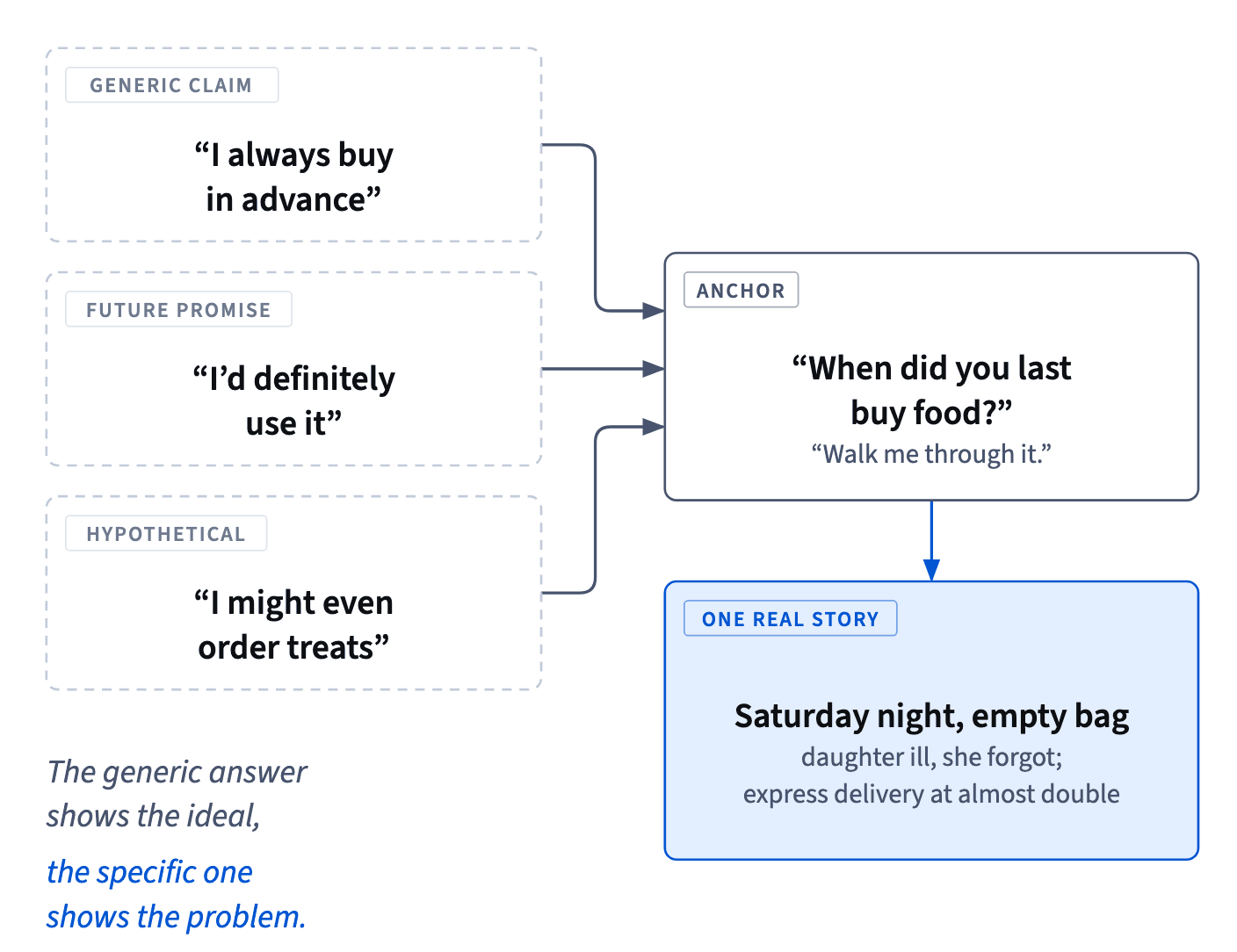
“Always buys in advance”, except when life happens, and then it costs her double. That's the pattern: the generic answer shows the ideal; the specific one shows the problem.
- Do“When did you last buy food? Walk me through it.”
Ties “always” to one real time.
- Don't“Great, you're well organised then!” and on to the next topic
Accepts the ideal and misses the Saturday night story.
Curious, not suspicious
Anchoring can feel awkward. Sofia said it felt as if she were checking whether Olivia lies. That's why tone matters as much as the question itself. You're not catching anyone out; you're curious about the details.
- Accept, then ask. “Oh, nice. And how did it go the last time you bought food?” sounds like interest, not an audit.
- Don't challenge. “Really? Always? Has it never once gone wrong?” or “Most people say that, but it's rarely true” makes people defend their ideal self instead of telling you a messy story.
- Don't close the topic for them. “Great, so you'd never need a delivery service?” invites a quick “right” and ends the story before it starts.
- Make the messy version easy to admit, for example with a bit of self-irony: “I always plan to buy ahead and never manage it. When did you last buy food?”
With future promises, anchor the part that already exists. If a customer would switch for a lower price, ask whether she has ever switched shops to save money, and what she pays now. Past behaviour predicts future behaviour better than any promise.
- Don't“Really? Always? Has it never once gone wrong?”
Sounds like an audit; she'll defend her ideal self.
- Do“Oh, nice. And how did it go the last time you bought food?”
- Do“Have you ever switched shops to save money? What do you pay now?”
Anchors a future promise to past behaviour.
Signs of a real customer
Megan, CatChow's head of sales, brought news from her team's calls: one man spent ten minutes complaining about pet-shop prices. “Someone should finally do cheap food delivery!” A hot lead? When asked whether he'd looked for cheaper delivery, he said no, never got round to it, and there are probably loads of them already.
Many people find the same thing annoying. Only some of them will ever pay to fix it, and the difference shows in what they've already done.
- A complainer says “Someone should fix this!” but hasn't lifted a finger to solve it. If they never looked for a fix, they won't look for yours either.
- A customer has searched, spent and switched: compared three shops, tested a delivery app, paid for an alternative, dropped one because the courier let them down.
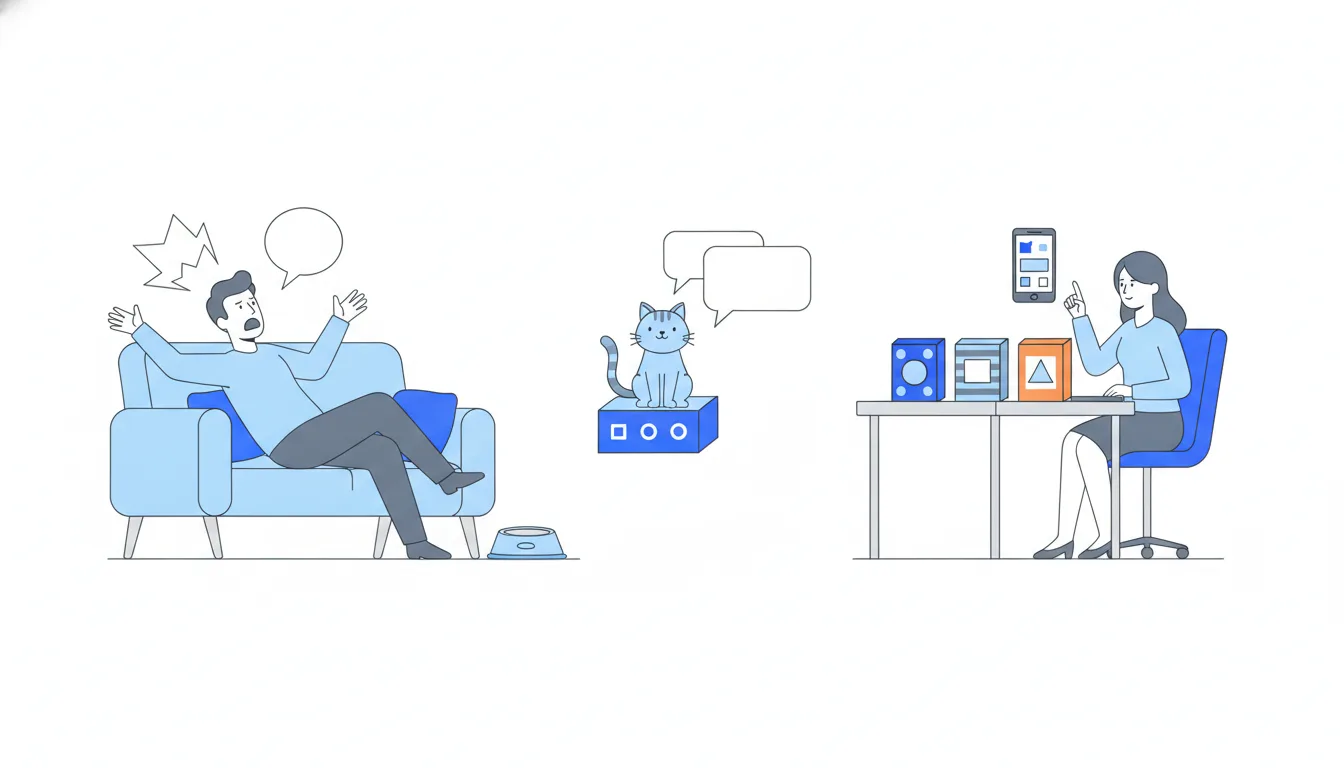
Future promises (“I'd pay for delivery, for sure”) and generic claims (“I'm always busy”) don't count as action; they cost nothing to say.
The best customer answers even tell you why the existing options fell short: “I tried two delivery apps this year: one was always late, the other didn't stock my cat's food.” That's the gap your product would need to fill.
- Don't“It's so annoying! Someone should fix this.”
A complaint with no action behind it.
- Do“I tried two delivery apps this year. One was always late, the other didn't stock my cat's food.”
Searched, spent, switched, and says why.
Test complaints with actions
Megan's team hears complaints like this every day, so they need a way to tell complainers from customers during the call itself. Some complaints sound exaggerated, and the urge is to push back: “Is it really that bad?” Don't. Arguing makes people defend their story and dig in, and the call turns into a debate.
How bad a problem really is shows in people's actions, not in a debate. So:
- Don't argue. Agree that it sounds annoying. It costs you nothing and keeps the person talking.
- Ask about actions: what they've tried, what they've looked for, what it costs them now. “Have you looked for cheaper delivery? What did you find?”
- Read the answers. Searching, spending and switching tell you more than any counter-argument. All “no”? Mark a complainer, thank them politely and move on.
That's still a useful call. Now you know this complaint, however loud, never turns into action, and you won't count him as a future subscriber. A true customer, on the other hand, will have stories to tell: the app they tried, the shop they dropped, the money they spent.
- Don't“Come on, is it really that bad?”
Starts a debate; people dig in.
- Do“That does sound annoying. Have you looked for cheaper delivery? What did you find?”
Agree, then ask about actions.
Ready to practise?
Answer the lesson's exercises and earn 250 points the first time you finish it.
Start the exercises