

What is GMV? GMV vs revenue, take rate and what a marketplace really earns
What is GMV, why gross merchandise value isn't revenue, how to calculate take rate and the agent vs principal test, with a worked marketplace example.
By Sergey BruhPublished 6 min read
What is GMV? GMV (gross merchandise value) is everything customers paid through a platform, including the share that goes to the sellers or service providers. Revenue is what the company itself earned: that's the GMV vs revenue difference in one line. A marketplace that only arranges someone else's service acts as an agent and reports just its commission as revenue. A company that controls the service acts as a principal and reports the full price. The take rate, revenue ÷ GMV, links the two, and when it falls, GMV can grow 40% while revenue grows 26%. Below: the control test, the take rate, a worked example and what changes on a slide.
GMV meaning: what it measures, and what it doesn't
GMV measures how much business flows through a platform. It's useful: it shows demand, and for the providers on the platform it's their income. But most of it was never the platform's money. If a ride, a room or a lesson costs 600 and the provider keeps 400, the platform earned 200, even though all 600 passed through its account.
Calling GMV "revenue" is the most common way a marketplace overstates itself, usually by accident. A board slide that says "revenue up 40%" when GMV grew 40% invites the wrong decisions about pricing, hiring and marketing.
Agent or principal: the control test
Whether the full price or only the commission is revenue doesn't depend on whose bank account the money reaches first. It depends on who controls the service before the customer gets it (the logic of IFRS 15 and ASC 606). Signs that you are the principal:
- you promise the service to the customer in your own name and answer for it if it goes wrong;
- you choose and replace who delivers it;
- you set the price and carry the risk if you can't sell what you've committed to.
If the customer chooses the provider, the provider delivers and answers for the result, and you run the platform and pass the money on, you are an agent. Your revenue is your commission, or net revenue.
The same company can be both. Klasna, an online tutoring school, runs two lines with the same tutors:
- 1:1 lessons for families. The family picks a tutor, the tutor teaches and answers for the lesson, Klasna passes on the tutor's share. Agent: revenue is the commission.
- Klasna for Teams, corporate English. Klasna signs the contract with the company, promises the lessons, picks the tutors and replaces them if needed. Principal: the full 800 UAH a lesson is revenue, and the tutor's 430 is a cost of revenue.
How to calculate take rate, the number that links GMV and revenue
Take rate = the platform's revenue ÷ GMV. In September 2026 families paid 4,284,750 UAH for delivered 1:1 lessons, and tutors received 2,936,250. Klasna's revenue was 4,284,750 − 2,936,250 = 1,348,500 UAH, a take rate of 1,348,500 ÷ 4,284,750 = 31.47%.
If you know GMV and the take rate, revenue is GMV × take rate. If the take rate moves, revenue and GMV grow at different speeds.
Worked example: "revenue up 40%"
Klasna's CEO prepared a headline for the board: revenue up 40% on last autumn. Here are September–November of both years for 1:1 lessons:
The working:
- Revenue = GMV − payouts: 14,721,940 − 10,061,190 = 4,660,750.
- Take rate: 3,711,740 ÷ 10,510,442 = 35.31%; 4,660,750 ÷ 14,721,940 = 31.66%.
- GMV growth: 14,721,940 ÷ 10,510,442 − 1 = 40.07%. Revenue growth: 4,660,750 ÷ 3,711,740 − 1 = 25.57%.
The 40% was GMV. Revenue grew a quarter. Why the gap? Per lesson, families paid 593.15 UAH on average instead of 613.86, because Klasna pushed its discounted 32-lesson package. Tutors were still paid their full rate (405.37 per lesson against 397.07). So the whole discount came out of Klasna's share: 187.78 per lesson instead of 216.78, down 13%.
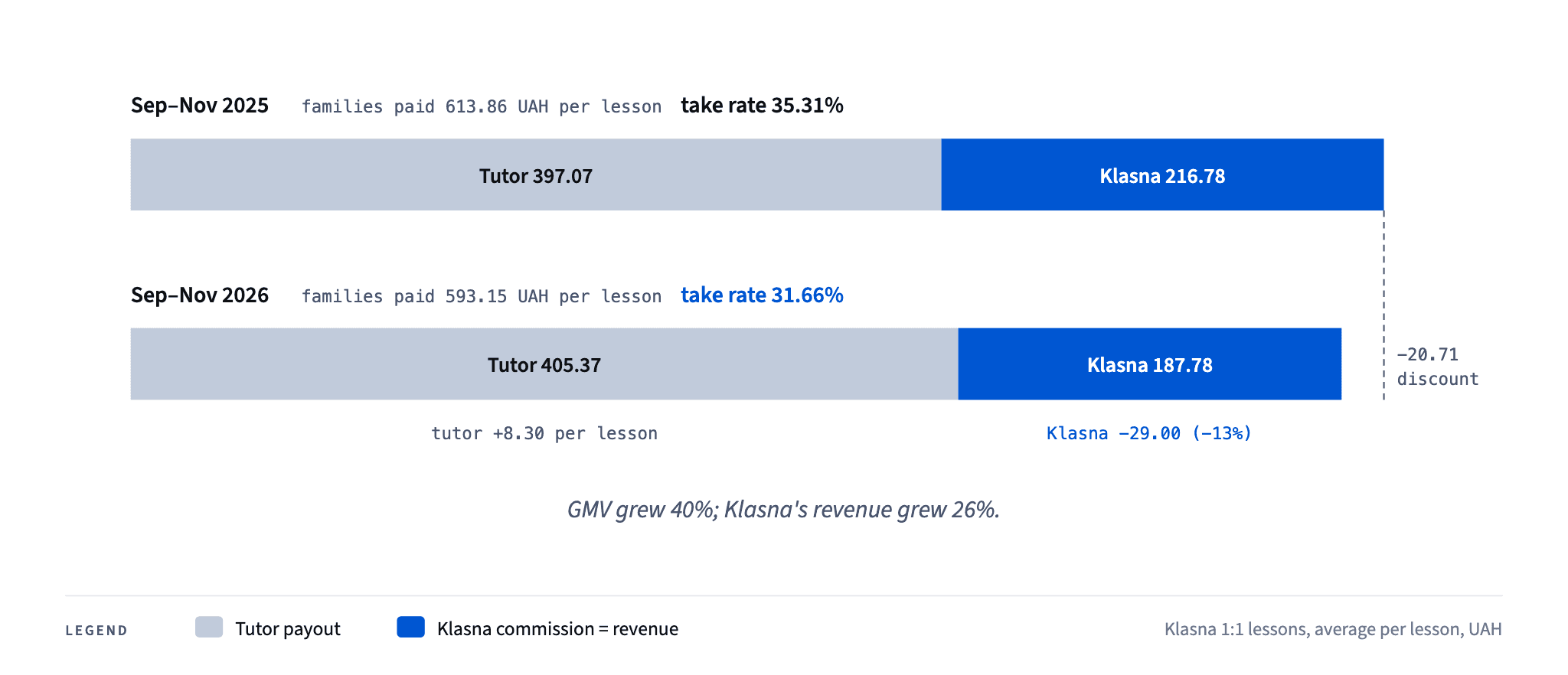
An honest headline keeps the growth and names both numbers: "Lesson GMV up 40% on 45% more lessons; our revenue, the commission, up 26%. The take rate fell from 35.3% to 31.7% because the package discount came out of our share. We're watching the take rate."
Gross or net changes margins, not gross profit
Presentation changes revenue and the gross margin, never the profit in hryvnias. A Teams lesson brings 800 UAH; the tutor gets 430 and video and AI cost 31, so gross profit is 800 − 430 − 31 = 339.
339 ÷ 800 = 42.38%; 339 ÷ 370 = 91.62%. Same lesson, same profit, margins twice as far apart. So never compare gross margins across lines or companies without asking how each one presents revenue. Compare gross profit, or GMV and take rate side by side.
Limits
The control test is a judgment, not a formula, and real contracts mix signals: who sets the price, who handles refunds, who holds the provider's obligations. When the answer changes reported revenue, your accountant or auditor makes the call, and the facts of the contract decide it, not which number looks better. GMV definitions also vary (with or without refunds, cancellations, taxes), so state yours whenever you show it.
Key takeaways
- GMV is volume flowing through the platform; revenue is what the company earned from it.
- An agent reports its commission; a principal that controls the service reports the full price and the provider's share as a cost.
- Take rate = revenue ÷ GMV. When it falls, revenue grows slower than GMV.
- Gross vs net presentation changes revenue and margins, never gross profit.
FAQ
Is GMV the same as revenue?
Only for a company that sells its own goods or services as a principal. For a marketplace acting as an agent, revenue is the commission, a fraction of GMV.
What does GMV mean in e-commerce?
The same thing as on any marketplace: the total value of orders placed through the store or platform in a period, before the platform's commission, sellers' payouts and often refunds. State whether yours includes refunds, cancellations and taxes.
How do you calculate take rate?
Divide the platform's revenue (its commission) by GMV for the same period: 1,348,500 ÷ 4,284,750 = 31.47% for Klasna's September.
Why do marketplaces report GMV at all?
It shows the size of the market they move and the income they bring providers. It's a fair metric when it's labelled GMV and shown next to revenue, never on the revenue line.
Learn it hands-on
Module 2 of the free course Finance for Product People covers this on Klasna's numbers: start with GMV vs revenue, then read a P&L top to bottom and see when prepaid money becomes revenue. Why prepaid revenue and cash part ways is in profit vs cash flow.