

Profit vs cash flow: why a profitable company runs out of money
Profit vs cash flow explained: why the P&L and the bank disagree, how a profitable year can end with an empty account, and how to close the gap early.
By Sergey BruhPublished 6 min read
The difference in profit vs cash flow is timing. Profit counts revenue when the work is delivered and costs when they are incurred, whatever day the money moves. Cash flow counts only the money that actually enters or leaves the bank. A profitable company runs out of money when cash leaves before it comes back: customers pay later than you pay your costs, prepaid money is spent before the work is done, or a big purchase lands in one month while its cost reaches the P&L over years. Below: a worked example of a profitable year that ends below zero, and what to do about it.
Why profit and cash flow tell different stories
The P&L is built on accrual accounting. It answers "what did we earn this month?" The bank answers a different question: "what money moved this month?" Neither is wrong, and you need both. Profit tells you whether the business works. Cash tells you whether it survives the calendar.
They part in four ways:
- Cash before revenue. A customer prepays for a service you deliver over the next months. The bank grows now; revenue comes later. Until then the money is deferred revenue: you owe the work.
- Revenue before cash. You deliver to a business client and invoice with 60-day terms. Revenue is in this month's P&L; the money arrives two months later.
- Cost before cash. A contractor's work in late May is a May cost, but you pay it on 5 June.
- Cash before cost. Laptops paid in August reach the P&L over two years, as depreciation. The cash leaves at once.
Worked example: a profitable school with an empty August
Klasna is an online tutoring school. Families buy prepaid packages of lessons, and the business is seasonal: a spring peak before exams, a summer dip, a restart in September. The payment provider keeps 2.5% of every payment on the day it arrives.
Start with two months side by side. In March 2026 Klasna earned 329,884 UAH of operating profit, and its bank balance grew by 1,705,570. In May profit was higher, 591,348, and the bank shrank by 579,217.50. In March families paid 6,279,600 UAH for packages but took lessons worth only 4,868,640; in May they paid 4,802,300 and took lessons worth 6,002,880. They were using lessons bought in spring.
For a business like this one (costs paid in the month they're incurred, no loans, no tax payments in the period) the bridge from profit to cash is short:
net cash flow = operating profit + 0.975 × (paid by customers − value of lessons delivered) − equipment
- March: 329,884 + 0.975 × 1,410,960 = 329,884 + 1,375,686 = +1,705,570.
- May: 591,348 + 0.975 × (−1,200,580) = 591,348 − 1,170,565.50 = −579,217.50.
Now the whole school year, September 2025 to August 2026, with June–August as a forecast. Klasna started it with 600,000 UAH in the bank.
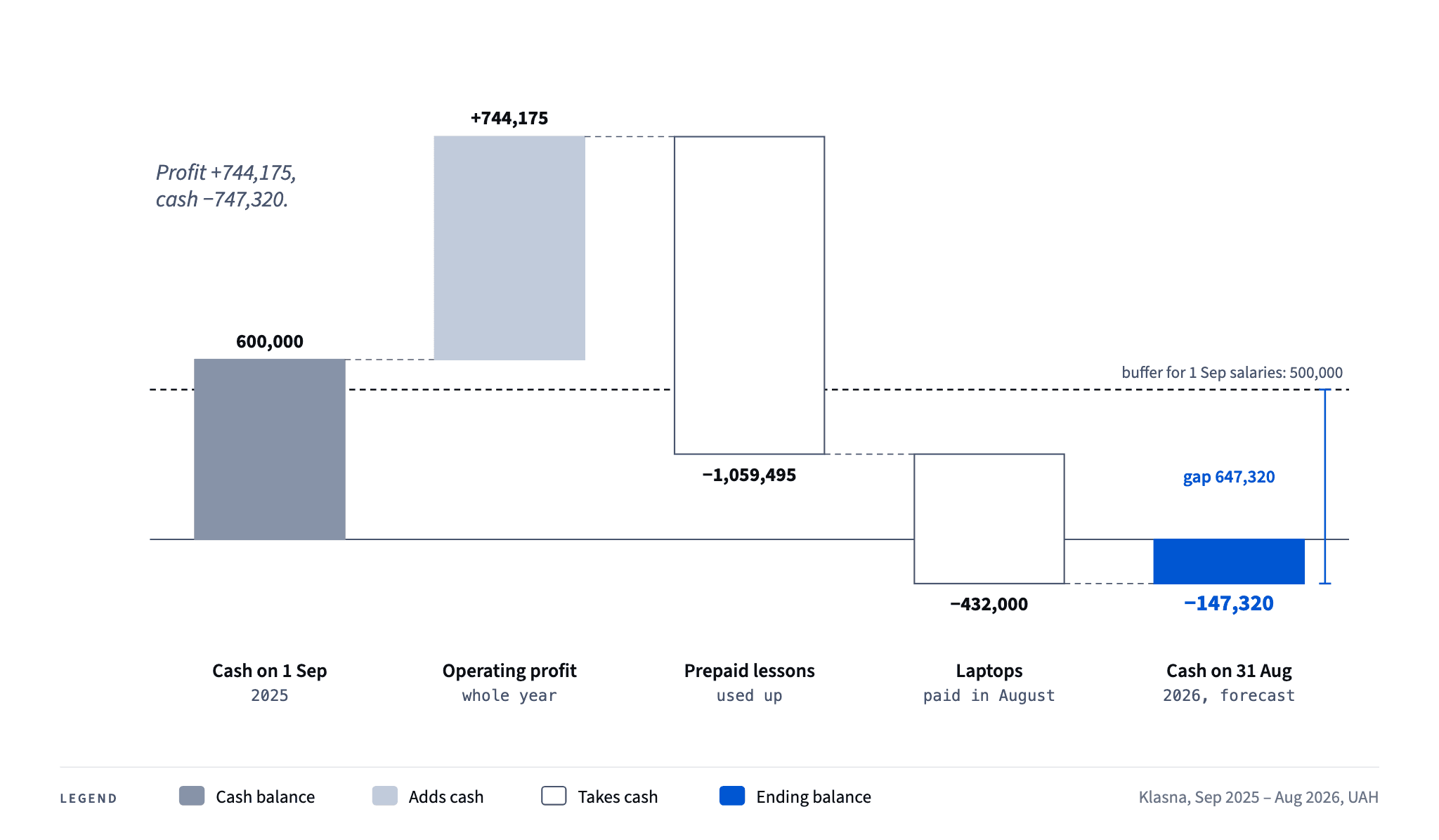
The year is profitable by 744,175 UAH, yet cash falls by 747,320, from 600,000 to −147,320 on 31 August. The distance between the two is 744,175 + 747,320 = 1,491,495 UAH, and it has exactly two causes:
- Prepaid lessons used up. Over the year families took 1,086,661 UAH more in lessons than they paid for during the year: 0.975 × 1,086,661 ≈ 1,059,494 of cash after fees. Some of September's lessons had been paid in the previous August, and in summer families work through packages bought in spring.
- Equipment. 432,000 UAH of laptops in August: all the cash now, the cost spread over the next two years.
Summer losses don't explain the gap: they are already inside the 744,175. The real trap is the April peak. With 4.37 million UAH in the bank, the school looked rich. Most of that money was the summer's lessons, held for a few months.
How to close a cash gap before it opens
Size the cash gap against what you need, not against zero. Klasna pays salaries on 1 September, before autumn prepayments arrive, so its head of finance wants 500,000 UAH in the bank on 31 August. The gap is 500,000 + 147,320 = 647,320 UAH.
Pull the cheap levers first, in June rather than on 30 August:
- Move capex. Buying the laptops in September instead of August adds 432,000: −147,320 + 432,000 = 284,680.
- Bring prepayments forward. An August early-bird sale for September packages: every 100,000 UAH prepaid adds 97,500 after fees. About 221,000 of prepayments closes the rest (215,320 ÷ 0.975 ≈ 220,841).
- Trim spending that doesn't pay back in time. Summer marketing is 540,000 UAH; keep only what brings September sign-ups.
- Arrange a credit line as a backup while the balance still looks healthy, and draw it only if July misses the forecast.
Limits of this example
The one-line bridge works because Klasna pays its costs in the month and has no loans or tax payments in the period. Real companies also have supplier terms, taxes, loan repayments and inventory; the cash flow statement adjusts profit for all of them. The summer numbers are a forecast, so compare them with actuals every week from July.
Key takeaways
- Profit follows the work; cash follows the money. Both are correct, and they answer different questions.
- In a prepaid seasonal business, the spring cash peak is the summer's work, not spare money.
- Measure a cash gap against the buffer you need and close it with timing levers first, borrowing last.
FAQ
Can a company be profitable and still run out of money?
Yes. A company gets into trouble when it can't pay what is due, not when its P&L shows a loss. Klasna's profitable year still ends 147,320 UAH below zero unless it acts.
Is positive cash flow better than profit?
Neither. A loss-making month can bring cash in when customers prepay faster than they use the service, but the loss is still real.
What should I watch besides profit?
Monthly net cash flow, the bank balance against a minimum buffer, the prepaid work you still owe, and a month-by-month cash forecast for the next 12 months.
Learn it hands-on
Module 3 of the free course Finance for Product People works through this on Klasna's data: start with why profit is not cash, read the cash flow statement, then solve the August cash case yourself. Payment terms make the same problem worse for B2B sales: see working capital and DSO.