

- Trainer
- Everyone
Personal Finance: Budget, Safety Cushion, Debt and Investing
Take charge of your money without giving up the things you enjoy. See where your money goes, build a safety cushion for real Ukrainian risks, work out what a loan or "pay in parts" really costs, live on irregular income, choose where savings live, invest without illusions, protect your family and plan for the long run. Educational, not financial advice.
Free32 lessons~11 h 1 min of learning
Module 1: Where does my money go?
Tracking a month, a spending plan with fun money, subscriptions and small payments, and running out before payday.
- 1.1Tracking a month without a spreadsheet habitSee where the money actually went, from a month of card payments.~20 min
- 1.2Spending plan: needs, wants and fun moneyA spending plan that covers needs, saving and the things that make life good.~18 min
- 1.3Subscriptions and small payments: the leaksHow small and recurring payments add up to more than one big purchase, and how a ten-minute monthly audit lets you keep what you value on purpose.~18 min
- 1.4Case: Sam's family lives paycheck to paycheckSam's family lives paycheck to paycheck, 6,558 UAH short every month. Find the gap in a month of data, close it with recurring cuts, keep fun money and start saving first.~29 min
Module examComplete 4 more lessons to unlockModule 2: What if the income stops?
How big a cushion to keep, where to keep it, how to build it automatically, and a cushion plan for summer and wartime.

- 2.1Emergency fund: how many months of essentialsHow much should an emergency fund be? Size it from essential costs and from how likely, and for how long, an income could stop.~18 min
- 2.2Where to keep it: access, currency, several banksMoney you can reach on a bad day, in the right currency and not all in one place.~19 min
- 2.3Building it without pain: pay yourself firstPay yourself first: automatic saving on payday instead of saving what is left, with a fixed sum for a salary and a percentage for irregular income.~18 min
- 2.4Case: Dana builds an emergency fund for summer and warHow to build an emergency fund on a seasonal income: a tutor separates a predictable summer dip from real emergencies, sizes both, places the money and plans how to fill it by June.~31 min
Module examComplete 4 more lessons to unlockModule 3: What does this debt really cost?
The real annual cost of a loan, credit cards and the minimum payment, installment plans and microloans, and a way out of debt.
- 3.1APR: the real annual cost of a loanAPR vs interest rate: why "0%" can cost as much as a credit card, and how to compare loans by everything you pay, not by the advertised rate or the monthly payment.~18 min
- 3.2Credit cards: grace period and the minimum-payment trapWhen a credit card costs nothing, how a balance quietly grows, and why paying the minimum can keep a debt alive for years.~18 min
- 3.3Buy now, pay later and payday loansWhen buy now, pay later is really free, when zero percent hides a price, and why payday loans, short microloans, are the most expensive money there is.~17 min
- 3.4Case: Sam's way out of debtA credit card and two installment plans, one fixed budget: compare paying the costliest debt first with paying the smallest first, and write the plan.~29 min
Module examComplete 4 more lessons to unlockModule 4: How to live on irregular income?
Averaging a lumpy income over a year, setting taxes aside as a sole proprietor, paying yourself a salary from a buffer.
- 4.1A year, not a monthWhy a great month is not a raise, and how to find your real income from a year of lumpy payments.~17 min
- 4.2Taxes first: how much to set asideHow much to set aside for taxes when self-employed in Ukraine: a group 3 FOP's single tax, military levy and social contribution, moved out the day the money arrives, with a rule that still works in a thin quarter.~18 min
- 4.3Paying yourself a salary from a bufferHow to pay yourself as a sole proprietor: turn an uneven income into a steady monthly salary with a buffer account, a salary set below the after-tax average, and a test against a weaker year.~18 min
- 4.4Case: Dana's 12-month budgetA budget for the self-employed, built on a tutor's year: real income, taxes set aside first, a salary from a buffer that survives the summer, the cushion, and a test against a weaker year.~29 min
Module examComplete 4 more lessons to unlockModule 5: Where should savings live?
Inflation and the real rate, the currency of a goal, deposits and government bonds, and a two-year savings choice.
- 5.1Inflation and the real rate of returnA 14% deposit is not 14% richer: find the real rate of return by taking off the tax on interest, then inflation, and see what your savings can really buy a year later.~17 min
- 5.2Hryvnia or dollars: the currency of a goalSave in the currency the bill will come in. Currency risk, the cost of exchanging money and what to do when a goal mixes currencies.~16 min
- 5.3Deposits and government bondsGovernment bonds (OVDP) and a term deposit compared side by side on the four questions for any place to keep savings: rate, tax, guarantee and access.~17 min
- 5.4Case: where to keep Dana's savings for two yearsShort-term savings on a worked case: Dana has 150,000 UAH for a kitchen renovation two years away. Price the goal, compare five options after tax, inflation and the exchange rate, stress-test them and write a recommendation.~31 min
Module examComplete 4 more lessons to unlockModule 6: How to invest without illusions?
Risk and return, diversification and index funds, what fees cost over time, and a regular plan instead of a hot tip.

- 6.1Risk and return: no "high and safe"Higher expected return always comes with bigger swings. Read twenty invented years of three options, see why averages flatter and why a fall needs a bigger rise to recover.~18 min
- 6.2Diversification and index fundsWhat is an index fund, why owning a little of everything beats betting on one company, what diversification can't protect against, and what to check before buying.~15 min
- 6.3Expense ratio: what 2% a year costsAn expense ratio, the yearly fund fee, is charged on the whole balance, every year, whatever the return. Over twenty years of 3,000 a month, 2% instead of 0.3% costs 220,130 UAH, about half of the growth.~19 min
- 6.4Case: "just buy crypto" vs a regular planLeo's coin rose 300% last year, and a messenger "platform" promises 2% a week. Check the maths, spot the red flags of an investment scam and write Dana a dollar-cost averaging plan that survives a bad year.~29 min
Module examComplete 4 more lessons to unlockModule 7: How to protect what you have?
Insurance for the losses you can't afford, fraud with calls and codes, family money documents, and a protection checklist.
- 7.1Insurance: big losses firstWhat to insure, what to pay from savings, and how to read a deductible and an exclusion.~18 min
- 7.2Phone scams: calls, codes and fake platformsHow phone scams work: the scripts fraudsters use, the rules that stop them, and what to do in the first hour if you've been scammed.~16 min
- 7.3Documents and access: if something happensA one-page money map, access without shared passwords, and documents your family can find in a hurry.~17 min
- 7.4Case: Sam's family protection checklistNine protection options and 1,500 UAH a month: choose what to insure, what to save for, and add fraud rules and a money map.~28 min
Module examComplete 4 more lessons to unlockModule 8: What am I saving for?
Goals with a price and a date, retirement, money in a couple, and a one-page money plan with a yearly review.
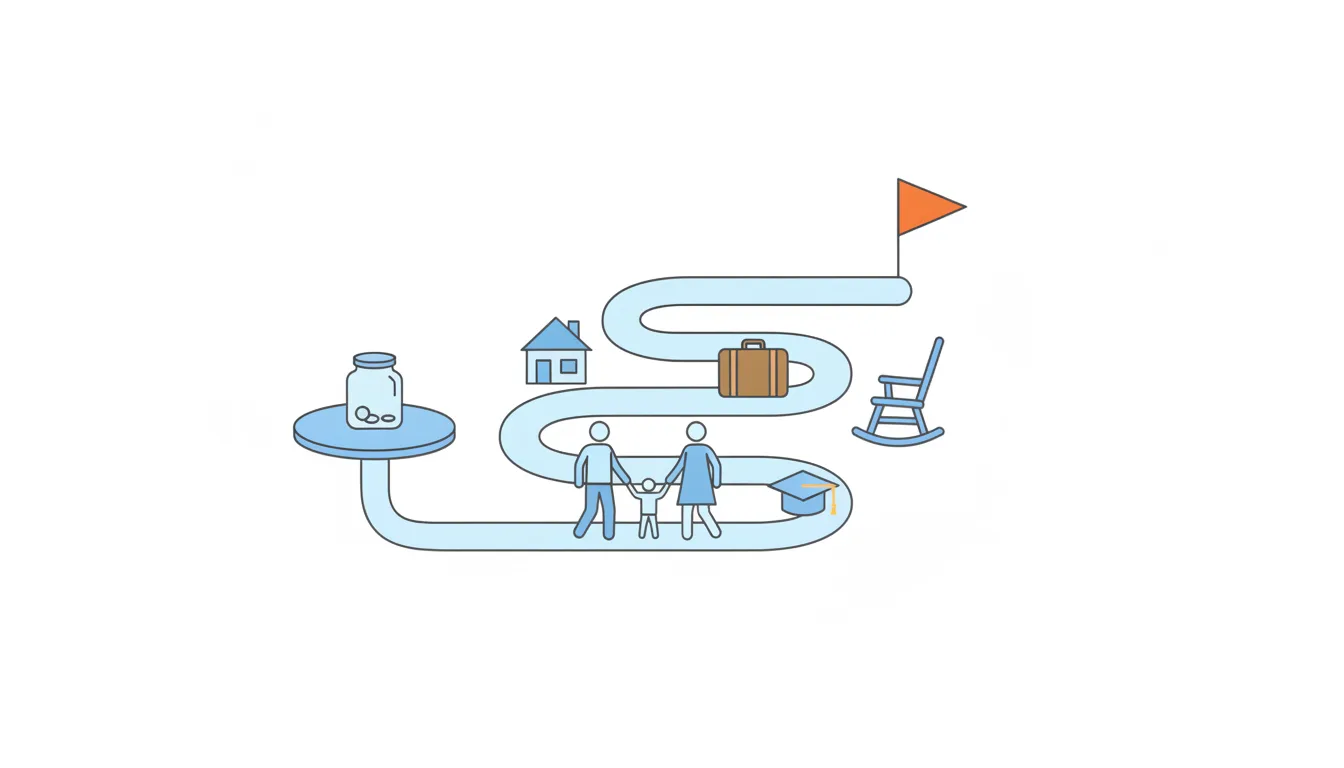
- 8.1Goals with a price and a dateTurning wishes into amounts, dates and a monthly number, and deciding what moves when they don't all fit.~18 min
- 8.2Retirement: what the state gives and what you addHow much to save for retirement: the insurance record a pension needs, why the state pension is a floor, and how much a monthly amount can grow to over 20 or 30 years.~19 min
- 8.3Money and a partner: joint, separate or bothSplitting shared costs fairly when incomes differ, and a few rules that stop money fights before they start.~17 min
- 8.4Case: a one-page financial plan and the yearly reviewDana's year in numbers: plan against actual, saving rate, net worth and the cushion, then a one-page personal financial plan for the next year.~31 min
Module examComplete 4 more lessons to unlock