

Theory
Three rules for questions that get honest answers
How to conduct customer interviews that get honest answers: talk about their life, ask about specific past events, listen more than you talk, and remember who owns the problem and who owns the solution.
~11 min read · 12 exercises · 250 points
Before you start
Back at CatChow
You're still on CatChow's product team, still checking with Sofia whether customers want the food subscription. Since last time she has rewritten her interview script: no more “do you like it?”. But the subscription still comes up in her very first sentence.
In this lesson you'll learn three rules for questions that get honest answers: what to talk about, which moments to ask about, and who should do most of the talking. Then you'll put them to work on a real call.
Rule 1: their life, not your idea
The first rule for honest answers: talk about the customer's life, not your idea. Ask about their routine, their hassles, what they spend and what they've already tried. Your idea stays in your pocket.
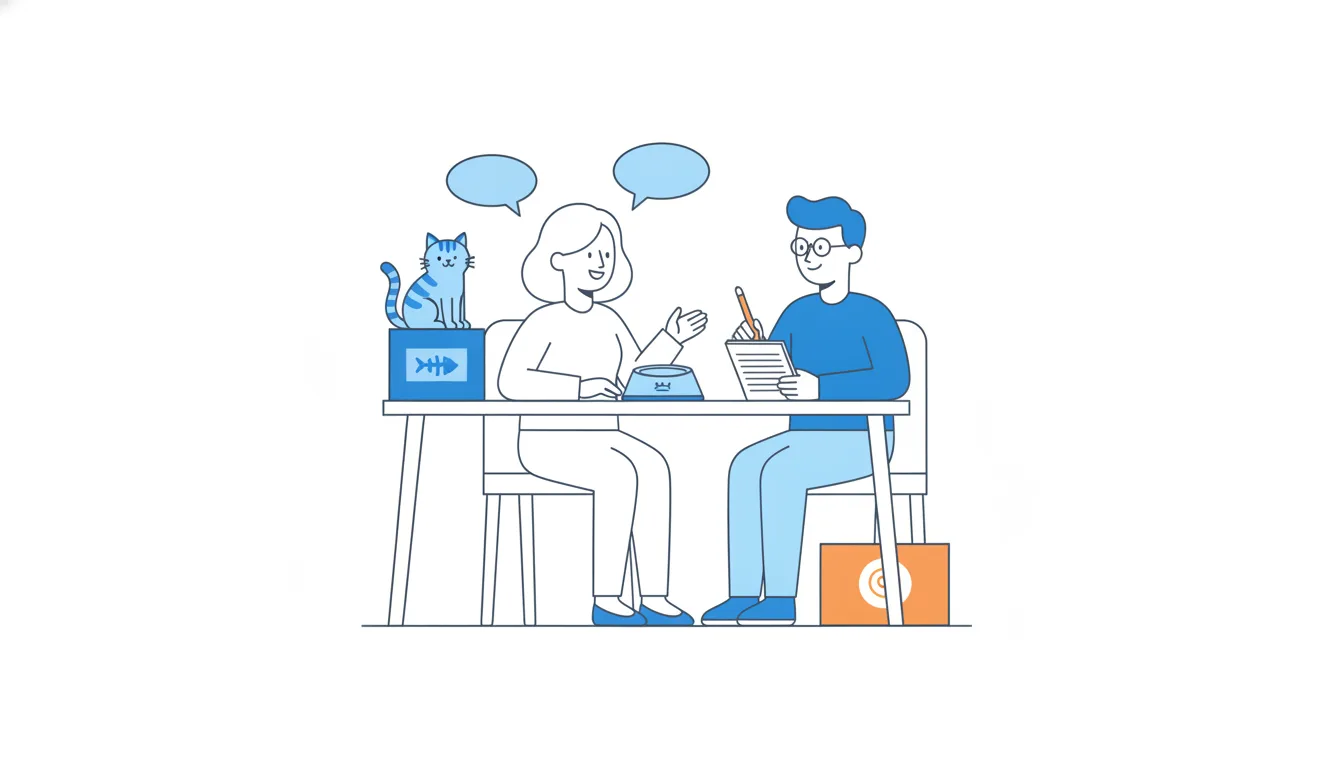
Sofia at CatChow learned this the hard way. She had already dropped “Do you like it?” and opened her calls with “We're launching a food subscription. Can I ask a few questions about how you buy cat food?” It sounds harmless, but the idea is in the very first sentence. From then on the customer answers with the subscription in mind and, being polite, tells you what you'd like to hear.
Does the idea stay hidden forever? No. Once you understand the problem, you test the idea by asking for something real, such as a pre-order, not for an opinion now. The usual mistake is showing it too early.
A good sign after a call: the customer leaves without knowing what you're building, and you leave knowing exactly how their last purchase went.
- Don't“We're launching a food subscription. Can I ask how you buy cat food?”
The idea in the first sentence colours every answer after it.
- Do“How's Whiskers? What's he eating these days, and where do you get it?”
All about her life; nothing to be polite about.
Rule 2: specifics in the past
The second rule: ask about specifics in the past, not generics or opinions about the future.
Sofia's next draft was “How do you usually buy cat food?” Closer, but “usually” invites a portrait of the person's ideal self: “Oh, I always buy in advance, I'm very organised.” That's a generic claim: it describes who she'd like to be, not what she did.
- “How do you usually…?” gets a habit as the person imagines it.
- “Would you…?” gets a cheerful guess. Everyone is a brilliant planner in the future, and the future is free.
- “When did you last…?” and “Walk me through it” get a real event: which shop, what day, what went wrong, what it cost.
Details are hard to embellish, so you can trust them. Listen for warning words such as “always”, “usually”, “never”, “would” and “will”. When you hear one, don't argue with it and don't write it down as a fact: ask about one specific time.
- Don't“How often do you usually go to the pet shop?”
Gets the habit she'd like to have.
- Do“When did you last buy food for your cat? Walk me through it.”
- Don't“Would you switch brands for a 10% discount?”
A free guess about the future.
Concrete is not the same as past
Rule 2 has two parts: specific and in the past. A question needs both, and the first part alone is a common trap.
Sofia asked: what about “What would you do if delivery took a whole week?” It's vivid and concrete, so it feels like a good question. But it describes an event that never happened. The customer has to invent an answer on the spot, and invented answers flatter the one who gives them: in an imagined crisis everyone is calm and resourceful.
Ask about the real version instead: “When did a delivery last arrive late? What did you do?” Maybe it never happened, and that's useful to know too: the problem you were worried about may be rare. If it did happen, you'll hear what they actually did: where they went, how long it took, what it cost.
A quick test for any question: could the person check their answer against a receipt, a calendar or a memory? If not, you're asking for a guess, however specific it sounds.
- Don't“What would you do if your usual pet shop closed for a month?”
Specific, but imaginary: the answer is invented.
- Do“When did you last have to buy food somewhere new? What happened?”
Specific and real, or a useful “never”.
Rule 3: talk less, listen more
The third rule: talk less, listen more. Every sentence about your solution is a sentence in which you learn nothing about the customer's problem.
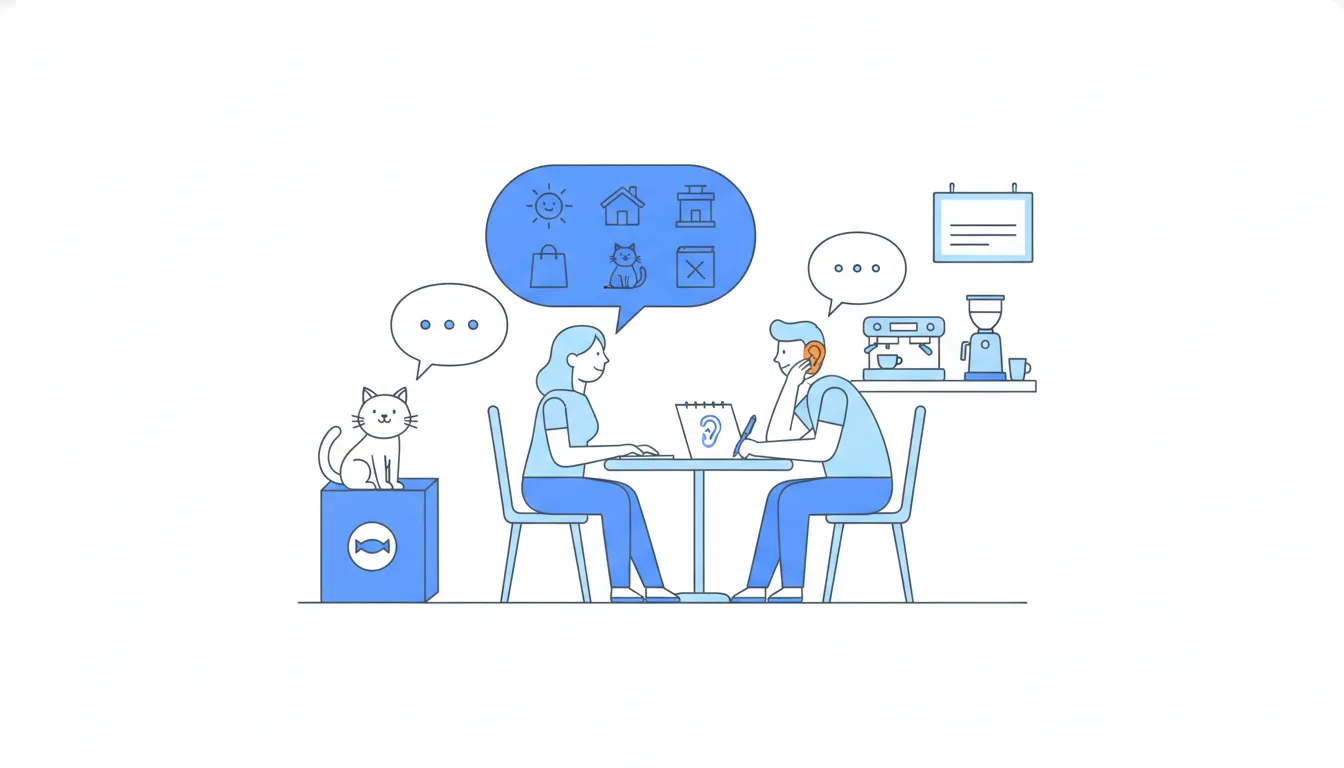
Here's how Sofia broke it. She asked Olivia a perfect question: “When did you last run out of food?” Olivia started a real story: two weeks ago, Sunday evening, the shop downstairs closed, and… Sofia jumped in: “That's exactly why we're building our subscription! Food arrives automatically, and it's 10% cheaper!” Olivia replied, “Oh, that's great, that would help.” Nobody will ever know how that Sunday ended.
That's the most expensive moment in a call: a real story is unfolding and you interrupt it with a pitch. The customer switches from remembering to being polite, and the story is gone.
So when someone starts telling you what happened, keep quiet and let them finish. Pauses feel awkward, but people often fill them with the most useful detail. A good first question is only half the job; the other half is letting the answer run to its end.
- Don't“That's exactly why we're building our subscription! Food arrives automatically!”
Cuts off a real story to pitch.
- Do“Sunday evening, and the shop was closed. What did you do?”
Repeats her words and lets the story continue.
Short replies keep the story alive
When a customer starts telling a real story, your job changes. You've already asked the good question; now you only need to keep the story going until it reaches the part you can't guess: what they did, how long it took, what it cost.
The best replies are short and about their story:
- “What did you do then?”
- “And then?”
- repeating their last words: “The shop was closed…”
- a pause, simply waiting.
Each one hands the floor back. The worst reply is anything about your idea, however relevant it feels. The moment Olivia mentioned the closed shop, Sofia heard the perfect cue for the subscription and took it. The customer heard a sales pitch and switched to being polite.
A useful habit: when you feel the urge to explain your product, ask one more question instead. If the idea really solves this problem, you'll have far better evidence for it once you've heard how the story ended.
- Do“And then?”
Two words that hand the story back.
- Don't“Our subscription would have saved you that trip!”
Ends the story and starts a polite chat.
Signs you were listening
Rule 3 is easy to agree with and hard to follow, especially when you care about your idea. Most people don't notice they're talking too much while it's happening, so check yourself after each call:
The three rules · shown above
- Who talked more? In a good call, the customer speaks most of the time and you mostly ask short follow-ups.
- Did you hear stories? Real situations with details (when, where, what it cost) mean you gave them room.
- How did it end? If the last thing you heard was “that would help” or “sounds great”, you were probably pitching, and the customer switched to being nice.
Another trap is the long list. Racing through fifteen questions in twenty minutes feels productive, but it leaves no pauses, and pauses are often where the most useful details appear. Three or four questions with full answers teach you more than fifteen with short ones.
A clear, complete explanation of your product is not a sign of a good call either. It's still you talking.
- Don'tCall notes: “Went through all 15 questions. She said it would really help!”
A rushed list and a polite ending.
- DoCall notes: “Three questions. She told me about two late deliveries and the shop she switched to.”
They own the problem, you own the solution
Customers are experts on their own problems: what annoys them, how often it happens, what they already do about it. They're usually not good at designing solutions, and it isn't their job.
When Sofia stopped talking, Olivia came up with an idea: “Make an app where I scan the bag and it reorders automatically!” Should CatChow build that? Maybe, maybe not, and Olivia can't decide it for them.
So split the roles: they own the problem; you own the solution. You don't tell customers what their problem is, and they don't tell you what to build.
That doesn't mean ignoring ideas. A request, especially one several people repeat, is a strong clue that something hurts. Treat it as a pointer, not a spec: ask why they want it and what it would save them. Maybe Olivia's real problem is remembering to reorder; maybe it's the trip to the shop. Those two need different fixes. The answer shows the real problem, and designing the fix is still the team's call.
- Don't“Five people asked for a scanning app, so let's build exactly that.”
- Do“Five people asked for a scanning app. What problem are they all trying to solve?”
The request is a clue; the fix is still the team's call.
Turning a feature idea into a clue
When a customer suggests a feature, they're telling you two things: that something bothers them, and one guess about how to fix it. The first part is valuable; the second is just a guess.
So when Olivia says “Make an app where I scan the bag!”, there are three reflexes to resist:
- selling the idea back: “Great idea! Would you pay extra for that?”
- designing together: “Should it also remind you about vet visits?”
- promising it: “Noted, it's on the roadmap.”
Each one moves you away from her problem. Instead, go back to her life and the problem behind the idea:
- When did this last happen?
- What did it cost you?
- How do you deal with it now?
Her answers show whether the problem is real and how much it matters. If she already sets a phone reminder and it works fine, the app solves nothing. If she ran out twice last month, you've found something. Then you decide what to build, and it may be simpler than what she imagined.
- Don't“Great idea! Should the app also remind you about vet appointments?”
Designs features instead of exploring the problem.
- Do“When did you last forget to reorder? What happened then?”
- Do“How do you keep track now of when the bag is getting low?”
Shows the current workaround and how well it works.
Spotting rule breaks in a script
Megan, CatChow's head of sales, and her team were about to call customers about the subscription with a script built to persuade. Sales scripts often break all three rules at once, so before using one for learning, review every line with three checks:
- Does it mention the idea? “We're launching a food subscription. Interested?” breaks rule 1: it's about your product, not the customer's life.
- Does it ask for a habit or a future? “How often do you usually buy food?” or “Would you switch to us?” breaks rule 2.
- Who is talking? A paragraph listing benefits (free delivery, 10% off, never run out) breaks rule 3: the customer just listens.
One line can break several rules. “Would you switch from your pet shop to us?” packs the idea, the future and a pitch into one sentence. When a line breaks more than one rule, name the most obvious break and fix that first.
A line that asks about one real past event in the customer's life, such as “Tell me about the last time you changed food brands”, follows all three.
- Don't“Would you switch from your pet shop to us?”
The idea, the future and a pitch in one line.
- Do“Tell me about the last time you changed where you buy food. What made you switch?”
Ready to practise?
Answer the lesson's exercises and earn 250 points the first time you finish it.
Start the exercises