

Theory
Finding people for customer interviews
How to find people for customer interviews: why cold outreach is only a starting push, how warm introductions and communities keep conversations coming, how to ask for a meeting in five parts, and how many interviews are enough.
~12 min read · 12 exercises · 250 points
Before you start
Out of friendly faces
Last module. Sofia is still interviewing for CatChow's product team, and finding people to talk to is getting harder: she has spoken to Olivia and six friends of colleagues, which is everyone she knows with a cat. Her plan is to buy a list of pet-shop customers and start calling.
This module is about running interviews as a steady process. In this first lesson you'll learn where to find people, how to ask for a meeting so they say yes, and how many conversations are enough.
Cold outreach: a starter, not a system
After the first few customer conversations, most people hit the same wall: everyone they know who has the problem has already been asked. Sofia has talked to Olivia and six friends of colleagues, and her next idea is to buy a list of 2,000 pet-shop customers and start calling.
That's cold outreach: contacting people who don't know you and have no reason to trust you, through bought lists, random calls or mass messages. It can work, but it's the hardest road. Strangers are busy and suspicious, and they owe you nothing, least of all openness.
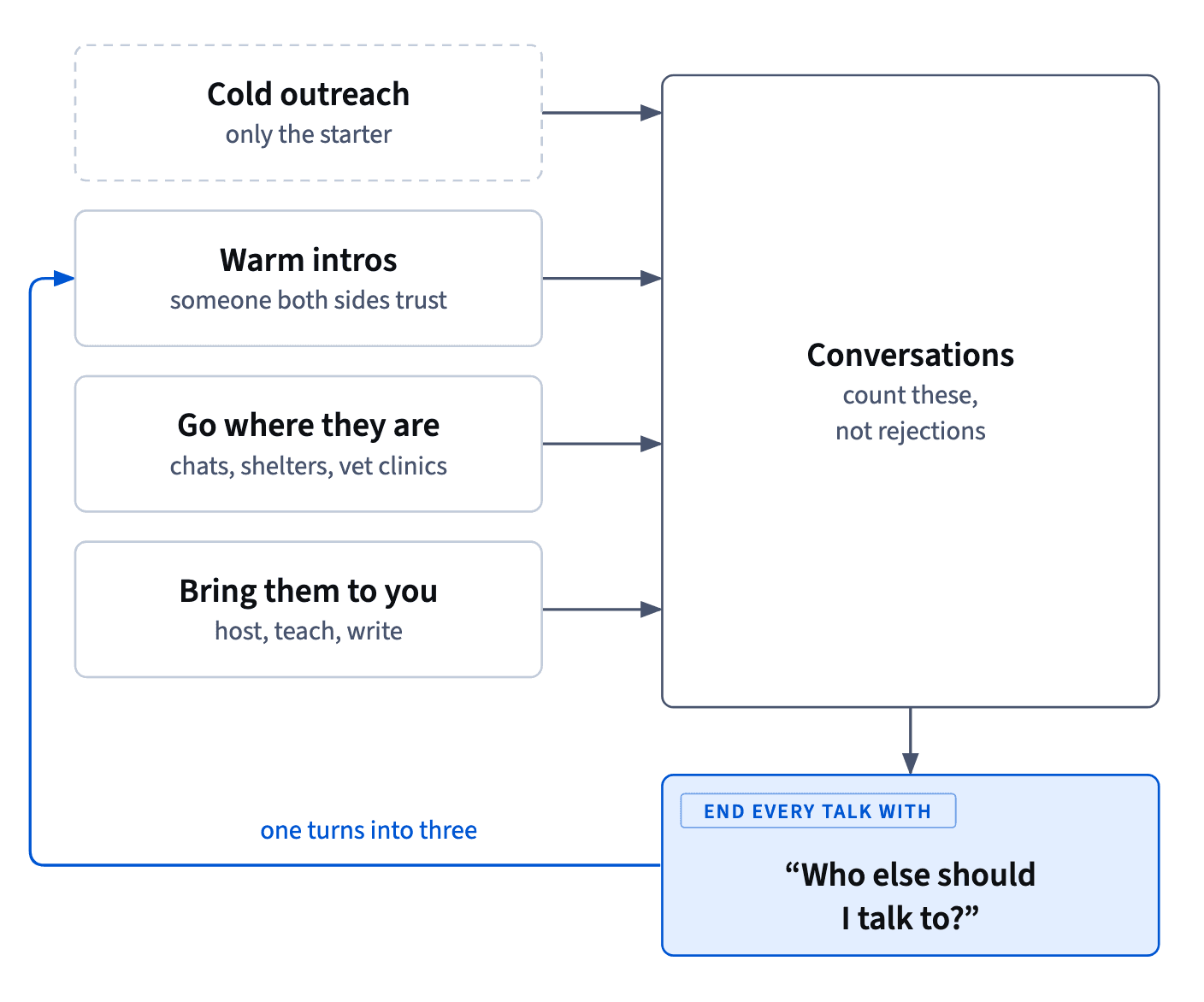
So give cold outreach one narrow job: getting your first two or three conversations. From then on the goal is to need it less and less, because each of those conversations should open the door to the next one.
And don't read refusals as data about your product. If 45 of 50 people hang up, you haven't learned that cat owners dislike subscriptions. You've learned that people dislike unexpected calls, which you knew already. Count the five conversations you got, not the 45 you didn't.
- Don't“45 people hung up, so cat owners don't want a subscription.”
Refusals measure patience with cold calls, not demand.
- Do“Five people talked to me. Who did each of them suggest I talk to next?”
Cold calls are only there to start the chain.
End every conversation with “Who else?”
The cheapest way to find your next conversation is the one you're having right now. Before you say goodbye, ask: “Who else should I talk to?” Someone who has just spent twenty minutes telling you about their cat-food habits knows exactly what you're looking for, and usually knows two or three people with the same problem.
Make the question work harder:
- Be specific. “Who else has had trouble keeping food in stock?” gets better names than “Know anyone with a cat?”
- Ask for an introduction, not just a name. “Could you introduce us?” means the next person hears about you from someone they trust.
- Make it easy. Offer a two-line message they can forward.
This is how a few cold starts snowball: each conversation brings one or two more, and soon you're no longer calling strangers at all. Don't spoil the ending with a discount or a pitch. It turns a learning chat into a sale at the last moment, and the person walks away with a code while you walk away with no new names.

- Do“Who else do you know who's had this problem? Would you mind introducing us?”
Specific, and it asks for a warm intro.
- Don't“Thanks! Here's a discount code if you ever want to try us.”
A pitch at the very end, and no new names.
Warm introductions
When Sofia asked Olivia who else to talk to, she got two names at once: Hannah, who runs a district cat chat of about 3,000 people (“tell her I sent you”), and Olivia's sister, who has just adopted two kittens and complains about food prices every day.
That's a warm intro: someone both sides trust connects you with a new person. Hannah will answer because Olivia vouched for Sofia, so the conversation starts with trust that a stranger with a phone list never gets.

Good sources of warm intros:
- friends, colleagues and their relatives who have the problem;
- partners you already work with, like the groomers and shelters CatChow supplies;
- people who once said “keep me posted, let me know if I can help”. Now's the time to take them up on it.
Writing to someone who brushed you off a month ago feels awkward, but you're asking for one introduction, not a purchase. Some will ignore you, and that's fine: you're collecting conversations, not a perfect reply rate.
The test: is there a real person in the middle who knows you and introduces you? If not, it's still cold outreach.
- DoOlivia to Hannah: “Sofia from CatChow will message you. She's easy to talk to, I promise.”
The go-between lends you her trust.
- Don'tThe same “Hi! I'd love to ask you a few questions about your cat” sent to 200 accounts
Friendly, but nobody vouches for you: still cold.
- Do“You once said to let you know if you could help. Is there one cat owner you could introduce me to?”
Turns an old “keep me posted” into one easy ask.
Going where customers already are
Warm intros take time. To find people this week, go where your customers already spend theirs: the district chat, a shelter's Saturday adoption day, a cat show, the waiting room of a vet clinic. Become a familiar face there rather than a visitor with a clipboard.
An informal chat needs no official reason. Help carry the cages, chat in the queue, ask people about their cats. It's a topic almost everyone enjoys, and you'll hear how they feed, buy and worry without ever asking for an interview.
One rule matters more than any question: keep the role you came in. If people opened up to a volunteer, a pitch or a discount at the end reveals a hidden purpose. It feels like a trick and burns trust, with that person and with the whole community, and communities talk.
That doesn't mean hiding anything. If someone asks where you work, say it plainly and get back to their cat. Treat these chats as pure learning. Asking “Who else should I talk to?” is still fine, because it asks for help, not for a sale.
- Don't“Lovely chatting! By the way, here's 15% off our food subscription.”
The volunteer suddenly turns into a salesperson.
- Do“I work at CatChow, yes. But tell me, how did you get Mia to eat the new food?”
Honest about the job, then straight back to their cat.
Starting an informal chat
Adoption days, cat shows and vet waiting rooms are full of potential conversations, but how you start decides whether you hear real stories or polite brush-offs.
Be useful first. Help the volunteers, hold a carrier, chat in the queue. People talk most freely to someone who's simply there to help, not to someone who has come to collect data. No speech about your company is needed at all.
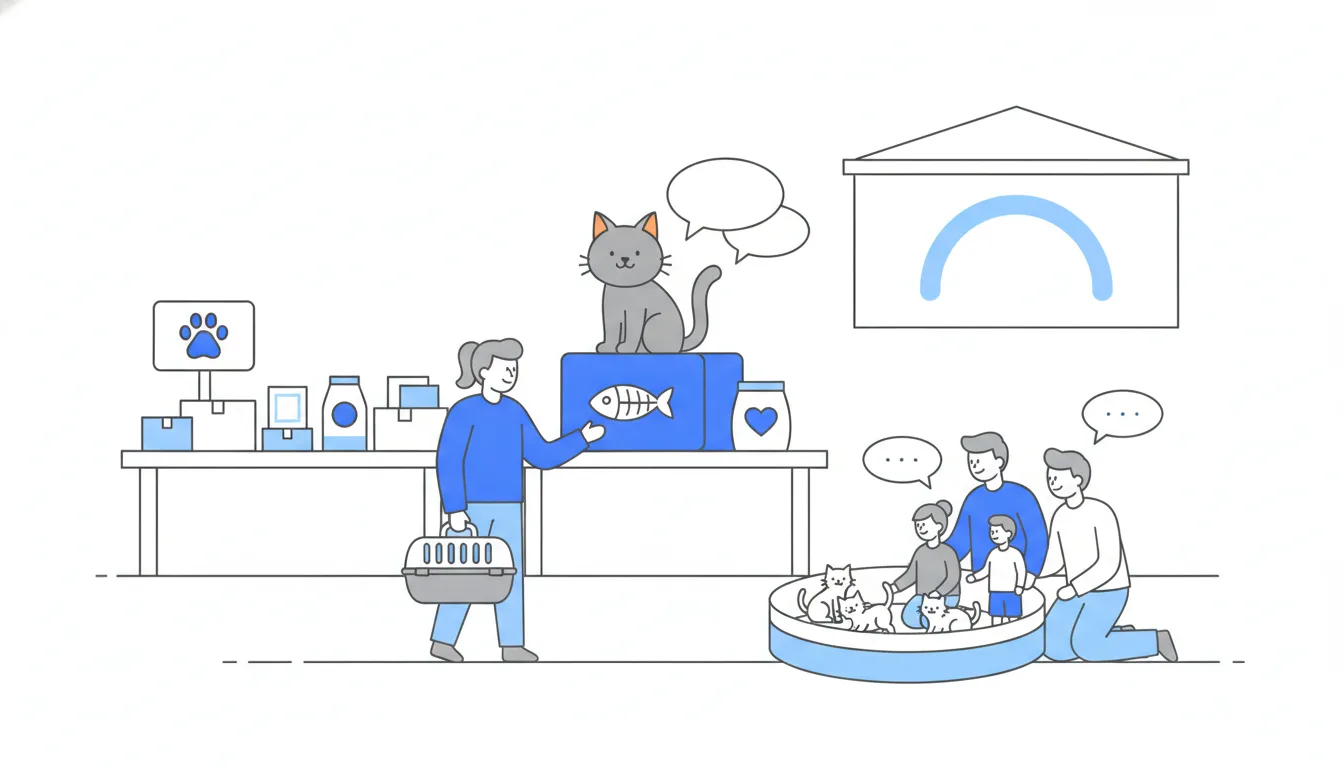
Open with their world. Ask about their cat: how old, how picky, what it eats, how they found a food that works. These questions are easy and pleasant to answer, and they lead straight to the habits you want to learn about: where people buy food, how often it runs out and what that costs them.
What spoils such a chat:
- a formal “Can I interview you for 20 minutes?”, which makes busy people guarded;
- flyers, discount codes and survey links, which turn you into a promoter;
- questions about your idea, like “Would you buy food on subscription?”, instead of questions about their life.
A survey link or a flyer gets you short, shallow answers at best. A chat over a cat carrier gets you the story.
- Do“What a calm cat! Is she fussy about food, or does she eat anything?”
Easy to answer, and it leads to real habits.
- Don't“Hi, I'm a researcher from CatChow. Do you have 20 minutes for an interview?”
Turns a friendly event into a chore.
- Don't“Would you buy cat food on subscription?”
An opinion about your idea, not a fact about their life.
Make them come to you
Chasing people puts you in the position of someone who wants something. Flip it: give them a reason to come to you.
- Host something. A free evening with a vet on switching a picky cat to new food draws exactly the owners who struggle with feeding, and the host gets instant credibility. Keep it for learning, not selling. Afterwards, talk to the people who asked the most questions.
- Teach or write. A newsletter post on feeding senior cats that ends with “Tell us how you solved it” brings replies from people who care about that very problem.
- Put up a landing page. People who leave an email have raised their hand.
Be careful with what you count. A sign-up costs almost nothing, so 300 emails in two weeks don't show that anyone will pay, and reporting them as proof of demand reads far too much into a cheap signal. Buying ads to double the number only makes a bigger number that proves just as little.
The real value is the list itself. Write to the people on it one by one and ask for a short conversation about how they buy food today.
- Don't“300 sign-ups in two weeks: demand confirmed!”
Leaving an email is free, so the count proves little.
- Do“Thanks for signing up! Could we talk for 15 minutes about how you buy food for your cat now?”
Uses the list to start real conversations.
A meeting request in five parts
Sofia's first message to Hannah read: “Hi! Can I interview you? We're launching a food subscription and want your feedback. Do you have 15 minutes for a quick call?” Every phrase works against her. “Interview” sounds like a chore, “feedback on our subscription” reveals the idea and asks for praise, and “quick call” promises a rush. It reads like a sales call in disguise.
A request that gets a yes usually has five parts:
- Problem: what you want to solve, without your idea or product.
- Stage: where you are, and that you're not selling anything.
- Stuck point: the exact thing you can't figure out.
- Why you: why this particular person can help, as a true, specific fact.
- Ask: a clear request, such as a call or a coffee.
The “why you” part isn't flattery if it's true: “You've answered hundreds of questions from cat owners in your chat” is a fact, and people like helping when they see they can make a difference. The parts can merge into two or three sentences and change order. Drop the product name, and mention the mutual contact: Olivia is your credibility.
- Don't“Can I interview you? We're launching a subscription and want your feedback. 15 minutes for a quick call?”
A chore, a pitch and a rush in three sentences.
- Do“We want cats to stop going without the right food when shops run out. We're early and not selling anything, and I'm stuck on how owners plan their purchases. You see dozens of owners a week, so you'd know. Could I buy you a coffee on Thursday?”
A note to a groomer: all five parts, no product in sight.
Ask for advice, not a favour, and own the first minute
Once a busy person says yes, nerves kick in: it can feel like begging for a favour. Asking for advice, not a favour changes that feeling. You aren't asking for help; you're finding out whether this person could be a good adviser for your company. You're the one assessing.
It's an inner stance, not something you announce. Telling Hannah “I'm checking whether you'd make a good adviser” would sound odd, even arrogant. The questions stay exactly the same. What changes is that you stop trying to please or convince her, and both of you feel the difference.
Then take control in the first minute:
- restate your frame in one sentence: the problem you're exploring, and that you're not selling;
- mention who connected you;
- ask your first real question straight away.
A line or two of small talk is fine. But if the first question comes late, the other person fills the silence with “So what are you building?”, and you slip into pitching before you've learned anything. Write your first question down before the call, so it's ready the moment you need it.
- Don't“So, as I said, I'm really assessing whether you'd make a good adviser for us.”
It's a mindset; said aloud, it sounds arrogant.
- DoTo a groomer: “Thanks for this. We're looking into how owners keep cat food in stock, and we're not selling anything. Olivia said you'd know. When did a client last tell you their cat's food had run out?”
Frame, connection and first question in one breath.
- Don't“Before we start, let me tell you about our subscription…”
The pitch takes over the first minute.
Saturation and a segment that's too broad
How many conversations are enough? There's no magic number like fifty or a hundred. Keep going until you stop hearing anything new. That point is called saturation, and with a well-defined group it often arrives after three to five conversations: the same problems come up, often in the same words, and the next talk mostly confirms what you already know.
If saturation never comes, look at the group, not the count. After nine conversations Sofia had nine different stories: one about price, one about a picky cat, one about delivery to a village. That isn't a sign she needs more interviews. It's a sign she's talking to several kinds of customer at once, and more conversations with the same mix just add more different stories.
The fix is to narrow the customer segment: from “cat owners” to, say, owners of cats on a prescribed diet, or from “parents” to parents of newborns buying a first wardrobe. Talk to that narrower group and answers start to repeat. Picking the loudest story or sending a survey to everyone doesn't help; both skip the narrowing.
- Don't“Twelve conversations, twelve different problems. Let's book thirty more.”
More of the same mix won't converge.
- Do“Five owners of diet cats, and four described the same weekend panic. Let's dig there.”
Repetition in a narrow group is saturation.
Ready to practise?
Answer the lesson's exercises and earn 250 points the first time you finish it.
Start the exercises