

Working capital and DSO: how payment terms eat your cash
Working capital and DSO explained: why sales on payment terms tie up cash, what net 60 really costs, how to price it, and how DSO spots late payers.
By Sergey BruhPublished 6 min read
Working capital is the money tied up in day-to-day operations: what customers owe you, minus what you owe suppliers, minus what customers have prepaid. When customers pay after you have paid for the work, every sale locks up cash until the invoice is paid, and the faster you grow, the more cash you need. Payment terms are a loan to the client: their cost is the invoice × the rate your money costs × the extra days ÷ 365. DSO (days sales outstanding) tells you how long that loan really lasts. Below: the formulas, a worked example with prepaid and invoiced sales, and how to price 60-day terms.
Working capital in one formula
For decisions about operations, use the operating version:
working capital = receivables − payables − deferred revenue
- Receivables: invoices sent but not yet paid.
- Payables: bills you have received but not yet paid.
- Deferred revenue: money customers prepaid for work you still owe.
Positive working capital means your own cash funds operations. Negative means customers and suppliers fund them. (The balance-sheet version, current assets minus current liabilities, also counts cash and short-term debt; the operating version isolates what the business model itself does to cash.)
Worked example: two lines, opposite cash
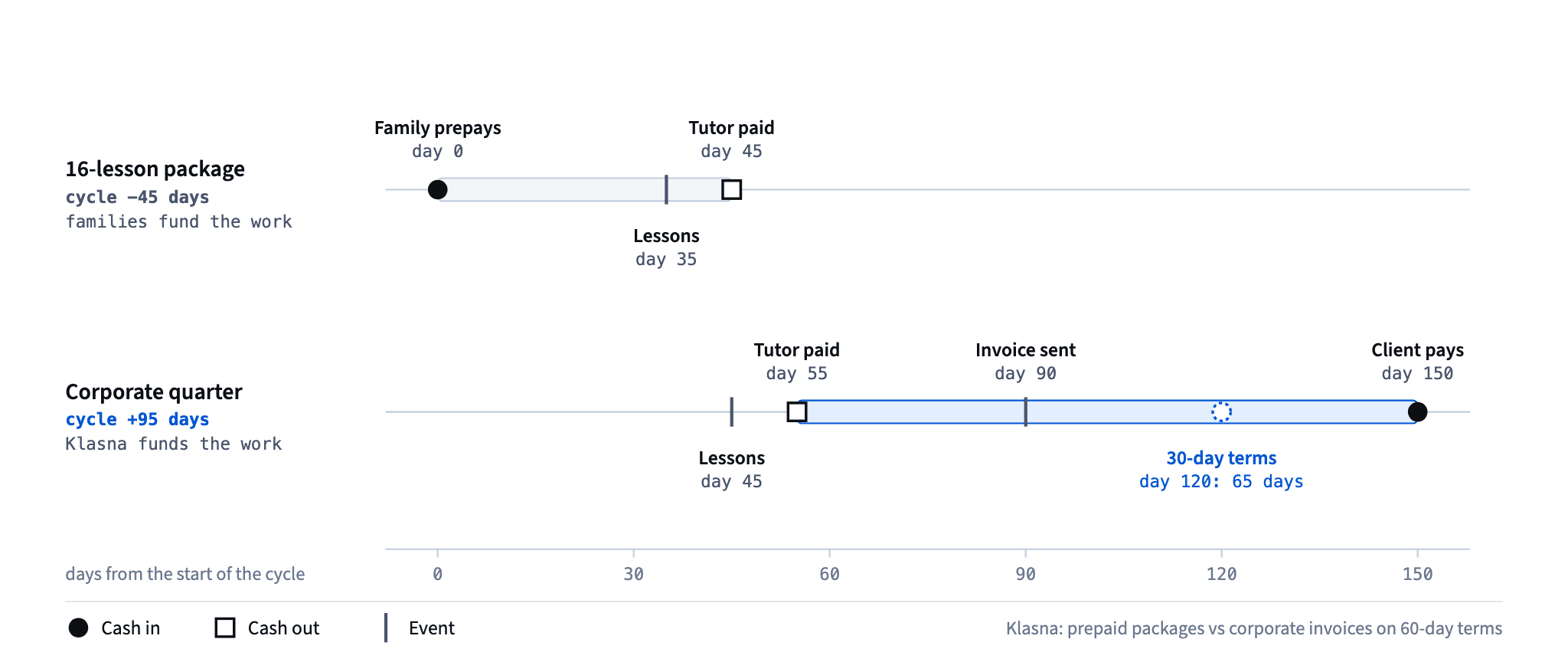
Klasna is an online tutoring school with two very different lines. Families prepay lesson packages. Companies buy corporate English on quarterly invoices with 60-day terms. Tutors are paid twice a month, on average about 10 days after a lesson.
The cash conversion cycle counts the days between paying for the work and getting paid for it:
A package brings cash 45 days before Klasna pays for it. A corporate quarter makes Klasna fund each lesson for about three months. Moving the client to 30-day terms cuts the cycle to 120 − 55 = 65 days; invoicing monthly would cut it further.
Now in hryvnias, on one date. Klasna's working capital on 30 November 2026:
640,000 − 2,294,300 − 6,523,800 = −8,178,100 UAH. Families and tutors are effectively lending Klasna 8.2 million interest-free. That's healthy while package sales hold, and it reverses every summer when they slow.
The corporate line works the other way. On the last day of a quarter its whole invoice sits unpaid, and the tutors for it are mostly paid already. The sales plan grows it from 640,000 to 1,600,000 UAH a quarter, so another 960,000 UAH waits to be collected at every quarter end. The line is profitable per lesson, and its growth still has to be funded from Klasna's own cash.
What 60-day terms really cost
A logistics company wants 240 lessons a month at 800 UAH, but on 60-day terms instead of the usual 30. One quarterly invoice is 240 × 3 × 800 = 576,000 UAH. Klasna's credit line costs 24% a year, and in summer it would be borrowing. The 30 extra days cost:
576,000 × 0.24 × 30 ÷ 365 = 11,362.19 UAH a quarter, about 2% of the invoice.
Over the quarter's 720 lessons that's 15.78 UAH a lesson. So "same price, 60 days" isn't free: 60-day terms at about 816 UAH a lesson leave Klasna as well off as 800 on 30 days. Offer a choice, not a favor.
The reverse lever is an early-payment discount. Two percent off for paying within 10 days instead of 60 costs Klasna 11,520 UAH on this invoice. As a yearly rate: 2 ÷ 98 × 365 ÷ 50 = 14.90%. That's cheaper than a 24% credit line, so when Klasna would otherwise borrow, the discount is the cheaper money.
DSO: how long clients actually take
Terms are a promise; DSO measures what happens:
DSO = receivables ÷ credit sales for the year × 365
Say corporate clients bought 3,840,000 UAH over a year (960,000 a quarter) and 1,180,000 is unpaid at year end. DSO = 1,180,000 ÷ 3,840,000 × 365 = 112.16 days.
Compare it with what the terms imply. The invoice for the last quarter is sent on 31 December, so on that day it is unpaid even if every client pays on time: 960,000 ÷ 3,840,000 × 365 = 91.25 days. The other 220,000 is older invoices past their due date. Time to look at which clients, and to make someone responsible for chasing them.
Limits
- The 24% is the cost of money when you'd borrow. With spare cash, the cost is what that cash would otherwise earn, which is usually lower.
- The cost formula assumes the client pays. Longer terms also raise the risk of not being paid at all, which this number leaves out.
- With quarterly invoices, DSO jumps depending on the day you measure it. Compare it at the same point in the billing cycle, and keep a list of overdue invoices per client.
Key takeaways
- Working capital = receivables − payables − deferred revenue. Negative means customers fund you.
- Prepaid lines release cash as they grow; lines with payment terms need funding as they grow.
- Payment terms cost invoice × rate × days ÷ 365, even when the client pays exactly on time.
- An early-payment discount is cheap money when its yearly rate is below what borrowing costs.
- DSO above what your terms imply means someone pays late.
FAQ
Is negative working capital bad?
Not by itself. For a prepaid business it means customers fund operations. The risk is timing: when prepaid sales slow, the pool shrinks and cash leaves.
What is a good DSO?
One close to what your terms and billing rhythm imply. Against 60-day terms with quarterly invoices, 112 days at year end means about 220,000 UAH is overdue.
Should I give a client longer payment terms?
Price them. Work out the cost with the formula above and offer options: a standard price on standard terms, a slightly higher price on longer ones, or a discount for paying early.
Learn it hands-on
Module 4 of the free course Finance for Product People works through this on Klasna's data: working capital: who pays whom first, receivables and payment terms, and a 12-month cash plan. Why a profitable year can still end short of cash is in profit vs cash flow.