

Break-even point: how to calculate it for an online business, month by month
The break-even point is the volume where contribution covers fixed costs. The formula, a monthly worked example and the margin of safety.
By Sergey BruhPublished 5 min read
The break-even point is the volume where contribution covers fixed costs. The formula, a monthly worked example and the margin of safety.
By Sergey BruhPublished 5 min read
A free course for PMs and marketers: short lessons, real product data and exercises with instant feedback.
Start the free course6 min read
Contribution margin is price minus variable costs: what one more sale adds. The formula, a worked example and why gross margin misleads decisions.
5 min read
Fixed vs variable costs: one question sorts every cost. Plus step costs that jump at thresholds, on a year of monthly costs.
The break-even point is the number of units (lessons, orders, subscriber-months) whose contribution margin exactly covers your total fixed costs for a period. Formula: break-even volume = total fixed costs ÷ contribution margin per unit, rounded up. Below that number the period loses money; above it, every extra unit adds its contribution margin to profit. For an online business the useful version is monthly, not yearly: a profitable year can hide several months below the line. Below are the formula, a worked example on an online tutoring school, and the two numbers that belong next to it: margin of safety and operating leverage.
where is the period's total fixed costs, the contribution margin per unit, sales, variable costs and units sold.
For a subscription the unit is a subscriber-month: monthly price minus per-subscriber costs (payment fee, usage-based hosting, support that scales with customers). Break-even subscribers = fixed costs ÷ that number.
Klasna is an online tutoring school: families buy packages of 1:1 video lessons, and tutors are paid for each lesson delivered. Its year, September to August, closed with an operating profit of 744,174.72 UAH. The CEO's conclusion: summer doesn't matter. Let's check month by month.
March. Families paid 4,868,640 UAH for 7,840 lessons. Variable costs: tutor payouts 3,136,000 + payment fees 121,716 + video and AI 243,040 = 3,500,756 UAH. That leaves a contribution of 1,367,884 UAH, or 174.48 UAH per lesson. Fixed costs: support coordinators 114,000 + team salaries 540,000 + office and tools 84,000 + marketing 300,000 = 1,038,000 UAH.
Round up: there is no such thing as part of a lesson. The same steps for two more months:
July has the lowest line of the three (two coordinators instead of four, 150,000 UAH of marketing), yet it delivered only 2,600 lessons, just over half of its break-even point. Its contribution of 458,510 UAH against 850,000 of fixed costs is a loss of 391,490 UAH.
Five months sit below their line: September, December, June, July and August, losing 1,029,144.15 UAH together. A strong spring covers it. With 20% fewer lessons from February to May, the same summer would wipe out the year's profit.
The margin of safety shows how far sales can fall before you reach break-even, as a share of actual volume:
March could lose almost a quarter of its lessons and still cover every fixed cost. May, the exam peak, had 35.04%. July had none: it was 2,220 lessons short.
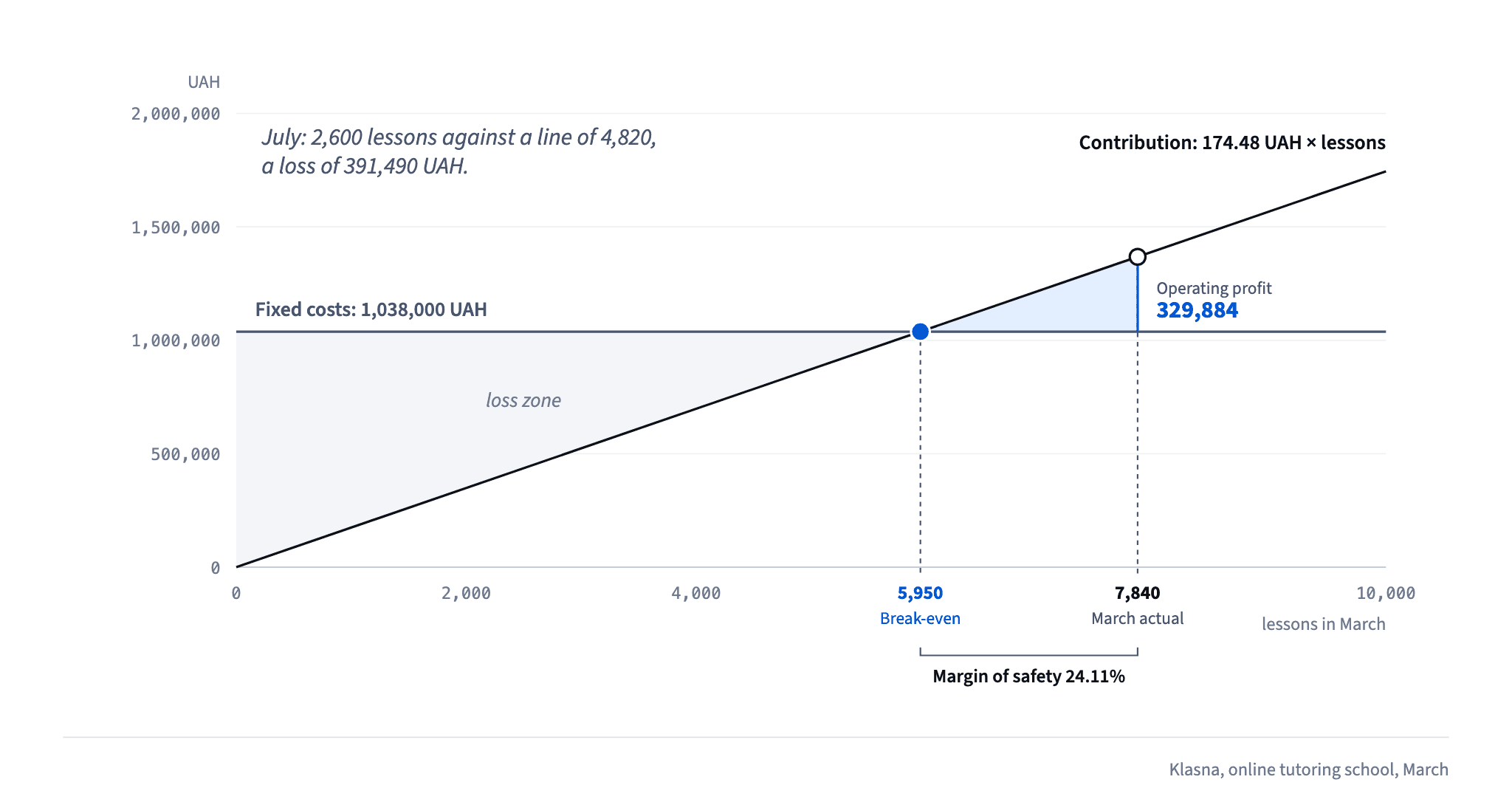
Operating leverage is contribution ÷ operating profit. For March: 1,367,884 ÷ 329,884 = 4.15. With 10% more lessons, contribution grows by about 136,788 UAH while fixed costs stay put, so profit grows by about 41%. Ten percent fewer lessons cut it by the same 41%. Leverage is roughly 1 ÷ margin of safety (1 ÷ 0.2411 ≈ 4.15): the closer a month is to break-even, the harder its profit swings.
Only two things: total fixed costs and contribution per unit. Selling more doesn't move the line; it moves you along it.
Total fixed costs for the period divided by contribution margin per unit (price minus variable costs per unit), rounded up to a whole unit.
Use a subscriber-month as the unit: monthly price minus per-subscriber variable costs. Divide monthly fixed costs by that number to get the subscribers you need.
The break-even point is the line; the margin of safety is how far your actual volume sits above it, as a percentage.
The lesson Break-even and margin of safety works through Klasna's twelve months with the full dataset and numeric exercises checked instantly. It is part of the course Finance for Product People: From Unit Economics to Business Cases, which starts with what one lesson leaves.