

Fixed vs variable costs (and step costs): how costs behave as a business grows
Fixed vs variable costs: one question sorts every cost. Plus step costs that jump at thresholds, on a year of monthly costs.
By Sergey BruhPublished 5 min read
The difference between fixed vs variable costs comes down to one question: if you sell one more unit this month, does this cost grow? If yes, it is variable (a tutor's payout per lesson, payment fees, usage-based hosting). If no, it is fixed (salaries, rent, the monthly marketing budget). A third kind, the step cost, stays flat and then jumps a whole amount at a threshold: one more support person for every few hundred customers. Getting the split right is what makes contribution margin, break-even and pricing decisions work. Below: the test, a year of monthly costs for an online school sorted column by column, and the traps.
The one-question test
Put each cost next to your volume, month by month.
- Variable costs rise and fall with volume. Per unit they stay roughly constant.
- Fixed costs ignore volume within a month. Per unit they shrink when you sell more and swell when you sell less.
- Step costs are flat over a range of volume, then jump.
"Fixed" describes how a cost reacts to volume, not whether you can change it. A budget you set every month is fixed for that month and still a decision.
A worked example: a year at an online school
Klasna is an online tutoring school: families buy packages of 1:1 video lessons, tutors are paid per lesson delivered, and a small in-house team runs everything else. Four months from its September–August year, amounts in UAH:
"Variable costs" adds up three columns: tutor payouts, payment fees and video and AI.
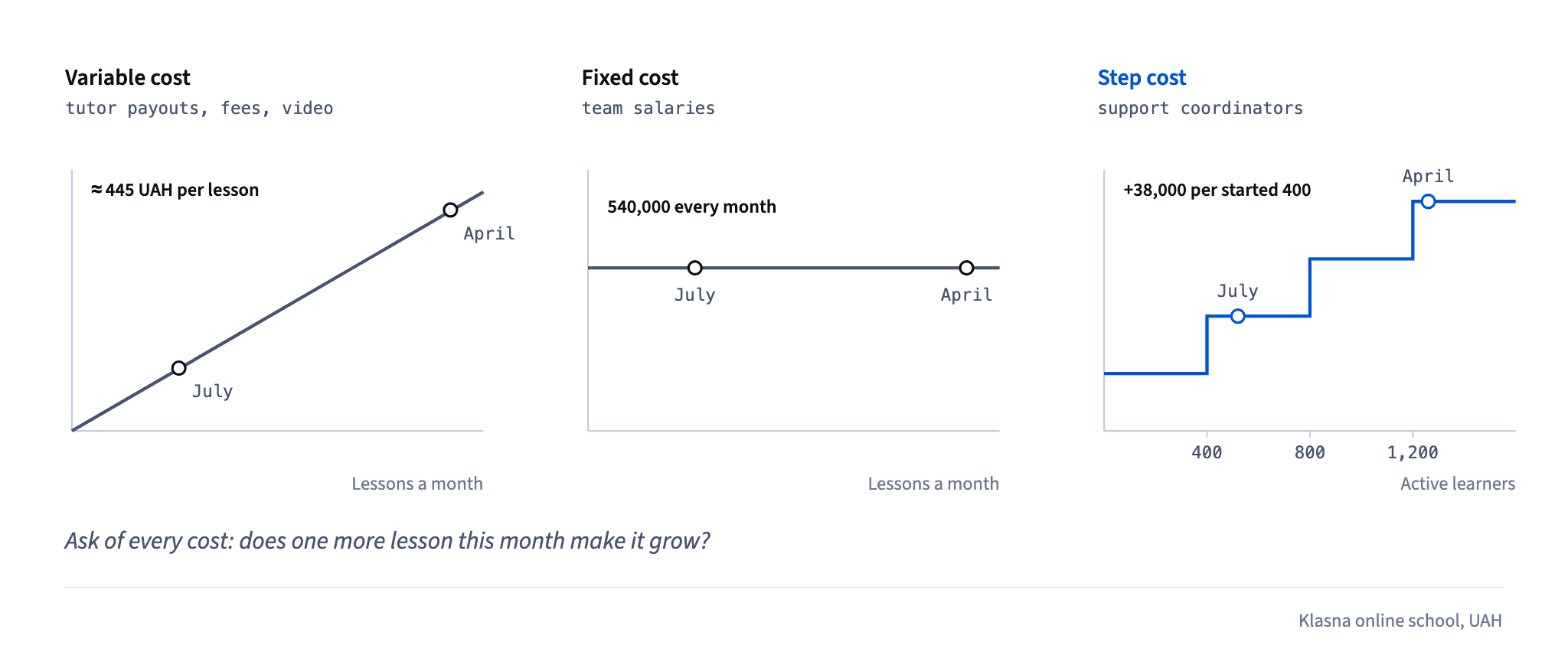
Variable. From November to April lessons grew by about 47%, and variable costs by about 48%. Per lesson they stay between 442 and 450 UAH all year: 444.40 in November (2,786,388 ÷ 6,270), 449.65 in July (1,169,090 ÷ 2,600).
Fixed. Team salaries are 540,000 and office and tools 84,000 in every month, busy April or empty July.
Step. Support coordinators cost 38,000 a month each, and Klasna adds one for every started 400 active learners. Up to 1,200 learners that means three (114,000). In April learners passed 1,200 (1,260), so a fourth started: 152,000. They are on seasonal contracts, so in summer the school goes down to two (76,000). The cost doesn't follow each learner; it follows thresholds.
Marketing. It rises in spring and falls in summer, just like lessons, so it looks variable. Test it: does one more lesson add marketing spend? No. The CEO sets it every month, and spring gets more because it is exam season. Within a month it behaves as fixed.
Why April cost more than its lessons
From March to April, 140 more learners came and variable costs rose by 615,808.90 UAH. Total costs rose by 673,808.90. The other 58,000 is on the fixed side: 38,000 for the fourth coordinator (the step) and 20,000 more marketing (a decision). Without the split, all of it would look like "growth costs money".
Why the split matters
Spread fixed costs over units and the cost per unit moves by itself. Divide all of May's costs by its lessons and you get (4,315,532 + 1,096,000) ÷ 9,620 = 562.53 UAH a lesson. July: (1,169,090 + 850,000) ÷ 2,600 = 776.57. Nothing about a July lesson changed: variable cost per lesson was 448.60 in May and 449.65 in July. Only the volume did. Price or judge a product on that "full cost" and you decide on noise.
The split feeds every unit-economics number. Price minus variable costs is the contribution margin; total fixed costs divided by it is the break-even point. Over the year Klasna's variable costs were 31,932,876.28 UAH and fixed costs 11,668,000 (salaries 6,480,000, office 1,008,000, coordinators 1,330,000, marketing 2,850,000), so almost three quarters of spending follows lessons.
Honest limits
- Fixed only within a range and a period. At 2,600 learners Klasna would need seven coordinators, probably more of the team, maybe more space. Stretch the range far enough and every fixed cost becomes a step.
- Mixed costs exist. A tool with a base fee plus usage is partly fixed and partly variable; split it into the two parts.
- The split depends on the decision. Over a year, salaries change too. For a decision about next month, use what will actually change next month.
Key takeaways
- Ask of every cost: does one more unit this month make it grow?
- Variable costs are constant per unit; fixed costs are constant per month; step costs jump at thresholds.
- Fixed doesn't mean unavoidable: marketing and salaries are decisions, just not per-unit ones.
- Never spread fixed costs over units to make a decision; cost per unit then moves with volume.
FAQ
Is marketing a fixed or variable cost?
Usually fixed for the period: you set the budget and one more sale doesn't add to it. Per-sale commissions to affiliates or partners are the exception: they are variable.
What is a step cost?
A cost that stays flat over a range of volume and then jumps by a whole amount, like one support person per 400 customers or a server tier.
Are salaries always fixed costs?
Salaries of a team paid regardless of volume are fixed within a period. Pay per delivered unit, like a tutor's payout per lesson, is variable.
Learn it hands-on
The lesson Fixed, variable and step costs sorts all twelve months of Klasna's costs with numeric exercises checked instantly, and Break-even and margin of safety puts the split to work. Both are part of the course Finance for Product People: From Unit Economics to Business Cases.