

Theory
Why most beginners lose
Losing accounts are mostly explained by three ordinary habits, not bad luck: paying costs on too many trades, bets too big for the account and dropping the plan mid-trade. The numbers are in the journal.
~9 min read · 9 exercises · 250 points
Before you start
Not bad luck
Still on your Pebble practice account, this lesson takes on the module's awkward question: why do most beginners who trade lose money? Studies of retail accounts keep finding the same pattern, though no single honest number fits every market.
You'll see what "most" can and can't mean, and then look at the habits that turn small costs and normal swings into a shrinking account. Nora, as usual, will test the ideas on her own trades.
Most beginners lose, and mostly not by bad luck
Studies of retail trading accounts in different markets keep finding the same thing: most of them lose money. The exact share varies by market and period, so beware anyone who quotes one precise number. The safe assumption is simple: you are not the exception.
Why do they lose? Mostly not bad luck. Luck comes and goes; habits repeat on every trade. Three ordinary habits explain most losing accounts:
- Trading too often, so costs swallow a small gain.
- Bets too big for the account, so one bad move takes a big bite.
- Changing the rules mid-trade, so a small planned loss grows.
The catch: memory keeps the wins and drops the rest. Nora remembers a 300-dollar week; she doesn't remember three months of costs. Only a trade journal, a record of every trade with its costs, shows which habit is at work. This lesson reads one beginner's journal for a whole year.

- Do"Most retail traders lose; I'll assume I'm not the exception and check my journal."
- Don't"I had a great week, so the statistics don't apply to me."
One week is memory, not evidence.
Habit 1: costs grow with the number of trades
Costs = number of trades × cost per trade. They grow with how often you trade, not with how good the trades are.
In one beginner's practice year on a 10,000 account, 244 trades cost 3 dollars each: 244 × 3 = 732 dollars. That's 7.32% of the account (732 ÷ 10,000), paid just for being in the market, win or lose. Before costs the year made +290; after costs it ended at 290 − 732 = −442.
Per month the picture is even clearer: about 61 dollars of costs (732 ÷ 12) against about 24 dollars of gain before costs (290 ÷ 12). Every month started with a bar of 61 to clear, and the trades cleared it only now and then.
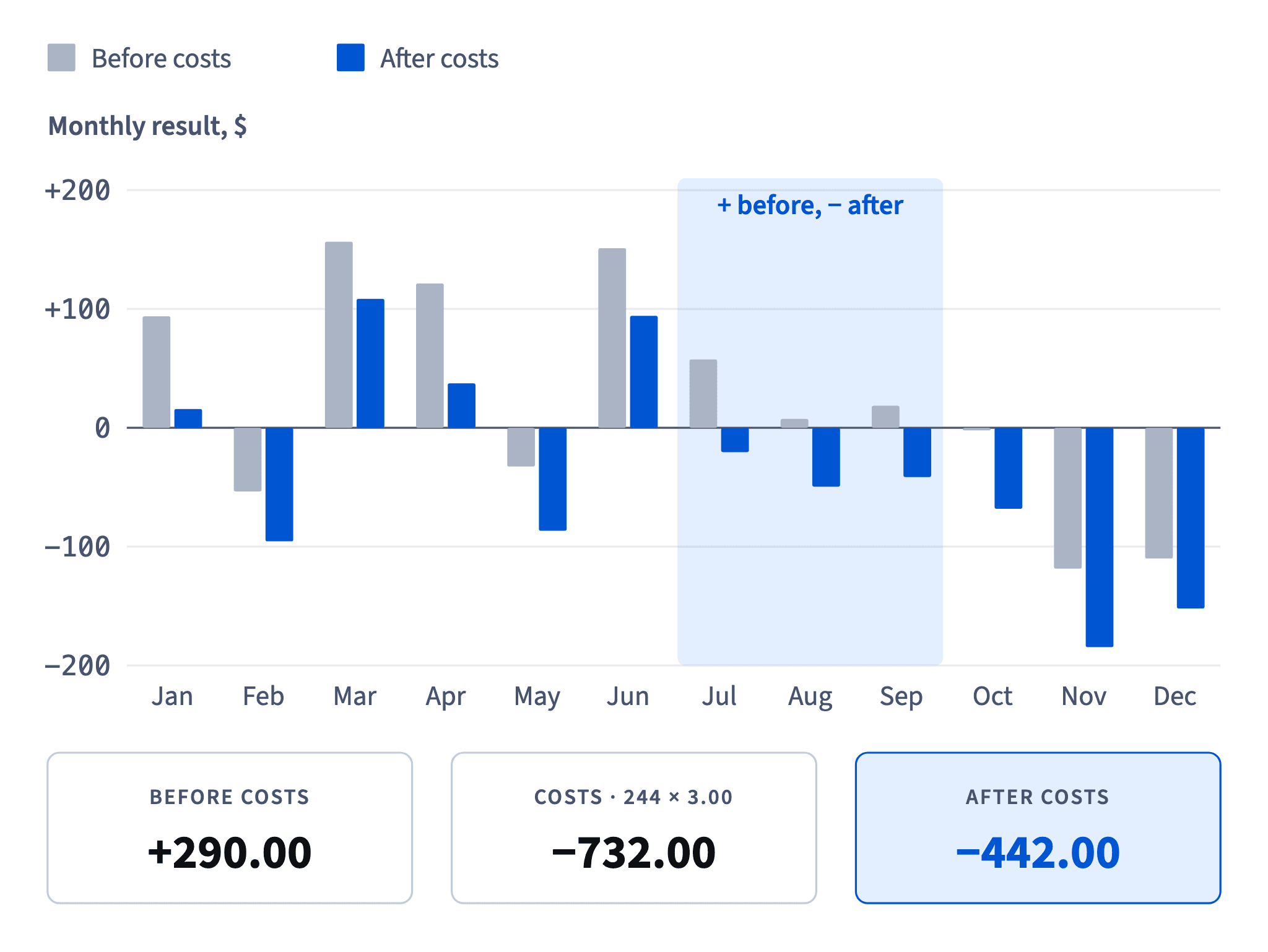
"Three dollars a trade is nothing" is the thought behind this habit. Three dollars, twenty times a month, is a bill of about 60 before you've earned a cent. Fewer trades lower that bar directly: half the trades, half the costs.
- Do"244 trades × 3.00 = 732.00 of costs against +290.00 before costs."
- Don't"Three dollars a trade is nothing."
Multiply by the number of trades first.
Right before costs, wrong after costs
A month can be "right" and still lose money. Read the journal month by month and compare two columns: the result before costs (gross_result) and the result after costs (net_result).
Dataset · 12 rows
One beginner's practice year
First 5 of 12 rows
In the beginner's year, 7 months of 12 were positive before costs: January, March, April, June, July, August and September. After costs only 4 stayed positive: January, March, April and June. So 3 months, July, August and September, went the right way overall and still lost money. In September, for example, the trades gained 18.58 before costs, but 20 trades × 3 dollars = 60 dollars of costs turned it into −41.42.
That's the costs habit in miniature: a small gain split across many trades can't pay a toll charged on each of them. When you count your good months, count them after costs, because "seven good months" and "four good months" describe two very different years.
- Do"7 months positive before costs, 4 after costs."
- Don't"September was a winning month: +18.58."
That's before 60.00 of costs; after them it's −41.42.
No account pays "before costs"
A result before costs describes a world where trading is free. That world doesn't exist, so a profitable year before costs can be a losing year on the statement. The beginner's year is the example: +290 before costs, −442 after 732 dollars of costs.
This is the same rule you met with single trades in Where the money goes, now on the scale of a year: the costs are fixed per trade, the gain is not. The more trades, the higher the bar the gross result has to clear.
Two habits keep you honest. First, label every result: "before costs" or "after costs". Marc writes one of the two next to every number, because only the second shows up on his statement. Second, when someone shows you a winning record, ask for the after-costs version. If it isn't there, assume the record looks worse once the costs are in.
Picture: July, August and September went the right way and still lost money. · shown above
- Do"+290 before costs, −442 after costs."
- Don't"My year was up 290."
Before or after costs? Here it's before, and the account is down.
Habit 2: bets too big for the account
The loss on the account = position as a part of the account × the price move. A big position makes every move louder, the bad ones included.
Nora's usual position is 25% of her 10,000 account: 2,500 dollars. A 4% fall costs 2,500 × 0.04 = 100 dollars, 1% of the account. Doubled to 50%, the same 4% fall costs 5,000 × 0.04 = 200 dollars, 2% of the account in one trade. Double the size, double the swing, both ways.
Why do people double? Usually after a lucky stretch, like Nora's 300-dollar week. But one week is a handful of trades, far too few to tell skill from luck. In this course a win rate is trusted only after at least 30 trades, and even then doubling needs a reason in numbers, not a mood.
Module 3 turns this into a rule: decide how much of the account one trade may lose before you choose the size.
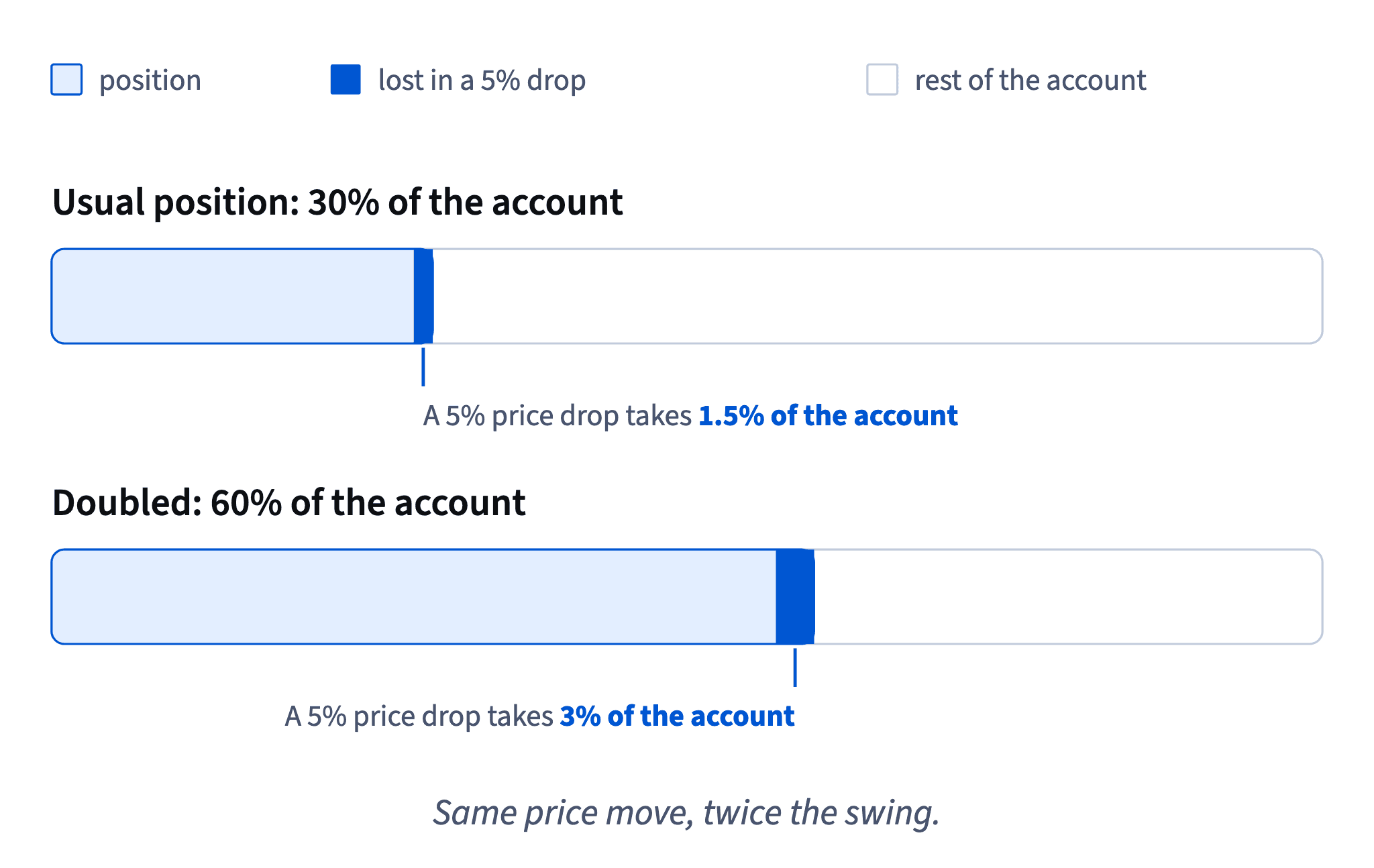
- Do"At 50% of the account, a 4% drop costs 2% of everything."
- Don't"Great week, so next week I double my size."
A week is far too few trades to prove anything.
Weigh the habits by their numbers
When an account loses, several habits are usually at work at once. To find the one that matters most, compare their sizes in money, not their drama.
In the beginner's year: direction wasn't the main problem, because 7 of 12 months were positive before costs. The two worst months, November and December, lost 118.53 + 109.97 = 228.50 before costs, with positions near 30% of the account; big positions made them deeper. But costs came to 732 dollars against a gross gain of 290. The biggest number wins the diagnosis: trading often did the most damage.
Dataset: One beginner's practice year · shown above
Notice what this rules out. "Bad luck" doesn't explain a year where the trades went the right way most months. A "hidden fee" doesn't either: 3 dollars a trade sat in the journal all year. The causes were ordinary and visible, which is good news, because ordinary habits can be changed.
- Do"Costs 732, bad months 228.50 before costs: frequency is the bigger leak."
- Don't"I just had a bad November and December."
The biggest number, costs, sat in every month.
Habit 3: changing the rules mid-trade
The third habit is dropping the plan once a trade is open: holding a loser "until it comes back", or moving the exit further away because the trade "just needs a bit more room". That's how a small planned loss becomes a big unplanned one.
It has a second cost: the journal stops teaching you. If the rules change on every trade, you can't tell whether the plan or the mood made the result.
Totals and prices don't show this habit, so you have to record it. Marc's trading plan fits on a card. Before a trade he writes three lines: why he's in, where he gets out if wrong, how big. After the trade, one more: did he follow it, yes or no.
The share of "yes" answers becomes the habit's number. A month with many "no" lines and a few big losses tells you exactly where to look.
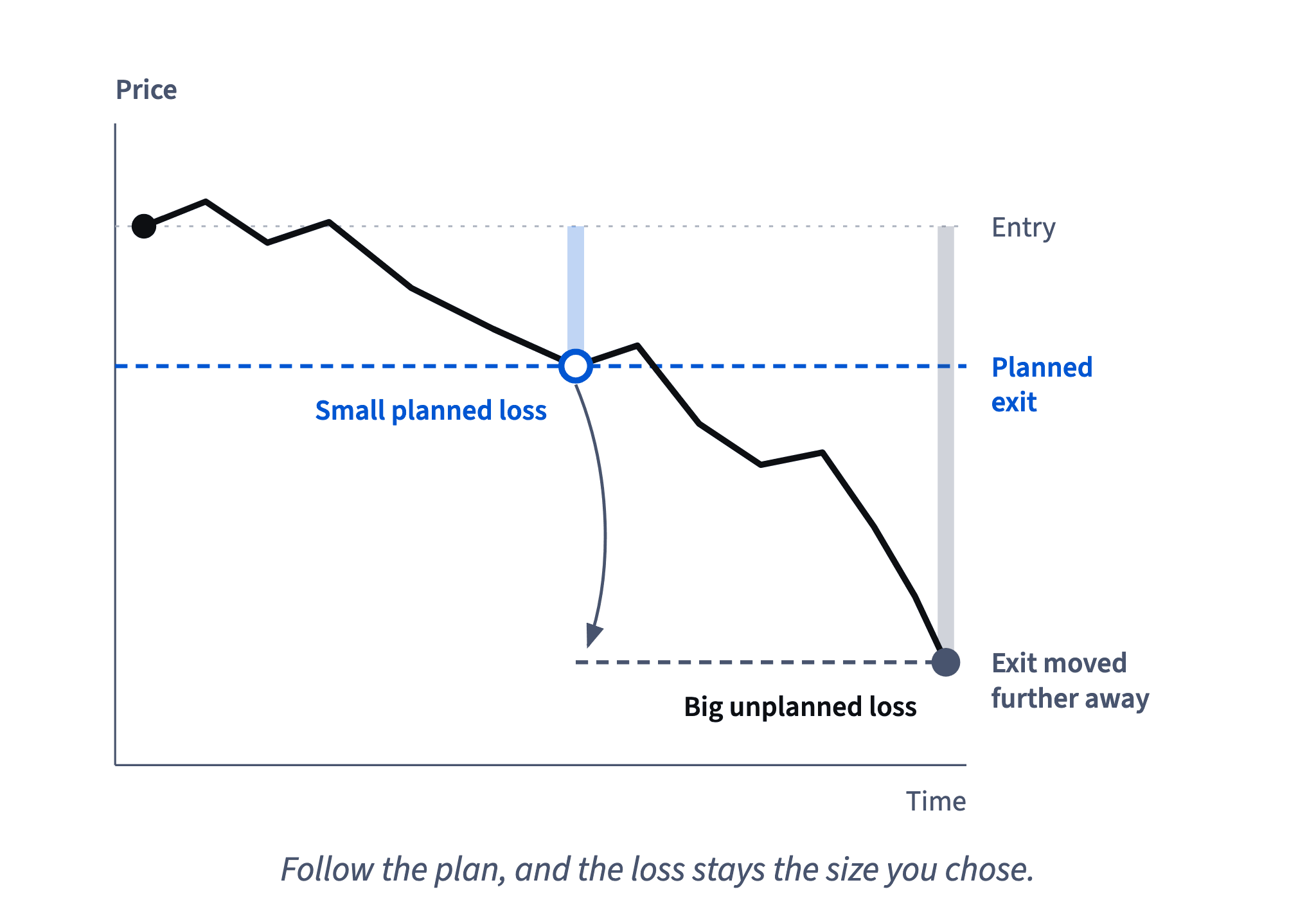
- Do"Why in, where out if wrong, how big. After: plan followed? Yes."
- Don't"It just needs a bit more room, I'll move the exit."
That's how a small planned loss grows.
Every habit leaves a number in the journal
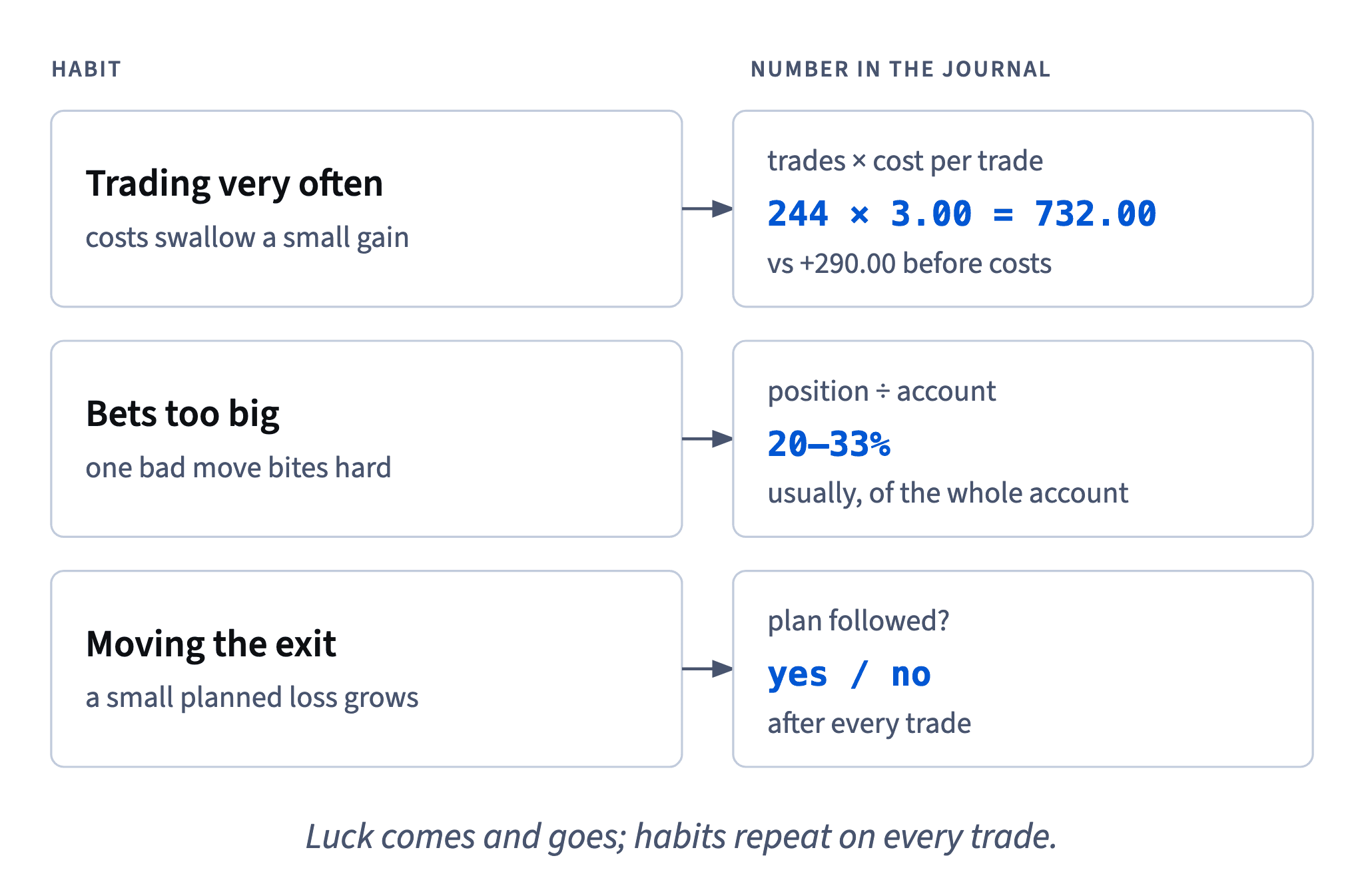
Losing accounts mostly come down to ordinary habits, and each one has its own mark on the account:
- Trading very often: costs swallow a small gain. Its number: trades × cost per trade, next to the result before costs.
- Positions too big for the account: one bad move takes a big bite. Its number: each position as a percent of the account.
- Moving the exit once the trade is open: a small planned loss grows into a big one. Its number: the part of trades where the plan was followed.
- Trading without a journal: you can't see which habit is costing you, because memory keeps only the wins.
So the first fix isn't a cleverer trade; it's counting. After a lucky week, the right move is to count before doubling anything: add up the last three months' trades and costs, and keep the size where it is meanwhile.
How it fits together: costs, size and broken plans explain most losses, and a journal turns each into a number. Next lesson: three too-good-to-be-true promises, and what to check before believing any of them.
- Do"Last three months: 61 trades, 183.00 of costs, plan followed in 40 of them."
- Don't"I don't need a journal, I remember how I did."
Memory keeps the wins and drops the costs.
Ready to practise?
Answer the lesson's exercises and earn 250 points the first time you finish it.
Start the exercises