

Theory
Where the money goes: spread, fees and slippage
Every trade starts a little in the red. See the costs that eat small gains and why many tiny trades lose.
~9 min read · 9 exercises · 250 points
Before you start
Up every time, still down?
You're back on your Pebble practice account with 10,000 practice dollars. Nora brings a puzzle: she made 30 quick trades in Northwind Foods, the price went up on every one, and her account is down anyway.
Pebble isn't broken. In this lesson you'll follow the money out of each trade: the two prices behind every quote, the fees, and what happens when the price moves before your order fills, and add them up over many trades.
Two prices, not one: bid, ask and the spread
A price screen looks like it shows one number, but a market always has two. The ask is the lowest price a seller will take right now: you buy there. The bid is the highest price a buyer will pay right now: you sell there. The difference between them is the spread, and the mid price sits halfway.
On Pebble, Northwind Foods shows bid 48.29 and ask 48.35. The spread is 48.35 − 48.29 = 6 cents, and the mid is 48.32. If you buy and sell straight away, you lose those 6 cents a share before the price has moved at all: 3 cents above the mid on the way in, 3 cents below it on the way out.
So every trade starts a little in the red. The spread isn't a fee on the bill; it hides in the prices you get, which is why beginners overlook it.
- Do"Bid 48.29, ask 48.35: I start every round trip 6 cents a share behind."
- Don't"The price is 48.32, so I can buy and sell at 48.32."
The mid is not a price anyone fills you at.
The four costs of a trade
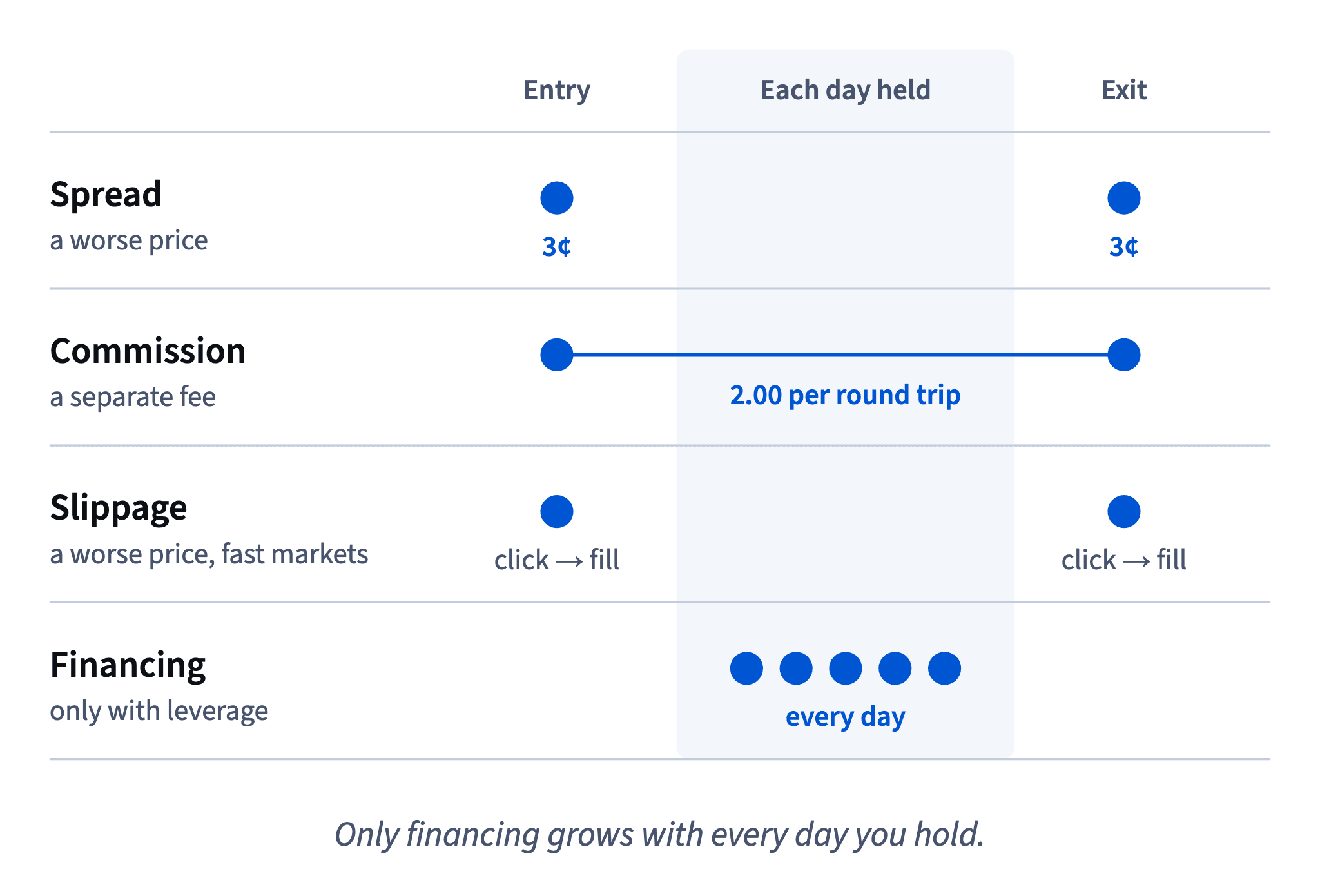
A trade can cost you in four ways. Two hide in the prices, one is a bill, and one grows with time.
Spread: you buy at the higher price (ask) and sell at the lower one (bid), so you pay the difference on every round trip.
Commission: a fee the broker charges for the trade. On Nora's Pebble trades it is 2 dollars per round trip, buying and selling together.
Slippage: the price moves between your click and your fill, usually against you. It's small in a calm market and larger when prices jump.
Financing cost: if you trade with borrowed money, called leverage, you pay interest for every day the position stays open. Leverage also multiplies losses; later modules come back to it.
The first three are paid when you enter and exit, so they repeat with every trade. Only financing grows with the days you hold.
- Do"Before the trade I add up spread, commission and a bit of slippage."
- Don't"Commission-free app, so trading costs me nothing."
The spread and slippage are still there, inside the prices.
Slippage: the cost you see only after the fill
Slippage is the difference between the price you saw when you clicked and the price you actually got. Between the tap and the fill, other orders arrive and the best price can move. Usually it moves against you, because many people are pushing in the same direction at the same moment.
Example: the ask shows 48.35, you tap Buy, and the fill comes back at 48.37. That's 2 cents a share of slippage, 2 dollars on 100 shares, paid on top of the spread and the commission.
Slippage is small in a calm, busy market and grows when prices jump: around news, at the open, or in a thinly traded instrument. You can't see it in advance, so a careful trader adds an allowance for it when counting costs.
Module 2 shows which order types limit the price you accept, and what they cost you in return.
- Do"I count 1–2 cents of slippage per share on top of the spread when news is out."
- Don't"I clicked at 48.35, so I bought at 48.35."
The fill price is what counts, not the click price.
One round trip, step by step
Follow one trade from start to finish and you can see each cost take its bite.
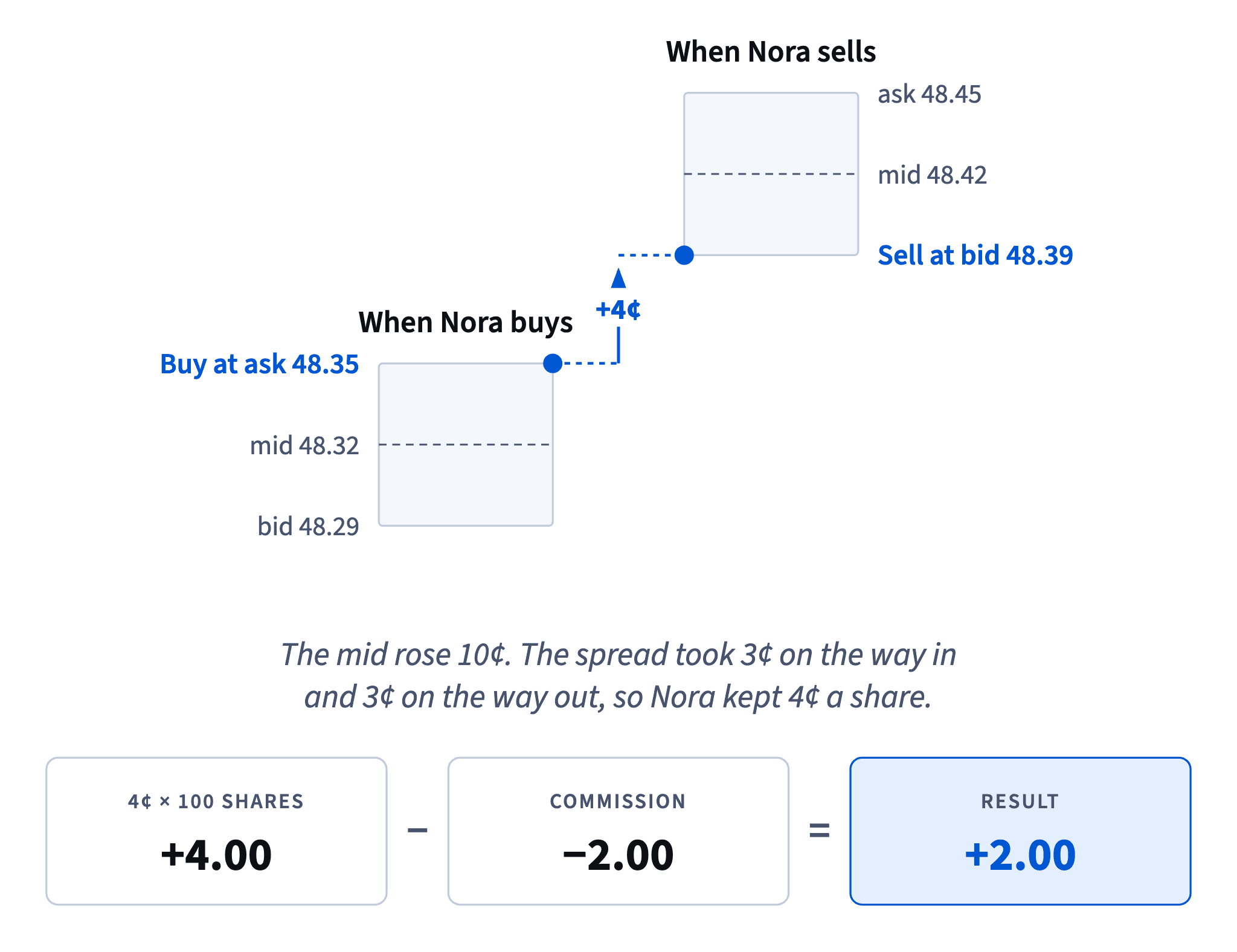
- Buy at the ask. Nora buys 100 shares of Northwind Foods at 48.35 while the mid is 48.32: 3 cents above the mid.
- The price moves. The mid rises 10 cents, to 48.42. Her call was right.
- Sell at the bid. She sells at 48.39: 3 cents below the new mid.
- Pay the commission. 2 dollars for the round trip.
The result: (48.39 − 48.35) × 100 = 4 dollars, minus the 2-dollar commission = 2 dollars. Of a 10-dollar move on 100 shares, she kept 2.
And that was one of her best trades. A move of only 2 or 3 cents in the right direction ends in a loss, because the costs are bigger than the move. Always compare fill prices, not mid prices, when you judge a trade.
- Do"Fills 48.35 in, 48.39 out, 2.00 commission: +2.00 net."
- Don't"The mid rose 10 cents on 100 shares, so I made 10 dollars."
That's the gain before costs.
The break-even move: the toll on every trade
The most useful question before any trade: how far must the price move just to get back to zero? That distance is the break-even move.
Per share, add up what the round trip costs: the spread on the way in, the spread on the way out, and the commission divided by the number of shares. Slippage, if any, comes on top.
For Nora's trades: fills 3 cents worse than the mid each way gives 3 + 3 = 6 cents; the 2-dollar commission over 100 shares is 2 cents a share. Break-even move: 6 + 2 = 8 cents.
On a share near 48 dollars, 8 cents is less than 0.2% of the price, which sounds like nothing. But it decides everything: a rise of 8 cents ends at zero, 7 cents ends in a loss, and only a rise of more than 8 cents makes money. Note that a fixed commission weighs less per share on a bigger trade: 2 dollars over 200 shares is 1 cent.
- Do"Break-even is 8 cents; I expect about 20, so the trade is worth a look."
- Don't"It only has to go up a little."
"A little" must still beat 8 cents.
Before costs and after costs
A list of trades has two totals, and only one of them reaches your account.
Before costs is the mid-to-mid gain: how far the price moved in your favor, times the shares. Nora's 30 trades in Northwind Foods all rose, for a total of 158 dollars before costs.
Dataset · 30 rows
Nora's 30 trades in Northwind Foods
First 5 of 30 rows
After costs subtracts what every trade paid. Spread: 6 cents × 100 shares × 30 trades = 180 dollars. Commission: 2 dollars × 30 = 60 dollars. Net: 158 − 180 − 60 = −82 dollars.
Thirty right calls, and the account is down. The costs (240 dollars) were bigger than all the gains together, because each trade's usual move was smaller than its toll.
Whenever someone shows you a result, ask which total it is. A result without costs should always be labelled "before costs"; on small, frequent trades the two totals can have opposite signs.
Chart data
| All 30 trades together | Gain before costs | Spread | Commission | Net result |
|---|---|---|---|---|
| 1–30 | 158 | -180 | -60 | -82 |
- Do"+158 before costs, −82 after spread and commission."
- Don't"All 30 trades went up, so the strategy works."
Direction isn't the result; the net is.
Which trades beat the toll
To sort winners from losers after costs, you don't need to redo every sum. Compare each trade's move with the break-even move.
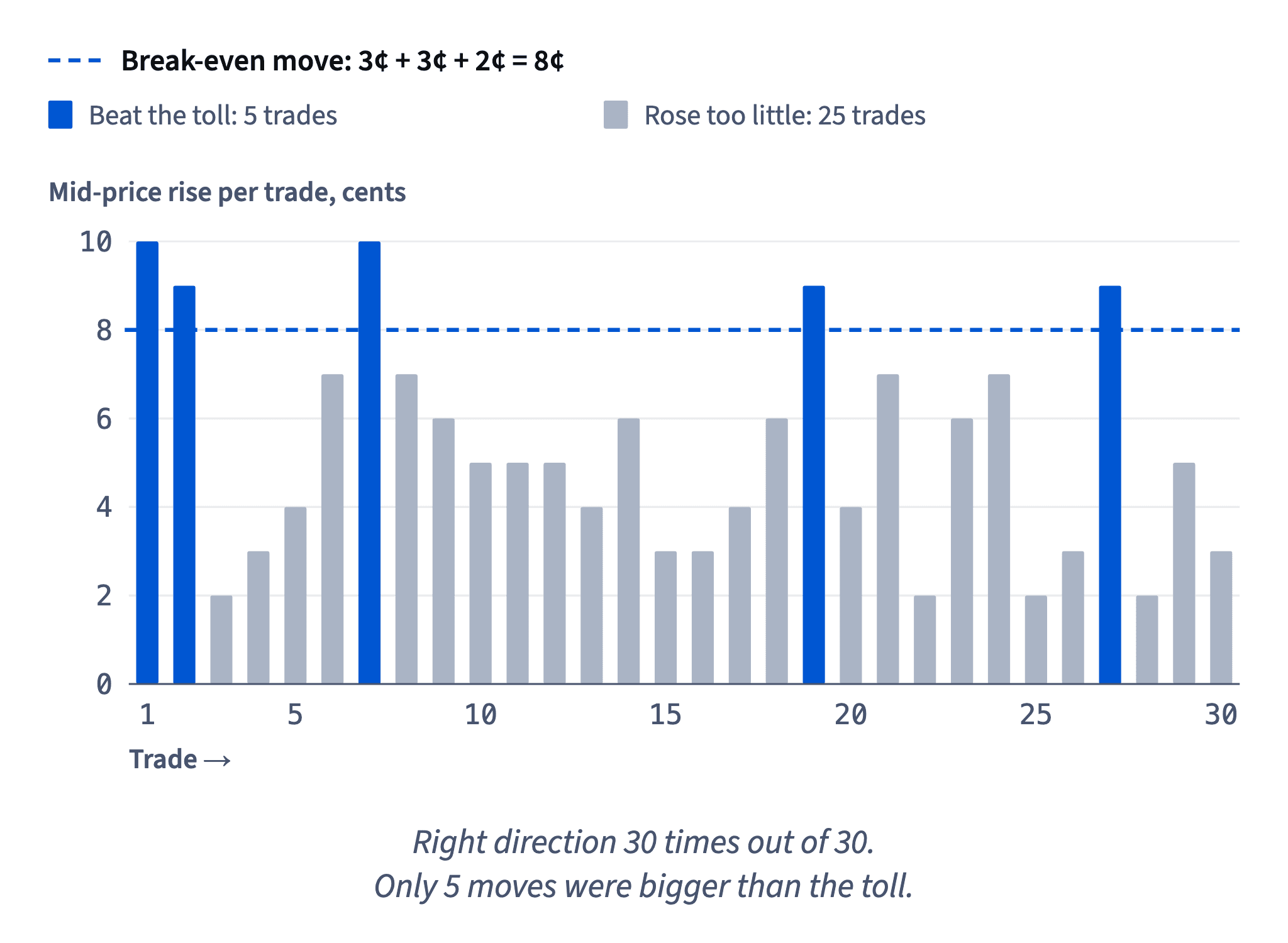
In Nora's list, take exit_mid − entry_mid for each row. The break-even move is 8 cents a share. A rise of more than 8 cents ends in profit; exactly 8 ends at zero; less ends in a loss, even though the price went the right way.
Dataset: Nora's 30 trades in Northwind Foods · shown above
Only five trades cleared the toll: trades 1 and 7 rose 10 cents (+2 dollars each after costs), trades 2, 19 and 27 rose 9 cents (+1 dollar each). The other 25 rose 2 to 7 cents and each lost money.
So "right 30 times out of 30" became "profitable 5 times out of 30". The share of winning trades depends on costs, not only on direction. That's why a win rate quoted without costs tells you little.
- Do"5 of 30 trades beat the 8-cent break-even move."
- Don't"30 of 30 went my way, so my win rate is 100%."
Count wins after costs.
Make the break-even move a habit
Marc writes the break-even move in his journal before each trade, next to the move he expects. If the expected move isn't clearly bigger, he skips the trade.
The arithmetic is short: what you keep = (move − break-even move) × shares. With an 8-cent toll and a 12-cent move on 100 shares, (12 − 8) × 100 = 400 cents = 4 dollars. A third of the move went to costs, and that was a good trade.
This kills a popular idea: "more trades spread the risk". Every trade pays the same toll. When the usual move is smaller than the toll, more trades only repeat the loss more often; Nora's 30 trades lost 82 dollars that way.
How it fits together: two prices make a spread, commission and slippage add to it, and their sum per share is the toll every trade must beat. Next lesson: the other reasons most beginners lose, seen over a whole year of trading.
- Do"Expected move 20 cents, break-even 8: worth it. Expected 6: skip."
- Don't"Small moves are fine, I'll just make more trades."
More trades pay the toll more often.
Ready to practise?
Answer the lesson's exercises and earn 250 points the first time you finish it.
Start the exercises