

Theory
Risk per trade: a small share of the account
Fix how much of the account one trade may cost if it goes wrong, and see why a small share, such as 1%, keeps you alive through a long losing run.
~9 min read · 9 exercises · 250 points
Before you start
How much can I lose on one trade?
You're back on your Pebble practice account with 10,000 practice dollars. This module answers the question every plan starts with: how much may one trade cost if it goes wrong? You'll fix the risk as a small share of the account, place the stop where the trade idea is proven wrong, and work out the position size from both. It ends with a case: sizing three trades for Nora's account.
This first lesson separates what you invest from what you risk.
What you invest is not what you risk
Two numbers are easy to mix up. What you invest is the size of the position: 100 shares at 38.00 is 3,800 dollars. What you risk is what you lose if the trade goes wrong and you get out.
A stop-loss is an order that closes the position at a price you choose in advance, below your entry when you buy. If you buy at 38.00 with a stop at 37.00, being wrong costs about 1.00 a share, so about 100 dollars plus costs, not 3,800.
Risk per trade is that planned loss written as a share of the whole account: 100 dollars on a 10,000 account is 1%. This is the number that decides how long you survive, so it comes first, before you think about profits.
The rest of this module builds on it: how big that share should be, where the stop goes and how many shares fit.
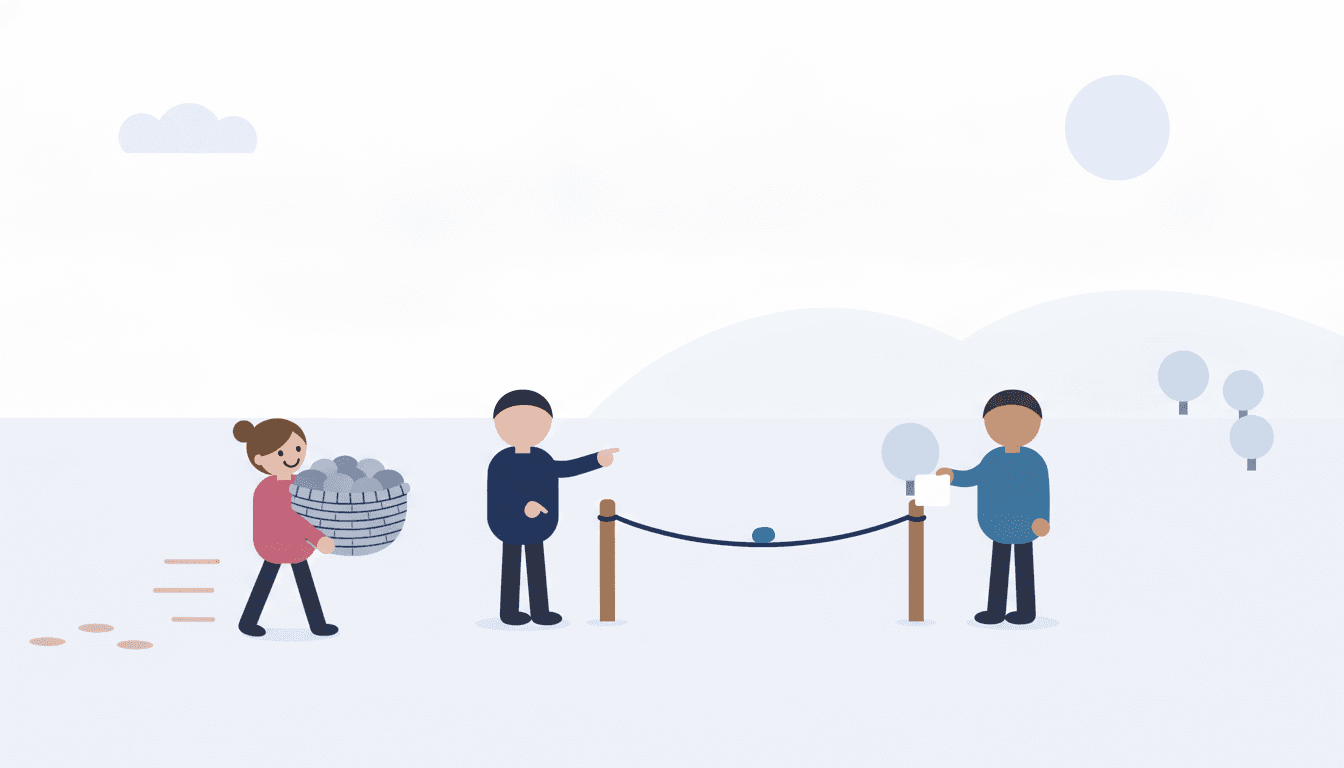
- Do"3,800 is in the position; if the stop fills I lose about 100 plus costs, 1% of the account."
- Don't"I put 3,000 in, so I'm risking 3,000."
With a stop, the risk is the planned loss, not the position.
The risk of a trade in dollars
To turn a planned trade into a dollar risk, three numbers are enough: the entry, the stop and the number of shares, plus costs.
Loss per share = the distance from entry to stop + costs per share. Risk in dollars = loss per share × shares.
Marc buys 100 shares at 38.00 with a stop at 37.00, and his costs for buying and selling are 0.04 a share. The loss per share is 1.00 + 0.04 = 1.04, so the risk is 1.04 × 100 = 104 dollars. On a 10,000 account that is about 1%.
Two slips are common. Leaving the costs out makes the risk look smaller than it is; on small stops the costs can be a big part of the loss. And the stop is a plan, not a promise: if the price jumps past it, the fill can be worse. Lesson 2 of this module comes back to that.
- Do"(38.00 − 37.00 + 0.04) × 100 = 104 dollars at risk."
- Don't"Stop one dollar away, 100 shares: exactly 100 at risk."
Costs are part of the loss.
Without a stop, the risk is the whole position
Risk per trade only exists when there is a planned exit. Without a stop, nothing limits the loss in advance: the price can keep falling, and each day you hold, you're deciding again under pressure. The only honest answer to "what does this trade risk?" is then "the whole position".
Nora's 3,000 dollars in Bluefin Energy with no stop risks 3,000 dollars, 30% of a 10,000 account, in one trade. That's not a bet on a move; it's a bet that she'll find the strength to sell later, in a loss, which is the hardest moment to decide anything.
That's why every plan in this course has a stop before the trade starts. It turns an open-ended loss into a number you choose while calm. Not selling doesn't avoid the loss either: it only keeps it off the screen until later.
- Do"Entry 38.00, stop 37.00, written down before I buy."
- Don't"I don't need a stop, I'll sell if it really drops."
Then the risk is the whole position.
One small fixed share, decided in advance
How big should the risk per trade be? Common examples are 0.5% to 2% of the account. The exact number matters less than two habits: it is small, and it is the same for every trade.
Turning it into dollars is one multiplication: account × share. On 10,000 dollars, 1% is 100 and 2% is 200. On an 8,000 account at 0.5%, it is 8,000 × 0.005 = 40 dollars. That amount is the whole planned loss if the stop fills, costs included.
Why so small, when one good day can bring more? Because losses come in runs, and runs are longer than people expect. The share is there to make sure a normal bad stretch leaves you able to keep trading the plan.
Write the number down before you trade. A share that changes with your mood is not a rule.
- Do"8,000 account, 0.5% per trade: each trade may lose 40 dollars, costs included."
- Don't"This setup looks great, so this time I'll risk 5%."
A share that grows with confidence isn't fixed.
What a losing run does at different risk levels
Take a 10,000 account and give it a run of losses in a row. Each loss takes the chosen share of the account as it stands at that moment, so the account is multiplied by the same factor again and again: 0.99 per loss at 1%, 0.98 at 2%, 0.90 at 10%.
After 10 losses: 10,000 × 0.99¹⁰ = 9,043.82 at 1%; 10,000 × 0.98¹⁰ = 8,170.73 at 2%; 10,000 × 0.9¹⁰ = 3,486.78 at 10%. After 20 losses the 10% account is down to 1,215.77, while the 1% account still holds 8,179.07.
The lesson isn't that ten losses in a row are likely on any given day. It's that they are possible even for a decent plan, and that the risk level decides whether such a run is an annoyance or the end of the account. At 1% you lose under 10% and keep trading; at 10% you have lost almost two thirds.
Chart data
| Losses in a row | 1% per trade | 2% per trade | 10% per trade |
|---|---|---|---|
| 0 | 10,000 | 10,000 | 10,000 |
| 5 | 9,509.9 | 9,039.21 | 5,904.9 |
| 10 | 9,043.82 | 8,170.73 | 3,486.78 |
| 15 | 8,600.59 | 7,385.7 | 2,058.9 |
| 20 | 8,179.07 | 6,676.09 | 1,215.77 |
- Do"Ten losses at 1% leave about 9,044 of 10,000; I can live with that."
- Don't"Ten losses at 10% cost 10 × 10% = the whole account."
Each loss is a share of what's left, so 3,486.78 remains.
How many losses until half the account is gone
A clear way to compare risk levels: count the losses in a row that would halve the account. Multiply by the factor per loss until the result drops below 0.5.
At 10% per trade: 0.9⁶ ≈ 0.531, 0.9⁷ ≈ 0.478, so 7 losses halve the account. At 2%: 0.98³⁴ ≈ 0.503, 0.98³⁵ ≈ 0.493, so 35 losses. At 1%: 0.99⁶⁸ ≈ 0.505, 0.99⁶⁹ ≈ 0.4998, so 69 losses.
Seven losses in a row are ordinary for many plans, even ones that make money over time. Thirty-five or sixty-nine in a row would be a strong sign that the plan itself is broken, and you'd have long since stopped to fix it.
So the risk share is really a choice of how many mistakes you can afford before the account is badly hurt. A small share buys you many tries.
- Do"At 1%, halving the account takes 69 losses in a row."
- Don't"At 10% I'd need ten losses to lose everything, that will never happen."
Seven losses already halve it, and seven in a row is ordinary.
A share of the current account adjusts by itself
Why a share and not a fixed amount? Because a share is always taken of the account as it is now.
Start with 10,000 and 1%: the first trade risks 100 dollars. After ten losses the account is 9,043.82, and 1% of it is about 90. After a run of gains to 11,000, 1% is 110. The dollar risk shrinks after losses and grows after gains, without any decision from you.
That's why the 1% line on the losing-run chart bends instead of falling in a straight line: each loss is a little smaller than the one before. A fixed 100 dollars per trade would not slow down at all; on a shrinking account it would become a bigger and bigger part of what's left.
Chart: The same losing run at three risk levels · shown above
So recompute the dollar amount from the current balance before each trade. It takes one multiplication and keeps the rule honest.
- Do"Balance 9,043.82 today, so 1% is about 90 dollars on this trade."
- Don't"I started with 10,000, so I always risk 100."
The share is of today's balance, not the starting one.
Decide the share calmly, and know what it can't do
A risk rule protects you only if your mood can't move it. After a win it's tempting to risk more "while it's going well"; after a loss, to risk more to win it back. Both push the share up exactly when judgment is worst. So choose the share once, at a calm moment, write it down (Marc keeps his on a sticky note: one trade may cost 1%, never more) and apply it to every trade.
Know its limits, too. A small share slows losses down; it doesn't make a plan profitable. Whether a plan earns depends on its wins, losses and costs, which module 4 measures. The share buys time to find that out.
How it fits together: risk is the planned loss to the stop, as a small fixed share of the current account, chosen calmly. Next lesson: where that stop should go.
- Do"Rule on my note: 1% per trade, set on a quiet Sunday, same for every trade."
- Don't"Two losses today, so the next one gets 3% to get it back."
Raising risk after losses is how runs become disasters.
Ready to practise?
Answer the lesson's exercises and earn 250 points the first time you finish it.
Start the exercises