

Theory
Practice account, starting small and the journal
Use a practice account to build the routine, start small with real money only if you choose to, and log every trade in a journal that memory cannot edit.
~9 min read · 9 exercises · 250 points
Before you start
What practice is for
Back on your Pebble practice account, today's question is what this account is actually for. Nora thinks practice money isn't real, so practice isn't real either, and she wants to switch to real money now.
You'll see what a practice account can and can't teach, how to start small without fooling yourself, and how to keep a journal that turns each trade into something you can check later.
A practice account trains the routine, not the feelings
A practice account trades a made-up balance on real-looking prices, like the 10,000 practice dollars on Pebble. Nora's objection, "practice money isn't real, so practice isn't real", is half right. It won't teach you how a real loss feels: a lost practice dollar doesn't hurt.
What it does teach is the routine: read the plan, check the no-trade list, set the stop together with the order, size from risk, log the trade. If that routine isn't automatic with play money, it won't be with real money, when your heart is racing.
So the goal of practice is not a profit. Marc, the experienced trader in this course, set himself 30 practice trades done by the plan before any real money: not 30 winners, 30 trades by the book. A simple test that the routine is there: count the plan breaks in your journal. When the last 10 trades have none, it has become a habit.
- Do"30 practice trades by the plan, and zero plan breaks in the last 10."
- Don't"I'm up 800 on practice, so I'm ready for real money."
A practice profit says nothing about the routine or the feelings.
Starting small: a cheap test, if you choose it
Real money is a choice, not the next level of a game. Many people stop after practice, and that is a perfectly good outcome.
If you do choose it, the first real step has one job: to find out cheaply whether you can follow your plan when the money is real. Making money is not the job. That sets the rules:
- a small amount, money you can afford to lose: losing all of it wouldn't touch rent, bills or savings;
- written down first and treated as already spent;
- the same plan and the same risk per trade as in practice;
- if it's gone, you stop and review; you don't top it up.
Expect it to feel harder. Real losses make the same routine feel heavier, which is exactly what this step is meant to show. Nora's worry, "small means I'd hardly make anything", misses the point: the small amount buys information, not income.
- Do"Real-money test: 500, written down today, same plan, same 1% risk. If it's gone, I stop and review."
- Don't"If the 500 runs out, I'll add another 500 from savings and win it back."
The limit disappears the moment it is needed.
A trade journal: memory that can't edit itself
A trade journal is a line for every trade, practice or real, written as it happens. Memory keeps the story you like: the winners you saw coming, the losses that "weren't really your fault". A journal can't edit itself, so it keeps the trades as they were.
The fields come in two groups. Before the click: date and time, instrument, side, entry, stop, target or time exit, size and the planned risk in dollars. These are decisions, and writing them first means you can't adjust them afterwards. After the exit: the exit price, fees, the result after fees, whether the plan was followed (yes or no) and a one-line note on why and how you felt.
Nora's log, date and result only, can say whether she made money. It can't say how much was at risk, whether she exited where planned, or why the bad trades happened. Those answers live in the other fields.
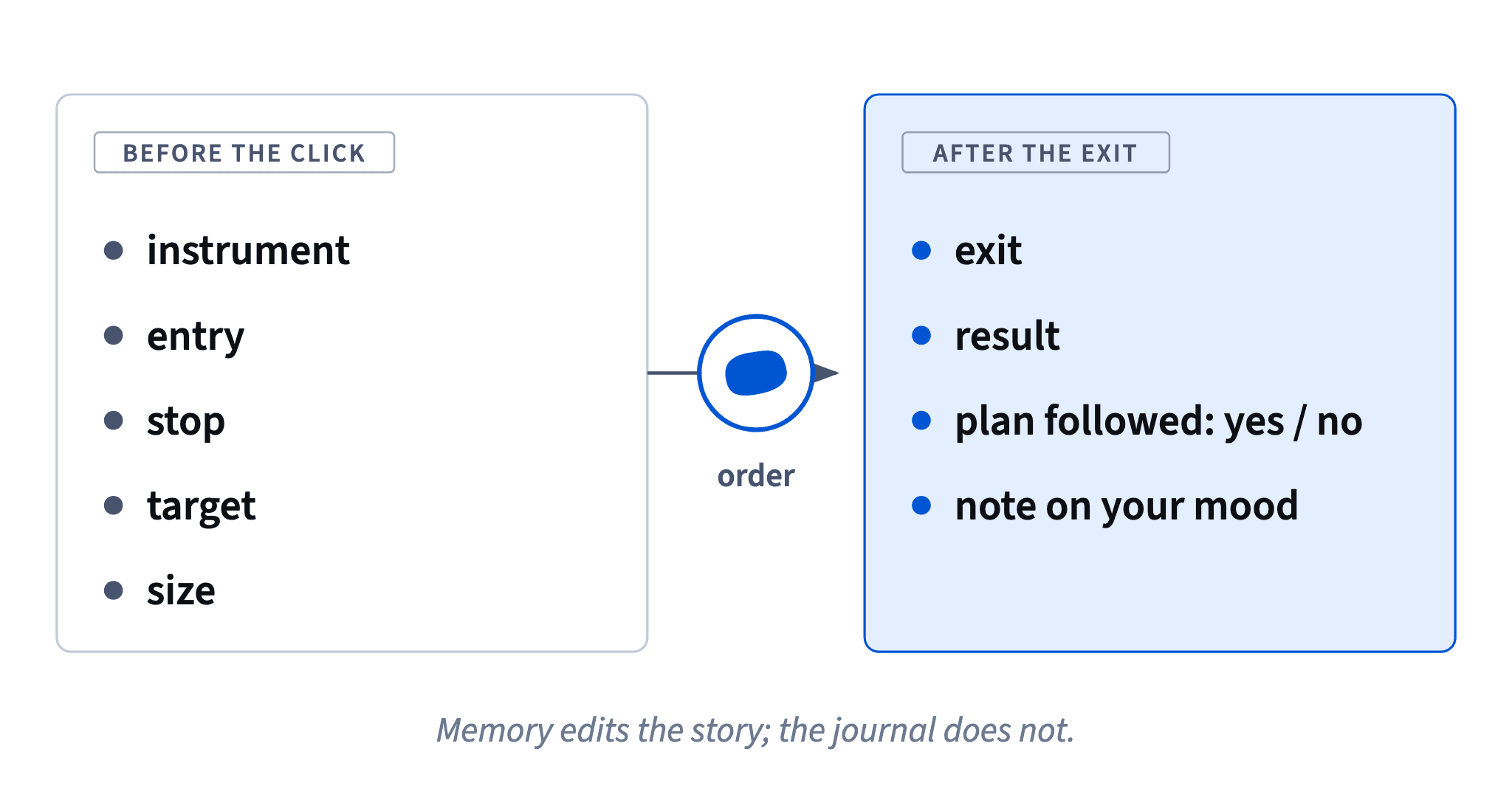
- Do"Before: BFE, long, entry 40.00, stop 38.00, target 44.00, size 50, risk 100. After: exit 38.00, fees 2.00, −102, plan yes, 'stop hit; ok'."
- Don't"12 May: −102."
The result without the decisions behind it.
Each field answers a question you will ask later
A journal pays off after many trades, when you start asking questions about them. Each field is there because it answers one of those questions.
Journal fields · shown above
- stop and size: how much was really at risk? This is where oversized trades show up.
- fees: how much did trading itself cost? The costs from module 1 add up quietly across many small trades.
- target or time exit: did I exit where I said I would?
- plan_followed: do my losses come from the plan, or from breaking it?
- note: what was going on when I broke the plan: after a loss, tired, angry?
The last two are the most valuable and the ones beginners skip. Without them a losing month looks like "the plan doesn't work", when the journal might show that the plan trades were fine and two impulsive trades did the damage.
A field you would never ask a question about can go; a question you can't answer means a field is missing.
- Do"plan_followed: no. Note: angry after trade 2; doubled size; moved the stop."
- Don'tA journal with result and date only.
Shows that money was lost, never why.
Read the journal like an auditor: start with the total
Reading a journal starts with the total, then goes past it. The sample journal is from a 10,000 practice account with a 1% risk plan: 100 dollars to the stop, an exit at the target, at the stop or after 3 days, and 2.00 of fees per round trip.
Dataset · 8 rows
A sample journal, 8 trades
Plan: risk 1% (100.00) to the stop; exit at the target, at the stop or after 3 days. Fees 2.00 per round trip; result is after fees.
First 5 of 8 rows
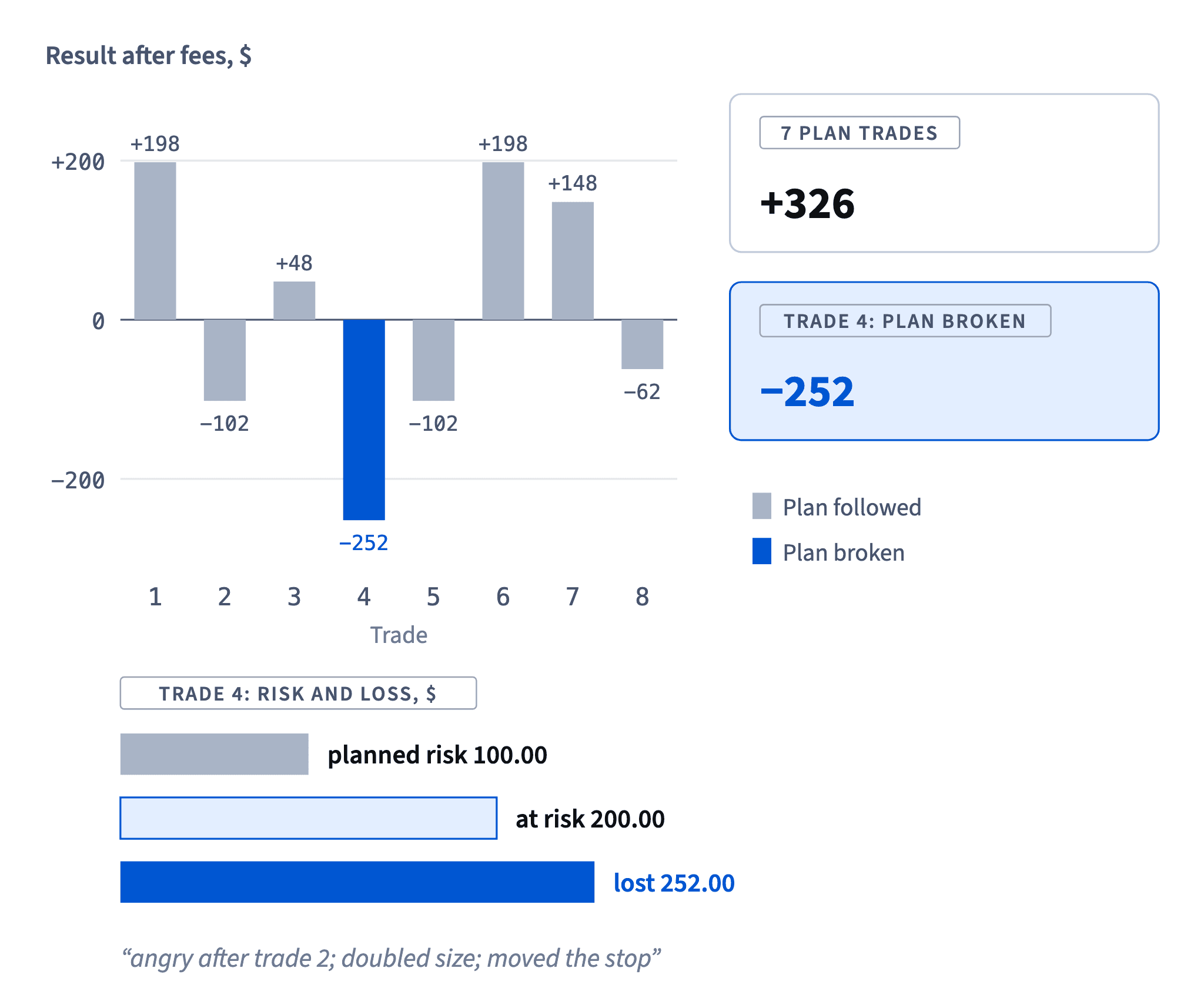
Its 8 results, after fees: 198 − 102 + 48 − 252 − 102 + 198 + 148 − 62 = +74. The fees, 8 × 2.00 = 16, are already inside that number.
Nora's question is "so the plan works?" Eight trades can't tell. Under 30 trades a total is too few to judge a plan either way, the sample rule from module 4 that A losing streak is normal in module 8 looks at more closely. A run of +74 or −74 over 8 trades is well within luck.
So the total is where an audit starts, not where it ends. The useful part is underneath: which trades made the money, which lost it, and whether the losers followed the plan.
- Do"+74 over 8 trades: too few to judge the plan. Now, where did the losses come from?"
- Don't"Plus 74, so the plan works."
Eight trades are within luck.
Find the plan break and price it
After the total, look for the rows where plan_followed is "no". In the sample journal there is one: trade 4 on Bluefin Energy.
Dataset: A sample journal, 8 trades · shown above
First check the risk. The plan risks 100 dollars to the stop. Trade 4: entry 39.00, stop 37.00, size 100, so (39.00 − 37.00) × 100 = 200 at risk, 2% of the account and double the plan. The size was not computed from risk and stop, as in Position size from risk and stop in module 3, but doubled.
Then check the exit. The price fell below 37.00, the stop was moved, and the trade closed at 36.50: (39.00 − 36.50) × 100 + 2.00 of fees = a 252 loss, two and a half times the planned 100.
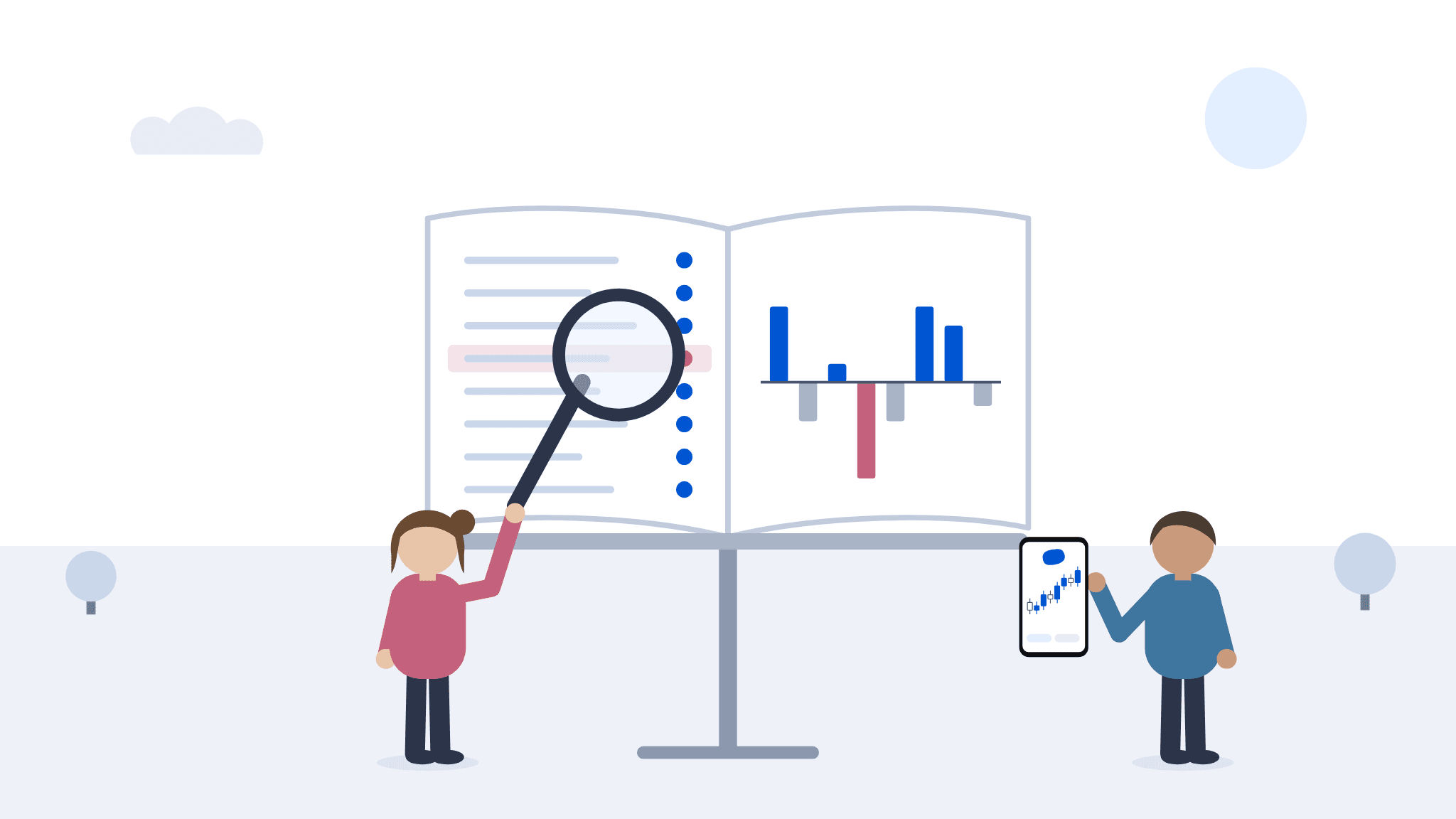
Finally read the note: "angry after trade 2; doubled size; moved the stop". Trade 2 had just lost 102. The journal has caught the mood, the oversizing and the moved stop in one line, which memory would have smoothed into "a bad trade".
- Do"Trade 4: risk 200 instead of 100, stop moved, −252; note: angry after trade 2."
- Don't"Trade 4 was just a bad day on Bluefin."
Blames the market for a broken plan.
Plan trades against plan breaks
The most useful split in any journal is plan trades against plan breaks. In the sample, the 7 trades that followed the plan made 198 − 102 + 48 − 102 + 198 + 148 − 62 = +326 after fees. The one trade that broke it lost 252.
So one impulsive trade wiped out about three-quarters of everything the other seven earned (252 ÷ 326 ≈ 0.77), and turned +326 into +74.
This split changes what the journal is telling you. A total of +74 invites the question "does the plan work?", which 8 trades can't answer. The split answers a question they can: where is the money leaking? Here the leak isn't the plan. It is a doubled size and a moved stop after a loss.
The same split works on any journal, of any length. Add up plan trades and breaks separately; if the breaks cost more than the plan earns, fix the routine before touching the rules.
- Do"Plan trades: +326. Plan breaks: −252. The leak is the routine, not the rule."
- Don't"Only +74 in a month, time to change the entry rule."
Changes the rule to fix a broken routine.
What a short journal can and can't tell you
A journal of 8 trades is too short for some questions and long enough for others.
It can't tell you whether the plan makes money, whether an instrument is good or bad, or what your win rate really is. Those need at least 30 trades, and even then the answer comes with doubt.
It can tell you things that don't need statistics: how much a single plan break cost, what came before it, whether the size matched the risk, whether stops stayed where they were written. One row with plan_followed "no" and a note like "angry after trade 2" is a finding on day one.
Dataset: A sample journal, 8 trades · shown above
That is why the journal starts with the very first practice trade, not "once there's enough data". The routine problems show up early and cost the most if they go unnoticed.
How it fits together: practice builds the routine, starting small tests it with real money, and the journal records both honestly. The case lesson next puts you in the auditor's chair: a longer journal, where you find the leak yourself.
- Do"After 8 trades: too early to judge the plan, but one plan break cost 252 after a loss."
- Don't"I'll start a journal once I have enough trades to analyse."
The early trades are where routine problems show first.
Ready to practise?
Answer the lesson's exercises and earn 250 points the first time you finish it.
Start the exercises