

Theory
Order types: market, limit, stop
Choose how you enter and leave: right now at any price, only at your price, or when a level breaks. See what each order does in a fast drop, with real fill prices.
~9 min read · 9 exercises · 250 points
Before you start
Three ways to say "buy"
Back on your Pebble practice account, today you look at the button behind "Buy". An order is your instruction to the broker, and Pebble offers three basic kinds.
You'll see what each kind promises and what it doesn't: getting filled, getting your price, or waiting quietly until the price reaches a level. You'll also meet the exit you set before the trade even starts.
Three basic orders: now, my price, or a trigger
An order is your instruction to the broker. Three basic kinds cover almost everything.
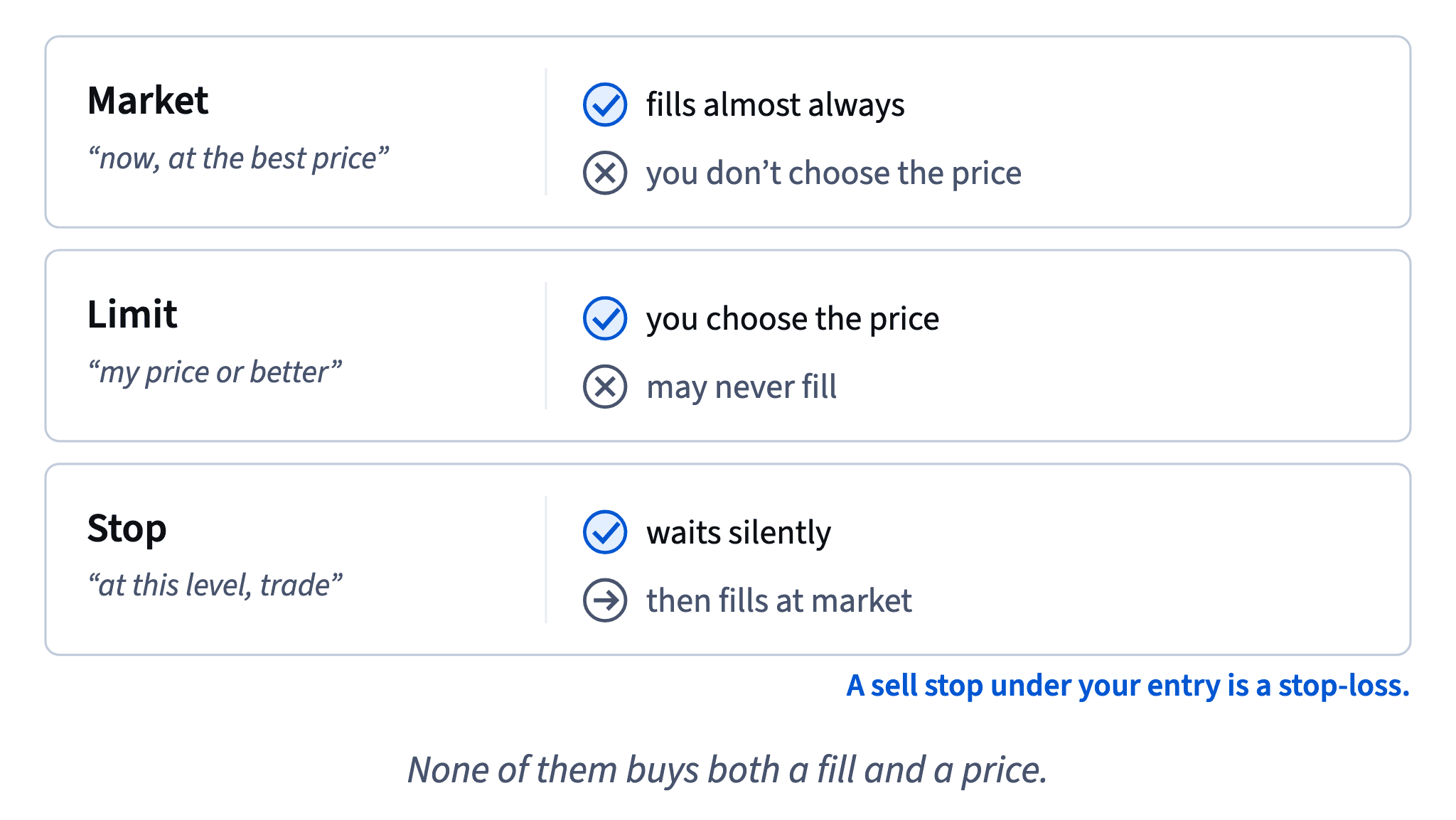
A market order says "now, at the best price available". A buy fills at the ask, the lowest price a seller accepts; a sell fills at the bid, the highest price a buyer pays. It almost always fills, but you don't choose the price.
A limit order says "only at my price or better". A buy limit at 39.10 pays 39.10 or less. You choose the price, but the order may never fill.
A stop order says "when the price reaches this level, trade at market". It waits silently and then becomes a market order. A sell stop below your entry is the usual stop-loss: the exit you set before the trade.
Each one trades something away: market gives a sure fill, limit a sure price, stop a trigger. None gives both a fill and a price.
- Do"I need a sure exit today, so market; I want 30.00 or less, so a limit."
- Don't"A limit order gets me in now at my price."
A limit fixes the price, not the fill.
Stops on both sides: exits below, entries above
A stop order is a trigger, and it works in both directions.
A sell stop sits below the current price. If the price falls to it, it sells at market. Placed under a long position, it's the stop-loss: the exit decided before the trade.
A buy stop sits above the current price. If the price rises to it, it buys at market. It's used to enter only when a level breaks, for example "buy only if Bluefin trades above 41.00".
Don't confuse a buy stop with a buy limit. Both name a price above the market, but a buy limit means "this price or lower". With the ask at 40.00, a buy limit at 41.00 is already satisfied and fills at once. A buy stop at 41.00 waits until 41.00 is reached.
The rule for every stop is the same: a trigger, then a market fill, at whatever the next price is.
- Do"Enter only on a break above 41.00: buy stop at 41.00."
- Don't"Buy limit at 41.00, so it waits for the break."
With the ask below 41.00 it fills at once.
Where a stop actually fills
A sell stop wakes up on the first bid at or below its level and then sells at that bid. It never sells "at the stop price" unless a bid happens to sit exactly there.
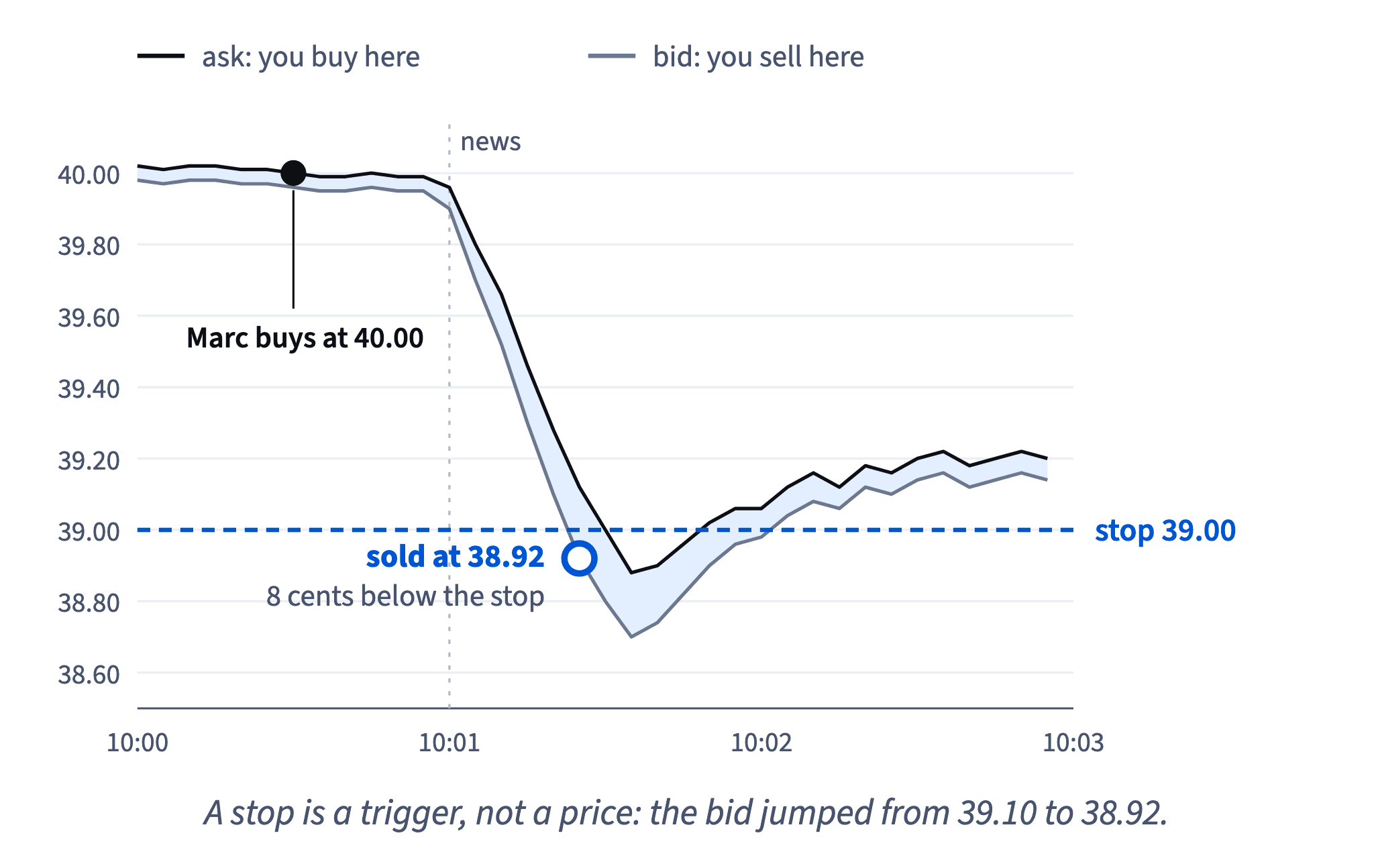
Marc bought 100 Bluefin Energy at 10:00:30 at the ask, 40.00, with a sell stop at 39.00. News came out at 10:01:00 and the price dropped. Read Pebble's quotes row by row: at 10:01:20 the bid is 39.10, still above the stop. Five seconds later, at 10:01:25, the bid is 38.92. That's the first bid at or below 39.00, so the stop triggers and sells there.
Dataset · 36 rows
Bluefin Energy quotes, 10:00–10:03
Every 5 seconds. The news comes out at 10:01:00.
First 5 of 36 rows
The price never traded at 39.00: it skipped over it. In a calm market the next bid would have been a cent or two below the stop; in a fast drop it can be several cents, and after a jump overnight much more.
So read a stop as "get me out around here", and plan for the fill to be a bit worse.
- Do"Stop at 39.00; I plan for a fill a few cents lower."
- Don't"My stop sells at exactly 39.00."
It sells at the first bid at or below 39.00.
Planned loss vs real loss: slippage
The planned loss is what you'd lose if the stop filled exactly at its level: (entry − stop) × shares. The real loss uses the price you actually got: (entry − fill) × shares. The difference is slippage: the gap between the price you expected and the one you got.
Marc's plan: (40.00 − 39.00) × 100 = 100 dollars. His stop filled at 38.92, so the real loss was (40.00 − 38.92) × 100 = 108 dollars. The extra 8 dollars is slippage, 8 cents a share on 100 shares. Commission would come on top.
Two lessons. First, slippage is normal, not a broken app: it comes from fast moves and thin moments. Second, it still beats the alternative. Marc kept his loss near plan; holding and hoping could have cost far more.
When you plan a trade, add a little slippage to the planned loss, so that 100 becomes "about 100 to 110".
- Do"Planned 100, real 108: 8 dollars of slippage, still near plan."
- Don't"The stop cost more than planned, so I'll stop using stops."
Without a stop the loss has no limit at all.
How a limit fills, or doesn't
A buy limit fills at the first ask at or below its price, and the fill can be better than the limit. A sell limit works the other way, on the bid.
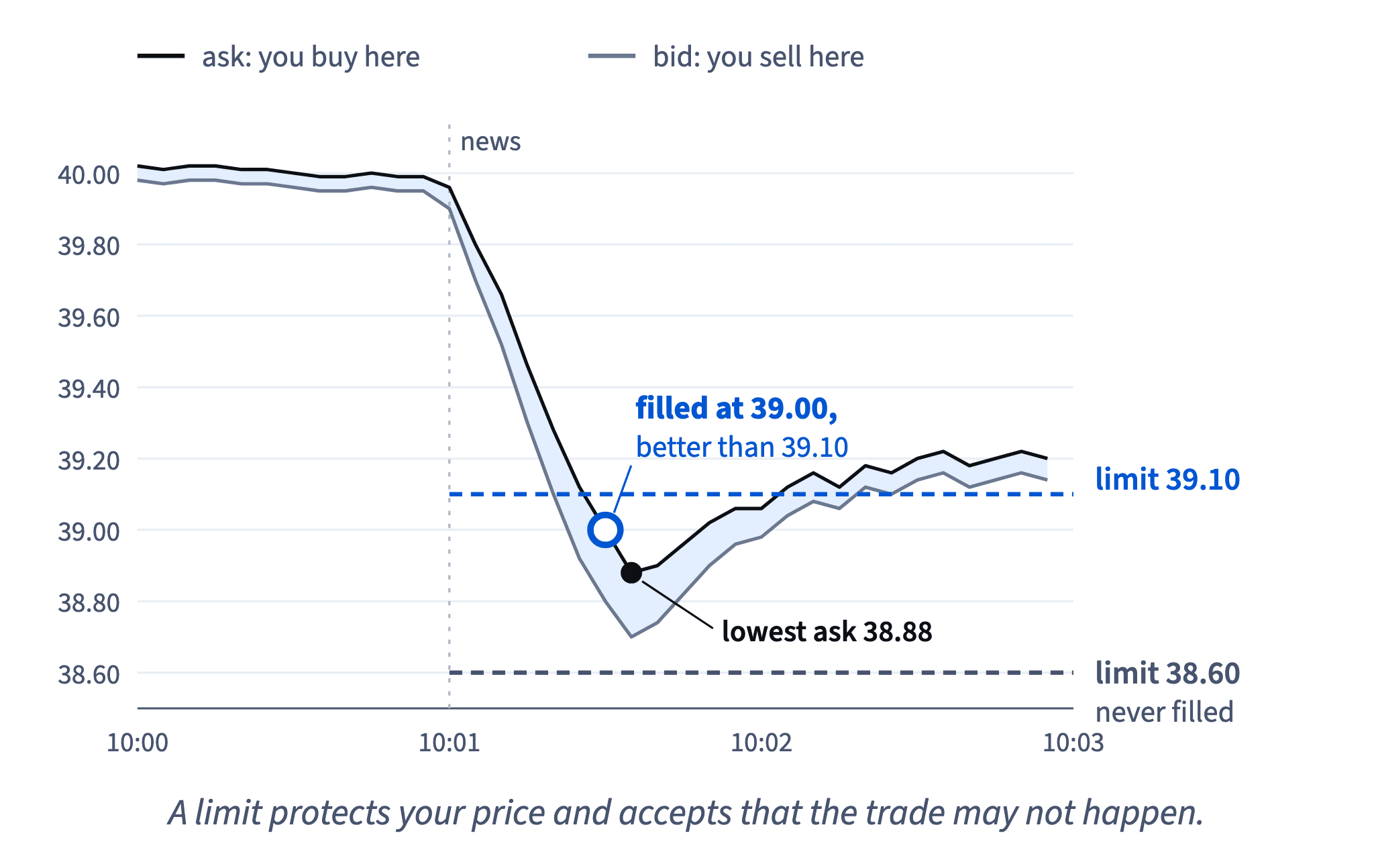
Nora placed two buy limits at 10:01:00 while Bluefin Energy was dropping. Her limit at 39.10 waited while the ask was 39.28, then 39.12. At 10:01:30 the ask fell straight to 39.00, so the order filled at 39.00, ten cents better than her limit: "your price or better".
Dataset: Bluefin Energy quotes, 10:00–10:03 · shown above
Her limit at 38.60 never filled. The lowest ask in the whole file was 38.88, at 10:01:35, still above 38.60. The bid did touch 38.70, but a buyer never gets the bid; buyers pay the ask.
A limit protects your price and accepts that the trade may not happen. Wishing for a price is fine; just know that the market may never offer it.
- Do"Buy limit at 39.10: I pay 39.10 or less, or nothing happens."
- Don't"The bid touched 38.70, so my limit at 38.60 almost filled."
Buyers pay the ask, which never went below 38.88.
In a fast move, market orders pay for speed
The spread is the ask minus the bid: what you'd lose if you bought and sold again at once. In a calm market it's small. When news hits, sellers and buyers pull back and the spread widens.
In Pebble's Bluefin Energy quotes, at 10:00:30 the bid was 39.96 and the ask 40.00: a spread of 4 cents. At 10:01:15, in the middle of the drop, the bid was 39.30 and the ask 39.46: 16 cents, four times wider.
Dataset: Bluefin Energy quotes, 10:00–10:03 · shown above
A market buy at 10:01:15 would have paid 39.46, and a market sell would have got 39.30. Every market fill in a fast move pays the wider spread, plus any slippage while the order travels.
That's the price of a sure fill. A limit avoids it by naming the price, at the risk of no fill. So in a fast market ask yourself: do I need to be in (or out) right now, or can I wait for a calmer price?
- Do"The spread is 16 cents right now, four times normal; I'll wait or use a limit."
- Don't"Market orders always cost the same, just the usual spread."
In a fast move the spread can widen several times.
A stop is a trigger, not a promise
The most common misunderstanding about a stop-loss is that it guarantees the exit price. It doesn't. It guarantees only that an order wakes up when the level is reached; after that it trades at market, at the next available bid.
Most of the time the difference is a cent or two. Two situations make it bigger. In a fast move, prices skip levels: Marc's stop at 39.00 sold at 38.92. After a jump between sessions, when the market opens far below yesterday's close (a gap), the first bid can be well below the stop, and the stop sells there.
Marc still uses stops: 108 dollars hurts less than holding and hoping. He just plans for a bit of slippage and keeps positions small enough that a worse fill doesn't break the account.
Module 3 builds on this: where the stop goes, and how big a position it allows.
- Do"My stop limits the loss roughly; a gap can make it worse."
- Don't"With a stop at 39.00, I can't lose more than to 39.00."
The fill can be below the stop.
No order is the safe one
After two fast minutes of Bluefin Energy, the trade-offs are concrete.
A market order is sure to fill, but it takes whatever price is there; at 10:01:15 that meant a 16-cent spread instead of 4.
A limit order fixes the most you pay: the 39.10 limit even filled at 39.00. But the 38.60 limit never filled at all.
A stop order gets you out (or in) when a level breaks, but at the next market price: Marc planned to lose 100 dollars and lost 108.
So the choice is never "which order is safe" but "what do I need most right now: to be sure of the fill, sure of the price, or sure that a level triggers me?" The answer changes with the situation, and costs and slippage come with every choice.
How it fits together: three orders, three trade-offs, all priced off the bid and the ask. Next lesson looks at those two prices closely: the spread, and why some markets are thick and others thin.

- Do"I need out today whatever happens, so market; I accept the spread."
- Don't"Which order is the safe one?"
Each one trades something away.
Ready to practise?
Answer the lesson's exercises and earn 250 points the first time you finish it.
Start the exercises