

Theory
A one-page trading plan
Write five things on one page before you trade: what you trade, when you enter, where you exit, how big you go and when you do not trade at all.
~9 min read · 9 exercises · 250 points
Before you start
Module 7: from an idea to a plan you can test
You're back on your Pebble practice account: 10,000 practice dollars and a small made-up market. This module asks one question: how do you turn a trading idea into a plan you can test? You'll write a one-page plan, see how tests on past prices can fool you, start small with a journal and, in the case, audit a journal to find where the money leaks. This lesson is the plan itself: five lines, each one checkable.
A plan answers five questions before the click
A trading plan is one written page that answers five questions before you place an order: what you trade, when you enter, where you exit (both for a loss and for a win), how big you go, and when you don't trade at all.
The point is timing. Each decision is made while you're calm, not while the price is moving and every tick pulls at you. One page is short enough to read top to bottom before every trade; a ten-page plan is never read when it matters.
On the Pebble practice account, Nora's current "plan" is to buy what's rising and sell when it feels like time. That answers two of the five questions, both with a mood, and skips the other three. The fifth question, when not to trade, is the one beginners leave out most often.
The rules in this lesson only show the format. A rule written in a plan is not yet a rule known to make money.

- Do"What I trade: only Northwind Foods and the Harbor 20 Index Fund, during market hours."
One of five lines, written before the first trade.
- Don't"My plan: buy what's going up, sell when it feels like time."
A mood that answers two questions and skips three.
The hand-over test: checkable lines
Every line of a plan must be checkable: it can be answered yes or no from prices, numbers or the calendar, with no feelings involved. The hand-over test is simple: hand the page to someone else. Would they place exactly the same orders? If not, the line is too vague.
Checkable comes first for a practical reason. Only a rule you can check can be tested on past prices and then in a journal. A vague rule can never be proven wrong: after a loss it "didn't really look strong", after a win it "obviously did". You never learn anything from it.
Checkable is not the same as good. "Buy after a close above the highest close of the last 10 days" passes the test, and it may still lose money after costs. Finding that out is the job of testing, which comes after the plan is written.
- Do"Buy at the next open after a close above the highest close of the last 10 days."
Two readers buy on the same day.
- Don't"Buy when the chart looks strong."
Can never be proven wrong, so it teaches nothing.
Turning a vague line into a checkable one
A vague line becomes checkable when you replace the feeling word with a number or a date. "Strong", "enough", "soon", "sure" and "too far" are the usual suspects.
Checkable lines come in a few shapes: a price level ("a close above the highest close of the last 10 days"), a distance ("a stop 1.50 below the entry"), a time limit ("close after 5 trading days"), a count ("after two losses in one day") or an account limit ("no new trades after a 300-dollar loss today").
The exit needs both halves. The stop is written before entry, not added after the price has dropped. The exit for a win is a target price or a time limit. Nora's "sell when I've made enough" becomes, for example, "sell at the close of the 5th day if neither the stop nor the target has been hit".
A quick self-check: can a spreadsheet answer the line with yes or no? If it needs your opinion, rewrite it.
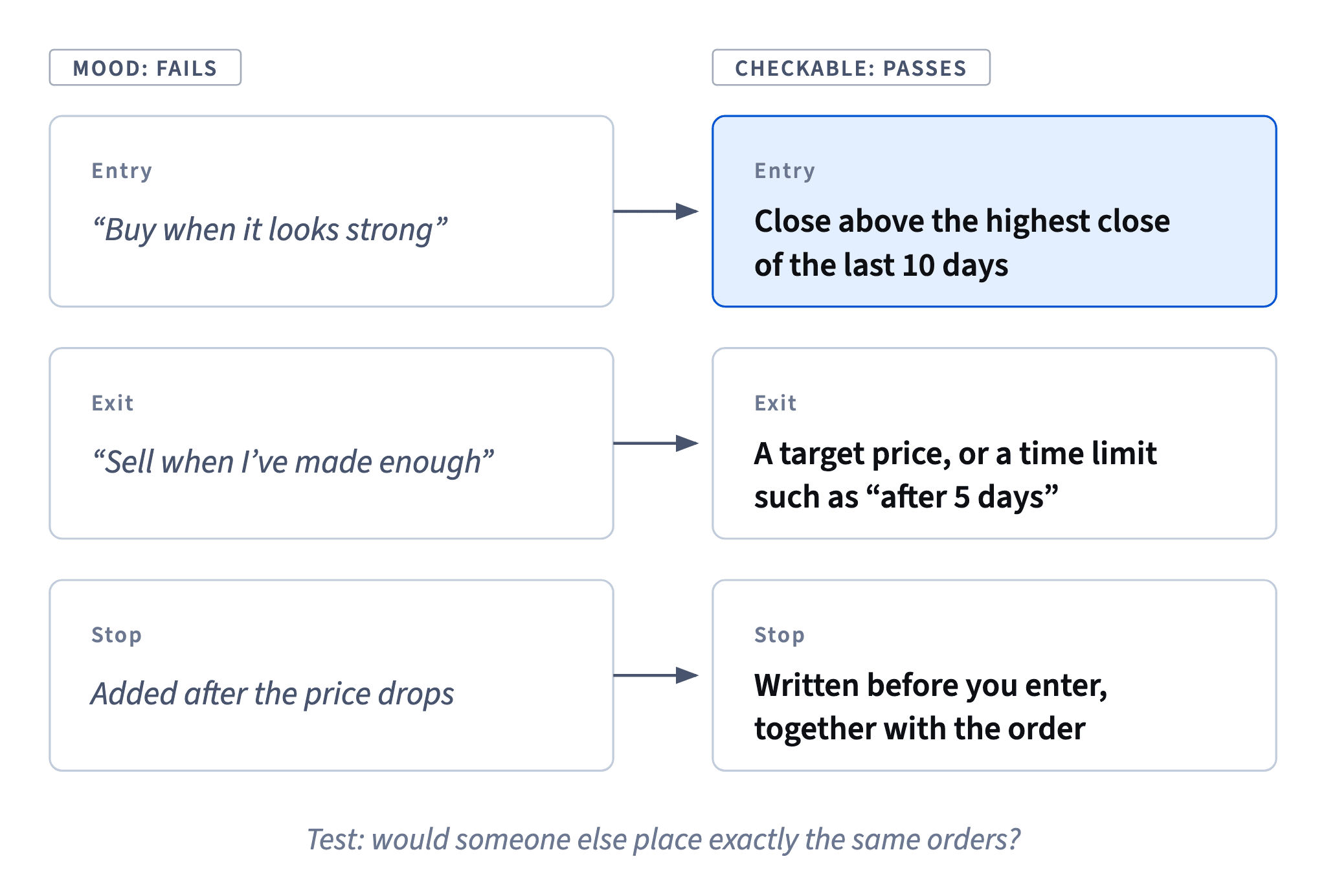
- Do"Close the trade after 5 trading days if neither the stop nor the target is hit."
- Don't"Sell when I've made enough."
No number, so the exit moves with the mood.
- Don't"I'll set a stop if it starts to fall."
A stop added after the drop is not a plan.
A fixed exit trades a little profit for something you can count
An exit for a win can be a target price ("sell at 54.00") or a time limit ("sell at the close of the 5th day"). Either way it is fixed before the trade, like the stop.
Nora's objection is fair: a fixed target will sometimes sell a trade that would have kept rising. That is a real cost. What you buy with it is a result you can count. When every trade follows the same exit, thirty trades become thirty comparable data points, and you can work out the win rate and the average result per trade, as in Expectancy: the average trade in module 4.
"Sell when it feels like time" gives a different rule on every trade: early on a nervous day, late on a greedy one. The journal then measures your moods, and a lucky week looks exactly like skill.
So the trade-off is deliberate: a little profit given up now, in return for knowing later whether the plan works at all.
- Do"Exit for a win: a target 4 dollars above the entry, or the close of the 5th day, whichever comes first."
- Don't"I'll hold while it keeps going and get out when it feels like the top."
A new exit rule on every trade; nothing to count.
The size line starts from risk, not from shares
The size line never says "buy 100 shares". It applies position sizing from Position size from risk and stop in module 3: first decide how much of the account you accept losing if the stop is hit, usually 0.5–2%; that is the risk per trade. Then divide it by the stop distance.
Worked example on a 10,000 account at 1%: the risk is 100 dollars. Entry 50.00, stop 48.00, so 2.00 a share. 100 ÷ 2 = 50 shares. A wider stop gives fewer shares and the same 100 at risk; a tighter stop gives more shares and still 100.
Two habits belong in the line itself. Round down, never up, so the loss at the stop stays inside the limit. And remember that spread, fees and slippage add a little on top, so the real loss at the stop is slightly more than the number you wrote.
A fixed share count ignores the stop, so the risk changes on every trade without anyone deciding it.
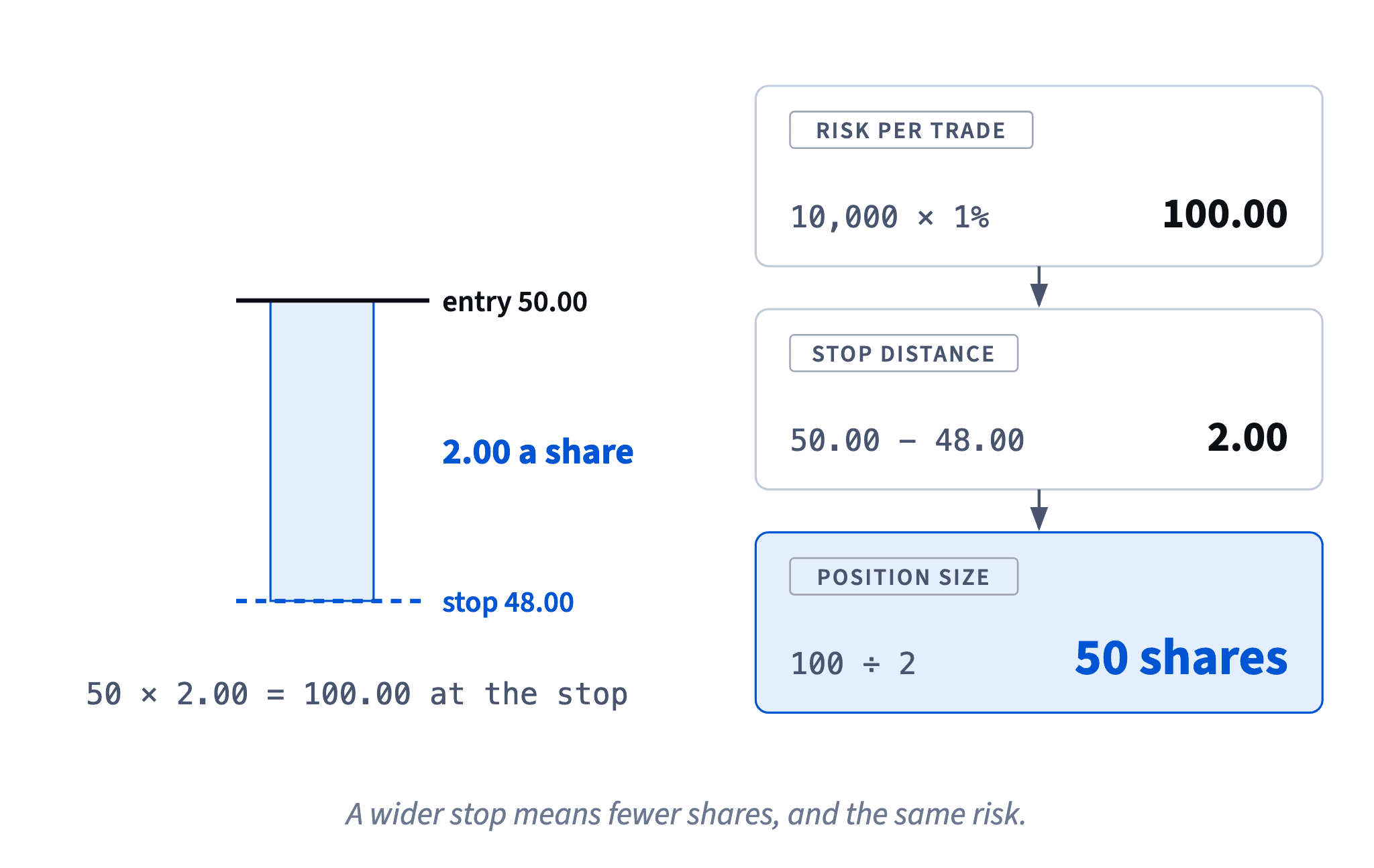
- Do"Risk 1% of the account to the stop; size = risk ÷ stop distance, rounded down."
- Don't"Buy 100 shares every time, more when I feel sure."
The risk then depends on the stop and the mood, not on a decision.
The no-trade list: the cheapest line in the plan
The fifth part of the plan says when you don't trade at all. Beginners skip it because it feels like missing chances. It is the line that protects the account when conditions or you are at your worst.
Typical entries, each checkable: report days, when the price can jump over a stop overnight (the gap from The stop: where it goes and why in module 3); after two losses in one day; when you are tired, angry or can't watch the screen; a set hour when the market is thin.
The arithmetic is lopsided. A skipped trade costs nothing; a bad trade on a bad day costs money and often leads to the next bad trade. "Today I don't trade" is therefore not the plan failing, it is one of its answers, and often the cheapest one.
Nora's worry, "then I'll miss trades", is true and fine. There will be another entry signal next week; there is only one account.
- Do"No trades on Northwind Foods report days, and none after two losses in one day."
- Don't"I'll trade every day so I don't miss anything."
Missing a trade is free; a bad day is not.
The line that stops the whole plan
The no-trade list skips single days. One more line decides when the whole plan stops: for example, "if the account falls 10% from its start, I pause and go back to the practice account".
The one-page plan: fill it in · shown above
Why write it, if a bad week is normal? Precisely because it is normal. Without a number chosen in advance, people do one of two things: they quit after three losses, judging the plan on a handful of trades, or they keep going all the way down, hoping the next trade fixes it. A fixed number takes the decision away from the mood of a bad week.
The same line sets when the plan is judged: after 30 trades, not before, because fewer trades are too few to tell skill from luck (the sample rule from module 4).
The two numbers work together. The 10% limit caps the damage of a plan that doesn't work; the 30-trade review stops you from throwing away one that does after an unlucky start.
- Do"If the account falls 10% from its start, I stop and return to the practice account. I judge the plan after 30 trades."
- Don't"Three losses in a row: this plan is broken, I'm switching to a new one."
Judges the plan on three trades.
Read the page top to bottom before every trade
A plan works only if it is used, so read it in the same order before every trade.
First, the no-trade list: on those days nothing else matters, and checking it first saves you from talking yourself into a trade. Second, the entry condition: yes or no. Third, the stop and the exit for a win, because the size can't be computed without the stop. Fourth, the size: risk ÷ stop distance, rounded down. Last, place the order together with the stop, not "in a minute".
The order is a guard against the usual slip: deciding the size first, from a feeling, and fitting the stop to it afterwards.
How it fits together: five checkable lines turn a mood into decisions made in advance; size limits each loss, the no-trade and stop-the-plan lines limit bad days. Checkable is not proven: the next lesson tests a rule on past prices and shows how such tests fool you.
- DoNo-trade list → entry condition → stop and target → size → order with the stop.
- Don't"I'll buy 200 shares and see where to put the stop later."
Size before the stop, stop after the order.
Ready to practise?
Answer the lesson's exercises and earn 250 points the first time you finish it.
Start the exercises