

Theory
Exchange, broker, instruments: a map
A plain map of where trades happen and what you can trade: shares, funds, currencies, futures and coins, plus what going short and leverage mean, with the warnings.
~9 min read · 9 exercises · 250 points
Before you start
How does a market work under the hood?
You're back on your Pebble practice account: 10,000 practice dollars and a small made-up market. This module opens the box behind the Buy button: who gets your order, what you can trade, which order types exist, and why the price to buy is always a little higher than the price to sell. It ends with a case where you pick and place the right order.
This first lesson draws the map: broker, exchange, market maker, the main instruments, and the words long, short and leverage.
Broker, exchange, market maker: the route of an order
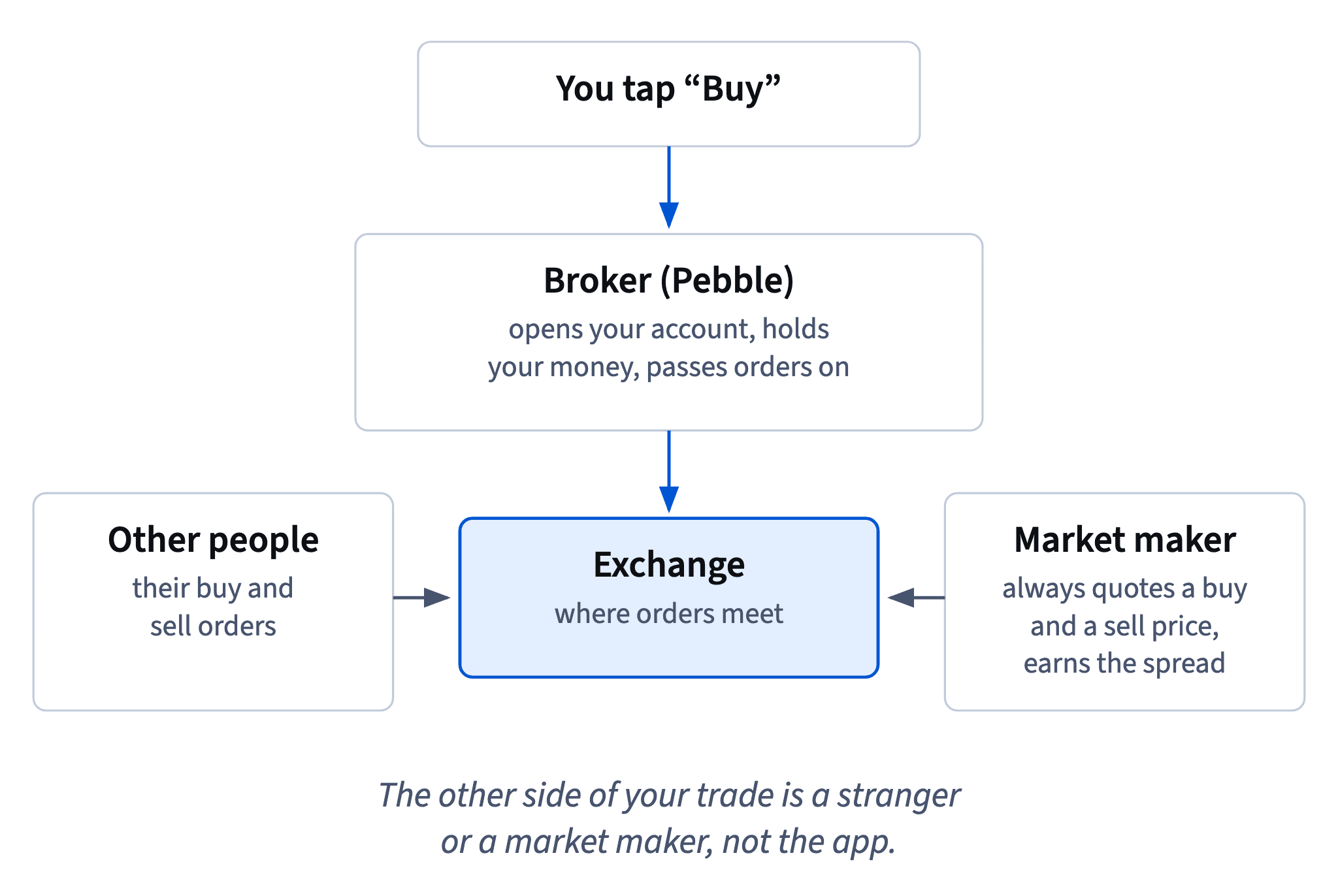
When you tap Buy, your order passes through several hands before it becomes a trade.
The broker is your door. It opens your account, holds your money and passes your orders on. Pebble is a broker; it usually doesn't sell you the share itself.
The exchange is the marketplace where buy orders and sell orders from many people meet. When a buyer's price and a seller's price match, a trade happens.
A market maker is a firm that always shows two prices on many markets: one at which it will buy and one at which it will sell. It earns the small difference between them, the spread, in return for always being there when you want to trade.
So for a share of Northwind Foods, the other side of your trade is usually a stranger or a market maker, not the app. Knowing the route helps you ask the right question: who earns what on my order?
- Do"My order goes from Pebble to the exchange; a market maker may be on the other side."
- Don't"Pebble sells me the share, it's their app."
The broker passes the order on; it's usually not the seller.
Who holds your money, and who is your other side
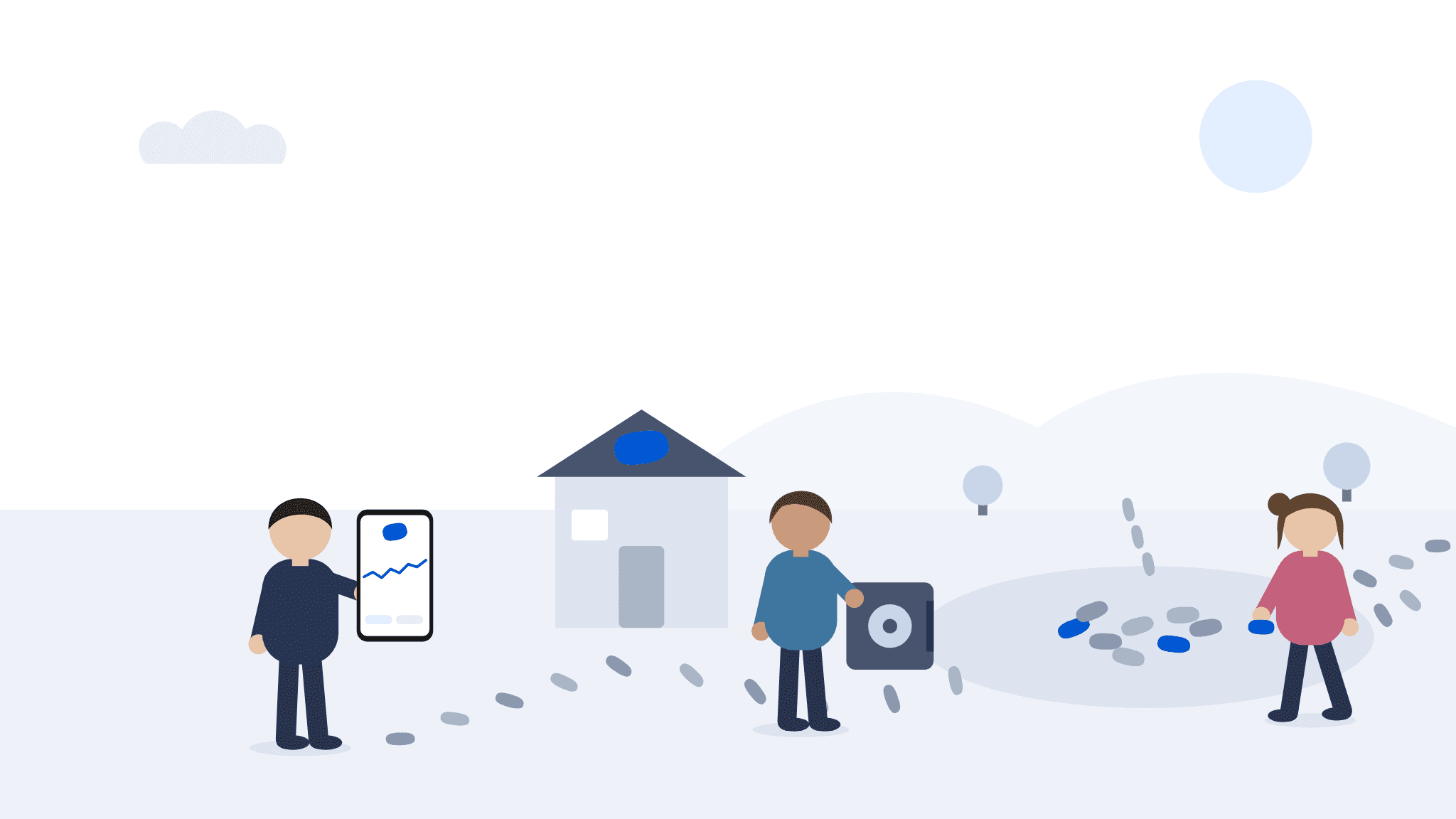
Before real money goes anywhere, two checks come first; Marc, another Pebble user, makes them every time: is the broker licensed where you live, and where does it hold clients' money? A licence means someone supervises how the firm treats your account. Knowing where the money sits tells you what happens if the firm gets into trouble. The rules differ by country, so check them where you live.
A third question matters for some products. Shares and funds usually trade on an exchange, where your other side is another participant. But many currency and coin trades happen directly with the broker or a dealer. Then the firm itself can be your other side, and it may earn when you lose. Ask how it earns from you: the spread, fees, financing, or your losses.
What doesn't count as a check: a modern-looking app, a long list of instruments, popularity among friends, or a promised monthly return. The last one is a warning sign.
- Do"Is it licensed here, where is my money held, and how does it earn from me?"
- Don't"Everyone at work uses it, so it must be fine."
Popularity isn't a licence.
The menu: what an instrument is
Anything you can trade is an instrument. Pebble's practice market has one of each main kind, all made up.
A share is a small piece of one company, like Northwind Foods. Its price reacts to that one company's news.
An index fund holds many companies at once: the Harbor 20 Index Fund holds 20. One firm's bad news is a small part of the basket, so it moves the fund far less than a single share. The fund still falls when many companies fall together.
A currency pair, like Lumen/Crown, is the price of one currency in another. Its daily moves are tiny, which is why brokers often offer leverage on it.
A coin, like Spark Coin, is a digital token. No company or profits stand behind it; its price rests only on what the next buyer will pay. It trades around the clock and can halve in a day.
Knowing what's behind an instrument tells you what can move its price.
- Do"Harbor is a basket of 20 companies; Northwind is one of them on its own."
- Don't"A coin is like a share, just digital."
No company or profits stand behind a coin.
Futures: leverage built in
Futures are contracts to buy or sell something later at a price fixed today. You don't pay the full amount up front: a small deposit controls the whole contract. That makes leverage part of the product, whether you asked for it or not.
Say a contract is worth 10,000 dollars and the deposit is 1,000, a tenth. A 10% move in the price changes the contract's value by 1,000 dollars, the size of the whole deposit. If the move goes against you, the deposit is gone; if it goes further, you may owe more.
Compare that with buying a share, a fund or a coin outright with your own money. Each can fall, and a coin can fall a lot, but none can lose more than you paid.
So when you read a product's description, look for the words "deposit", "margin" or "contract". They tell you the loss is counted on a bigger amount than you put in.
- Do"The deposit is 1,000, but the contract is 10,000: a 10% move is my whole deposit."
- Don't"I only put in 1,000, so that's the most at stake."
With futures the loss counts on the whole contract.
Long and short: why a short has no ceiling
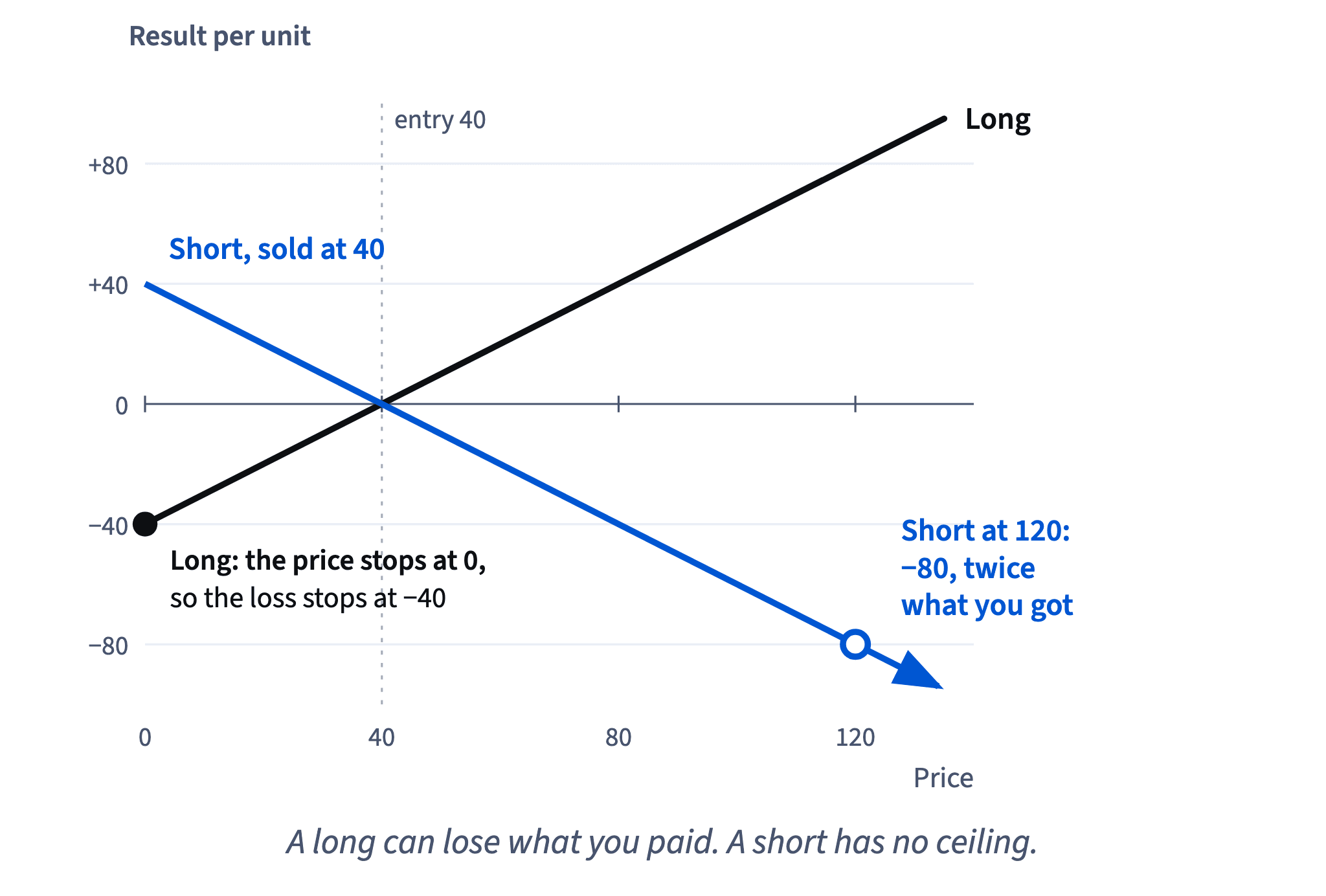
A long position means buying first and hoping to sell higher later. A short position means selling first, with an instrument borrowed through the broker, and buying it back later. A short earns when the price falls: you sold high and buy back cheaper.
It sounds like buying, backwards, but the losses aren't symmetric. A long bought at 40 can lose at most 40 a unit, because a price stops at zero. A short sold at 40 loses as the price rises, and a price has no upper limit. At 80 the short is down 40 a unit; at 120 it's down 80, twice what it received when it sold.
That's why shorting carries a warning label in this course. The loss on a long is capped by what you paid. The loss on a short is capped only by when you buy back, or when the broker closes it for you.
- Do"Short at 40: if it climbs to 120, I lose 80 a unit."
- Don't"A short can lose at most what I got for selling."
A price can rise without limit.
Leverage: count the loss on your own money
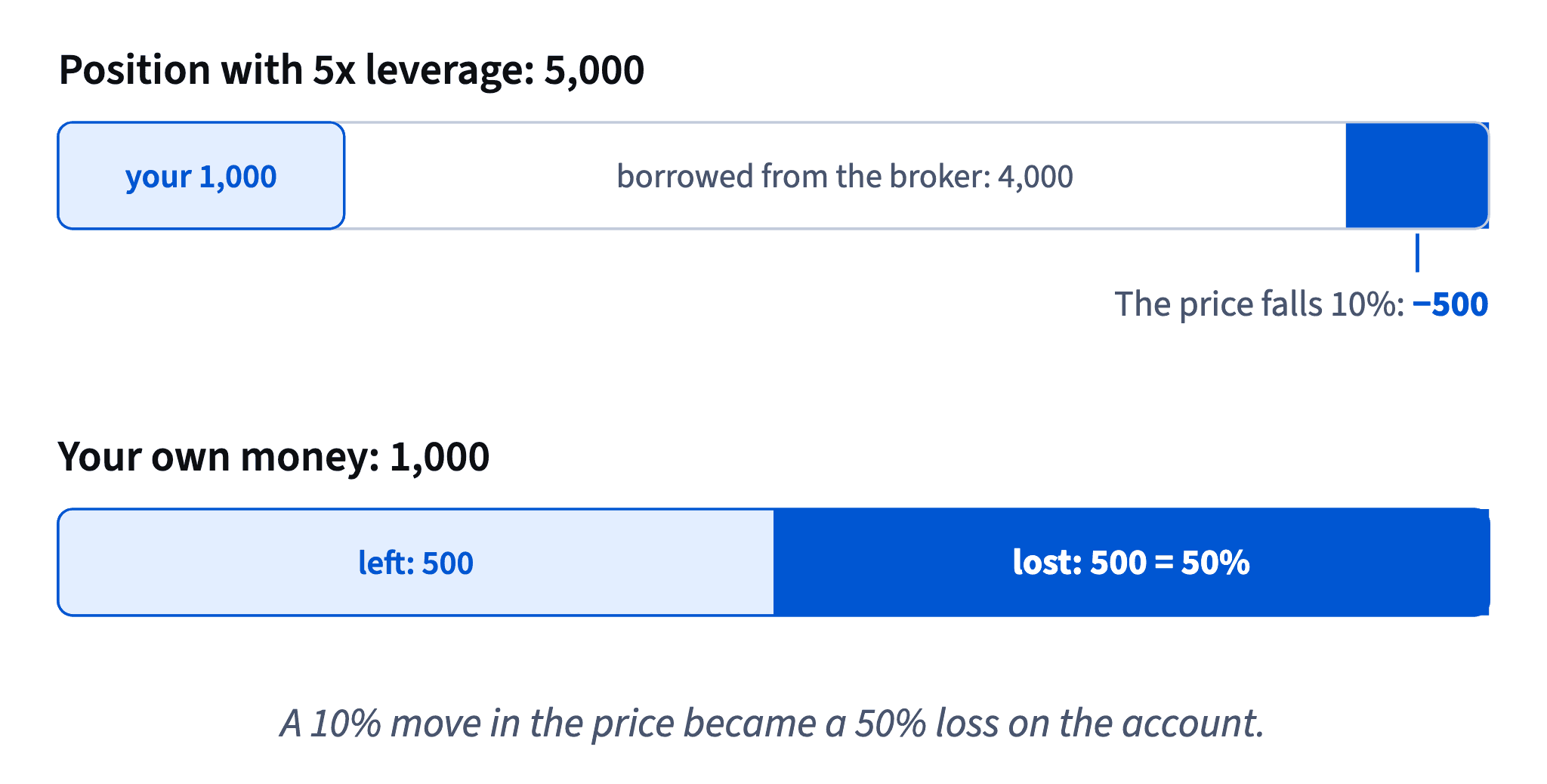
Leverage means trading with money borrowed from the broker. With 1,000 dollars of your own and 5x leverage, you control a 5,000-dollar position.
The trick is where the loss lands. It is counted on the whole position, but it comes out of your own money. A 10% fall in the price: 5,000 × 10% = 500 dollars lost. Against your own 1,000 that's 500 ÷ 1,000 = 50%. A 20% fall, 1,000 dollars, takes everything.
A quick rule: the move against you, times the leverage, is the share of your own money lost. 10% × 5 = 50%. At 10x, a 5% move costs 50% and a 10% move wipes the account.
Leverage multiplies gains by the same factor, which is why it looks attractive. But a beginner's first job is to survive the losses, and borrowed money also has a financing cost for every day you hold it.
- Do"5x on 1,000: a 10% fall costs me 500, half my own money."
- Don't"The price only fell 10%, so I'm only down 10%."
With leverage the loss on your money is the move times the leverage.
Three ways to lose faster
Three things on the map get a warning label in this course. They are not "advanced tricks"; they are ways to lose faster.
Shorting: the loss grows as the price rises, and a price has no ceiling, so a short can lose more than it received.
Leverage: the loss is counted on the whole position but paid from your own money. At 10x, a 10% move takes the whole account. Futures have it built in.
Coins: nothing stands behind the price, trading never stops, and a coin can halve in a day or be pumped up and dumped.
Compare a small long position in a fund, bought with your own money. It can fall, sometimes a lot, but it can't lose more than you paid, and a basket of many companies rarely moves as fast.
Practice money doesn't remove the danger. If 5x feels fine with pretend dollars, it will feel fine with real ones too, and that is the problem.
- Do"No leverage and no shorting until I can say what I'd lose if I'm wrong."
- Don't"It's only practice money, so 10x is fine."
Habits built on practice money carry over to real money.
One question before any trade
The map has many parts: brokers and exchanges, shares, funds, currency pairs, futures and coins, long and short, with or without leverage. One question works across all of them: if I'm wrong, how many dollars do I lose?
For a long position in a share bought with your own money, the worst case is what you paid, and a sensible exit comes much earlier. For a short, the answer depends on where you'll buy back. With leverage, multiply the move by the leverage and count it against your own money. If you can't answer in dollars, the trade isn't ready.
Marc turns this into a rule on his practice account: no leverage and no shorting until he can say exactly how much he'd lose if he's wrong. The rule is about the habit, not the instrument.
How it fits together: the map shows who handles your order, what you can trade and which choices multiply losses. Next lesson: the order types, market, limit and stop, that decide at what price you trade.
- Do"If I'm wrong, I lose 50 dollars; that's decided before I buy."
- Don't"Let's see how it goes and decide later."
Deciding the loss after the trade is how accounts get wiped.
Ready to practise?
Answer the lesson's exercises and earn 250 points the first time you finish it.
Start the exercises