

Theory
Case: place the right order
Three situations on a practice account: pick the order type, the price and the size, and say why, using the quotes, the spread and what a gap can do to a stop.
~9 min read · 10 exercises · 250 points
Before you start
Three tickets
Back on your Pebble practice account, today you place the orders yourself. Marc and Nora each bring a situation, and there's a third one about a stop, each with its own quote snapshot.
This case closes the module on how a market works. For each situation you'll decide which order to use, at what price, for how many units, and explain why, using everything you've learned about order types, spreads and liquidity.
An order ticket, step by step
An order ticket is the trade written down before you tap anything: the order type, the price, the number of units and a short reason. Writing it turns a mood into a decision you can check later.
The steps follow from each other. First read the quote: the bid, the ask, the spread in percent and the size waiting at the best price. That tells you whether the market is deep or thin. Then choose the type: in a deep market a market order and a limit at the ask give almost the same fill; in a thin one a limit caps the price. Then set the price if the type needs one, and count the units that fit the budget at that price, rounding down. Last, write the loss if you're wrong, in dollars, including what a gap could do to a stop.
Skip a step and the ticket breaks: a size counted before the price, or a loss counted before the stop, is a guess.

- Do"Limit 112.41, 17 shares, deep market; if wrong, I sell at my stop."
- Don't"Just tap Buy and see what happens."
An unwritten order can't be checked later.
When the order type barely matters
The difference between a market order and a limit order shows up only when the book is thin. So the first check is a comparison: your size against the size waiting at the best price, together with the spread.
Situation A: Harbor 20 at midday, bid 112.39, ask 112.41, a 2-cent spread, and 3,790 units waiting at the ask. Marc needs 17. A market buy takes 17 of those 3,790 at 112.41 and never touches the next price. A buy limit at 112.41 fills in exactly the same place. The limit simply rules out a surprise if the quote jumps the moment he taps.
Flip the numbers and the answer flips. When your size is bigger than what waits at the best price, or the spread is wide, a market order walks the book and the type matters a lot.
So in a deep market the real question isn't the order type; it's the size.
- Do"17 against 3,790 at the ask, 2-cent spread: market or limit, same fill."
- Don't"Limits are always better, whatever the market."
In a deep market the type hardly changes the fill.
Size from a budget: divide and round down
When a ticket has a money budget, the number of units comes from one division: budget ÷ price you'll pay, then round down to a whole unit.
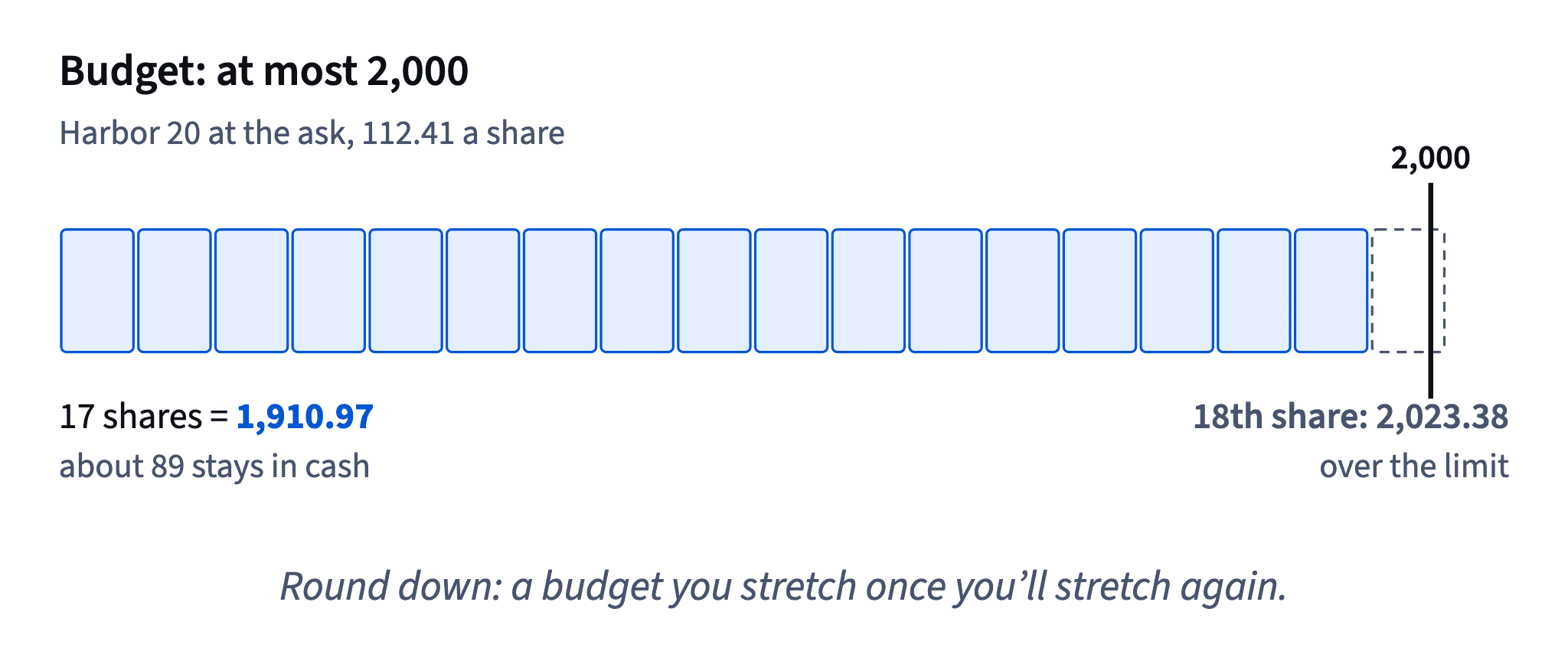
Marc has at most 2,000 dollars for Harbor 20 and buys at the ask, 112.41. 2,000 ÷ 112.41 ≈ 17.8, so 17 whole units. They cost 17 × 112.41 = 1,910.97, and about 89 dollars stay in cash. An 18th unit would bring the cost to 18 × 112.41 = 2,023.38, over the budget.
Two details matter. Divide by the price you'll actually pay: for a buy that's the ask, not the mid or the last trade. And round down, never to the nearest: rounding 17.8 up breaks the budget. As Marc puts it, a budget you stretch once is a budget you'll stretch again.
In module 3 the same division returns with a different budget: not the money you spend, but the money you're ready to lose.
- Do"2,000 ÷ 112.41 = 17.8, so 17 units; 89 stays in cash."
- Don't"17.8 rounds to 18, close enough."
18 units cost 2,023.38, over the budget.
A thin market at night: cap the price, shrink the size
Situation B is the opposite of A. Spark Coin at 20:00: bid 2.35, ask 2.45, a 10-cent spread on a 2.40 mid, more than 4%. Only 150 coins wait at 2.45; behind them 200 at 2.47 and 250 at 2.50.
A market buy for 500 would walk the book: 150 at 2.45, 200 at 2.47, 150 at 2.50, about 1,236.50 instead of the 1,225 the screen suggests. A buy limit at 2.60 for 500 "to be sure it fills" does the same thing, just with a ceiling high enough not to matter.
Better tickets cap the price and respect the size: a buy limit at 2.45 or lower for at most 150 coins, or waiting for busier hours, when the spread is usually 2 cents. A buy stop at 2.30 is no entry at all: a buy stop sits above the price and waits for a rise.
And if it can't wait until tomorrow, it's probably a mood, not a plan.
- Do"Buy limit 2.45 for 150 coins, or wait for midday."
- Don't"Limit at 2.60 for 500, so it surely fills."
A ceiling that high just walks the book.
A limit can fill in part
A limit order doesn't have to fill all at once or not at all. It takes everything available at its price or better, and the rest waits in the book as a resting order.
At 20:00 the Spark Coin asks are 150 at 2.45, 200 at 2.47 and 250 at 2.50. A buy limit at 2.45 for 500 can take only the asks at 2.45 or lower: 150 coins, for 150 × 2.45 = 367.50. The other 350 sit in the book at 2.45 and fill only if sellers come down to that price, later tonight, tomorrow, or never.
That's the limit's trade-off in numbers: the price is capped, the quantity isn't guaranteed. A partial fill is a normal outcome, not an error.
Two habits follow. Decide whether a partial position still makes sense before you place the order. And cancel the waiting remainder when the reason for the trade is gone; a forgotten resting order can fill days later, when you no longer want it.
- Do"150 filled at 2.45; I'll cancel the other 350 and re-place them tomorrow if I still want them."
- Don't"I placed 500, so I own 500."
A limit can fill in part; check what actually filled.
A report can open the price below your stop
Between today's close and tomorrow's open nobody trades the share on the exchange, but news keeps arriving. A company report before the open is the classic case. The next morning the price can open far from where it closed, jumping over every level in between: a gap.
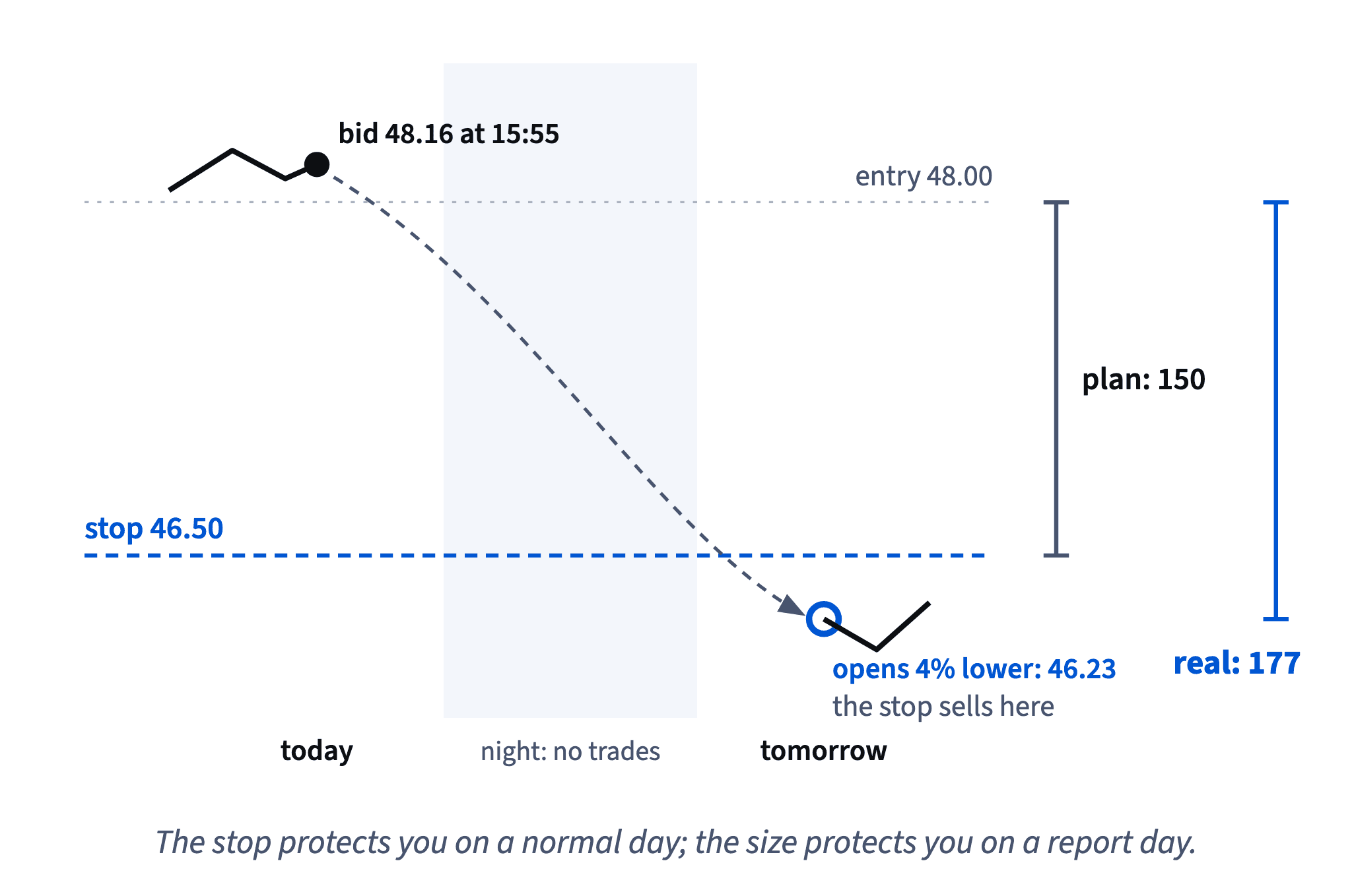
Situation C: 100 Northwind Foods bought at 48.00, a sell stop at 46.50, the bid at 48.16 at 15:55. The planned loss is (48.00 − 46.50) × 100 = 150 dollars.
After its last report Northwind opened 4% lower. If that happens again: 48.16 × 0.96 ≈ 46.23. The first bid is already below 46.50, so the stop wakes up and sells right there, at 46.23. The loss is (48.00 − 46.23) × 100 = 177 dollars, not 150. A worse surprise would open lower still.
The stop did its job; it just can't sell at a price that never traded.
- Do"Stop at 46.50, but a 4% gap after the report means about 177."
- Don't"My stop is at 46.50, so tomorrow's report can't hurt more than 150."
The stop sells at the first bid, after the gap.
Planned loss is not maximum loss
It's easy to read the stop as the most you can lose: (entry − stop) × units. That number is the planned loss, the loss on a normal day when the stop fills near its level. It is not the maximum loss.
Two things push the real loss past the plan. On a fast day, slippage: the stop fills a few cents below its level. Across a gap, much more: the stop fills at the first price after the jump. In situation C the plan is 150 dollars; a 4% lower open after the report makes it 177, and nothing caps how far a worse report could open.
So on a ticket write both numbers: the planned loss at the stop, and the loss you'd face after a plausible gap. Marc writes the gap risk next to the stop in his journal, so the number he lives with is honest.
- Do"Planned: 150 at the stop. After a 4% gap: about 177."
- Don't"Worst case is the stop, 150."
Gaps and slippage go past the stop.
On a report day, the size protects you
If a gap can carry the price past your stop, the stop can't keep the loss within budget. The size can, and it's decided today, before the close.
Work backwards from the loss you accept. With Northwind bought at 48.00 and a plausible 4% gap open at 46.23, each share would lose 48.00 − 46.23 = 1.77. With a 150-dollar limit: 150 ÷ 1.77 ≈ 84.7, so at most 84 shares (84 × 1.77 = 148.68). The other 16 are sold today near the 48.16 bid. Since a worse report would open lower, keeping fewer, say 50 (about 88.50 after a 4% gap), leaves room.
Other honest choices: sell everything before the report, or keep all 100 and knowingly accept the bigger possible loss. What isn't a choice is pretending the stop caps it.
How it fits together: quotes decide the type, the price decides the size, and gaps decide what a stop really protects. Module 3 asks how much one trade may lose, and sizes every position from that.
- Do"1.77 a share after a 4% gap; 150 ÷ 1.77 means 84 at most, so I keep 50."
- Don't"I'll keep all 100; the stop will handle it."
Across a gap the stop can't hold the line.
Ready to practise?
Answer the lesson's exercises and earn 250 points the first time you finish it.
Start the exercises