

Theory
Bid, ask, spread and liquidity
Read the two prices on every screen, see why thin markets and odd hours cost more, and what a big market order does to a thin order book.
~9 min read · 9 exercises · 250 points
Before you start
Two prices, always
Still on your Pebble practice account, today you read the two numbers next to every instrument. Nora shrugs at the difference between them: two cents here, forty there, who cares about cents?
You'll turn that difference into a cost per dollar traded, compare calm and jumpy instruments in the made-up market, and see why the time of day and how busy a market is change what every round trip costs.
Bid, ask, mid, and the cost of a round trip
Every instrument on the screen shows two prices. The bid is the most a buyer will pay you right now; the ask is the least a seller will take from you. You buy at the ask and sell at the bid. Halfway between them is the mid price, the fair middle.
The difference, ask minus bid, is the spread. Measured from the mid, you pay about half of it going in and half coming out, so a round trip, buying and then selling, costs about one full spread.
Harbor 20 at midday: bid 112.39, ask 112.41, mid 112.40, spread 2 cents. Buy 100 units at market and sell them straight back, and you get back 2 dollars less than you paid, (112.41 − 112.39) × 100, even though the price didn't move.
That's why a trade has to move in your favor by at least the spread, plus fees, before it earns anything.
- Do"Bid 112.39, ask 112.41: I start every round trip 2 cents a unit behind."
- Don't"The price is 112.40, so that's what I pay and what I get back."
You pay the ask and get the bid.
Compare spreads in percent, not cents
Cents mean nothing until you compare them with the price. Ten cents is a lot on a 2-dollar coin and almost nothing on a 112-dollar fund. So turn the spread into a percent of the mid price: (ask − bid) ÷ mid × 100. That's the cost of a round trip on every dollar you trade.
Harbor 20 at midday: 0.02 ÷ 112.40 × 100 ≈ 0.018%. A round trip of 1,000 dollars costs about 18 cents in spread.
Spark Coin at 20:00: bid 2.35, ask 2.45. The spread is 0.10, the mid is (2.35 + 2.45) ÷ 2 = 2.40, and 0.10 ÷ 2.40 × 100 ≈ 4.17%. A round trip of 1,000 dollars costs about 41.70 dollars before the price moves at all.
The coin's 10 cents looks like the smallest spread on the screen, and it's by far the most expensive. Always divide by the mid before you compare.
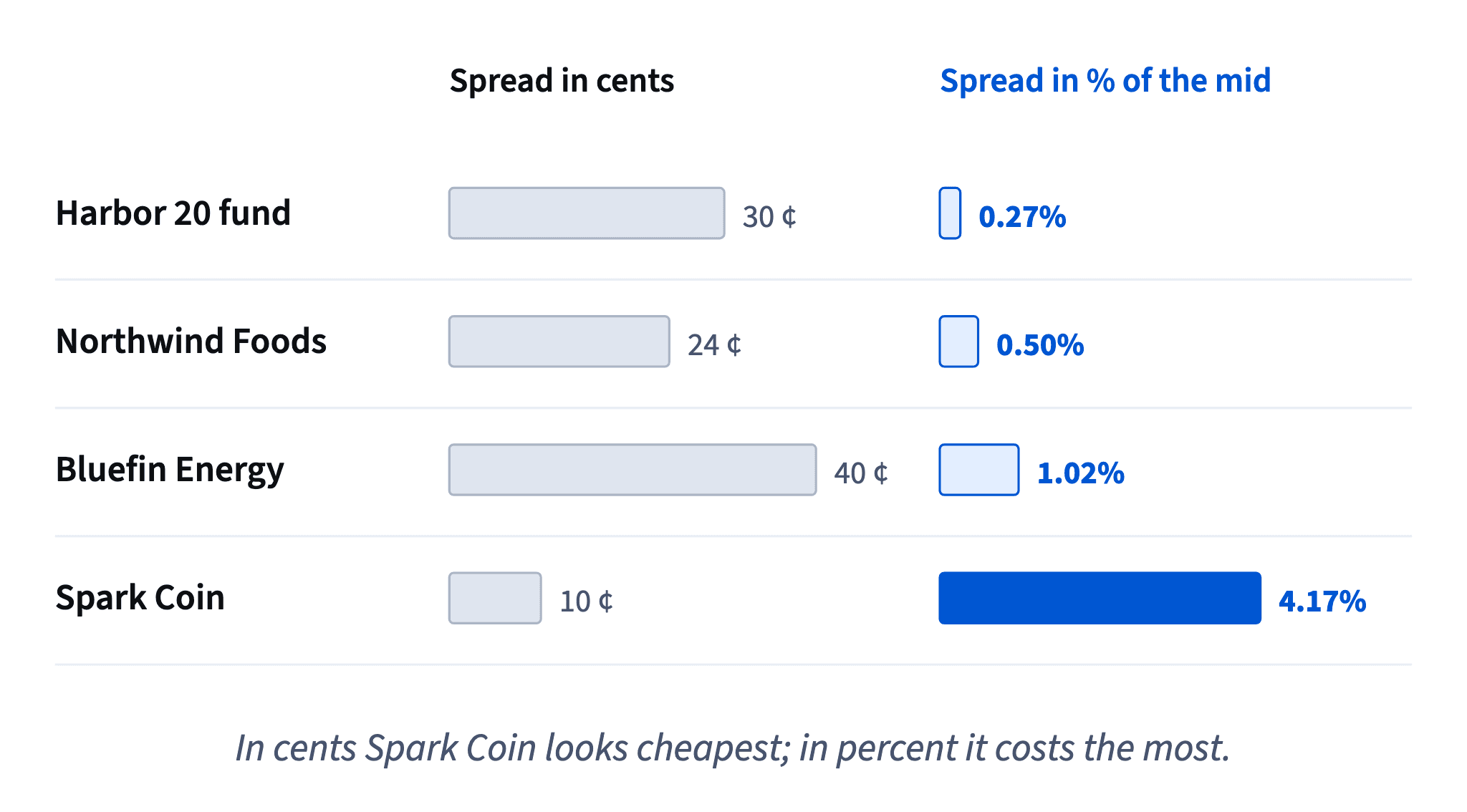
- Do"10 cents on 2.40 is 4.17%; 40 cents on 39.05 is 1.02%."
- Don't"The coin's spread is only 10 cents, the cheapest here."
Cents hide the price level.
Liquidity: deep and thin markets
Liquidity is how easily you can trade the size you want without moving the price. You can read it from two numbers on the screen.
The spread: a deep market has a tight one, a thin market a wide one. The sizes at the best bid and ask: how many units wait there. In a deep market many orders sit near the price; in a thin one only a few.
Harbor 20 at midday is deep: 2 cents of spread, about 5,300 units waiting at the bid and 3,800 at the ask. Bluefin Energy at 20:00 is thin: 40 cents of spread and only 90 shares at the ask.
Dataset · 16 rows
Quotes by time of day
Shares and the fund trade on an exchange from 09:30 to 16:00; 20:00 is after hours. Spark Coin trades around the clock.
First 5 of 16 rows
Liquidity matters most on the way out. When you're wrong, you want to leave quickly at a fair price. In a thin market the exit door is narrow, and when everyone runs for it at once, prices jump.
A high price, a famous name or round-the-clock trading are not signs of liquidity. Read the spread and the sizes.
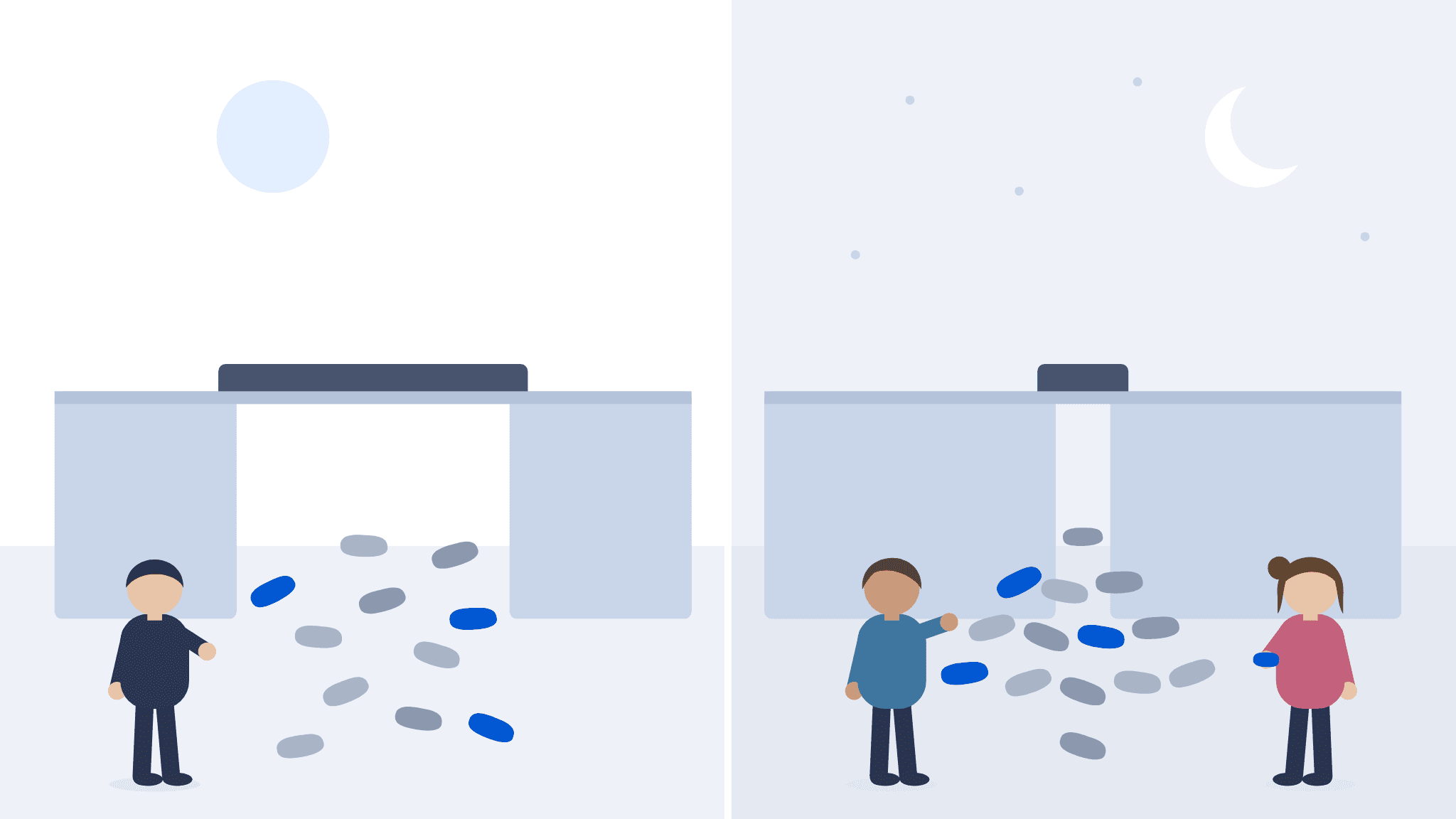
- Do"Spread 40 cents, 90 shares at the ask: thin, so I keep the size small."
- Don't"It trades 24 hours, so it's always liquid."
Open doesn't mean liquid.
Liquidity changes with the time of day
The same instrument can be deep at one hour and thin at another. Pebble's shares and fund trade on an exchange from 09:30 to 16:00; 20:00 is after hours.
Northwind Foods on one day: a spread of 8 cents at the open (48.16 / 48.24), 2 cents at midday, 4 cents just before the close, and 24 cents after hours. Same share, same day, twelve times the cost.
Dataset: Quotes by time of day · shown above
Why? Right after the open, prices are still settling after the night's news, and orders are only arriving. At midday the market is busy and calm, with the most orders near the price. After hours, most traders have gone, and the few who stay quote wide and small: only 120 Northwind shares wait at the ask at 20:00.
So, for a share, the middle of the session is usually the cheapest time to trade, and the first minutes and the hours after the close are the most expensive.
- Do"I'll place it around midday, not in the first minutes or after the close."
- Don't"After hours it's quiet, so it must be cheap."
Quiet means few orders and wide spreads.
Ranking costs across instruments
To compare the cost of trading different instruments at the same moment, put each spread over its own mid price and rank the percentages.
At 20:00, after hours, Pebble's four instruments look like this:
- Harbor 20: 30 cents on a mid of 112.38, about 0.27%
- Northwind Foods: 24 cents on 48.16, about 0.50%
- Bluefin Energy: 40 cents on 39.05, about 1.02%
- Spark Coin: 10 cents on 2.40, about 4.17%
Picture: At 20:00 Spark Coin has the smallest spread in cents, 10, but the biggest in percent of the mid, 4.17%, against 0.27% to 1.02% for the others. · shown above
In cents, the coin looks cheapest and Bluefin most expensive. In percent, the coin costs four times as much as Bluefin and fifteen times as much as Harbor for every dollar traded.
Two habits follow. Rank by percent, never by cents. And compare at the same time of day: the same coin is 2 cents at midday and 10 cents at 20:00, five times wider.
- Do"At 20:00: Harbor 0.27%, Northwind 0.50%, Bluefin 1.02%, the coin 4.17%."
- Don't"Bluefin's 40 cents is the widest spread, so it's the most expensive."
In percent, the coin's 10 cents costs four times as much.
Walking the book: a big market order climbs
The order book lists everyone waiting: sellers at each ask price with their sizes, buyers at each bid price with theirs. The screen shows only the best line of each side.
A market buy takes the cheapest asks first. When the size at the best ask runs out, it moves on to the next price, and the next. That's walking the book.
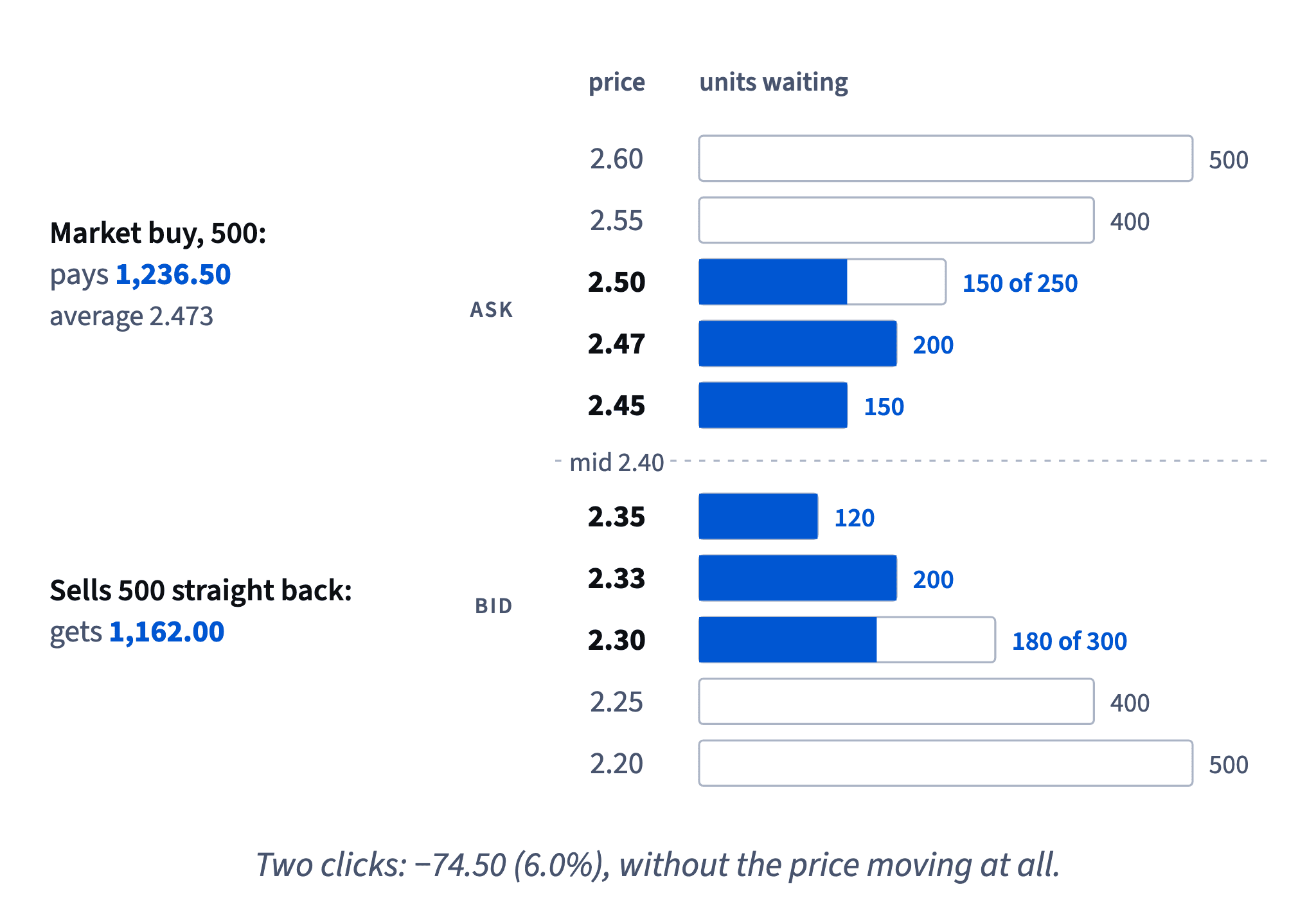
Nora wants 500 Spark Coins at 20:00. The screen says ask 2.45, so she expects 500 × 2.45 = 1,225 dollars. But only 150 coins wait at 2.45. Her order takes 150 × 2.45 = 367.50, then 200 × 2.47 = 494.00, then the last 150 at 2.50 = 375.00. Total: 1,236.50, an average of 2.473 a coin and 11.50 more than the screen suggested.
Before a market order, compare your size with the size at the best price. If yours is bigger, the screen price is only where your fill starts.
- Do"Only 150 at the best ask and I want 500, so I'll pay more than 2.45 on average."
- Don't"500 × 2.45 = 1,225, that's my cost."
The screen price covers only the size waiting there.
The way out walks the book too
A market sell takes the highest bids first and then moves down the book, the mirror image of a buy. In a thin market the exit can cost as much as the entry.
Nora's 500 Spark Coins at 20:00: the best bid has only 120 coins at 2.35, the next 200 at 2.33, then 300 at 2.30, of which she needs 180. She receives 120 × 2.35 = 282.00, plus 200 × 2.33 = 466.00, plus 180 × 2.30 = 414.00: 1,162.00 in total.
She paid 1,236.50 a moment earlier. The round trip lost 74.50, about 6.0% of what she paid, and the price didn't move at all. Most of that loss is the wide spread; the rest is walking both sides of a thin book.
Picture: A market buy of 500 coins takes 150 at 2.45, 200 at 2.47 and 150 at 2.50 for 1,236.50; selling them straight back returns 1,162.00, a 74.50 loss. · shown above
This is the hidden cost of a thin market: getting out is expensive exactly when you want to leave fast. Count it before you go in.
- Do"In: 1,236.50. Out: 1,162.00. Two clicks cost 74.50."
- Don't"I can always sell back at the screen price if I change my mind."
The bid side is thin too, and you walk down it.
The screen price fits a small size only
The price on the screen is real only for the size waiting behind it. A bigger market order walks the book and pays more on the way in and gets less on the way out. The thinner the market, the further it walks.
Marc's habits for thin markets: check the spread in percent and the size at the best prices before the trade; use a limit order so the fill can't climb past a price you chose; trade a smaller size; or wait for busy hours.
Coins need one extra warning: open doesn't mean liquid. Spark Coin trades all night, but at 20:00 its spread is five times its midday spread, and thin hours are when the wildest jumps and fake pumps happen.
How it fits together: two prices, the spread in percent, depth by time of day and walking the book together give the real cost of a fill. Next lesson is a case: picking and placing the right order for a situation.
- Do"Thin book: limit order, smaller size, or wait for midday."
- Don't"Night is the cheap time to buy coins, the market's open."
At night the coin's spread is five times wider.
Ready to practise?
Answer the lesson's exercises and earn 250 points the first time you finish it.
Start the exercises