

Theory
Case: audit a journal and find the leak
Read a month of trades, find where the money leaks and write the one rule that would have fixed most of it.
~9 min read · 10 exercises · 250 points
Before you start
Nora's March
Back on your Pebble practice account, it's audit day. Nora kept a journal for all of March, 40 trades, and she's down 2,190 dollars. She thinks the plan is broken and wants a new entry rule.
This case closes the module on plans. Instead of starting with a new rule, you'll split the journal, compare the trades with what the plan said, and find where the money actually leaked.
An audit starts by splitting the journal
A journal audit has one question: where did the money go? The tempting answer after a bad month is "the plan is broken, I need a new entry rule". An audit doesn't start there. It starts by splitting the journal into two piles: the trades done by the plan and the trades that broke it. That is what the plan_followed column in a trade journal is for (the journal itself comes from Practice account, starting small and the journal).
Dataset · 40 rows
Nora's journal, March 2025
10,000 practice account. Plan: risk 100.00 to the stop, exit at the stop on a loss. Fees 2.00 per round trip; result is after fees.
First 5 of 40 rows
Then add up each pile separately, after fees. The two totals answer different questions. The plan pile says how the rules perform when you follow them. The break pile says what your departures from the rules cost.
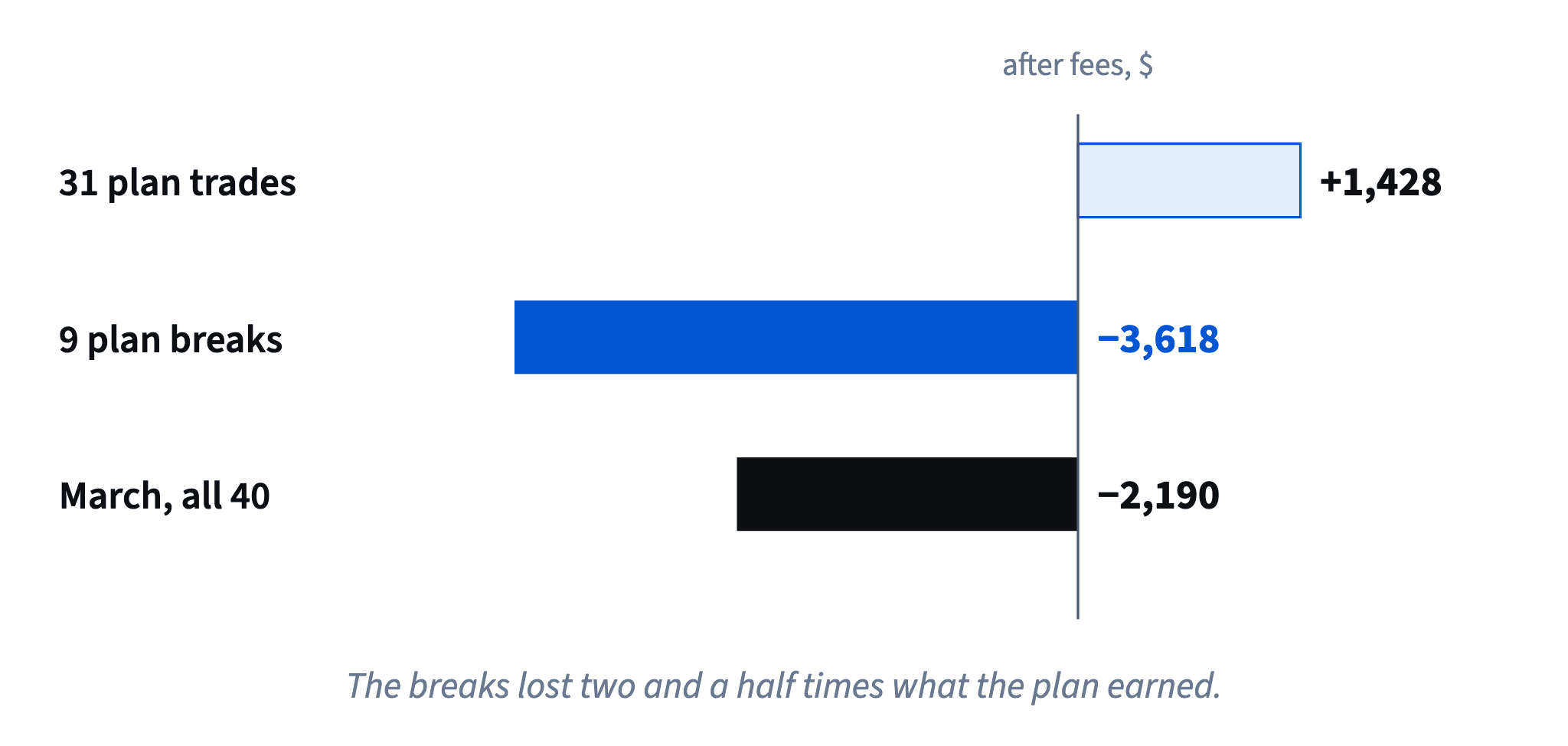
Nora's March on the Pebble practice account: 40 trades, −2,190 after fees, a plan that risks 100 to the stop. Her 31 plan trades: 17 winners worth +2,856 and 14 losers at exactly −102 each (100 to the stop plus 2 in fees), so +1,428 in total.

- Do"First I add up the plan trades and the breaks separately, then I decide what to change."
- Don't"I lost 2,190 this month, so I'm switching to a new entry rule."
Changes the rules before knowing where the loss came from.
Reconcile the two piles with the month
The second pile is the trades that broke the plan. In Nora's journal there are 9 of them, and together they lost −3,618 after fees.
Always check that the two piles add up to the month's result: +1,428 from the plan trades and −3,618 from the breaks give −2,190, exactly what the account shows. If the sum doesn't match, a trade is missing, counted twice or labeled wrong, and every conclusion after that is built on sand.
Now compare the sizes of the two piles. Nine breaks lost two and a half times what 31 plan trades earned. The month's loss didn't come from the plan; it came from less than a quarter of the trades.
That changes the question. It is no longer "which entry rule is better?" but "what happened in those nine trades?" A new entry rule would keep whatever caused the breaks and throw away the part that worked.
- Do"+1,428 (plan) − 3,618 (breaks) = −2,190: matches the account."
- Don't"The breaks were only 9 trades, so they can't matter much."
A few large losses can outweigh many small wins.
Judge the plan on its own trades, with a sample warning
Once the breaks are set aside, the plan pile can be read as a small test of the rules. Its average result per trade after fees is the expectancy from Expectancy: the average trade in module 4: 1,428 ÷ 31 = 46.06 dollars per trade.
Look at what sits behind the average. 17 of 31 plan trades won (55%), averaging 168.00; the 14 losers were all exactly −102.00, because the stop did its job. Small, equal losses and larger wins: that is how a plan is supposed to behave.
Then add the honest caveat. 31 trades is only just past the 30-trade minimum, in one month, on practice money. That makes +46 per trade an early sign, not proof that the plan works. The audit can say "the plan is not where the money leaked"; it can't yet say "the plan makes money".
- Do"Plan trades: +46 a trade on 31 trades. Early sign, keep logging."
- Don't"+1,428 on the plan trades: the plan is proven, time to go live."
One month and 31 trades can't prove an edge.
Find what the breaks have in common
After splitting and pricing the piles, read the break pile line by line with three questions: when, how big, and where did each one exit?
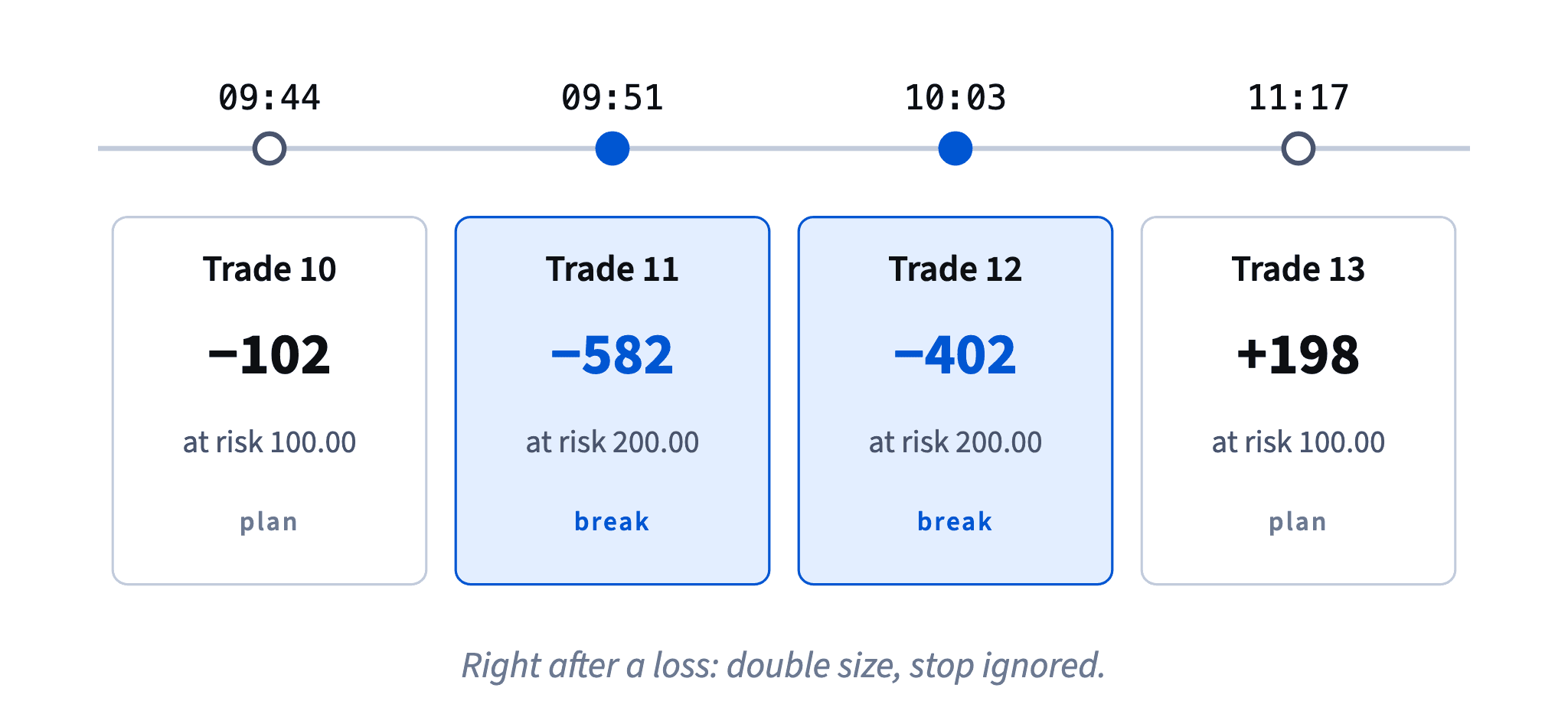
In Nora's journal the answer repeats nine times. When: minutes after a losing trade (trade 5 at 11:51, twelve minutes after trade 4 lost; trade 11 seven minutes after trade 10). How big: (entry − stop) × size = 200, double the plan's 100. Where out: the losers ran 1.8 to 3 stop distances below the entry, so the stop was moved or ignored.
Dataset: Nora's journal, March 2025 · shown above
This pattern has a name: revenge trading, going bigger right after a loss to win it back fast and refusing to take the next loss. Module 8 looks at the feelings behind it; an audit only needs to see the pattern and its price.
Patterns that don't repeat (one instrument, one weekday) are noise. Check them, then drop them.
- Do"All 9 breaks: minutes after a loss, 200 at risk, stop moved."
- Don't"Bluefin Energy is cursed for me, I'll stop trading it."
Blames an instrument the pattern doesn't single out.
A moved stop turns a planned loss into an unplanned one
A stop is the price at which the plan admits a trade was wrong, set before entry (the stop from The stop: where it goes and why in module 3). Its whole value is that the loss is known in advance. Moving it lower "to give the trade room" removes that value.
Trade 5 shows the cost in one line. 50 shares, entry 56.25, planned stop 52.25: at the stop the loss would have been 50 × 4.00 + 2 in fees = −202. The stop was not respected, and the trade exited at 45.45: 50 × 10.80 + 2 = −542. The moved stop alone cost 340, on top of the doubled size.
Dataset: Nora's journal, March 2025 · shown above
A second loss within minutes feels unbearable, so hope takes over, and hope has no exit price. That is why the fix is mechanical: the stop goes in together with the order and is never moved further away.
- Do"The stop goes in with the order. I may tighten it, never widen it."
- Don't"It's just below my stop, I'll give it another dollar of room."
The planned −202 becomes −542.
Price the habit: replay the breaks by the plan
To know what a habit costs, replay the same trades as if the plan had been followed: same entries, plan size, exit at the planned stop on a loss. The entries stay; only the behavior changes.
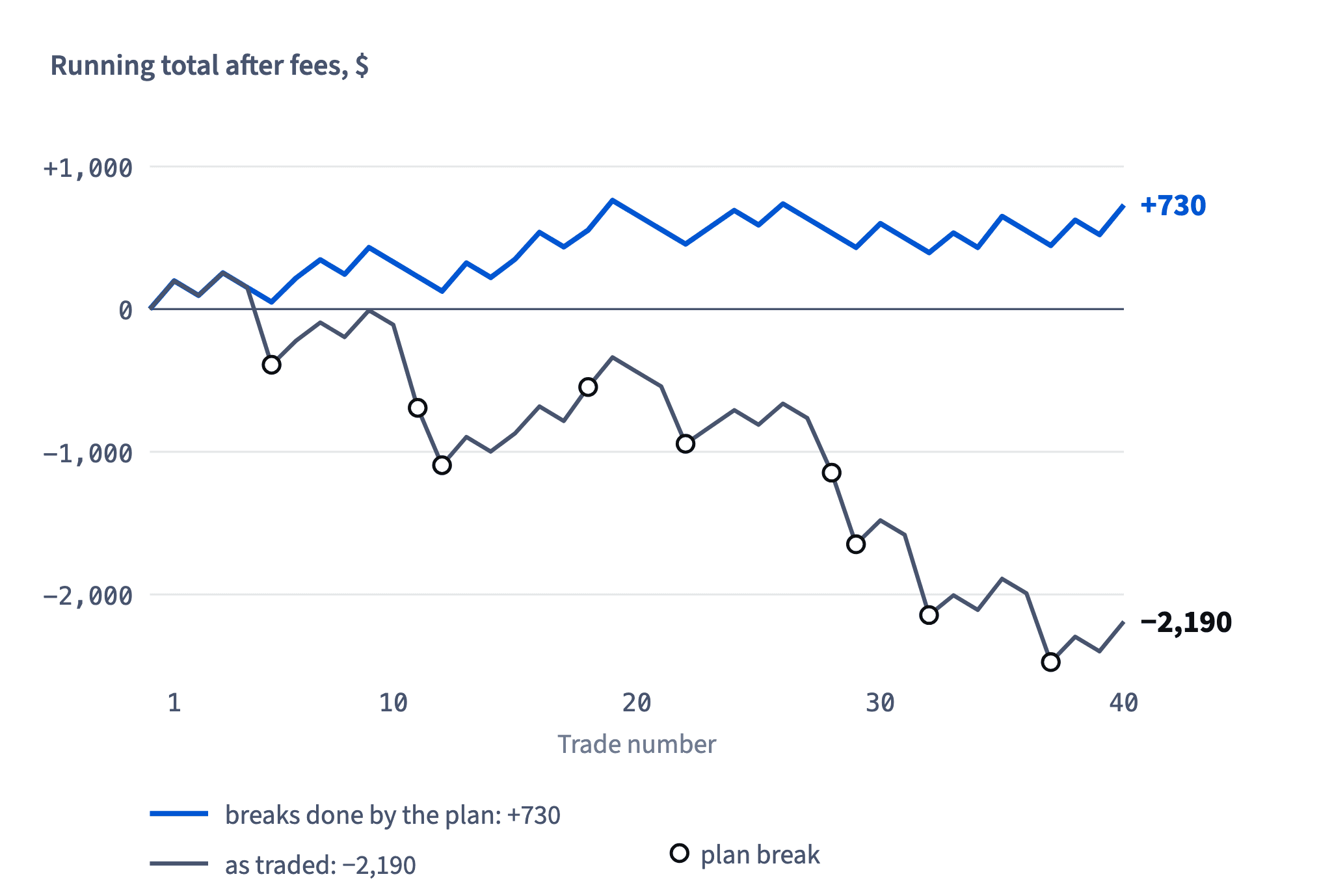
For Nora's 9 breaks: the 8 losers at the plan would have lost 8 × −102 = −816. The one winner, trade 18, at the plan's half size makes 20 × (116.00 − 110.00) − 2 = +118. Together −698, instead of −3,618. Add the plan trades: 1,428 − 698 = +730 for the month, instead of −2,190.
So the habit cost about 2,920 in one month. Note that trade 18 won at double size: a habit that wins sometimes is the hardest kind to drop, because the win is remembered and the eight losses are explained away.
The replay is a "what if", not a promise. It shows where the leak is, not what next month will bring.
- Do"Same entries by the plan: +730 instead of −2,190. The leak is behavior."
- Don't"But trade 18 made 238 at double size, so going bigger works."
One win against eight large losses.
One fix: aimed at the moment, checkable, hard to break
An audit ends with one rule, not five. One rule can be followed and checked in next month's journal; five rules blur into "be better".
A good fix has three marks. It targets the moment of the leak: for Nora, the minutes right after a loss. It is checkable yes or no, like every line of a plan (A one-page trading plan). And it is hard to break in the heat of the moment: it removes a decision instead of relying on willpower.
"After any losing trade, no new trade for the rest of the day" has all three. "Try harder to stay calm" has none of them. A new entry rule or a new instrument misses the moment completely.
Marc, the experienced trader in this course, adds two habits that make such a rule stick: the stop goes in with the order and is never moved, and after a loss he closes the app and writes the journal line first. By the time it is written, the urge has passed.
- Do"After any losing trade: no new trade until tomorrow."
Aimed at the moment, yes or no, no willpower needed.
- Don't"From now on I'll be more disciplined."
Can't be checked, fails exactly when it's needed.
What one month can and can't tell you
A month of journal is a backtest of your own behavior, and it deserves the same closing question as any test (Backtest basics and traps): what could be wrong with this?
What Nora's March can show: the pattern is clear and repeated nine times out of nine, and its price is large (about 2,920). That is enough to act on: add one rule and watch it in next month's journal.
What it can't show: that the plan makes money. 31 plan trades is only just past the 30-trade minimum, it is one month of one kind of market, and it is practice money, where fills and nerves differ from real money. So the honest summary is "the leak is behavior; the plan's edge is not proven yet".
How it fits together: split the journal, price both piles, find the pattern, price the habit, add one checkable rule, state the limits. The leak was Nora herself, which is module 8's question: what if I am the weak link?
- Do"The leak is revenge trading. The plan looks fine so far, but 31 trades prove nothing yet."
- Don't"Plan trades were +1,428, so with the new rule I'll make 1,400 a month."
Turns one month into a promise.
Ready to practise?
Answer the lesson's exercises and earn 250 points the first time you finish it.
Start the exercises