

Theory
Product vision and value proposition
What a product vision is and how a mission, a product vision and a product strategy differ, how to fill in a value proposition template, how Sofia compresses it into a one-line vision for CatChow, and three product vision examples.
~10 min read · 11 exercises · 250 points
Before you start
The mission isn't the vision
Still at CatChow, still building next year's roadmap for Ian. The inputs are in, and the same three problems keep coming up. Now Ian wants the board slides to open with the vision, and he'd like to reuse the mission from the website.
In this lesson you'll see how a mission, a product vision and a product strategy differ, fill in a value proposition for CatChow's customers, and help Sofia compress it into a one-line vision.
Mission, vision, strategy, objectives
Four statements sit above a roadmap, and each has its own job. Together they make up the “why” behind it:
- A mission says what the company does now, and for whom.
- A product vision describes the future the product is working towards: who benefits and how their life is different.
- The product strategy is the path chosen from here to the vision: which customers and problems to focus on, and what not to do.
- A business objective is a measurable result that shows the strategy is working, such as cutting monthly churn from 9% to 6%.
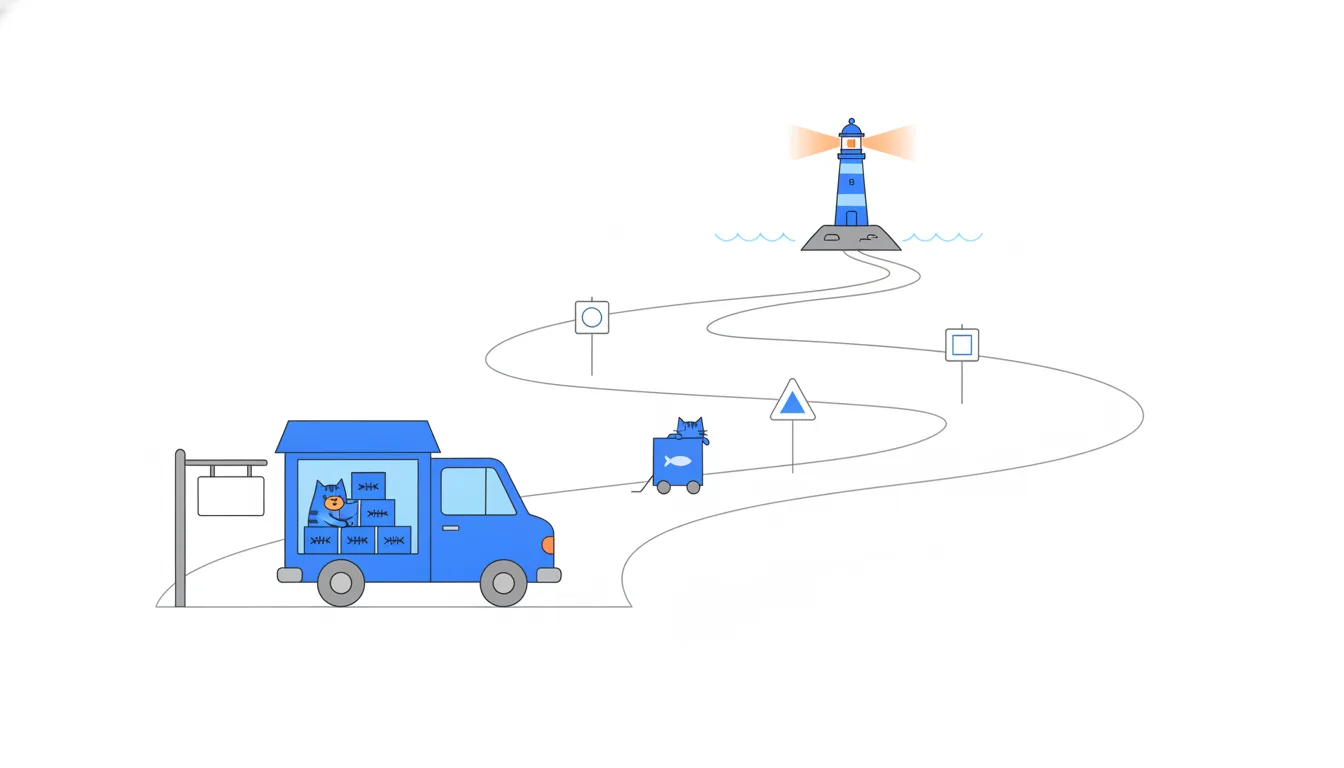
The roadmap is the strategy put in order and written so people can read it; without a vision above it, it's just a list. This lesson builds the vision; the next one builds the strategy and the objectives.
Mixing them up is common. CatChow's CEO, Ian, wants the board slides to open with the vision and suggests the website mission: “Healthy food for every cat, delivered to your door.” That describes what CatChow does today, not the future it's working towards.
- Don'tVision slide: “Healthy food for every cat, delivered to your door.”
That's the mission: what CatChow does today.
- DoVision: “Cat owners and vet clinics never have to worry about running out of the right food.”
A future for the people CatChow serves.
What a vision is not
A vision starts from the people the product serves, so a sentence about the company's own ambition isn't one. Ian's backup idea, “Become the number one pet food brand in Ukraine”, shows why. The board might love it; customers won't notice, and it tells the team nothing about what to build or what to skip. Being number one is a fair ambition, and it belongs among the business objectives. A vision may say what success means for the company too, but it has to start from the customer.

Other things that don't belong in a vision:
- a feature list (“an app, a portal and loyalty points”): that's the roadmap's job, and only as examples;
- a date (“by 2028”): a vision is a direction, not a deadline;
- a revenue number (“1 billion in sales”): that's an objective;
- words any company could claim, such as “best”, “innovative” or “leading”.
A quick test: would a customer reading it recognize a change in their own life? If the sentence only flatters the company, it isn't a vision yet.
- Don't“Become the number one pet food brand in Ukraine.”
About the company, not the customer: an objective at best.
- Don't“The most innovative pet food platform, with an app and loyalty points, by 2028.”
Buzzword, features and a date.
- Do“Every cat eats the right food, and owners never worry about running out.”
Starts from the customer and names the change.
A value proposition template
To get from a rough draft to a good vision, start wider, then compress. A value proposition spells out who the product is for, what they need, what it gives them and how it differs from the alternatives.
A common template fits it into two sentences: “For [customer] who [need], [product] is a [category] that [benefit]. Unlike [alternative], it [difference].” Each slot forces a choice you might otherwise skip.
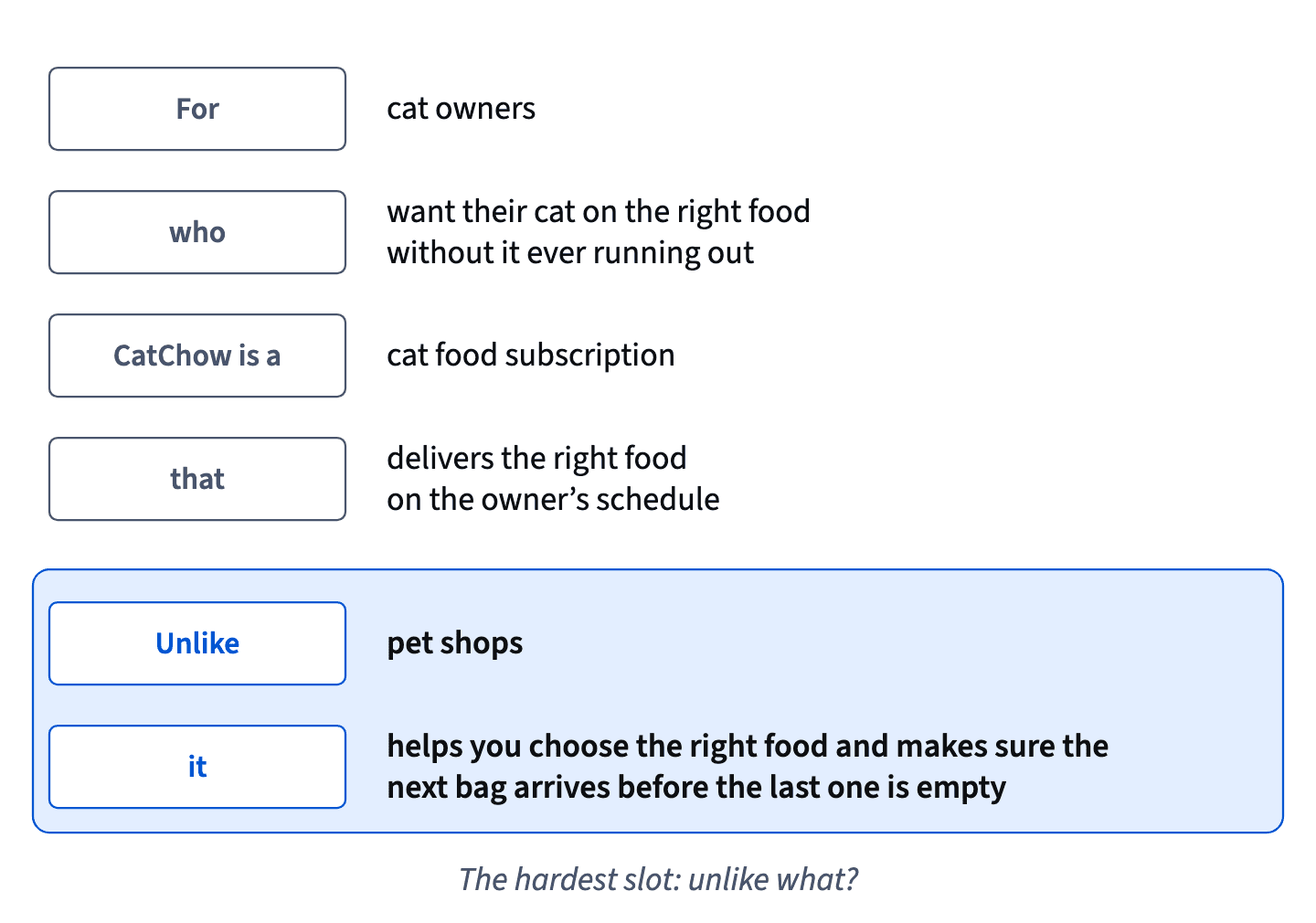
The “who [need]” slot is where drafts most often go wrong. Sofia's first try for subscribers was “for cat owners aged 25 to 40 in big cities”. That's a demographic, not a need: it says who they are, not what they struggle with. Other common slips put a solution in the slot (“who want a mobile app”) or a behavior segment (“who have ordered twice”).
A need describes a struggle, and the inputs already name CatChow's: food running out between deliveries, and not knowing which food suits the cat. So: “For cat owners who don't want the food to run out and aren't sure which food suits their cat…”
- Don't“For cat owners aged 25 to 40 in big cities…”
A demographic, not a need.
- Don't“For cat owners who want a mobile app for ordering…”
A solution hiding in the need slot.
- Do“For cat owners who don't want the food to run out and aren't sure which food suits their cat…”
Names what they struggle with.
Unlike what? Finding a real difference
The hardest slot in the template is “unlike [alternative]”. Sofia's draft so far: “For cat owners who want their cat on the right food without it ever running out, CatChow is a cat food subscription that delivers the right food on the owner's schedule.” Unlike what?
Picture: The template is a thinking tool, not a slogan. · shown above
Unlike pet shops and marketplaces? They sell the same bags, so the difference can't be the bag. What does CatChow do that a shop doesn't? It helps people choose the food, and it can make sure the next bag arrives before the last one is empty. That's a real difference.
A real difference names a concrete alternative and something the customer would notice and value. Three fakes to avoid:
- a claim anyone can make (“high-quality”);
- a feature with no clear benefit (“a modern app with badges”);
- something that matters only to you (“the fastest-growing company”).
The result may read a bit mechanically, and that's fine: the template is a thinking tool, not a slogan for the website.
- Don't“Unlike other shops, we offer high-quality food.”
Any shop can claim it.
- Do“Unlike pet shops, CatChow helps you choose the right food and makes sure the next bag arrives before the last one is empty.”
A concrete alternative and a difference customers notice.
A value proposition for the clinics
The value proposition template works for any customer, as long as every slot is filled from that customer's side. Brandon, the key account manager, wants a clinic version for talks with new clinics: the customer is the clinic, and the need is the pain he heard at PurrPoint, a chain of 14 vet clinics: prescription diets in stock without hours on the phone.
Three things make this version work:
- The clinic's words, not CatChow's. A clinic director should recognize their own problem in the first sentence. “Optimize procurement workflows” is our language; “diets on the shelf without an hour of phone calls” is theirs.
- The real alternative. Who do clinics order from today? Distributors, by phone. So the difference has to be more than “we also take calls”.
- The benefit, not the feature. The team hasn't chosen a solution yet: the pilot will show whether it's a portal, automatic reorders or something simpler. A value proposition that promises “a clinic ordering portal” commits to an output nobody has tested. Say what changes for the clinic instead: the right diets stay on the shelf, and a cat on a prescription diet keeps getting it.
- Don't“Unlike distributors, CatChow offers a clinic ordering portal with bulk ordering.”
Promises a solution the pilot hasn't chosen.
- Do“Unlike ordering from distributors by phone, CatChow keeps the right diets on your shelf, so no cat on a prescription diet goes without.”
The real alternative and a benefit in the clinic's words.
Clinics in the vision
A vision should name the customers the strategy bets on, and a second kind of customer fits only when one shared need ties them together. At CatChow, Brandon asks whether his clinics are in the vision: if it only says cat owners, clinic directors will think CatChow is just a shop for consumers.
A stakeholder asking isn't a reason on its own. The real reasons are in the strategy. Ian made the vet clinic channel one of his two objectives, so leaving clinics out of the vision would be strange. Check it the other way round: could a clinic theme trace back to a vision about cat owners only? Only through a detour. Better to name them.
But won't a vision for two kinds of customers get long? Not if they share the need. Owners and clinics both want the right food on hand when it's needed, so one sentence can hold both.
That doesn't mean a vision should list every segment a company has, or that naming more customers makes it more ambitious. More names only make it harder to remember.
- Do“…neither owners nor vet clinics ever have to worry about running out.”
Two customers, one shared need.
- Don't“…for owners, clinics, breeders, shelters, pet hotels and groomers.”
A segment list, not a vision.
Compress it into one breath
A vision is a value proposition compressed to one breath: keep who benefits and what changes for them, drop the category and the competitor, which have done their work in the template. Ian's reason is practical: if he can't say it in one breath, the board won't remember it.
For CatChow: “Every cat eats the right food, and neither owners nor vet clinics ever have to worry about running out.” One breath, two kinds of customers, one need, no features.
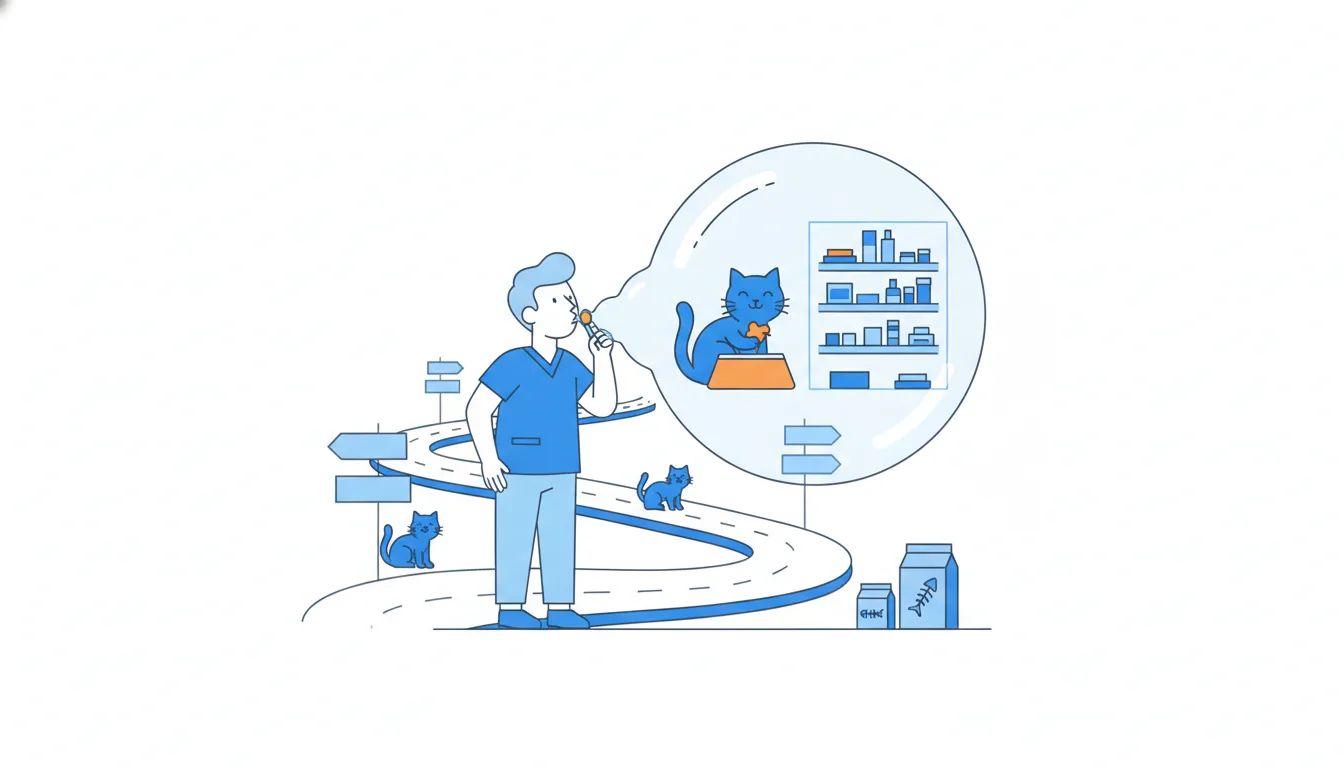
The difference from shops didn't vanish. It lives in the value proposition, which sales and marketing will use. The vision keeps only what everyone must remember.
The same move works for any product. A service for small cafés has a value proposition about owners losing hours ordering from a dozen suppliers. A product description (“an ordering platform with supplier catalogs”), a company ambition (“the leading platform in Eastern Europe”) or a list of outputs with a date are not its vision. “Café owners spend their time on guests, not on chasing suppliers” is.
- Don't“An ordering platform for cafés with supplier catalogs and order history.”
A product description, not a vision.
- Do“Café owners spend their time on guests, not on chasing suppliers.”
Who benefits and what changes, in one breath.
A vision that rules things out
The real test of a vision: it should be specific enough to rule things out. CatChow's tech lead, Lucy, asks exactly that: will the sentence help her say no to the shiny thing someone brings every quarter?
Try it on the spreadsheet. Reorder reminders, flexible delivery dates, the food-picker quiz and Brandon's bulk ordering are all about the right food, on hand when it's needed: they stay as candidates. Birthday greetings for cats serve neither part of the vision: out. A vision like “the best pet food experience” would rule out nothing, which is why it helps no one.
Dataset · 40 rows
CatChow's request spreadsheet
The 40 feature requests from sales, support and the founders that the product team starts the course with, in the order they sit in the spreadsheet. Synthetic data made for this course.
First 5 of 40 rows
The vision also opens every version of the roadmap, for every audience. And the benefit it promises customers has to serve a company objective too, or nobody will fund it.
How it fits together: inputs lead to a value proposition, the value proposition compresses into a one-breath vision, and the vision becomes a filter for the spreadsheet. Next, the lesson on business objectives turns the strategy into objectives the board can measure, each with its key results.
- DoVision filter: “Birthday greetings for cats? Neither owners nor clinics run out less. Out.”
The vision says no for you.
- Don't“The best pet food experience.”
Fits every idea, so it filters nothing.
Ready to practise?
Answer the lesson's exercises and earn 250 points the first time you finish it.
Start the exercises