

Theory
The Σ sign: sums, limits and running totals
Read Σ with its limits, see why deviations from the mean add up to zero, use sums of products, running totals and double indices, and two shortcuts: n(n + 1)/2 and k(k − 1)/2.
~9 min read · 9 exercises · 250 points
Before you start
Σ means "add them up"
You're still on Klasna's product team, and the statistics and finance formulas you'll meet are full of a big Σ. Last lesson gave you the dictionary of notation; today you take on its most common sign.
Using the lessons a few Klasna learners took in a month, you'll read what a sum asks you to add and which terms it covers, rewrite familiar formulas such as the mean with Σ, and build running totals.
Σ: what to add and which terms
Σ, the Greek capital sigma, means "add them up". A sum has three parts: what follows Σ says what to add, the mark below says where to start and the mark above where to stop.
Σ from i = 1 to n of xᵢ is x₁ + x₂ + … + xₙ. For five learners who took 6, 9, 4, 7 and 14 lessons, Σxᵢ = 40. The mean is that sum divided by how many: x̄ = (1/n)Σxᵢ = 40 ÷ 5 = 8. Behind the symbols, the mean formula just says "add them all, divide by how many".
The limits are a filter on the index. From i = 2 to 4 means x₂ + x₃ + x₄ = 9 + 4 + 7 = 20, counting positions as collected. When a formula drops the limits and writes just Σx, it means all of them.
Read a sum aloud before computing it: "for every learner, take their lessons, and add".
- DoΣ from i = 2 to 4 for 6, 9, 4, 7, 14: 9 + 4 + 7 = 20
- Don'tAdding x₁ and x₅ as well, "because Σ means everything"
The limits say which terms.
Deviations add up to zero
A sum you'll meet in every formula about spread is Σ(xᵢ − x̄): subtract the mean from each value first, then add. For 6, 9, 4, 7, 14 with x̄ = 8 the deviations are −2, +1, −4, −1 and +6, and they add up to 0.
That's no coincidence. It happens for every list, because the mean is the balance point: the total distance of the values below it equals the total distance of those above. In symbols, Σ(xᵢ − x̄) = Σxᵢ − n·x̄, and n·x̄ is exactly Σxᵢ, so the result is 0.
So an "average deviation" can't measure spread: it's always zero, whether the values are tightly packed or wildly different. Statistics gets around this by squaring the deviations before adding them, Σ(xᵢ − x̄)², so negative and positive ones can't cancel. Module 4 explains why squares.
The zero is also a handy check: if your deviations don't add up to zero, the mean or one of the deviations is wrong.
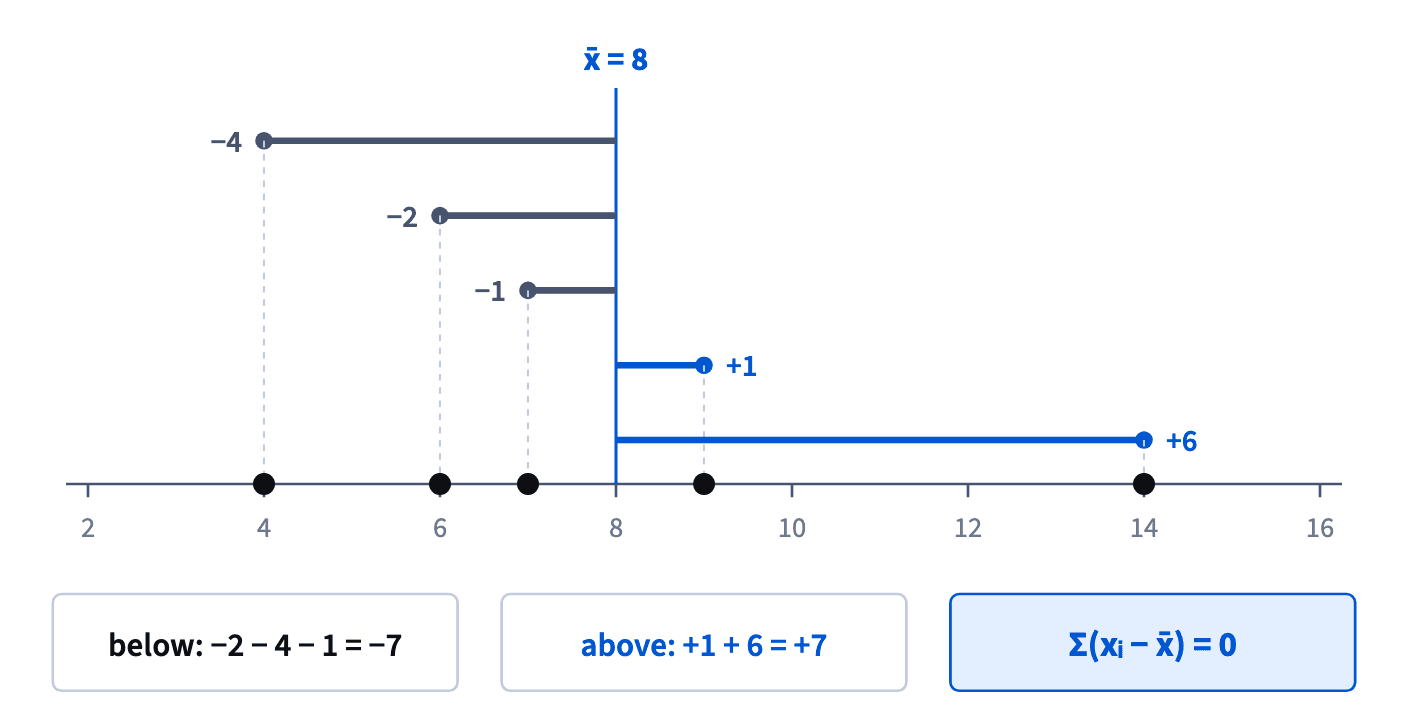
- Do−2 + 1 − 4 − 1 + 6 = 0, so the mean 8 checks out
- Don't"The average deviation is 0, so lesson counts don't vary"
It's 0 for every list.
Σxᵢ² or (Σxᵢ)²: the brackets decide
A square next to a sum can mean two very different things, and the brackets say which.
- Σxᵢ²: square each value first, then add. For 6, 9, 4, 7, 14: 36 + 81 + 16 + 49 + 196 = 378.
- (Σxᵢ)²: add first, then square the total: 40² = 1,600.
It's the order of operations from module 1 again: powers come before addition unless brackets say otherwise, and the square in Σxᵢ² sits on each xᵢ.
The two live in different places. Sums of squared values and squared deviations sit inside variance and standard deviation. A squared total appears in shortcut formulas such as Σxᵢ² − (Σxᵢ)²/n, which gives the sum of squared deviations without computing every deviation. For 1, 2, 3 it gives 14 − 36/3 = 2, the same as (−1)² + 0² + 1².
When a formula has both, compute each on its own line before you combine them.
- DoΣxᵢ² for 6, 9, 4, 7, 14 = 378
- Don'tΣxᵢ² = 40² = 1,600
That's (Σxᵢ)².
Sums of products
Often each term of a sum is itself a product. In March Klasna sold English lessons in three packages: 1,200 lessons at 650 UAH, 3,400 at 620 and 2,000 at 580. Revenue is Σqᵢ·pᵢ, quantity times price, package by package:
1,200 × 650 + 3,400 × 620 + 2,000 × 580 = 780,000 + 2,108,000 + 1,160,000 = 4,048,000 UAH.
Multiply inside each term first, then add the terms, as the order of operations says. The tempting shortcut, adding all the quantities and all the prices and multiplying the totals, gives 6,600 × 1,850 = 12,210,000, three times too much.
Divide the sum of products by Σqᵢ = 6,600 and you get the average price per lesson, about 613.33 UAH, an average weighted by quantity; module 3 builds on it. Correlation in statistics is a sum of products too: Σ(xᵢ − x̄)(yᵢ − ȳ).
- DoΣqᵢ·pᵢ = 780,000 + 2,108,000 + 1,160,000
- Don't(Σqᵢ) × (Σpᵢ) = 6,600 × 1,850
Three times too much.
Running totals and payback
When the upper limit of a sum moves, you get a running total: Sₖ = x₁ + … + xₖ, everything added up to step k. In a spreadsheet it's a column that adds each new value to the cell above.
A cohort of learners brings 120, 100, 90 and 80 UAH of margin per learner in months 1 to 4. The running totals are S₁ = 120, S₂ = 220, S₃ = 310 and S₄ = 390. Plotted against k, that's an LTV curve: it keeps rising while each month adds something, but more slowly as the monthly amounts shrink.
Payback is the first k where the running total reaches the acquisition cost. If a learner cost 300 UAH to win, S₂ = 220 is not enough and S₃ = 310 is, so payback comes in month 3.
Two slips: comparing the cost with one month's value instead of the running total, and dividing the cost by the first month as if every month brought the same.
- DoS₃ = 310 ≥ 300: payback in month 3
- Don't"Month 1 brings 120, so payback takes 300 ÷ 120 = 2.5 months"
Ignores that the monthly amounts shrink.
Two indices: cohorts and ages
Some sums run over two things at once. To forecast active users, product analytics adds up cohorts: MAUₜ = Σ N_c · r₍ₜ₋c₎. MAUₜ is the monthly active users in month t, N_c is how many joined in month c, and r₍ₜ₋c₎ is the share still active t − c months later, at the cohort's age in month t.
Cohorts of 400, 500 and 600 joined in January to March; retention is 100%, 50% and 40% at ages 0, 1 and 2. In March the January cohort is 2 months old, February's 1 and March's 0:
400 × 0.4 + 500 × 0.5 + 600 × 1 = 160 + 250 + 600 = 1,010 active learners.
On a cohort grid, one index walks down the cohorts and the other across the months; the sum for one month adds up one column. The usual slip is pairing a cohort with the wrong age, for example giving the newest cohort the oldest retention. Write each cohort's age next to it before you multiply.
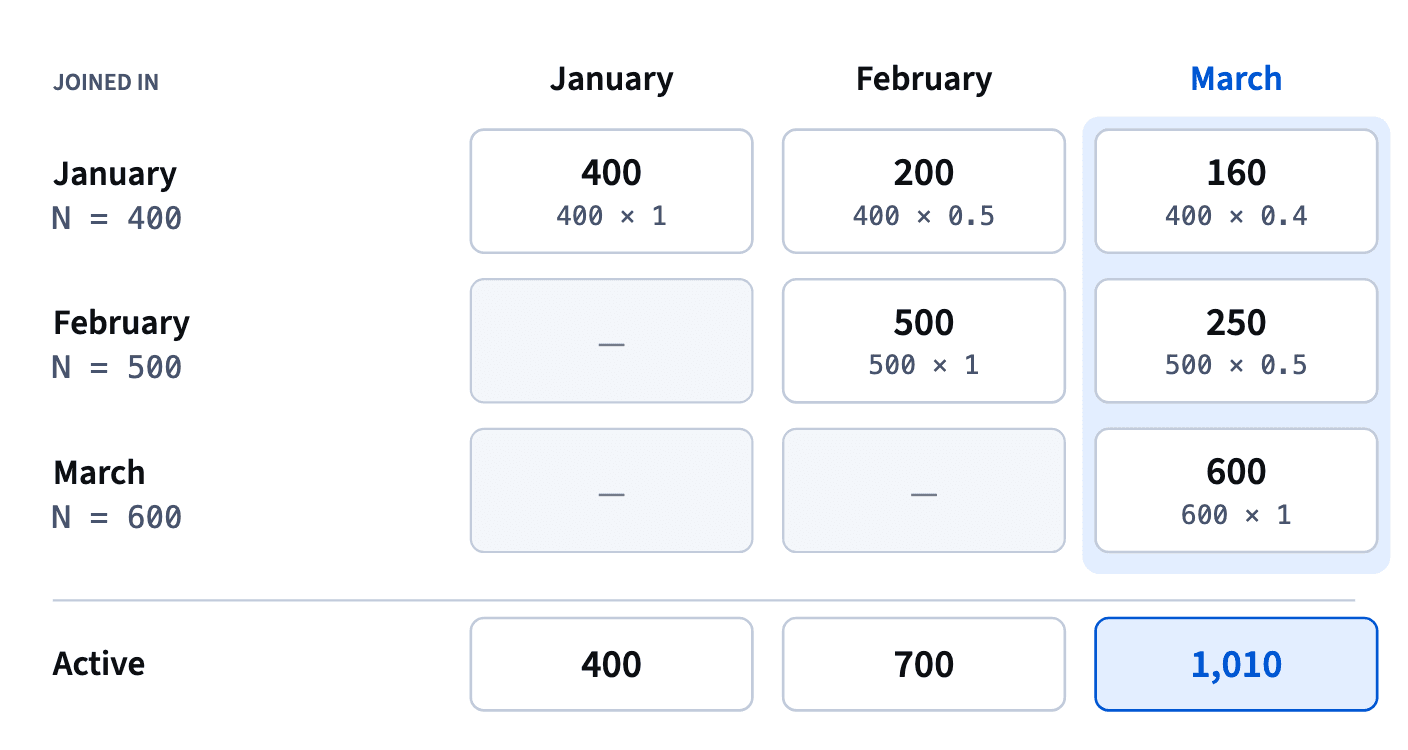
- DoJanuary cohort in March: age 2, so 400 × 0.4
- Don't400 × 1 + 500 × 0.5 + 600 × 0.4
Ages reversed.
1 + 2 + … + n = n(n + 1)/2
Some sums have a shortcut. The sum of the first n whole numbers is 1 + 2 + … + n = n(n + 1)/2.
Why: pair the first number with the last, 1 + n, the second with the second-to-last, 2 + (n − 1), and so on. Every pair adds to n + 1, and there are n/2 pairs. For n = 10, each pair is 11 and there are five pairs: 55.
The shortcut appears in the Mann–Whitney test, which ranks all observations and works with sums of ranks. Whatever the data, the ranks of n observations always add to n(n + 1)/2, so the test can subtract that baseline: U = R − n(n + 1)/2. Thirty ranked users always give 30 × 31 ÷ 2 = 465, whatever their scores.
Check the formula on a case you can add by hand, n = 4: 1 + 2 + 3 + 4 = 10, and 4 × 5 ÷ 2 = 10.
- Do1 + … + 10 = 10 × 11 ÷ 2 = 55
- Don't1 + … + 10 = 10 × 10 ÷ 2 = 50
Each pair adds to n + 1, not n.
How many pairs: k(k − 1)/2
How many pairs can you make from k things? Each of the k can pair with the k − 1 others, which gives k(k − 1), but that counts every pair twice, A with B and B with A. So the number of pairs is k(k − 1)/2.
Four test variants give 4 × 3 ÷ 2 = 6 pairwise comparisons; eight give 28. Pairs grow roughly with the square of k, much faster than the variants themselves. That matters in testing: every extra comparison is another chance of a false alarm, which is why tests with many variants need stricter thresholds, as module 7 shows.
How it fits together: Σ says what to add and which terms; deviations from the mean add up to zero; squares, products, running totals and two indices all mean "do this to each term, then add"; two shortcuts count ranks and pairs. Next lesson: rearranging a formula to find the number you need.
- Do5 variants → 5 × 4 ÷ 2 = 10 pairs
- Don't4 variants → 4 × 3 = 12 pairs
Counts each pair twice.
Ready to practise?
Answer the lesson's exercises and earn 250 points the first time you finish it.
Start the exercises