

Theory
The linear function
Read y = a + bx in business formulas: profit = c·n − F, trend lines, a tax with a fixed part, the design effect, where two lines cross, and two relations that are not lines.
~9 min read · 9 exercises · 250 points
Before you start
Module 5: lines and models
This module asks how one number depends on others. Profit depends on lessons, tax on income, a forecast on several drivers at once, and a change in a total splits into its causes. Most of these links are lines or sums of lines, so reading them comes down to two questions: where does it start, and what does one more unit add? This lesson covers the linear function y = a + b·x: intercept and slope, break-even, why a line with a fixed part isn't a proportion, where two lines cross, and two shapes that only look like lines.
The linear function: intercept and slope
A linear function has the form y = a + b·x. Two numbers fix it completely:
- the intercept a: the value of y when x = 0, where the line starts;
- the slope b: how much y changes when x grows by 1.
Klasna's monthly profit model is profit = 174.48·n − 1,038,000, with n the lessons delivered. Written as a + b·x, it is −1,038,000 + 174.48·n. The intercept, −1,038,000 UAH, is a month with no lessons at all: fixed costs are still paid, so the line starts below zero. The slope, +174.48 UAH, is what each extra lesson adds, the contribution per lesson.
Read the roles, not the positions. The number standing alone is the start and the number multiplying x is the change per unit, in whatever order they are written. A slope's unit is always "y-units per x-unit": UAH per lesson, learners per month, hryvnias of tax per hryvnia of income. A negative slope means y falls as x grows; a negative intercept only means the line starts below zero.
- Do"−1,038,000 is the profit with zero lessons; +174.48 is what each lesson adds."
- Don't"The first number in a formula is always the intercept."
In 174.48·n − 1,038,000 the first number is the slope.
Reading a value off a line
To use a line, put a value of x in and compute y. The order of operations from Order of operations, ratios and multiples applies: multiply first, then add or subtract.
For 7,000 lessons: 174.48 × 7,000 = 1,221,360, then 1,221,360 − 1,038,000 = 183,360 UAH of operating profit.
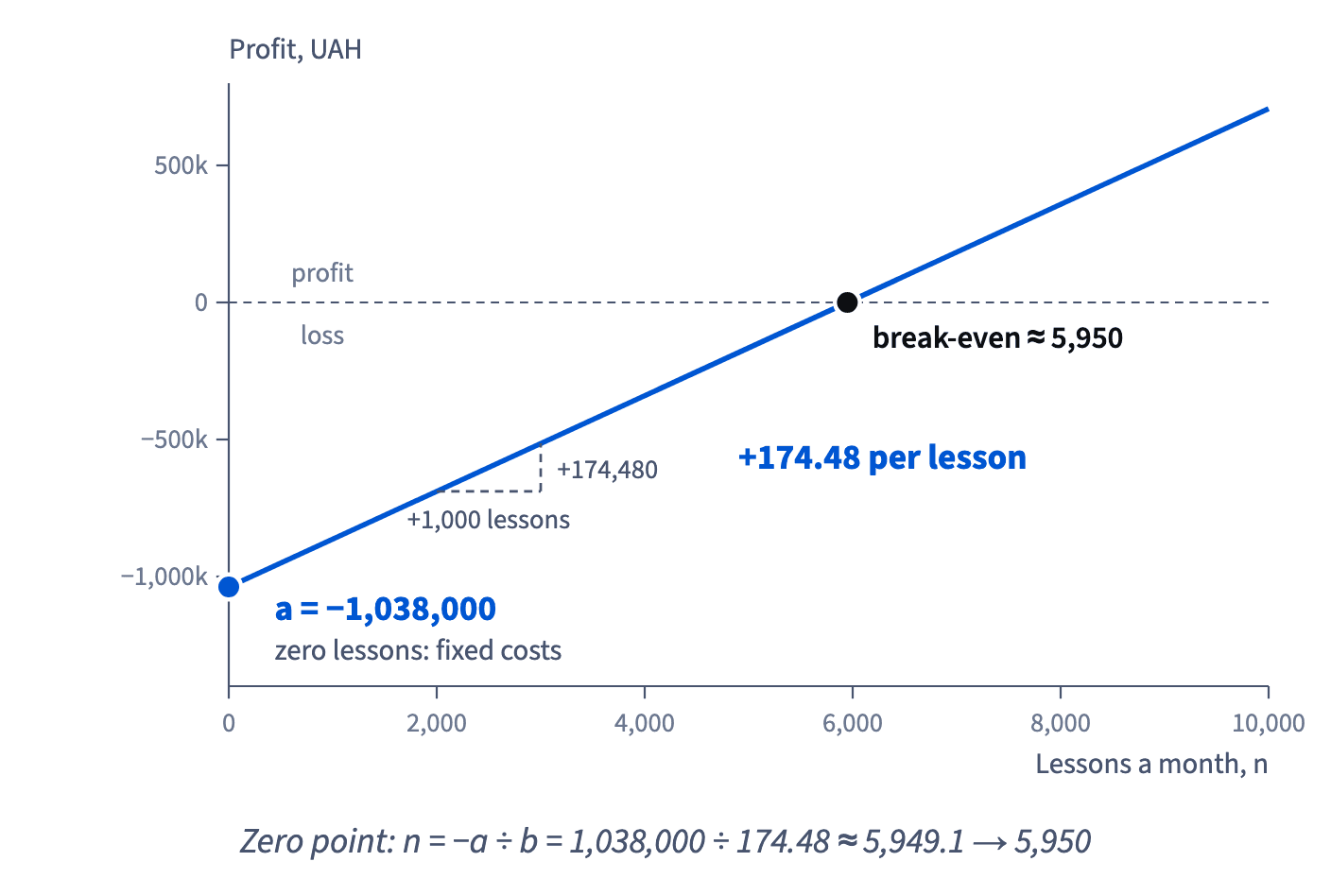
Two quick checks keep the result honest. The sign: below break-even (about 5,950 lessons) profit must be negative, above it positive; 7,000 is above, so a positive result fits. The step: moving along a line by Δx changes y by exactly b·Δx, whatever the intercept. So 1,000 fewer lessons cost 174,480 UAH, and 6,000 lessons should give 183,360 − 174,480 = 8,880 UAH.
A line is a model that holds within a range. This one assumes fixed costs stay at 1,038,000; far beyond the volumes Klasna knows, new hires or bigger premises would change both numbers.
- DoMultiply, then subtract: 174.48 × 7,000 − 1,038,000 = 183,360.
- Don't174.48 × (7,000 − 1,038,000)
Brackets the formula doesn't have change the result.
Where a line crosses zero: break-even
A line with a negative intercept and a positive slope crosses zero exactly once. Setting a + b·x = 0 gives x = −a ÷ b. In a profit model that point is the break-even: below it the month loses money, above it it earns.
For profit = 174.48·n − 1,038,000: n = 1,038,000 ÷ 174.48 ≈ 5,949.1. Lessons come whole and 5,949 still leaves a small loss, so the break-even is rounded up to 5,950 lessons, the rounding-up rule from Rounding: at the end, and sometimes up.
Picture: The intercept is where the line starts, the slope is how steeply it climbs. · shown above
The same move works for any line. A webinar that costs 4,000 UAH to run and earns 150 UAH per attendee breaks even at 4,000 ÷ 150 ≈ 26.7, so 27 attendees.
Read the result as the size of the hole (the intercept) divided by how fast each unit fills it (the slope). Halve the slope and the break-even doubles; double the fixed costs and it doubles too.
- DoBreak-even 5,949.1 → plan for 5,950 lessons.
- Don'tBreak-even 5,949.1 → "5,949 lessons is enough".
Rounding down leaves a small loss.
The same shape in many formulas
Once you know a + b·x, you'll find it all over business formulas. The trick is to name what x is, then read the start and the change per unit.
- Trend line: active learners ≈ 820 + 50·t, with t in months since September 2025. Start 820, plus 50 learners a month.
- Tax with a fixed part: a sole proprietor (FOP) pays 6% of income plus a fixed contribution of 5,707.02 UAH a quarter: tax = 5,707.02 + 0.06·income. This line starts above zero.
- Design effect in tests on groups: DE = 1 + (m − 1)·ICC. Here x is m − 1, the other people in a group; the intercept is 1 and the slope is ICC, how alike group members are. Groups of 6 with ICC 0.1 give 1 + 5 × 0.1 = 1.5, so the test needs 1.5 times as many learners.
Sometimes x hides inside brackets, as m − 1 does here. Rewrite the formula until it reads "number + number × something", and the intercept and slope are in plain view.
- DoDE = 1 + (m − 1)·ICC: "start 1, plus ICC for each extra group member".
- Don'tRead the 6% in the tax rule as the whole story of what a tutor pays.
The fixed 5,707.02 is the intercept and is paid even with no income.
A line is not a proportion
Only a line through zero, y = b·x, is a proportion: double x and y doubles, halve x and y halves. As soon as there is an intercept, that stops being true.
Take a tutor's tax, 5,707.02 + 0.06·income per quarter. At 100,000 UAH of income it is 5,707.02 + 6,000 = 11,707.02; at 200,000 it is 5,707.02 + 12,000 = 17,707.02. Income doubled, tax grew about 1.5 times, because the fixed part didn't move.
With a negative intercept it goes the other way. A webinar earning 150·n − 4,000 UAH makes 500 UAH with 30 attendees and 5,000 with 60: twice the attendees, ten times the profit, because the fixed cost is covered only once.
So before saying "twice the x, twice the y", look at the intercept. If it isn't zero, compute both points instead of scaling one.
- DoCompute both points: 11,707.02 at 100,000 and 17,707.02 at 200,000.
- Don't"Income doubles, so tax doubles to 23,414.04."
The intercept breaks proportionality.
The effective rate
With a fixed part, the share of x that y makes up changes with x. That share, y ÷ x, is the effective rate. The slope is only the rate on the next unit, the marginal rate, which the next lesson takes up.
For the tax line 5,707.02 + 0.06·income:
- a thin summer quarter of 69,000 UAH: tax 5,707.02 + 4,140 = 9,847.02, effective rate 9,847.02 ÷ 69,000 = 14.27%;
- a quarter of 300,000 UAH: tax 5,707.02 + 18,000 = 23,707.02, effective rate 7.90%.
The fixed part is spread over more income, so the effective rate falls toward the 6% slope but never reaches it. Quoting "6%" as what a small practice pays understates its real burden more than twice.
The same reading works for cost per lesson: fixed costs ÷ lessons + variable cost per lesson falls as volume grows, toward the variable cost.
- DoEffective rate = tax ÷ income = 9,847.02 ÷ 69,000 = 14.27%.
- Don't"Our tutors pay 6% tax, whatever they earn."
6% is the slope; the effective rate is higher, more so on small incomes.
Where two lines cross
Many choices compare two options, each a line in the same x. Setting them equal, a₁ + b₁x = a₂ + b₂x, gives the crossing point x = (a₂ − a₁) ÷ (b₁ − b₂): the difference in starts divided by the difference in slopes. It's the same solving as in Rearranging a formula: solve for what you need.
An example from the finance course: founders keep 0.80·(X − 1,200,000) of a profit X with a loan and 0.70·X with an investor. Open the brackets: 0.80·X − 960,000 = 0.70·X, so 0.10·X = 960,000 and X = 9,600,000 UAH.
Then read the picture. Left of the crossing the line that starts higher wins; right of it, the steeper one. Below 9.6 million of profit the investor deal leaves the founders more, above it the loan does.
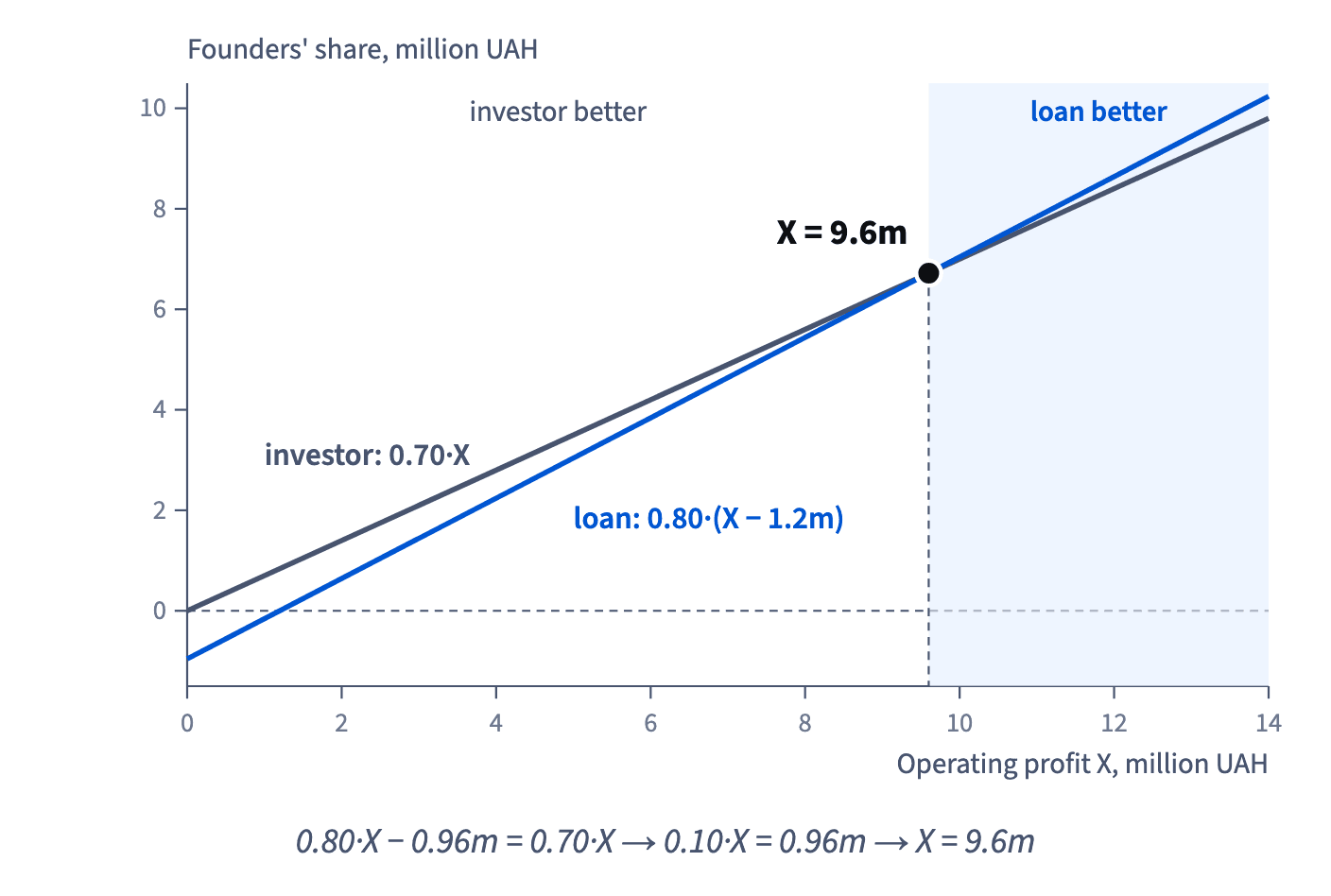
Two lines with the same slope never cross: one stays ahead everywhere. And a crossing far outside realistic values means one option wins in practice.
- Do30·n = 120,000 + 8·n → n = 120,000 ÷ 22 ≈ 5,455 lessons.
- Don't"The loan is better, because it keeps 80% and the investor only 70%."
Which line wins depends on which side of the crossing you are.
Not every relation is a line
Two common cost shapes look like lines but aren't.
Steps. Support coordinators cost ⌈learners ÷ 400⌉ × 38,000 UAH: flat up to 400 learners, then a jump of a whole salary. A straight line drawn through the steps misleads near every jump.
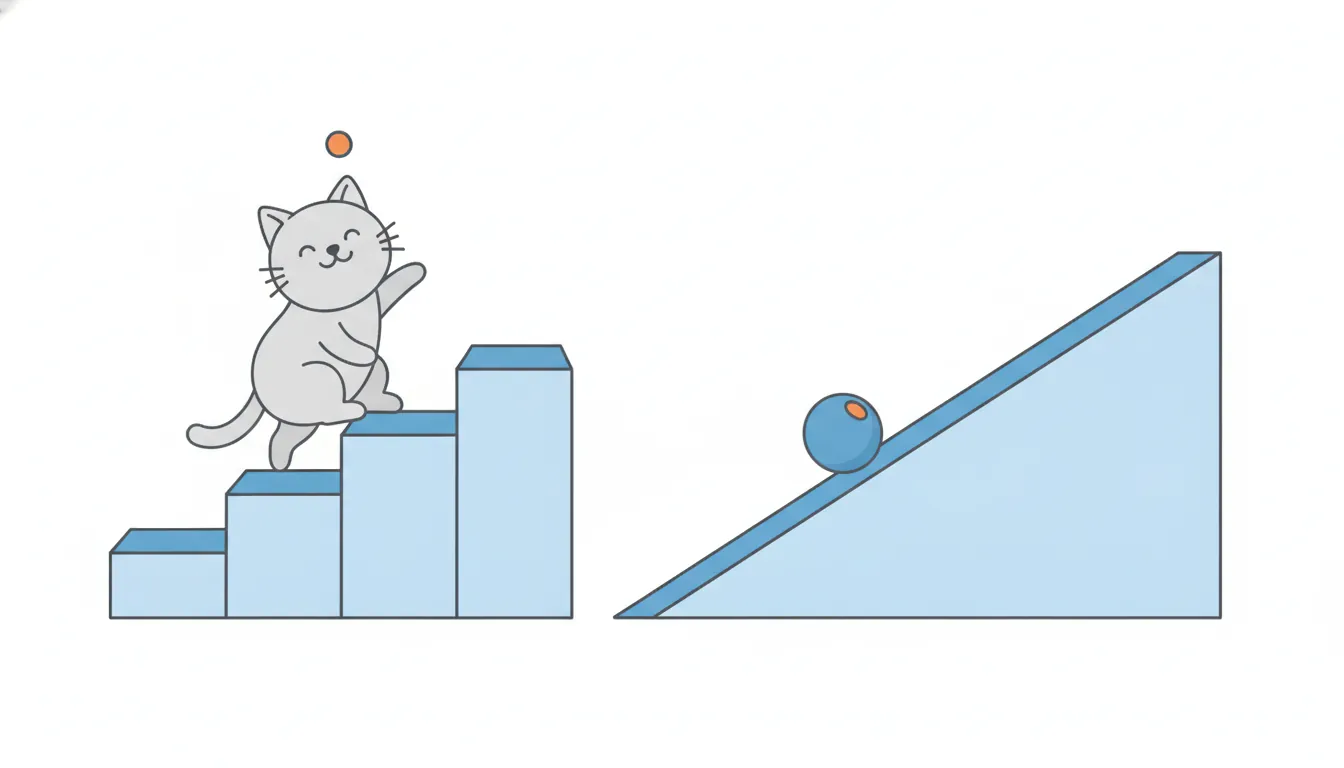
A curve with a minimum. A job of 36 person-days shared by n people takes 36 ÷ n days, but every extra person adds a day of coordination: time = 36 ÷ n + (n − 1). The first part falls, the second grows, so the total is smallest somewhere in between. Compute a few values: 5 people take 7.2 + 4 = 11.2 days, 6 take 6 + 5 = 11, 7 take about 5.1 + 6 = 11.1. A straight line has no minimum inside its range; finding one shows the relation isn't linear.
How it fits together: a line is a start plus a constant step; break-even, effective rates and crossing points all come from it, and steps or curves show where it stops working. The next lesson looks at the slope itself: what one more unit adds, and why that differs from the average.
- DoCompute time = 36 ÷ n + (n − 1) for several n and pick the smallest.
- Don't"More people always finish faster."
Coordination grows with every person added.
Ready to practise?
Answer the lesson's exercises and earn 250 points the first time you finish it.
Start the exercises