

Theory
Taxes and fees
The after-tax rate r(1 − t), the tax-equivalent rate r ÷ (1 − t), a flat tax plus a fixed contribution and its effective rate, and how a yearly fee compounds against you.
~9 min read · 10 exercises · 250 points
Before you start
Where the deposit's rate went
Last lesson Dana's deposit grew more slowly than its headline rate. Today, still at Klasna, you find out why: tax takes part of the interest, and a yearly fee on a balance keeps taking its share.
This lesson closes the course. You'll work out what is taxed and what is kept, compare rates after tax, tell the tax on the next hryvnia from the average one, and see what a small fee does over many years.
After tax: multiply by 1 − t
A tax on interest takes a share of the interest, not of the deposit. If the tax rate is t, you keep 1 − t of every hryvnia of interest, so the after-tax rate is r × (1 − t).
As of September 2026, Ukraine taxes deposit interest at 18% income tax plus a 5% military levy, 23% in total. Dana's deposit at 14% therefore grows at 14% × 0.77 = 10.78% a year. On 150,000 that is 21,000 of interest, 4,830 of tax and 16,170 kept, exactly 150,000 × 10.78%. A 12% deposit keeps 12% × 0.77 = 9.24%.
Two slips are common. Subtracting the tax rate from the interest rate, 14% − 23%, mixes a share of the interest with a rate on the deposit. And 14% − 2.3 confuses percentage points with percent: the tax takes 23% of 14 points, which is 3.22 points.
- Do12% × (1 − 0.23) = 9.24% after tax.
- Don't"12% minus 23% tax: the deposit loses money."
The 23% is a share of the interest, not a rate to subtract.
The same tax keeps the order
When two options are taxed at the same rate, the tax multiplies both after-tax rates by the same 1 − t. The order doesn't change: the better option before tax is the better one after tax. Only the gap shrinks, by the same factor.
Deposits at 14% and 12%, both taxed at 23%: 10.78% and 9.24% after tax. On 100,000 UAH for a year that is 10,780 against 9,240 kept. The gap of 2,000 before tax becomes 2,000 × 0.77 = 1,540 after it.
So tax is not what decides between two deposits from the same system. It matters when one option is taxed and another isn't, when their tax rates differ, or when the tax is charged at different times. Then compare after tax, or use the tax-equivalent rate from the next card.
- Do"Both deposits are taxed at 23%, so 14% still beats 12%, by 1,540 a year on 100,000."
- Don't"After tax the two deposits are about the same."
A shared tax shrinks the gap by 23%, it doesn't erase it.
The tax-equivalent rate
To compare a taxed option with an untaxed one, put them on the same footing. Either take the tax off the taxed rate, r × (1 − t), or turn the formula around and ask what taxed rate would leave as much as the untaxed one: r ÷ (1 − t). That second number is the tax-equivalent rate, a rearrangement from Rearranging a formula.
Formula: r: the rate before tax; t: the tax rate on the interest. · shown above
Government bonds held by individuals were tax-free as of September 2026. A 16% bond keeps all 16%. A deposit taxed at 23% would need 16% ÷ 0.77 = 20.78% before tax to match it; a 15% bond needs 15% ÷ 0.77 = 19.48%. Check by going back: 19.48% × 0.77 = 15.0%.
The tempting shortcut, 15% × 1.23 = 18.45%, comes out too low: dividing by 0.77 is not the same as multiplying by 1.23. Compare after tax or tax-equivalent, never a taxed rate with an untaxed one.
- Do"The 15% tax-free bond equals a 19.48% taxed deposit."
- Don't"The deposit pays 18%, the bond 16%, so the deposit wins."
18% × 0.77 = 13.86% after tax, below the bond's 16%.
A flat tax plus a fixed part
Some taxes have a percentage and a fixed amount. That is a line with an intercept from The linear function: tax = rate × income + fixed. The effective tax rate is the total tax divided by the income.
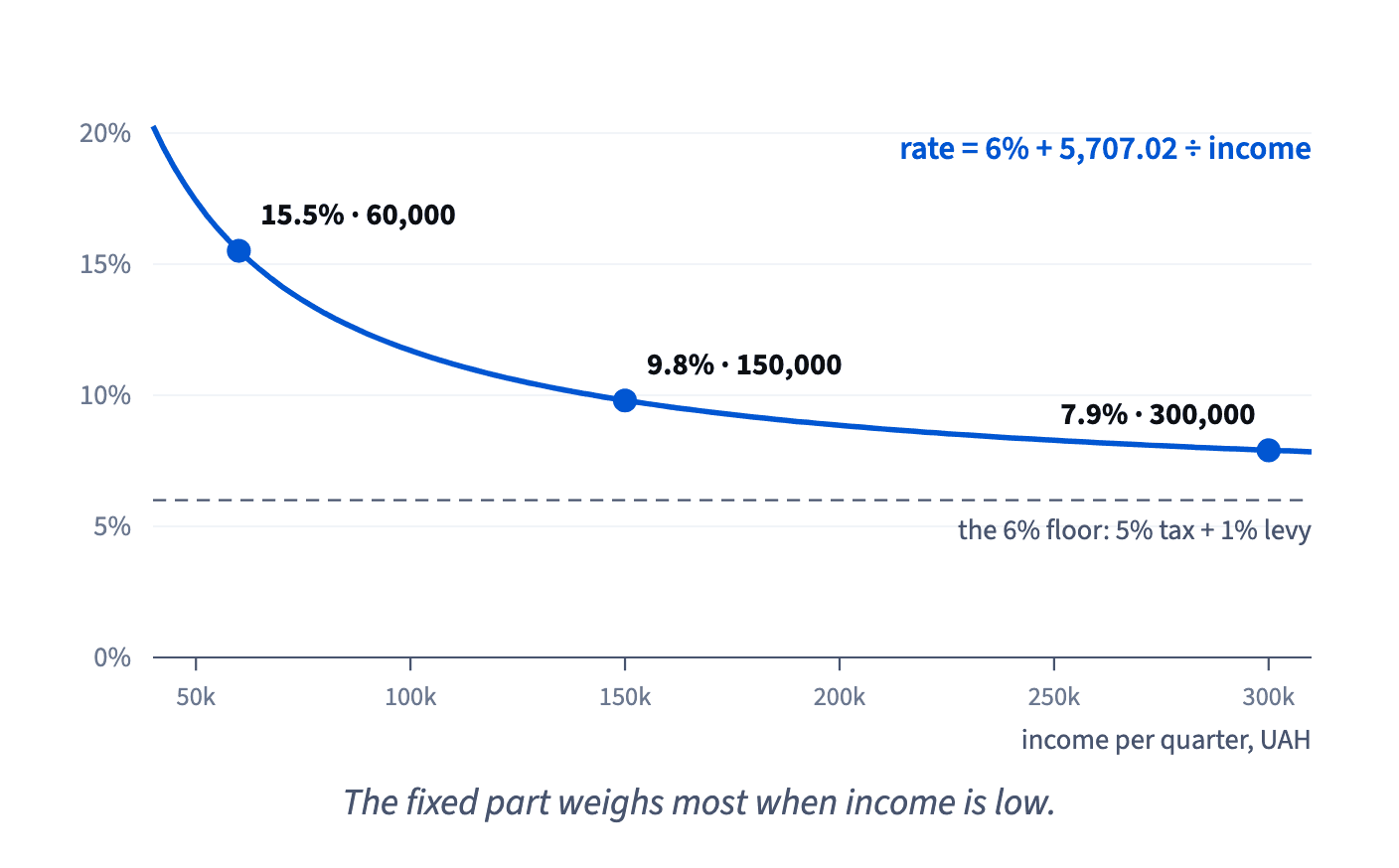
Dana, a sole proprietor in simplified-tax group 3, pays (as of September 2026) 5% of income plus a 1% military levy, and a fixed social contribution of 5,707.02 UAH a quarter whatever she earns: tax = 0.06 × income + 5,707.02. On 150,000 a quarter: 9,000 + 5,707.02 = 14,707.02, an effective rate of 9.8%. On 100,000: 11,707.02, or 11.7%. On 60,000: 15.5%. With no income she still owes 5,707.02.
So the effective rate falls as income grows, toward 6% but never below it. For someone with irregular income this means a slow quarter costs a larger share, and money set aside in good quarters covers the fixed part in bad ones.
- Do"On 100,000 this quarter the tax is 11,707.02, an effective 11.7%."
- Don't"Group 3 pays 6%, so 6,000 on 100,000."
Forgets the fixed 5,707.02 contribution.
The next hryvnia: marginal against effective
A tax line has two rates, and they answer different questions, as in Inequalities, intervals and formulas with cases. The effective rate, tax ÷ income, says what share of all the income went to tax. The marginal rate says how much tax one more hryvnia brings: on a line, it is the slope.
For Dana's tax = 0.06 × income + 5,707.02, the marginal rate is 6% at every income: the fixed part doesn't grow. When her quarter rises from 150,000 to 160,000, tax rises by 0.06 × 10,000 = 600, from 14,707.02 to 15,307.02. Her effective rate falls from 9.8% to 15,307.02 ÷ 160,000 = 9.6%.
Use the marginal rate for decisions about extra work: an extra 10,000 lesson block leaves 9,400, not 10,000 minus 9.8%. Use the effective rate to describe the whole year or to compare with someone else's tax burden.
- Do"10,000 more this quarter means 600 more tax: I keep 9,400."
- Don't"My rate is 9.8%, so 10,000 more costs 980 in tax."
Applies the effective rate to the next hryvnia; the fixed part is already paid.
A fee on the balance: multiply, don't subtract
A yearly fee on the balance, like 2% a year in a fund, takes a share of everything you hold, gains included, not a share of the gain. So in a year the money first grows by 1 + r and then keeps 1 − f of itself. The net yearly return is (1 + r)(1 − f) − 1.
At 5% with a 2% fee: 100 becomes 105, then 2% of 105 goes, leaving 102.90, a net 2.9% a year. At 7% with a 1.5% fee: 1.07 × 0.985 = 1.05395, a net 5.4%.
For one year, subtracting the fee, 7 − 1.5 = 5.5%, is close. But only the product compounds correctly over many years, so use it whenever you project further than a year. And mind the base: a 2% fee is 2% of the balance, which is far more than 2% of the year's gain.
- Do1.07 × 0.985 − 1 = 5.4% net a year.
- Don't"A 2% fee on a 5% return takes 2% of my gain, about 0.1%."
The fee is on the whole balance, not on the gain.
Fee drag over many years
A small yearly fee compounds like a negative return, so over decades its effect, the fee drag, grows far beyond its size. Compare the balance with and without the fee, and measure the gap as a share of the growth you would have had.
100,000 UAH at 5% a year for 20 years: 1.05²⁰ × 100,000 = 265,330. With a 2% yearly fee: (1.05 × 0.98)²⁰ × 100,000 = 177,136. The fee takes 265,330 − 177,136 = 88,194, which is 88,194 ÷ 165,330 = 53.3% of the growth.
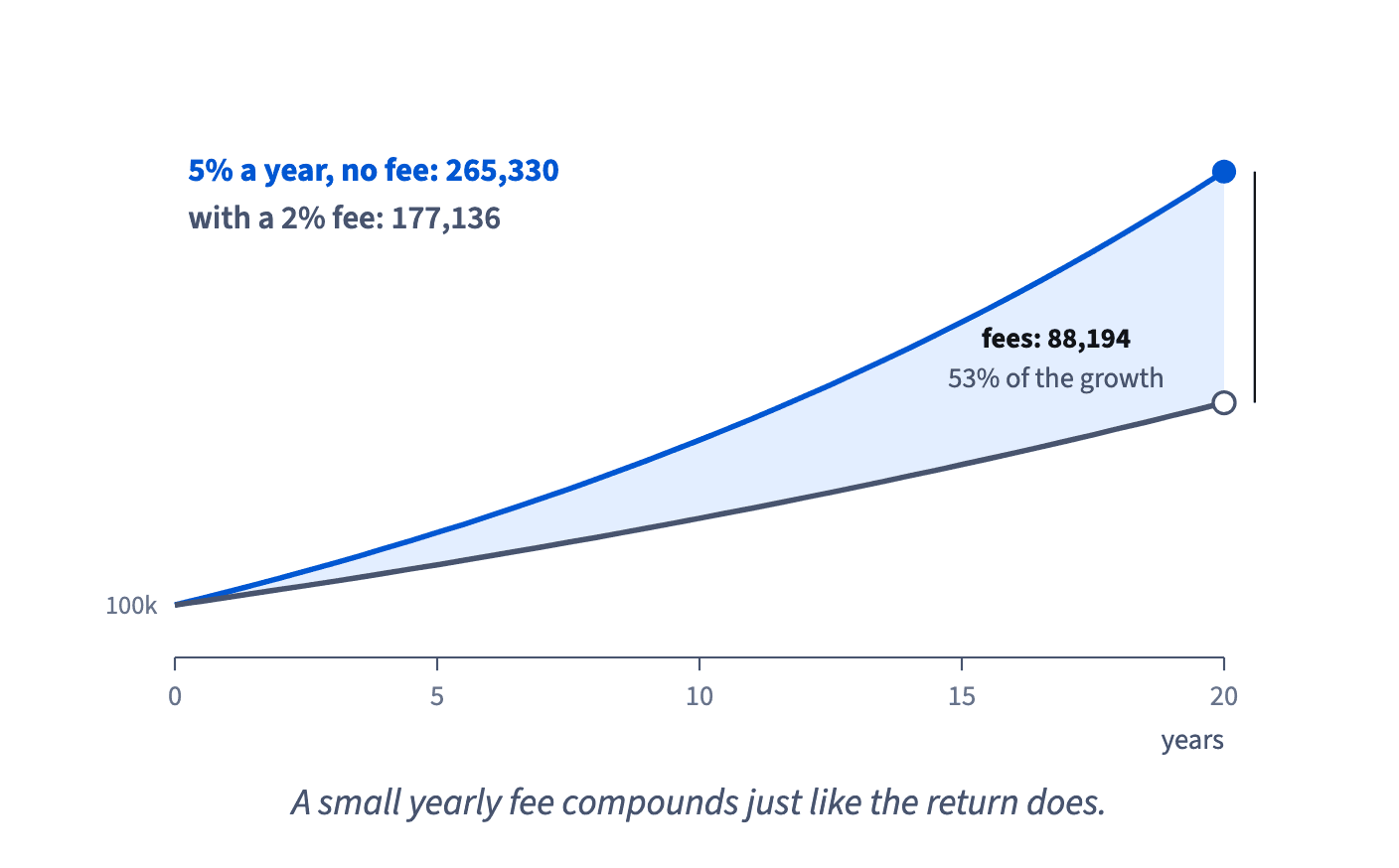
Why so much? The fee alone keeps 0.98²⁰ = 0.668 of the money over 20 years, so about a third of the final balance goes, and the growth, which is the part above 100,000, absorbs all of it. Comparing funds over long horizons, the fee is often the one number you know for sure, while the return is a guess.
- Do"Over 20 years the 2% fee takes about 88,000, more than half of the growth."
- Don't"2% a year for 20 years is 40% of the money."
Fees compound; the real cost is measured against the growth you'd have had.
A one-off fee or a yearly one
A one-off entry fee is paid once: 3% at the start keeps 0.97 of the money, whatever the horizon. A yearly fee keeps (1 − f)ⁿ, so its cost grows with every year. A 1% yearly fee keeps 0.99³ = 0.9703 after 3 years, about even with the entry fee, but 0.99²⁰ = 0.818 after 20 years: 18.2% of the money gone.
So the horizon decides which fee matters. For money parked for a year or two, a large entry fee can be the worse deal; for twenty years, the yearly fee is the one to watch.
Across this course the same few moves kept returning: a share and its base, a sum, a square and its root, a line, a growth factor, a probability.
How it fits together: tax takes 1 − t of the interest; a yearly fee takes 1 − f of the whole balance and compounds. That ends the course: you can read a formula, say what each part does and compute it wherever statistics, finance, product analytics or personal finance use it.
- Do"For a 20-year plan, a 1% yearly fee costs about 18% of the money; the 3% entry fee costs 3%."
- Don't"1% a year is less than 3% once, so the yearly fee is cheaper."
True only for about three years; after that the yearly fee costs more.
Ready to practise?
Answer the lesson's exercises and earn 250 points the first time you finish it.
Start the exercises