

Theory
Simple interest, days and annualizing
Interest on the original amount, counting days, the cost of paying late or skipping an early-payment discount, and turning a period rate into a yearly one.
~9 min read · 9 exercises · 250 points
Before you start
What does time do to money?
Klasna, the online tutoring school, invoices companies on 60-day terms, borrows on a credit line and sells courses in parts, so the date of every payment has a price.
This module puts a number on that price: simple interest by the day, loans and their amortization, real against nominal rates, and taxes and fees. This first lesson prices a delay by the day, turns daily and monthly rates into yearly ones, simple and effective, and shows two kinds of interest in disguise: the early-payment discount and the fee on the original amount.
Simple interest: a price per day
Money has a price per day. While a client holds Klasna's money, Klasna borrows the same amount on its credit line at 24% a year. Simple interest counts that price on the original amount only: I = P × r × d ÷ 365, where P is the principal, r the yearly rate and d the number of days.
A Klasna for Teams invoice (the school's lessons for companies) of 576,000 UAH paid 30 days late costs 576,000 × 0.24 × 30 ÷ 365 ≈ 11,362 UAH: almost 2% of the invoice for one month of waiting. The amount grows in a straight line, the same sum every day, because interest is never charged on earlier interest.
Order matters for accuracy. Multiply first and divide by 365 last; rounding 30 ÷ 365 to 0.08 early would turn 11,362 into 11,059. Simple interest is the right tool for short delays, invoices and day-count fees; when unpaid interest joins the balance, you need compounding instead.
- DoI = 576,000 × 0.24 × 30 ÷ 365 ≈ 11,362 UAH.
- Don'tI = 576,000 × 0.24 = 138,240 UAH for a 30-day delay.
That's a whole year of interest; scale by d ÷ 365.
Count days, and check the year
The d in I = P × r × d ÷ 365 is a count of days between two dates, not a number of months. From 1 March to 30 April is 60 days; "two months" could mean 59, 61 or 62 depending on which months they are. Count the actual days, or let a spreadsheet subtract the dates.
Formula: P: the principal; r: the yearly rate; d: the number of days. · shown above
The divisor is a convention written into the contract. 365 is usual; some lenders divide by 360. The same quoted 24% then costs more, because each day is a bigger slice of the year: 365 ÷ 360 ≈ 1.014, about 1.4% more interest. On 576,000 UAH for 30 days that is 11,520 instead of 11,362, a gap of 158 UAH.
So before comparing two offers with the same rate, check two things: how the days are counted and which year they are divided by. A cheaper-looking rate on a 360-day year can cost more than a slightly higher one on 365.
- Do"1 March to 30 April: 60 days, divided by 365 as the contract says."
- Don't"Two months is 60 days, give or take."
Months differ in length; count the dates.
From a period rate to a yearly rate, simply
A rate is often quoted per day or per month, and you need it per year to compare. The simple way multiplies by the number of periods in a year: 1% a day × 365 = 365% a year; 3% a month × 12 = 36%; 0.8% a day × 365 = 292%.
This is exactly right as long as interest is charged on the original amount and never added to the balance. As of September 2026, Ukrainian law caps the daily rate on consumer loans at 1%, which is that 365% a year.
Two slips are common. Multiplying a daily rate by 30 gives a monthly figure, not a yearly one: 0.8% × 30 = 24% a month. And a small daily number hides a large yearly one: 0.8% a day on 10,000 UAH is 80 UAH every single day.
If unpaid interest does join the balance, the simple yearly rate understates the cost, and you need the effective rate instead.
- Do0.8% a day × 365 = 292% a year, simple.
- Don't"0.8% a day, so about 24% a year."
24% is one month of 0.8% a day.
The effective annual rate
When unpaid interest joins the balance and earns interest too, a year grows faster than the simple rate says. The effective annual rate (EAR) captures that: EAR = (1 + period rate)^periods − 1, the compounding from Compounding applied to one year.
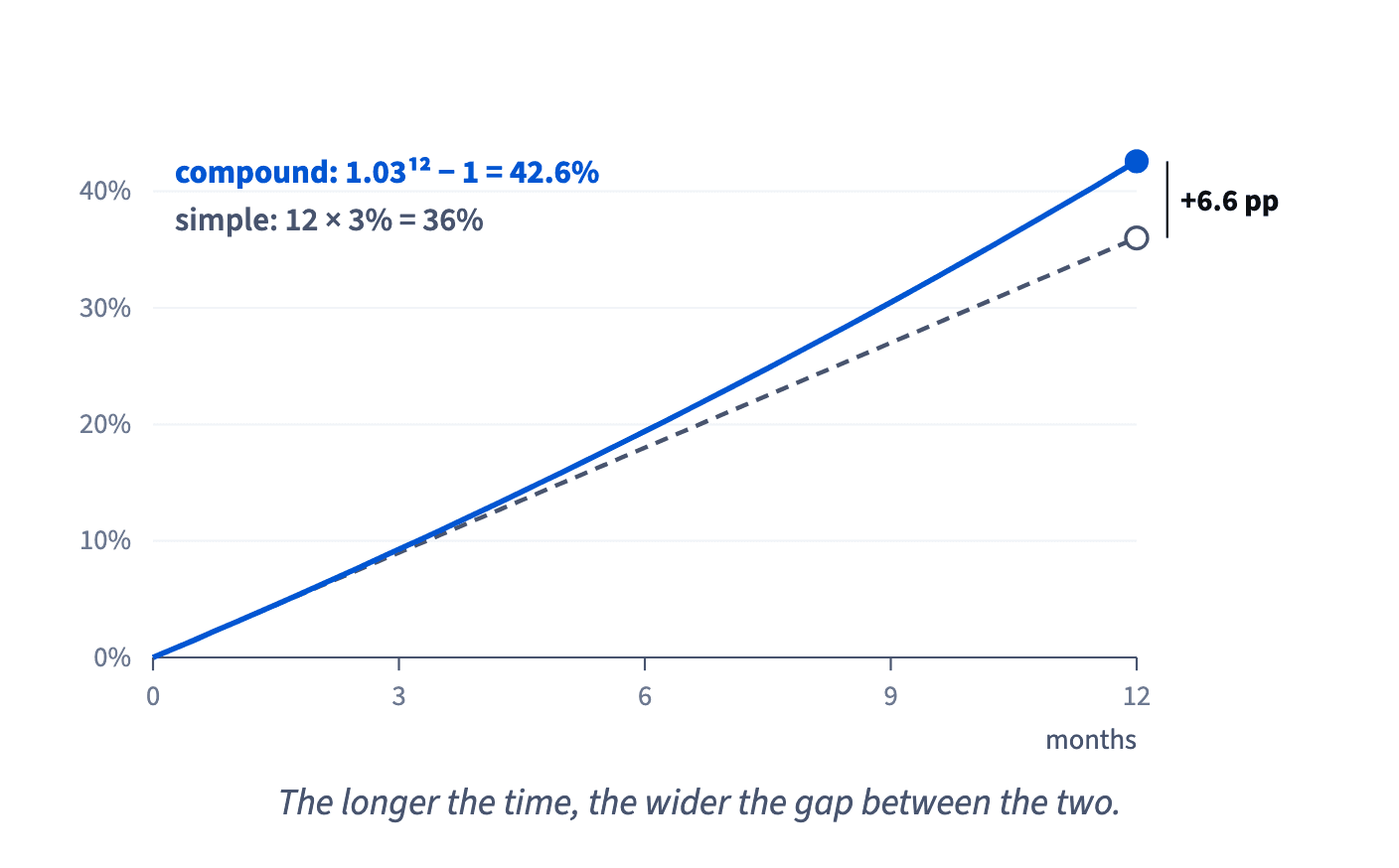
At 3% a month the simple yearly rate is 36%, but 1.03¹² − 1 = 42.6%. A card at 2.5% a month added to the balance: 1.025¹² ≈ 1.3449, so 34.5% a year, not 30%. The more often interest is added, and the higher the rate, the wider the gap.
The nominal yearly rate, period rate × periods, is the friendlier-looking number, which is why lenders like to quote it and why the law asks them to show the real annual cost too. When you compare two offers, put both on the same footing: effective against effective.
- Do2.5% a month, added monthly: 1.025¹² − 1 ≈ 34.5% a year.
- Don'tComparing one lender's nominal 30% with another's effective 32%.
Different footing; convert both to effective first.
When the simple and effective rates match
The simple yearly rate and the effective annual rate describe the same loan in two ways. They agree only in one case: interest is never added to the balance. Then each month's interest is charged on the same amount, 2% a month is 2% × 12 = 24% a year, and that is all.
As soon as unpaid interest joins the balance, the second month charges 2% on 102, the third on 104.04, and so on. A year of that is 1.02¹² ≈ 1.268, so 26.8%, not 24%. The gap is the interest on interest.
So "2% a month" on its own isn't enough to know the yearly cost. Ask whether interest is paid off each month or rolls into the debt. For a loan you repay steadily, the next lesson shows how the balance, the interest and the principal move month by month.
- Do"2% a month, rolled into the debt: about 26.8% a year."
- Don't"2% a month is 24% a year, full stop."
True only if interest is never added to the balance.
The annual cost of an early-payment discount
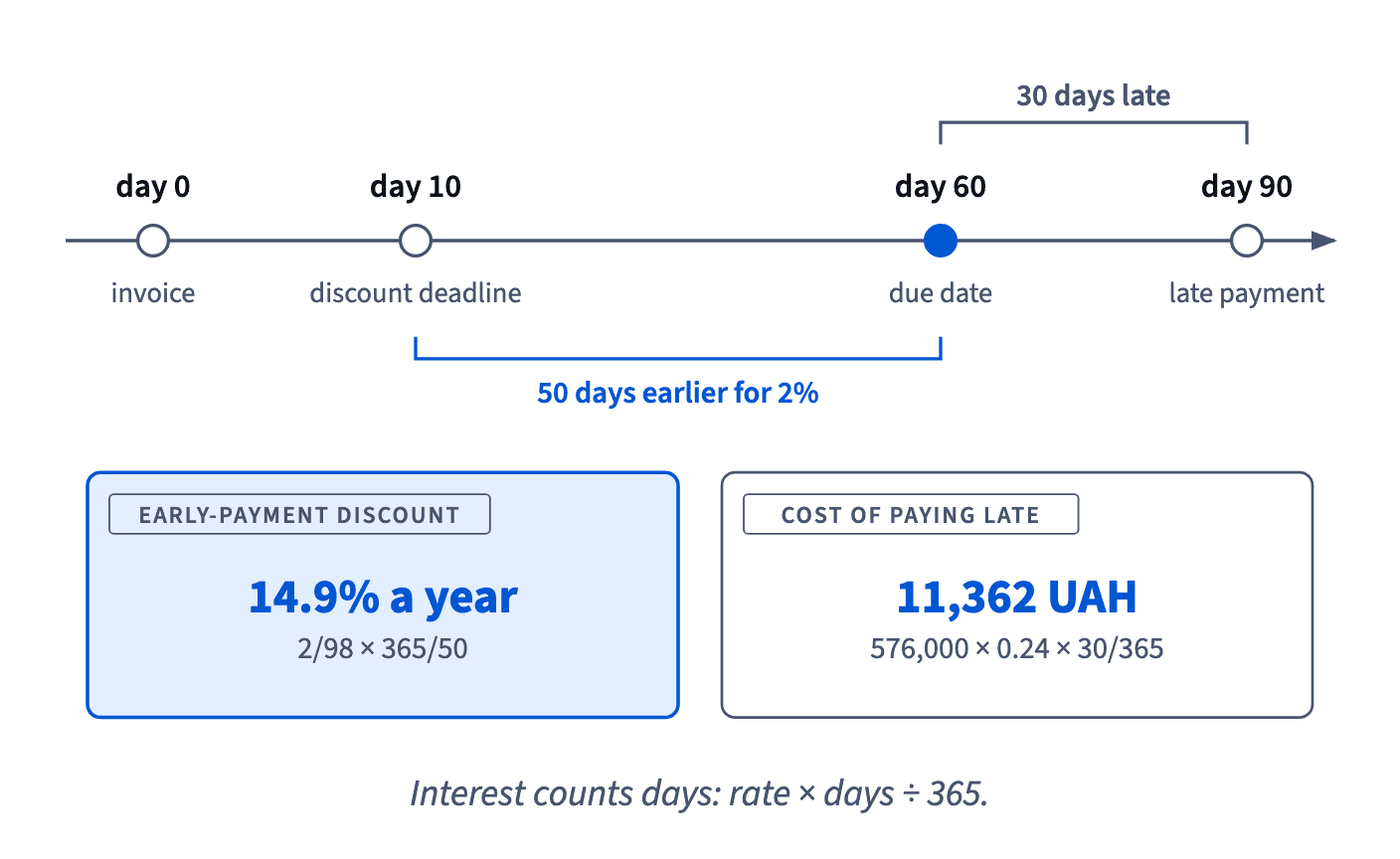
An early-payment discount is a loan in disguise. If Klasna offers 2% off for paying on day 10 instead of day 60, it receives 98 instead of 100, 50 days earlier: it pays 2 to use 98 for 50 days. As a yearly rate: d ÷ (1 − d) × 365 ÷ (days_net − days_discount) = 2 ÷ 98 × 365 ÷ 50 ≈ 14.9%.
The base is 98, not 100, because that is the money actually held early; it's the base rule from Percent vs percentage points. The days are only the days gained, 60 − 10 = 50, not the full 60.
Then compare with what money costs elsewhere. Klasna's credit line costs 24%, so getting paid early at 14.9% is cheaper money: worth offering. Seen from the payer's side, the same number is what skipping the discount costs: a supplier's 1% for paying in 10 days instead of 30 is 1 ÷ 99 × 365 ÷ 20 ≈ 18.4% a year, more than many credit lines.
- Do2% for 50 days: 2 ÷ 98 × 365 ÷ 50 ≈ 14.9% a year, below the 24% credit line.
- Don't"It's only 2%, far below our 24% rate."
Compares a 50-day rate with a yearly one; annualize first.
Two slips in the discount formula: base and days
The discount formula d ÷ (1 − d) × 365 ÷ (days_net − days_discount) has two places where an answer quietly goes wrong.
Formula: d: the discount as a share; the divisor 1 − d is what you actually receive. · shown above
The base. The rate is earned on what changes hands early. With 3% off, the payer hands over 97, not 100, so the period return is 3 ÷ 97 ≈ 3.09%, not 3%. The smaller the base, the larger the rate; using 100 understates it.
The days. Only the days gained count. Paying on day 10 instead of day 40 gains 30 days, so the period return is annualized with 365 ÷ 30, not 365 ÷ 40. Using the full term makes the discount look cheaper than it is.
Put together for 3% on day 10 instead of 40: 3 ÷ 97 × 365 ÷ 30 ≈ 37.6% a year. The wrong base gives 36.5%, the wrong days 28.2%, and forgetting to annualize leaves 3.1%, which looks small next to any yearly rate.
- Do3 ÷ 97 × 365 ÷ 30 ≈ 37.6% a year.
- Don't3 ÷ 100 × 365 ÷ 40 ≈ 27.4% a year.
Wrong base and wrong days at once.
A fee on the original amount
A flat fee on the original amount charges a percentage of the starting debt every period, even as the debt is paid down. It looks cheap because the quoted rate is applied to a number you no longer owe.
Take a 12,000 UAH course in four monthly parts of 3,000 with 1.5% a month of the original 12,000: 180 a month, 720 in total. The offer reads like 1.5% × 12 = 18% a year. But the debt runs 12,000, 9,000, 6,000, 3,000, so on average you owe only 7,500. 720 on 7,500 is 9.6% for four months, about 28.8% a year on the money you actually hold.
Rule of thumb: when the debt falls steadily to zero, the average balance is roughly half the original, so a flat fee costs close to twice its quoted rate.
How it fits together: simple interest prices days on the original amount; annualizing turns period rates into yearly ones, simple or effective; discounts and flat fees are interest in disguise. The next lesson follows a loan's balance month by month.
- Do"1.5% a month on the original 12,000 is about 29% a year on what we actually owe."
- Don't"1.5% a month, so 18% a year."
The fee stays fixed while the debt halves on average.
Ready to practise?
Answer the lesson's exercises and earn 250 points the first time you finish it.
Start the exercises