

Theory
Rearranging a formula: solve for what you need
Do the same to both sides and undo in reverse order: break-even Q = F/c, runway, the regression intercept, sample size, a fraction inside a denominator, and why a gross-up divides by (1 − f).
~8 min read · 9 exercises · 250 points
Before you start
Same formula, different question
Still on Klasna's product team. The finance course writes break-even volume one way, while you may have first met it as a profit formula. Are they two different formulas, or one formula asked two questions?
You'll learn to rearrange a formula to get the unknown you need on its own, step by step and without memorising variants, and to check the result by putting numbers back in.
An equation is a balance
Rearranging a formula means asking the same formula a different question. Profit = c·Q − F answers "how much profit at this volume?"; Q = F/c answers "what volume gives zero profit?". They are one formula, rearranged.
One rule does all the work: an equation is a balance, so whatever you do to one side, you do to the other. Then undo the operations around the unknown in reverse order, the outermost first.
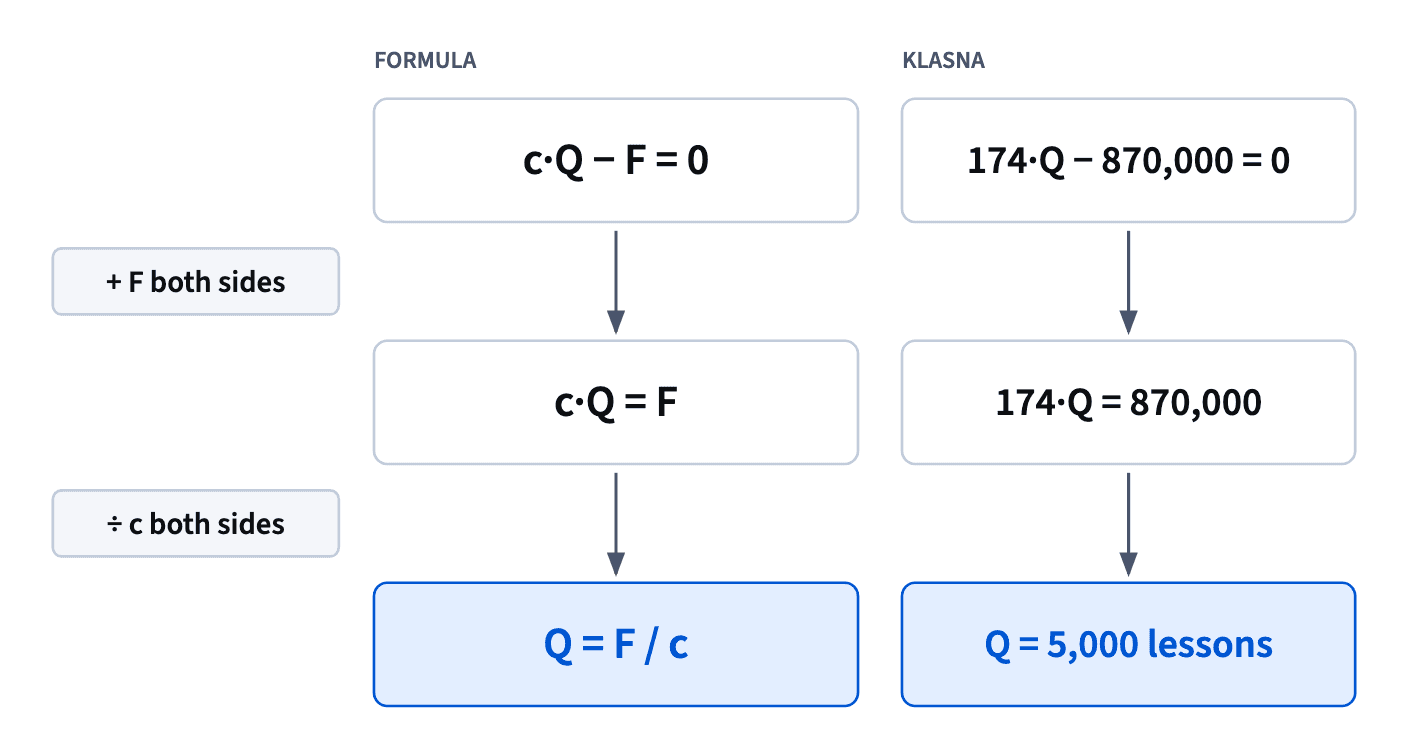
In 174·Q − 870,000 = 0, Q is first multiplied by 174, then 870,000 is subtracted. Undo in reverse: add 870,000 to both sides (174·Q = 870,000), then divide both sides by 174 (Q = 5,000).
Legal moves: add or subtract the same number on both sides; multiply or divide both sides by the same non-zero number; square both sides. Not legal: changing one side only, or dividing some terms of a side and not others.
- Do174·Q − 870,000 = 0 → 174·Q = 870,000 → Q = 5,000
- Don'tDividing only the left side by 174
The balance tips.
Break-even: Q = F/c
Break-even is the classic rearrangement. Profit is c·Q − F: each lesson leaves c, and fixed costs F come off the top. Break-even is the volume at which profit is zero, so set c·Q − F = 0 and solve for Q:
- add F to both sides: c·Q = F;
- divide both sides by c: Q = F/c.
With Klasna's F = 870,000 UAH a month and c = 174 UAH a lesson, Q = 870,000 ÷ 174 = 5,000 lessons. A subject with F = 540,000 and c = 150 needs 540,000 ÷ 150 = 3,600.
When the division isn't exact, round up, as in module 1: a fraction of a lesson short still leaves a loss.
Check by putting the answer back: 150 × 3,600 − 540,000 = 0. If the check fails, a step was done to one side only.
- DoQ = 870,000 ÷ 174 = 5,000 lessons
- Don'tQ = c/F = 174 ÷ 870,000
Flipped, about 0.0002 lessons.
Solving runway for savings
When the unknown sits inside a fraction, undo the division first, then whatever is left.
Personal runway in the bootstrapped course is R = (S − Z)/(E − I): savings S minus a cushion Z you never touch, divided by monthly expenses E minus income I. To find how much to save for a target runway, solve for S:
- multiply both sides by (E − I): R·(E − I) = S − Z;
- add Z to both sides: S = Z + R·(E − I).
With E = 45,000, I = 15,000, Z = 60,000 and a target of 12 months: S = 60,000 + 12 × 30,000 = 420,000 UAH.
Two slips are common: multiplying by E alone instead of the whole bracket (E − I), and forgetting to add the cushion back. Check by putting the answer into the original: (420,000 − 60,000) ÷ 30,000 = 12 months.
- DoS = 60,000 + 12 × 30,000 = 420,000 UAH
- Don'tS = 12 × 45,000
Ignores income and the cushion.
Solving for the intercept
A regression line ŷ = b₀ + b₁x has a slope b₁ and an intercept b₀, the predicted value when x is zero. Statistics computes the slope first; the intercept then comes from one fact and one rearrangement.
The fact: a least-squares line always passes through the point of means, (x̄, ȳ). So ȳ = b₀ + b₁x̄.
The rearrangement: subtract b₁x̄ from both sides, and b₀ = ȳ − b₁x̄.
Say a line of monthly lessons against ad spend has b₁ = 30 lessons per thousand UAH, with average spend x̄ = 50 thousand and average lessons ȳ = 8,000. Then b₀ = 8,000 − 30 × 50 = 6,500 lessons.
Read the result for what it is: the line's starting height, not a promise of what zero spending would bring, especially when no month in the data had spending near zero.
- Dob₀ = 8,000 − 30 × 50 = 6,500
- Don'tb₀ = ȳ + b₁x̄
Added instead of subtracted.
Undoing a square root
A square root is undone by squaring both sides. The standard error of a conversion rate is SE = √(p(1 − p)/n), and a test plan needs the reverse: how many users n give a chosen SE?
- square both sides: SE² = p(1 − p)/n;
- multiply both sides by n: n·SE² = p(1 − p);
- divide both sides by SE²: n = p(1 − p)/SE².
For p = 0.2 and a target SE = 0.01: n = 0.2 × 0.8 ÷ 0.0001 = 1,600 users.
The shape of the result tells a story: SE is squared in the denominator, so halving the error needs four times the users. That's why tests chasing small effects get long.
Slips: forgetting to square SE (dividing by 0.01 instead of 0.0001 gives 16 users), and squaring only part of a side. Check by putting n back: √(0.16 ÷ 1,600) = √0.0001 = 0.01.
- Don = 0.16 ÷ 0.0001 = 1,600
- Don'tn = 0.16 ÷ 0.01 = 16
SE wasn't squared.
Dividing by a share makes it bigger
Dividing by a number below 1 makes the result bigger, and intuition often resists that. Dividing by a fraction is multiplying by its flip: ÷ 0.5 is × 2, ÷ 0.15 is × 6.67.
That's how a post-money valuation works. An investor pays X for a share s of a company, so X = s × value, and rearranging gives value = X/s. Paying 3 million UAH for 15% means the company is worth 3 ÷ 0.15 = 20 million after the deal. The pre-money value, before the new money arrives, is post-money minus the investment: 20 − 3 = 17 million.
Sanity check: s × value should give back X. 15% of 20 million is 3 million, so it holds.
The slip to avoid is multiplying instead: 3 × 0.15 = 0.45 million is less than the money paid, which can't be what the whole company is worth.
- Do3 ÷ 0.15 = 20 million post-money
- Don't3 × 0.15 = 0.45 million
Less than the investor paid.
Interest-only: balance = interest ÷ r
The same move turns an interest payment into the loan behind it. On a loan where you pay only interest, each month's payment is interest = balance × r, with r the monthly rate. Rearranged: balance = interest ÷ r.
3,000 UAH a month at r = 2% a month means a balance of 3,000 ÷ 0.02 = 150,000 UAH. Again, dividing by a small share makes the number much bigger, and again that is correct: a small rate on a big balance gives a modest payment.
Two habits keep this right. Write the rate as a decimal before dividing: 2% is 0.02, not 2, and dividing by 2 gives 1,500, a hundred times too small. And check every rearranged answer by putting it back into the original formula: 2% of 150,000 is 3,000. The check takes seconds and catches most slips.
- Do3,000 ÷ 0.02 = 150,000; check 0.02 × 150,000 = 3,000
- Don't3,000 ÷ 2 = 1,500
The rate typed as a whole number.
The gross-up: divide by (1 − f)
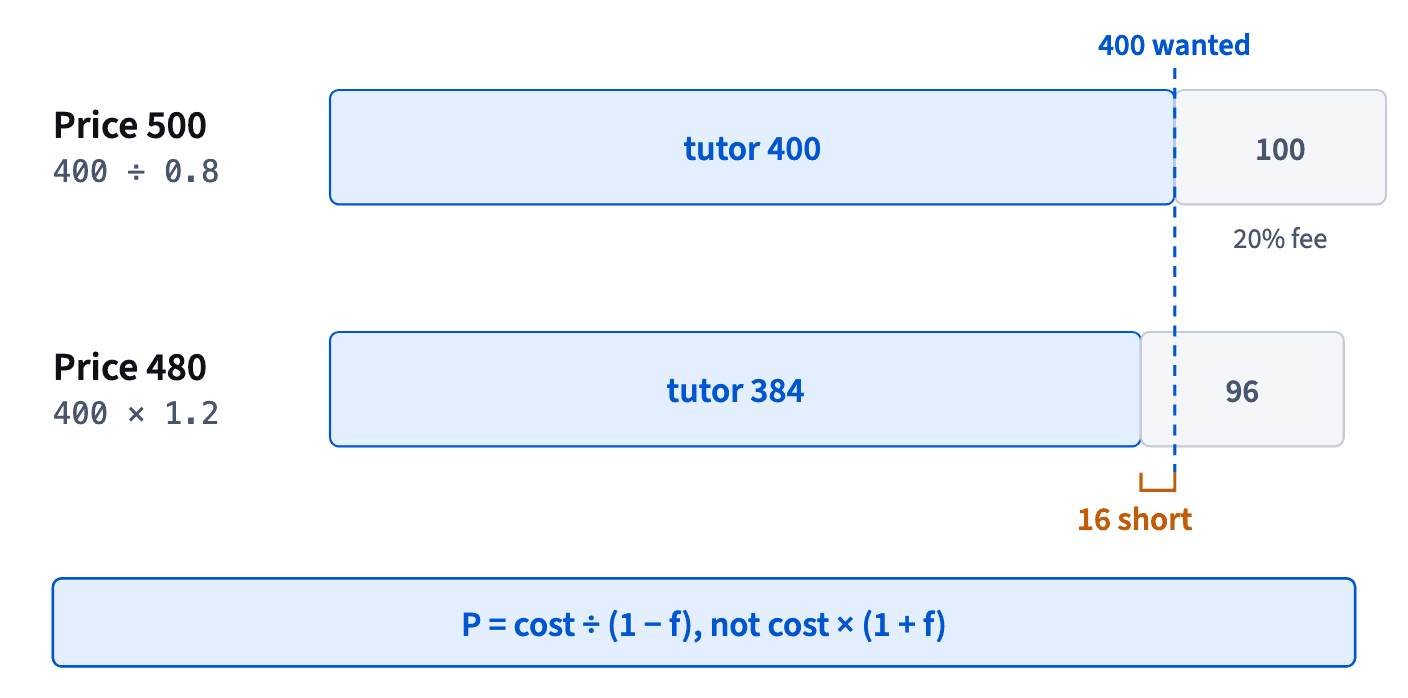
A partner platform keeps 20% of each lesson price, and a tutor wants 400 UAH in hand. "400 plus 20%" gives 480, but the platform takes 20% of 480, which is 96, and the tutor gets 384. The fee is a share of the price, not of the 400.
Write it as an equation: P·(1 − f) = net. Solve for P: P = net/(1 − f) = 400 ÷ 0.8 = 500. Check: 20% of 500 is 100, and 400 is left.
Multiplying by (1 + f) is right only when the fee is charged on top of the cost, like a markup. So always ask: a share of what?
How it fits together: keep the balance, undo the operations in reverse order, square to undo a root, remember that dividing by a share makes a number bigger, and check by substituting back. Next lesson: inequalities, intervals and formulas with cases.
- Do400 ÷ 0.8 = 500
- Don't400 × 1.2 = 480
The tutor ends up with 384.
Ready to practise?
Answer the lesson's exercises and earn 250 points the first time you finish it.
Start the exercises