

Theory
Real and nominal rates
Inflation and purchasing power, the real rate as a ratio of growth factors, why n − i is only a shortcut, deflating a future sum, and exchange spreads.
~8 min read · 9 exercises · 250 points
Before you start
Richer by how much?
Still at Klasna, but today's case is personal. Dana, an English tutor at the school, is saving for a new kitchen in two years, and her deposit promises a tidy sum on top.
The kitchen gets dearer too, though. You'll compare a deposit's growth with inflation, separate the nominal rate from the real one, see why subtracting the two rates only approximates how much richer Dana gets, and spot a fee hidden in an exchange rate.
More hryvnias isn't more kitchen
A deposit statement shows nominal money: how many hryvnias you will have. What you care about is what those hryvnias will buy, and prices move too. Growth in what money buys is real growth.
Dana, an English tutor at Klasna, saves 150,000 UAH for a kitchen in two years. A deposit at 10.78% a year after tax turns it into 150,000 × 1.1078² = 184,083: a nominal gain of 34,083. But with prices rising 8% a year, the same kitchen will cost 150,000 × 1.08² = 174,960. Over the new price she has 9,123 to spare, and 184,083 ÷ 174,960 = 1.052: about 5.2% more kitchen, not 23% more.
So any claim of "richer by X" needs a second number next to it: how much the things you plan to buy got dearer over the same time. The rest of this lesson turns that comparison into one rate.
- Do"In two years the deposit buys about 5% more kitchen than today."
- Don't"34,083 more, so the kitchen is covered with 34,083 to spare."
Ignores that the kitchen's price rose by 24,960.
Prices compound like deposits
Inflation is a growth rate for prices, and it compounds exactly like interest from Compounding: each year's rise applies to the price already raised. A price p today costs p × (1 + i)ⁿ in n years at inflation i.
A 32-lesson package at 20,000 UAH, with prices rising 8% a year: 20,000 × 1.08³ = 20,000 × 1.2597 = 25,194 UAH in three years. Adding 8% three times, 20,000 × 1.24 = 24,800, misses about 400 UAH, and the gap widens with every year and every point of inflation.
This is the first half of any real-money question. Before you ask whether savings will be enough for a goal, put a future price on the goal: the kitchen, the course or the laptop at the date you'll pay for it, not at today's price.
- Do"The package will cost about 20,000 × 1.08³ ≈ 25,200 in three years."
- Don't"8% a year for three years is 24%, so 24,800."
Inflation compounds; adding the yearly rates undercounts.
The real rate: divide, don't subtract
To compare growth of money with growth of prices, compare their growth factors. Each year Dana's money grows ×1.1078 and prices grow ×1.08, so what her money buys grows by their ratio: 1.1078 ÷ 1.08 = 1.0257. That is a real rate of 2.57% a year:
real rate = (1 + n) ÷ (1 + i) − 1, with n the nominal rate you are paid and i inflation over the same period.
A tax-free bond at 16% with 8% inflation gives 1.16 ÷ 1.08 − 1 = 7.4%. Two checks keep it right: n and i must cover the same period (both yearly or both monthly), and n should be what you actually keep, after tax and fees.
Over several years, compound the real rate like any other: 1.0257² = 1.052, the same 5.2% two-year gain you get by comparing the deposit with the kitchen's future price.
- Do1.16 ÷ 1.08 − 1 = 7.4% real for a tax-free 16% bond.
- Don'tReal rate of a 14% deposit = 14% − 8% = 6%, before tax.
Use what you keep after tax, and divide.
The shortcut n − i and its error
Subtracting, n − i, is a popular shortcut for the real rate. It always overshoots, because it forgets that this year's gain is itself worth less at the new prices. At low inflation the error is small; at high inflation it isn't.
10.78% and 8%: the shortcut says 2.78%, the exact rate is 2.57%, off by 0.2 pp. 16% and 8%: 8% against 7.41%. 30% and 25%: 5% against 1.30 ÷ 1.25 − 1 = 4.00%. 40% and 30%: 10% against 1.40 ÷ 1.30 − 1 = 7.69%, off by more than 2 pp.
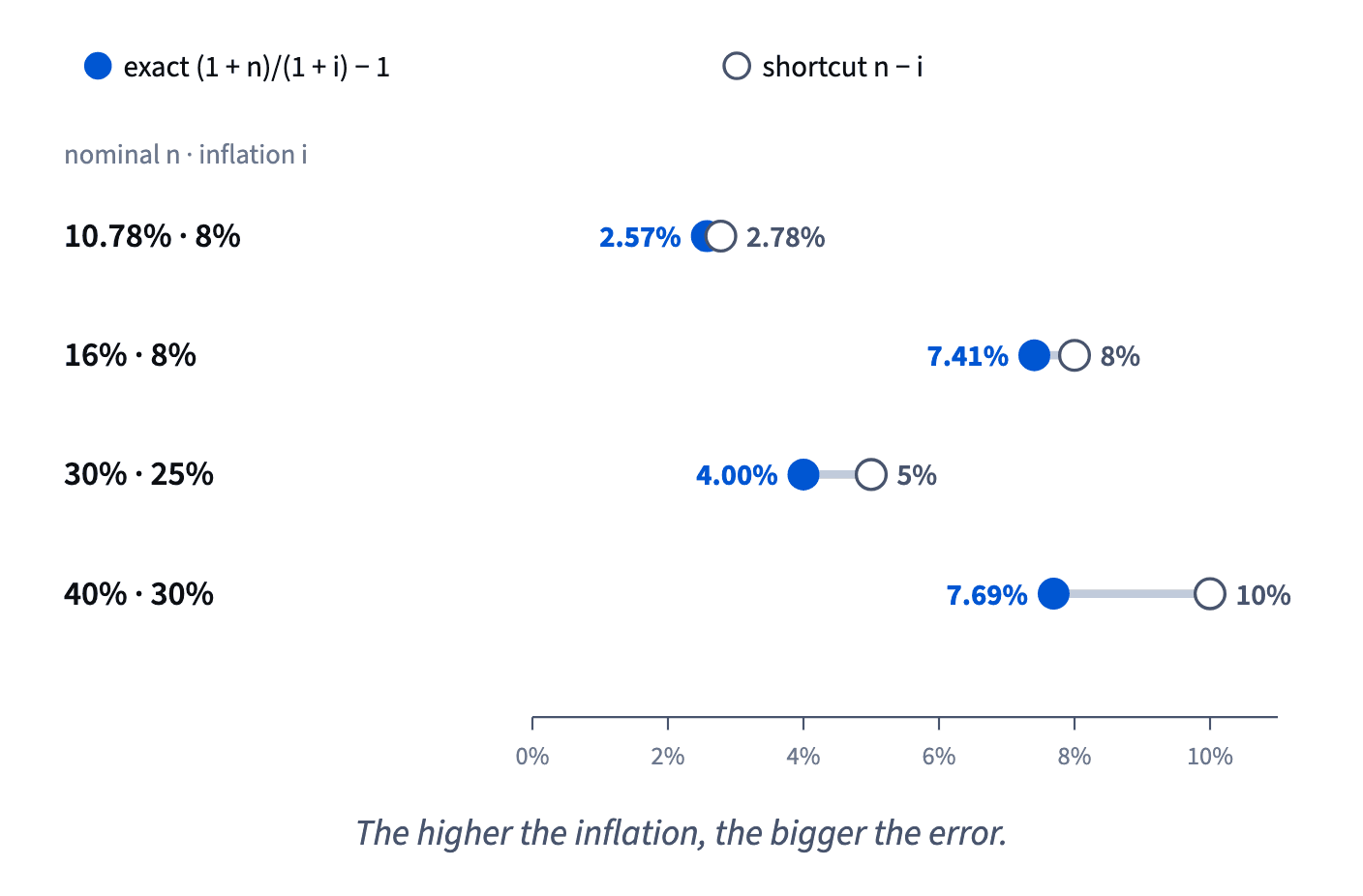
The size of the error is roughly the real rate times inflation, so it grows with both. Use n − i for a quick look when inflation is a few percent and the decision doesn't hinge on the decimal. When inflation is in double digits, or two options are close, divide.
- Do"At 40% nominal and 30% inflation the real rate is 1.40 ÷ 1.30 − 1 ≈ 7.7%."
- Don't"40 − 30 = 10% real; close enough."
At high inflation the shortcut is off by more than 2 pp.
A real rate can be negative
When inflation beats the rate you are paid, the real rate drops below zero. The balance still grows every month, so nothing on the statement looks wrong, but each year it buys less.
A deposit at 6% with 8% inflation: 1.06 ÷ 1.08 − 1 = −1.85% a year. 100,000 UAH becomes 106,000 in a year, yet in today's money that is 106,000 ÷ 1.08 = 98,148: about 1,850 less purchasing power. Money on a card that pays nothing does worse: 1 ÷ 1.08 − 1 = −7.4% a year.
A negative real rate isn't automatically a bad choice: an emergency fund is kept for access, not growth, and losing a little to inflation is the price of having it at hand. The point is to see that price, not to mistake a growing balance for growing wealth.
- Do"The 6% deposit loses about 1.85% a year in purchasing power while inflation is 8%."
- Don't"The balance went up every month, so the money is growing."
Nominal growth can hide a real loss.
Deflating: back to today's money
The same comparison has a second route: turn the future sum into today's money by dividing out inflation. This is deflating, and it is the discounting move from Discounting, with inflation as the rate: today's money = future sum ÷ (1 + i)ⁿ.
Dana's deposit will hold 184,083 UAH in two years. With 8% inflation each year: 184,083 ÷ 1.08² = 184,083 ÷ 1.1664 = 157,821 in today's prices. Compared with the 150,000 she starts with, 157,821 ÷ 150,000 = 1.052: a 5.2% real gain over two years, exactly 1.0257², the real rate compounded. Both routes agree, as they must.
Two slips to avoid: dividing by 1.16 (two years of 8% added) instead of 1.08², and deflating with a different period than the one the sum covers. Deflated numbers are what you put next to today's prices on a slide.

- Do184,083 ÷ 1.08² = 157,821 in today's money.
- Don't184,083 ÷ 1.16 = 158,692 in today's money.
Two years of inflation compound to 1.1664, not 1.16.
The exchange spread: a fee hidden in the rate
Currency has a price too, and an exchange point quotes two: the rate at which it buys a currency from you and the higher rate at which it sells it. The gap is the spread, and as a share of your money it is 1 − buy ÷ sell.
Klasna's EU families pay in euros, and its video and AI costs are in dollars, so the spread is a real cost. With dollars bought at 41.20 UAH and sold at 41.80: 1 − 41.20 ÷ 41.80 = 0.0144, or 1.44%. 10,000 UAH buys 10,000 ÷ 41.80 = 239.23 dollars, which sell back for 239.23 × 41.20 = 9,856 UAH, even if the dollar doesn't move at all.
So any plan that switches currency and back starts 1.44% behind, and that cost belongs in the comparison next to rates and inflation. The spread is charged per round trip, so frequent switching repeats it.
- Do"Changing hryvnias to dollars and back at 41.20 / 41.80 costs 1.44% up front."
- Don't"The dollar didn't move, so swapping back and forth cost nothing."
The spread is paid on every round trip.
The break-even exchange rate
Saving in another currency is the same comparison as the real rate, with the exchange rate playing inflation. The break-even exchange rate is the future rate at which both choices end equal: today's rate × (1 + home rate) ÷ (1 + foreign rate).
A hryvnia deposit at 10.78% after tax against a dollar deposit at 1.5%, with the dollar at 41.5 UAH: 41.5 × 1.1078 ÷ 1.015 ≈ 45.29. If the dollar ends the year above 45.29, the dollars win; below it, the hryvnias win.
Nobody knows next year's rate, so the break-even rate doesn't say what to do. It says what you are betting on: keeping dollars bets that the hryvnia falls by more than 45.29 ÷ 41.5 − 1 ≈ 9.1% within the year, plus a little more to pay the spread.
How it fits together: money and prices both compound; their ratio gives the real rate, deflating gives today's money, and currency is one more price. The next lesson shows where the 10.78% after tax came from, and what fees do over many years.
- Do"Dollars win only if the rate passes about 45.29 within the year, a 9% fall of the hryvnia."
- Don't"Dollars are safer, so they earn more."
Whether they earn more depends on the future rate against 45.29.
Ready to practise?
Answer the lesson's exercises and earn 250 points the first time you finish it.
Start the exercises