

Theory
Percent vs percentage points
Absolute and relative change, new ÷ old − 1, lift in an A/B test, and why "+1%" can mean two different things.
~8 min read · 9 exercises · 250 points
Before you start
A detour to Halves
Today's main case comes from another company. Halves is an app that splits bills between flatmates, couples and travel groups, with a free tier and a paid plan, Halves Plus. Its product team has just tested a new paywall, and the summary already has two readers arguing about how big the effect was.
You're helping report the result in numbers nobody can misread. The lesson covers absolute and relative change, percentage points, the base of a percent, and ROI as one more relative change.
Absolute change and percentage points
The simplest way to describe a change is to subtract: absolute change = new − old. It keeps the units of the number itself. Klasna delivered 7,840 lessons in March and 9,620 in May: +1,780 lessons. A price going from 620 to 580 UAH changes by −40 UAH.
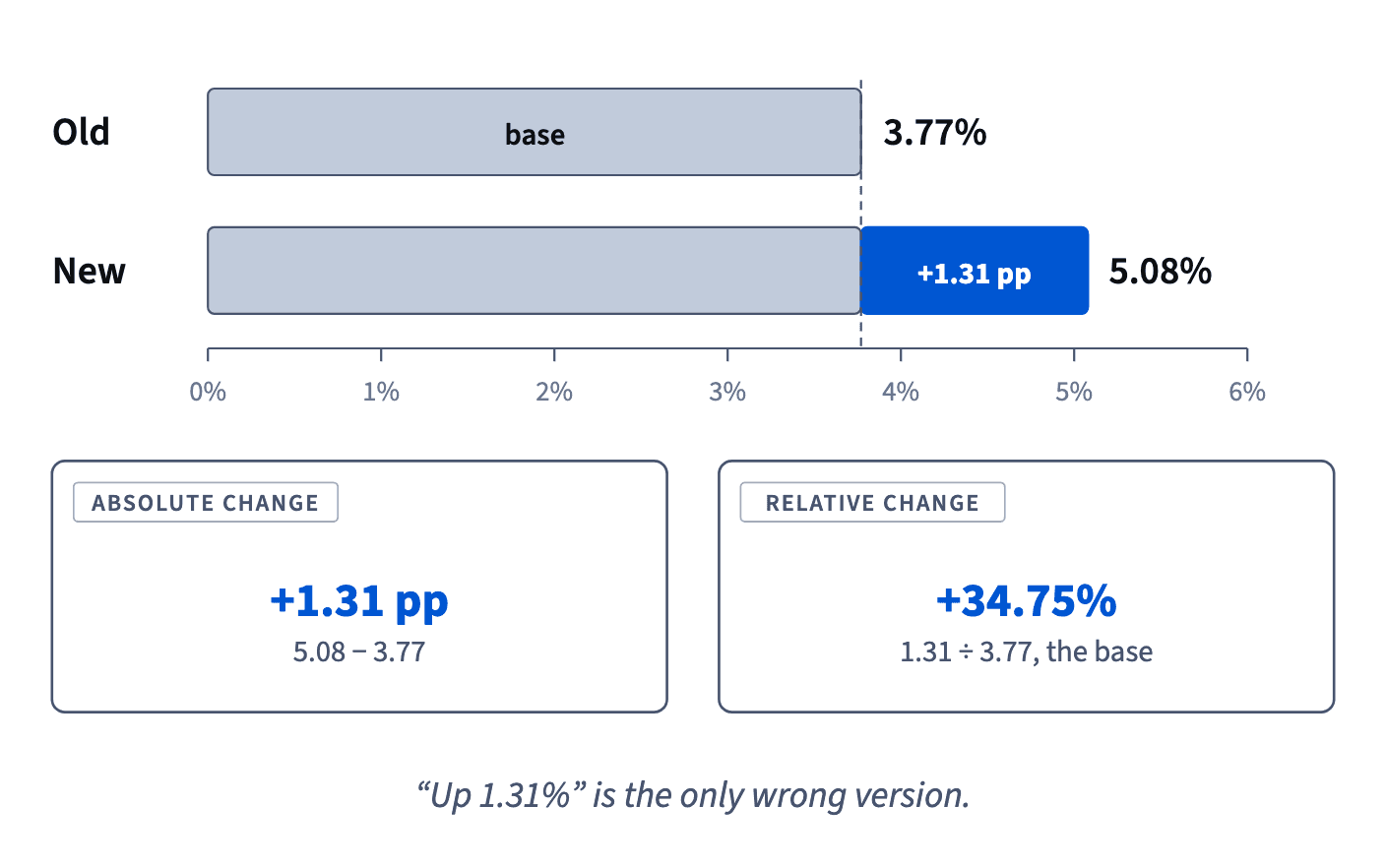
When the numbers compared are already percentages, such as conversion, churn, a fee or a margin, their difference has its own unit: the percentage point, written pp. Churn falling from 6% to 4.5% is −1.5 pp. Halves' paywall test moved paid conversion from 3.77% to 5.08%, +1.31 pp: out of every hundred people who saw the paywall, about 1.3 more paid.
Points say nothing about how big the change is compared with where you started. That is a second, separate number, the relative change. Writing points with a % sign ("+1.31%") makes the reader take one for the other.
- DoChurn: 6% → 4.5%, −1.5 pp
- Don't"Churn fell 1.5%"
Reads as a 1.5% relative drop; the real one is −25%.
Relative change: new ÷ old − 1
The relative change compares a change with where it started, the base:
Δrel = a ÷ b − 1 = (a − b) ÷ b, where a is the new value and b the old one. Multiply by 100 for percent.
Both forms give the same answer. For Halves' paywall test: 5.08 ÷ 3.77 − 1 = 1.3475 − 1 = 0.3475, so +34.75%. Or (5.08 − 3.77) ÷ 3.77 = 1.31 ÷ 3.77 = 0.3475. The first form is quicker on a calculator; the second shows the logic: the gap, measured in units of the starting value.
A ratio above 1 gives a rise, below 1 a fall: 4.5 ÷ 6 − 1 = −0.25, so churn that went from 6% to 4.5% fell by 25% relative.
Two habits keep it right. Always divide by the old value, the one you compare from. And when the inputs are percentages, keep the two kinds of change apart: the relative change is in percent, the absolute one in points.
- Do5.08 ÷ 3.77 − 1 = +34.75% relative
- Don't1.31 ÷ 5.08 ≈ +25.8%
Divided by the new value instead of the base.
Two honest numbers and one wrong one
A change between two percentages can be reported truthfully in two ways and misreported in one.
Take conversion going from 4% to 5%:
- absolute: 5 − 4 = +1 pp;
- relative: 5 ÷ 4 − 1 = +25%, the same as saying 5% is 1.25 times 4%.
Both are true. "+1%" is not: it takes the size of the absolute change and the unit of the relative one, so a reader hears a relative change of 1% when the real one is 25 times larger. "+20%" is wrong in another way: it divides the gap by the new value, 1 ÷ 5, instead of the base.
In an A/B test the two have names: the difference in points is the absolute lift, the ratio minus one the relative lift. A summary nobody can misread gives the starting and final values, the points, then the relative change with its label: "from 3.77% to 5.08%: +1.31 pp, about +35% relative".
- Do"4% → 5%: +1 pp, +25% relative"
- Don't"Conversion up 1%"
Neither number; the reader can't tell which you meant.
The base decides the percent
Every percent is a percent of something, the base you divide by. Change the base and the same gap gives a different percent.
A lesson price cut from 620 to 580 UAH is 580 ÷ 620 − 1 = −6.45%. Raising it back from 580 to 620 is 620 ÷ 580 − 1 = +6.90%. The same 40 hryvnias are a smaller share of 620 than of 580. So a −6.45% cut is not undone by a +6.45% rise: 580 × 1.0645 ≈ 617.41, short of 620.
With bigger swings it gets dramatic: a metric that falls 50% needs +100% to get back.
When a percent looks odd, ask two questions: of what, and compared with when? "Revenue −20%" against last month and against the same month last year are different claims. In a percent change, the base is always the old value; in a share, it is the whole that the part belongs to.
- Do620 → 580: −6.45%; 580 → 620: +6.90%
- Don't"We cut 6.45% and then raised 6.45%, so we're back at 620"
580 × 1.0645 ≈ 617.41.
From percent to times: add back the 100%
A percent change and a multiple describe the same jump, just as three times as much is +200%. To go from a percent change to a multiple, add the 100% back:
new = old × (1 + change).
Halves' dashboard said sign-ups were "up 156%" over a long weekend. That is new ÷ old − 1 = 1.56, so new = old × 2.56. A usual long weekend brings about 787 sign-ups, so this one brought about 787 × 2.56 ≈ 2,014.
Three slips are common: adding 156 sign-ups instead of 156% (787 + 156 = 943); multiplying by 1.56 and losing the original 100% (about 1,228); multiplying by 3.56 (about 2,802). For a fall the rule works with a minus: −30% means × 0.70.
When a big percent shows up, translate it into "times" before you repeat it: "up 156%" is "about two and a half times the usual".
- Do+156% → × 2.56
- Don't+156% → × 1.56
Forgets the original 100%.
Small bases make big percents
On a small base, relative changes look huge. Conversion going from 0.2% to 0.3% is +50% relative, yet it means one extra paying person per thousand: +0.1 pp. From 0.1% to 0.2% is +100%, a doubling of almost nothing.
That's why the rule for test reports is points first: start with the starting and final values and the absolute lift in pp, then add the relative lift with its label. Points tell the reader how many more people out of every hundred actually did the thing, and revenue and workload depend on that.
The relative change still earns its place. It's the right way to compare changes that start from different bases, and businesses plan in it: "revenue +10%". Just never let a reader guess which kind a number is.
A quick smell test: if a relative lift sounds like a miracle, look at the base before you celebrate.
- Do"0.2% → 0.3%: +0.1 pp, +50% relative"
- Don't"Conversion +50%!" with no base
Sounds like a miracle; it's one person in a thousand.
When both numbers are rates
The classic trap appears when the thing that changes is itself a percentage: a fee, conversion, churn, a margin. Then "+1%" or "−0.5%" can mean two different things.
Klasna's payment fee is 2.5% of the price. If the provider cuts it to 2%:
- absolute: 2 − 2.5 = −0.5 pp;
- relative: 2 ÷ 2.5 − 1 = −20%, so the fee bill shrinks by a fifth.
Both are true; "the fee fell 0.5%" is neither. Margins work the same way: an English lesson keeps 29.76% of its price as contribution margin in the 16-lesson package and 25.09% in the 32-lesson one. That is 4.67 pp lower, and relative to 29.76% it is about −15.7%.
A simple guard: whenever you subtract two percentages, write "pp" after the result straight away. Whenever you divide them, the result is a relative change in percent and needs the word "relative".
- DoFee 2.5% → 2%: −0.5 pp, −20% relative
- Don't"The fee fell 0.5%"
Neither the points nor the relative change.
ROI is a relative change too
The formula new ÷ old − 1 hides in many business metrics. Return on investment is one of them: ROI = (gross profit − spend) ÷ spend, which is (a − b) ÷ b with spend as the base.
Formula: a: the new value; b: the old value, the base. Multiply by 100 to get percent. · shown above
- Do
- Don't"ROI: 125%"
That's gross profit ÷ spend, a ratio of 1.25, not the return.
Ready to practise?
Answer the lesson's exercises and earn 250 points the first time you finish it.
Start the exercises