

Theory
Loans and amortization
How a payment splits into interest and principal, months to repay, a flat fee against interest on the balance, and the real annual cost of a loan as its internal rate.
~9 min read · 9 exercises · 250 points
Before you start
One step of a loan
Still at Klasna, which is buying laptops for its support team on an equipment loan repaid in six equal monthly payments. Where does that payment come from, and how much of each one is interest?
You'll follow the loan one month at a time, with the balance growing by the interest and shrinking by the payment, build an amortization table, and connect it to the annuity formula from module 6.
One month of a loan
A loan is easiest to understand one month at a time. Each month two things happen to the balance: it grows by the interest, the monthly rate times what is still owed, and it shrinks by the payment. In one line: next balance = balance × (1 + r) − payment.
Klasna's equipment loan for support laptops is 60,000 UAH at 2% a month, repaid in six equal payments of 10,711.55 UAH. Month 1: 60,000 × 1.02 = 61,200, minus 10,711.55 leaves 50,488.45. Feed that balance into the same line for month 2, and so on until it reaches zero.
The equal payment itself comes from the annuity formula in Geometric series, but you don't need it to follow a loan: the one-step rule, repeated, rebuilds the whole schedule in a spreadsheet. Two habits keep it right: use the monthly rate (2%, not 24%) for a monthly step, and add the interest before taking off the payment.
- Do50,000 × 1.02 − 8,000 = 43,000: 1,000 of interest, 7,000 repaid.
- Don't50,000 − 8,000 = 42,000 left to pay.
Forgets the month's interest.
Interest first, the rest repays principal
Every loan payment splits in two. The interest part is the price of holding the money this month: the rate times the balance at the start of the month. The rest, payment − interest, is the principal part, and only it reduces the debt.
In the first month of the laptop loan, interest is 60,000 × 0.02 = 1,200, so 10,711.55 − 1,200 = 9,511.55 repays principal. The balance falls by exactly that: 60,000 − 9,511.55 = 50,488.45, the same number the one-step rule gives.
That is why "I paid 10,711.55" and "my debt fell by 10,711.55" are different statements. A loan statement shows both lines. When you read one, check that interest = rate × opening balance; if it doesn't, the loan carries a fee or a rate nobody mentioned.
- DoPayment 10,711.55 = 1,200 interest + 9,511.55 principal.
- Don't"I paid 10,711.55, so I now owe 49,288.45."
Counts the interest as if it repaid the debt.
Interest shrinks, principal grows
With equal payments, the split changes every month. Interest is always the rate times a balance that keeps falling, so the interest part shrinks and the principal part grows by the same amount. A month-by-month table of these splits is an amortization schedule.
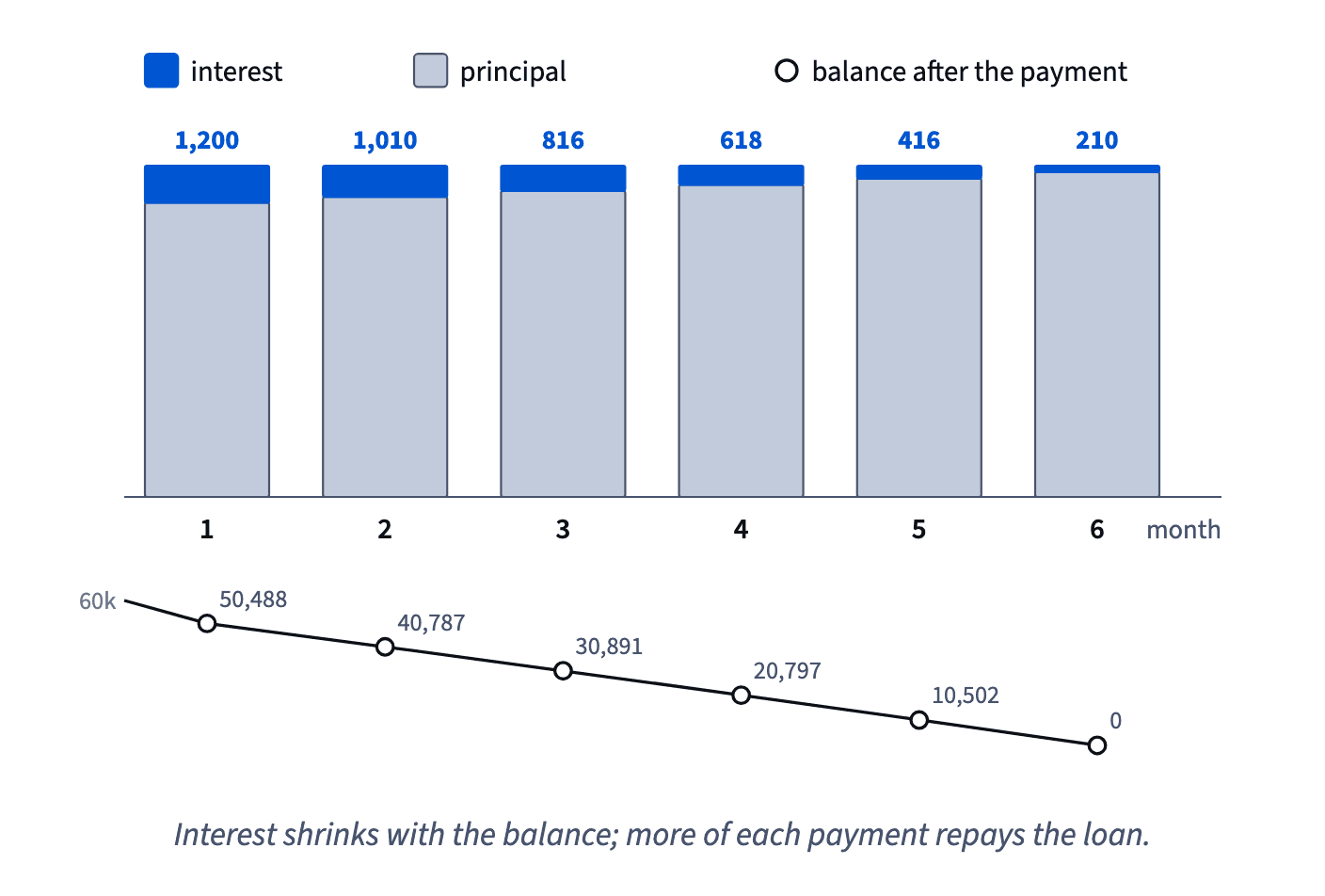
For the laptop loan the interest parts run 1,200, 1,010, 816, 618, 416 and 210 UAH. In month 2 the balance is 50,488.45, so interest is 50,488.45 × 0.02 = 1,009.77 and principal is 10,711.55 − 1,009.77 = 9,701.78. In the last month only 210.03 is interest and 10,501.52 repays the loan.
Two readings follow. On a long loan the early payments are mostly interest, so extra repayments save the most when they come early. And total interest is the sum of these falling parts, not the first month's interest times the number of months: 6 × 1,200 = 7,200 would overstate it.
- DoMonth 2: 50,488.45 × 0.02 = 1,009.77 interest, 9,701.78 principal.
- Don't"Interest is 1,200 every month, 7,200 in total."
Interest falls with the balance; the true total is 4,269.30.
The price of a loan
The simplest honest number about a loan is its price: everything you pay minus what you received. With equal payments, price = n × payment − principal.
The laptop loan: 6 × 10,711.55 − 60,000 = 4,269.30 UAH. It equals the sum of the six interest parts, as it must: every hryvnia above the 60,000 went to interest. A 20,000 UAH course loan repaid in 12 payments of 1,950 costs 12 × 1,950 − 20,000 = 3,400 UAH. Any fee counts as well: a 500 UAH setup fee adds 500 to the price.
The price answers "how much does this cost me?" but not "how expensive is it?". 3,400 on 20,000 over a year and 3,400 on 20,000 over three months are very different deals, because in the second you hold the money for a quarter of the time. Comparing loans of different lengths needs a rate, which the last card of this lesson finds.
- Do12 × 1,950 − 20,000 = 3,400 UAH paid for the loan.
- Don't"3,400 on 20,000 is 17%, so it's a 17% loan."
A price over the whole term isn't a yearly rate; length and the shrinking balance matter.
A payment must beat the interest
The one-step rule exposes a trap at once. If the payment equals the month's interest, the balance doesn't move. If it is smaller, the debt grows even though you pay every month.
Sam, a support coordinator at Klasna, owes 20,000 UAH on a card at 3% a month. Interest is 600, so paying 600 a month keeps the debt alive forever: 20,000 × 1.03 − 600 = 20,000. A balance of 15,000 at 3% with a 400 payment does worse: interest is 450, and after a month the balance is 15,000 × 1.03 − 400 = 15,050.
So the first check on any repayment plan is payment > rate × balance. Only the part above the interest repays anything: Sam's 1,000 a month removes just 400 of debt in month one. A minimum payment set close to the interest feels affordable precisely because it barely repays anything.
- Do"Interest is 450 a month, so we pay well above 450 to make progress."
- Don't"I pay 400 every month, so the card debt is going down."
400 is below the 450 of interest, so the debt grows.
How many months to repay
How long a debt lasts depends on how far the payment is above the interest. The months come from the ln trick in e, ln, odds and the sigmoid: n = −ln(1 − r × B ÷ payment) ÷ ln(1 + r), with r the monthly rate and B the balance.
The ratio r × B ÷ payment is the share of the first payment eaten by interest. For Sam's 20,000 at 3%: with 1,000 a month it is 0.6, and n = −ln 0.4 ÷ ln 1.03 ≈ 31 months, about 31,000 paid. With 1,500 a month it is 0.4, and n = −ln 0.6 ÷ ln 1.03 ≈ 17.3 months, about 25,900 paid. Half as much again per month nearly halves the term and saves about 5,000.
When the ratio reaches 1, the payment only covers the interest, ln 0 has no value, and the formula's answer is "never". Round n up: 17.3 means 18 payments, the last one smaller.
- Do"Raising the payment from 1,000 to 1,500 cuts 31 months to about 18."
- Don't"1,500 is 1.5 times 1,000, so it takes 31 ÷ 1.5 ≈ 21 months."
The term falls faster than the payment rises, because less goes to interest.
Two debts: avalanche or snowball
With several debts and some money spare each month, the order of repayment changes the total interest. The avalanche sends the extra to the highest rate first: every hryvnia taken off a 3% debt stops 3 kopiykas of interest a month, off a 1.5% debt only 1.5. The snowball sends it to the smallest balance first, for quick wins.
Sam owes 20,000 on a card at 3% a month and 6,000 on an installment plan at 1.5%, with 2,000 extra a month. On the card, the 2,000 stops 60 UAH of interest a month; on the installment plan, only 30. The avalanche wins on money, and an even split lands in between at 45.
The snowball isn't a mistake: clearing a whole debt early keeps some people going, and a plan that is kept beats a cheaper one that is dropped. Just know its price, the interest gap between the two orders. Either way, keep paying at least the minimum on every debt.
- Do"Extra money goes to the 3% card first; minimums on everything else."
- Don't"Spread the extra evenly over all debts, to be fair."
An even split saves less than highest rate first.
The real rate of a loan is its IRR
A flat fee on the original amount sounds cheap because it is quoted on money you hold only at the start. Paying 12,000 UAH in four monthly parts with 1.5% a month of the original amount costs 180 every month, 720 in total. 1.5% on what is still owed would be 180, 135, 90 and 45: only 450.
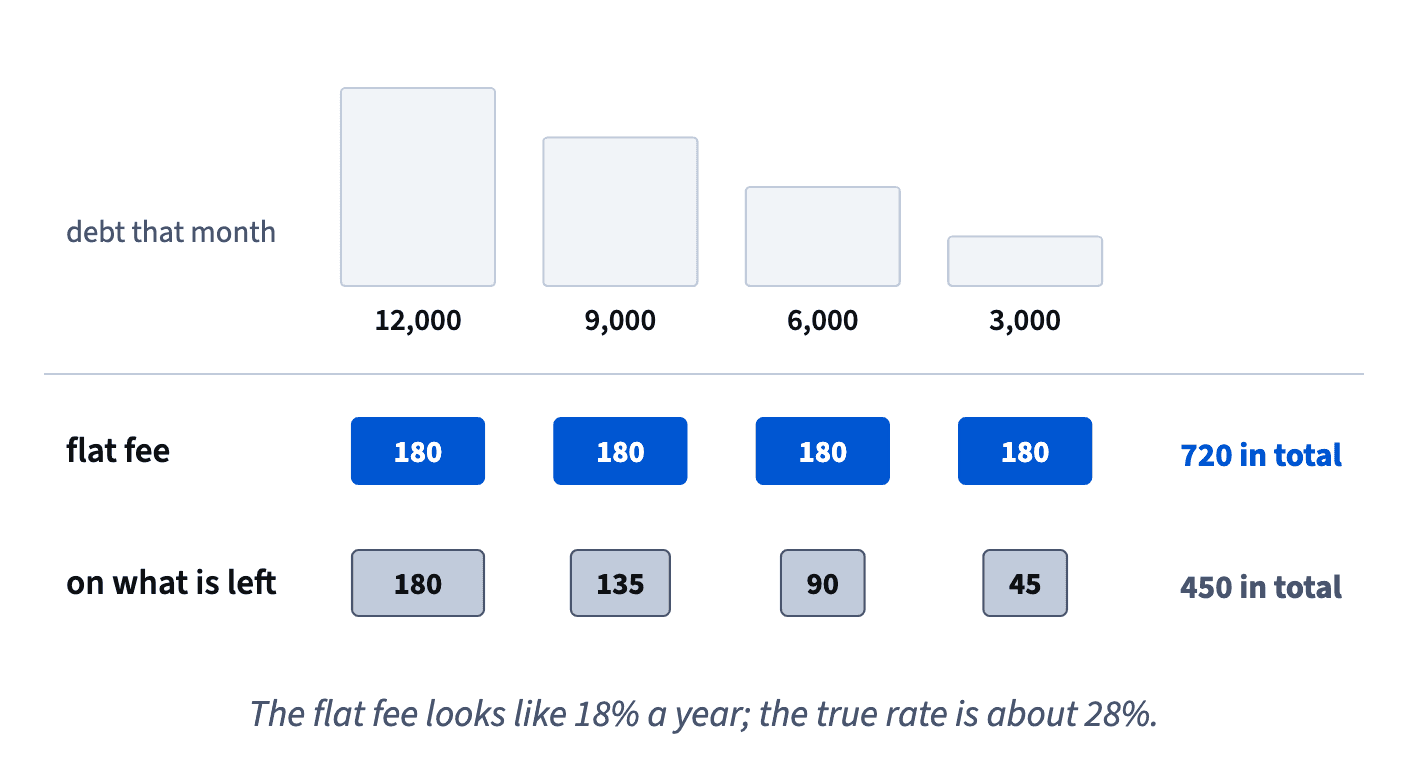
To compare offers, find the rate at which the payments, discounted, add back up to the money you actually received: the loan's internal rate, its IRR from Discounting. For four payments of 3,180 against 12,000, RATE(4, −3180, 12000) ≈ 2.37% a month, about 28% a year, not the advertised 18%. By hand, bracket it: at 2% the payments are worth about 12,109, at 3% about 11,820. Upfront fees push the rate higher still: you receive less and repay the same.
How it fits together: one step, balance × (1 + r) − payment, gives the schedule, the price, the months to repay and the real rate. The next lesson asks what the money is worth after inflation: real against nominal rates.
- Do"Compare the offers by their rate on the money received, not by the advertised fee."
- Don't"1.5% a month, so 18% a year."
The fee is on the original amount; the true rate is about 28%.
Ready to practise?
Answer the lesson's exercises and earn 250 points the first time you finish it.
Start the exercises