

Theory
Inequalities, intervals and formulas with cases
<, ≤, ± and intervals, "if and only if", min and max, formulas with cases, fences, payback as the first month that clears a bar, and tiered rates with effective vs marginal.
~8 min read · 10 exercises · 250 points
Before you start
Less than, at most, plus or minus
Still on Klasna's product team. So far every formula said "equals", but the A/B test reports Klasna reads are full of <, ≤ and ±, and a value right on a boundary can land on either side.
This lesson closes module 2. You'll read strict and non-strict signs, write ranges as intervals, see what "plus or minus" really covers, and read formulas that change with the case.
< or ≤: one value decides
Formulas aren't only about "equals". Inequalities say which side of a boundary a number falls on, and the two kinds differ by exactly one value, the boundary itself.
- <, "less than", excludes the boundary: p < 0.05 does not include 0.05.
- ≤, "at most", includes it: p ≤ 0.05 does.
- > and ≥ work the same way upwards; ≥ reads "at least".
Most numbers never land exactly on a boundary, so the sign seems pedantic until one does: a rating of exactly 4.0, a p-value of exactly 0.05, sales of exactly 100,000 UAH. Then the sign alone decides the outcome, and a rule that doesn't say which side the boundary is on starts an argument.
When you write a rule, make every boundary belong to exactly one side: "from 100,000 up to, but not including, 300,000" is 100,000 ≤ s < 300,000. When you read one, check the sign before the number.
- Do100,000 ≤ s < 300,000: exactly 100,000 belongs to this band
- Don'tBands written as "0–100,000" and "100,000–300,000"
Which band gets exactly 100,000?
± gives an interval
±, "plus or minus", gives two numbers at once: a ± b means everything from a − b to a + b. A lift of 1.3 pp ± 0.9 pp is the range from 0.4 to 2.2 pp.
Written as an interval: [0.4; 2.2]. Square brackets include the ends, round ones exclude them: (0.4; 2.2) is the same range without its endpoints. A mix such as [0; 5) includes 0 and excludes 5.
The middle of a ± interval is the estimate, and b is its margin of error: how far the true value may plausibly sit on either side. So the interval is 2b wide, and halving b halves the uncertainty.
Two slips: reading 1.3 ± 0.9 as "from 0.9 to 1.3", and giving the margin in percent when the estimate is in points. Keep the units of the estimate: a lift in pp has a margin in pp.
- Do1.3 ± 0.9 pp = [0.4; 2.2] pp
- Don'tReading 1.3 ± 0.9 as "from 0.9 to 1.3"
The ± spreads both ways from 1.3.
Does the interval contain 0?
For a test result, the key question about an interval is whether it contains 0, because 0 means "no effect".
- An interval entirely above 0, like [0.4; 2.2], rules out "no effect": every plausible value is a gain.
- An interval that contains 0, like [−0.3; 1.9], doesn't. The symbol ∈ reads "is in": 0 ∈ [−0.3; 1.9]. ∉ means "is not in".
- An interval entirely below 0 points to a loss.
An interval that only touches 0, like 0.8 ± 0.8 = [0; 1.6], still contains it, so it doesn't rule out "no effect".
The arrow ⇔, "if and only if", ties a decision to a condition both ways: "reject 'no effect' ⇔ p < α" means a small p leads to rejecting, and rejecting means p was small. There's no third case. Convert a ± into an interval first; then the 0 check takes one glance.
![Three intervals on a line around 0: [0.4; 2.2] lies entirely above 0, [−0.3; 1.9] contains 0, and [−1.6; −0.2] lies entirely below 0.](/_next/image?url=%2Fcourses%2Fmath-basics%2Fdiagrams%2Fm2-l4-intervals.png&w=3840&q=75&dpl=dpl_AV55DN2Tr9Dn4pRSyLqbca6FFiei)
- Do2.1 ± 1.5 = [0.6; 3.6], entirely above 0
- Don't"1.0 ± 1.4 is positive on average, so it's a win"
[−0.4; 2.4] contains 0.
Formulas with cases: check the condition first
Some formulas branch: the answer depends on which case you're in. A curly bracket on the left lists the cases, each with its condition on the right. Read the condition first, then use the formula next to it.
The median is a classic. With n odd, it's the middle value after sorting, x₍₍ₙ₊₁₎/₂₎; with n even, there's no single middle, so it's the mean of the two middle ones, (x₍ₙ/₂₎ + x₍ₙ/₂₊₁₎)/2. For 4, 6, 7, 9 (n = 4): (6 + 7) ÷ 2 = 6.5. For 4, 6, 7, 9, 14 (n = 5): x₍₃₎ = 7.
Business rules are written the same way: a bonus that is 0 below one rating, one rate in a middle band and another above it. The cases must cover every possible value exactly once, with no gaps and no overlaps, and that's where the < and ≤ signs earn their keep.
Most errors come from skipping the condition and using the first formula in sight.
- Don = 4 is even, so average x₍₂₎ and x₍₃₎
- Don'tTaking x₍₂₎ for n = 4 "because it's near the middle"
The even case needs both middle values.
Outlier fences: two inequalities
A common rule for flagging unusual values is a pair of inequalities, the fences. A value is flagged if
x < Q₁ − 1.5·IQR or x > Q₃ + 1.5·IQR,
where Q₁ and Q₃ are the lower and upper quartiles and IQR = Q₃ − Q₁ is the spread of the middle half of the data.
With Q₁ = 6 and Q₃ = 10 lessons a month, IQR = 4, the lower fence is 6 − 6 = 0 and the upper fence is 10 + 6 = 16. A learner with 18 lessons is flagged; one with exactly 16 is not, because the rule uses a strict >.
"Or" matters: a value is flagged if it breaks either fence. And a flag is a reason to look, not to delete: 18 lessons may be a real, very keen learner.
- DoQ₁ = 6, Q₃ = 10: fences 0 and 16
- Don'tUpper fence = Q₃ + 1.5 × Q₃
Uses Q₃ instead of the IQR.
max and min: lower limits and caps
max picks the larger of its inputs and min the smaller. That makes them the shorthand for lower limits and caps.
- max(0, x − 50) never goes below 0: it's 0 until x passes 50, then grows by 1 for each unit above. An overage charge of 30 UAH per hour above 50 is 30 × max(0, h − 50): 0 for 42 hours, 30 × 14 = 420 UAH for 64 hours.
- min(cap, x) never goes above the cap: a referral reward of 10% of the first payment, capped at 500 UAH, is min(500, 0.1 × payment). A 3,000-UAH payment gives 300; a 7,000-UAH one gives 500.
- max(a, b, c) of several durations is how long a plan takes when its tracks run in parallel: 5, 8 and 6 weeks give 8.
To find where a cap starts to bind, set the inside equal to the cap and solve: 0.1 × payment = 500 gives a payment of 5,000 UAH.
- Domax(0, 42 − 50) = 0
- Don'tmax(0, 42 − 50) = −8
max with 0 never returns a negative number.
Payback: the first k with Σ ≥ CAC
Payback combines a running total, as in the lesson on Σ, with an inequality: it's the first month k for which the running total of margin per learner reaches the acquisition cost, Σ from i = 1 to k of mᵢ ≥ CAC.
Both "first" and "≥" matter. Margins of 140, 120 and 110 UAH give running totals 140, 260 and 370. Against a CAC of 300, month 2 gives 260 < 300 and month 3 gives 370 ≥ 300, so payback is month 3, even though the total keeps growing afterwards.
With ≥, a running total exactly equal to the CAC counts as paid back; with a strict > it wouldn't, and the answer could move by a month. Read the sign in the definition you're given.
Two slips: reporting the month after the crossing, and looking for a month whose single margin exceeds the CAC instead of the running total.
- Do260 < 300, 370 ≥ 300, so month 3
- Don'tWaiting for one month's margin to reach 300
Payback uses the running total.
Tiered rates: effective vs marginal
A tiered rate applies each rate only to its own slice. Klasna pays sales partners 10% on the first 100,000 UAH of monthly sales, 15% on the part from 100,000 to 300,000 and 20% on everything above 300,000.
For 380,000: 10% × 100,000 = 10,000; 15% × 200,000 = 30,000; 20% × 80,000 = 16,000. Total 56,000 UAH. The effective rate is total ÷ base, 56,000 ÷ 380,000 ≈ 14.74%; the marginal rate, on the next hryvnia, is 20%. Being "in the 20% bracket" doesn't mean 20% of everything: that would be 76,000, overpaying by 20,000.
When rates rise slice by slice, the effective rate is always below the marginal one.
How it fits together: inequalities and intervals say which side of a line a number falls on; cases and max/min turn those sides into rules; tiers apply a rule slice by slice. Next module: averages and shares of shares.
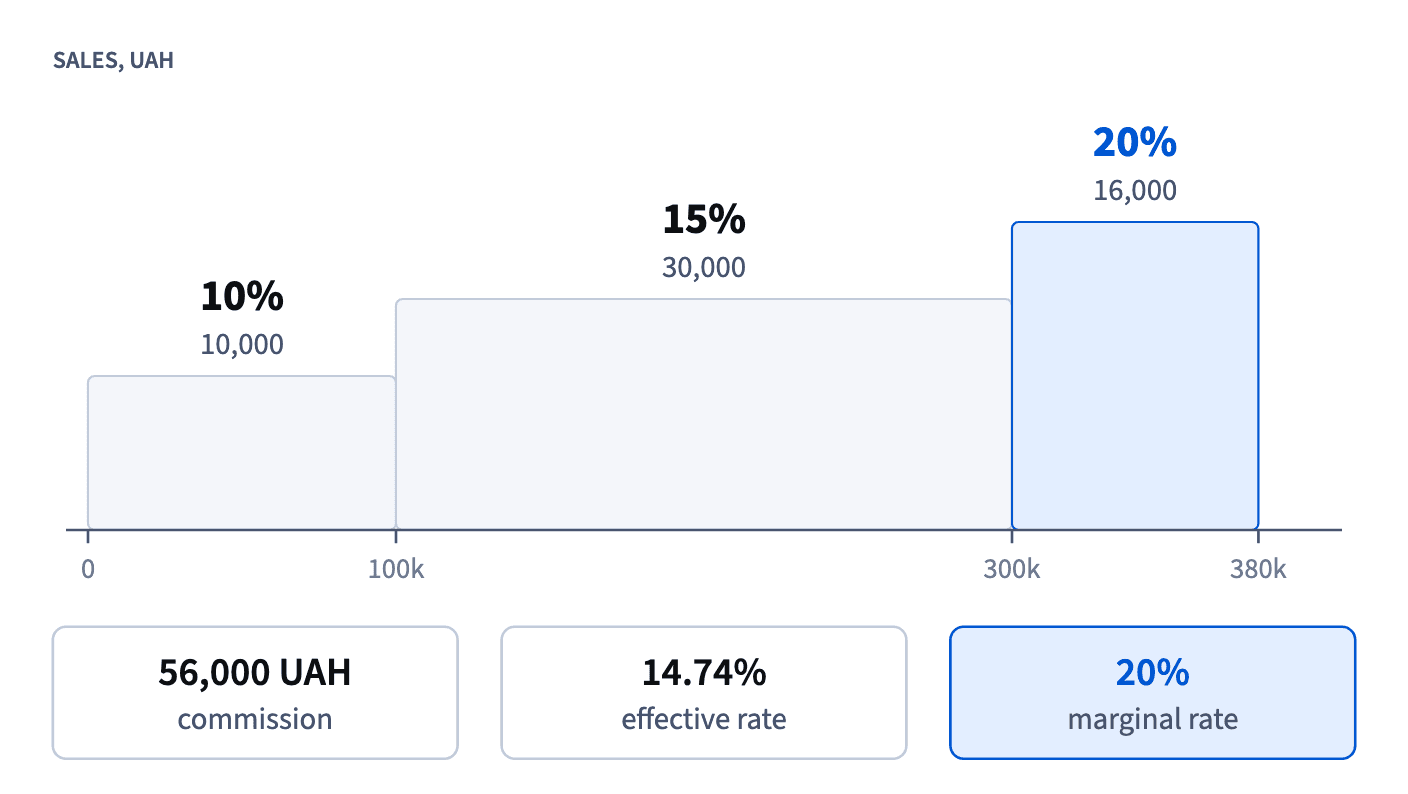
- Do10,000 + 30,000 + 16,000 = 56,000 UAH
- Don't20% × 380,000 = 76,000 UAH
The top rate applied to every slice.
Ready to practise?
Answer the lesson's exercises and earn 250 points the first time you finish it.
Start the exercises