

Theory
Geometric series
Sums that shrink by the same factor: seed ÷ (1 − k) for referrals, LTV ≈ margin ÷ churn and lifetime 1 ÷ churn, the finite sum for annuities, capped LTV and a savings pot.
~10 min read · 9 exercises · 250 points
Before you start
Each step a share of the last
Still on Klasna's product team. The referral programme has data now: on average each new family brings a few more, and marketing plans 100 families from ads this month. Those bring friends, the friends bring friends, and the question is how many arrive in the end.
You'll meet sums where each term is a share of the previous one, find when an endless sum has a finite total, and use it for referrals and for the lifetime value of a customer.
Geometric series: an endless sum with a finite total
A geometric series is a sum where each term is the previous one times the same factor q: a + aq + aq² + aq³ + … Here a is the first term and q the step factor.
When q is between −1 and 1, the terms shrink fast enough for the endless sum to settle on a finite total: a ÷ (1 − q). Why: call the sum S. Then qS is the same sum without its first term, so S − qS = a, and S = a ÷ (1 − q).
Example: 100 + 30 + 9 + 2.7 + … has a = 100 and q = 0.3, so the total is 100 ÷ 0.7 ≈ 142.9. The first three terms already give 139.
When q is 1 or more, the terms never shrink and the sum grows without limit. 1 + 1.1 + 1.21 + … has no total, and plugging it into a ÷ (1 − q) gives a meaningless negative number, 1 ÷ (−0.1) = −10. Always check |q| < 1 before you use the formula.
- Do100 + 30 + 9 + … = 100 ÷ (1 − 0.3) ≈ 142.9.
- Don't1 + 1.1 + 1.21 + … = 1 ÷ (1 − 1.1) = −10.
With q ≥ 1 there is no finite total.
Referral chains: seed ÷ (1 − k)
Referrals are a geometric series in disguise. If every new family brings k more on average, a seed of families from ads grows generation by generation: seed, seed × k, seed × k², …
Total families = seed ÷ (1 − k). Families added by referrals = seed × k ÷ (1 − k).
Example: Klasna's ads bring 100 families, and each new family brings 0.3 more. Total = 100 ÷ 0.7 ≈ 142.9; referrals add about 42.9 on top. The generations run 100, 30, 9, 2.7, 0.81…, so almost all of the effect comes in the first two or three.
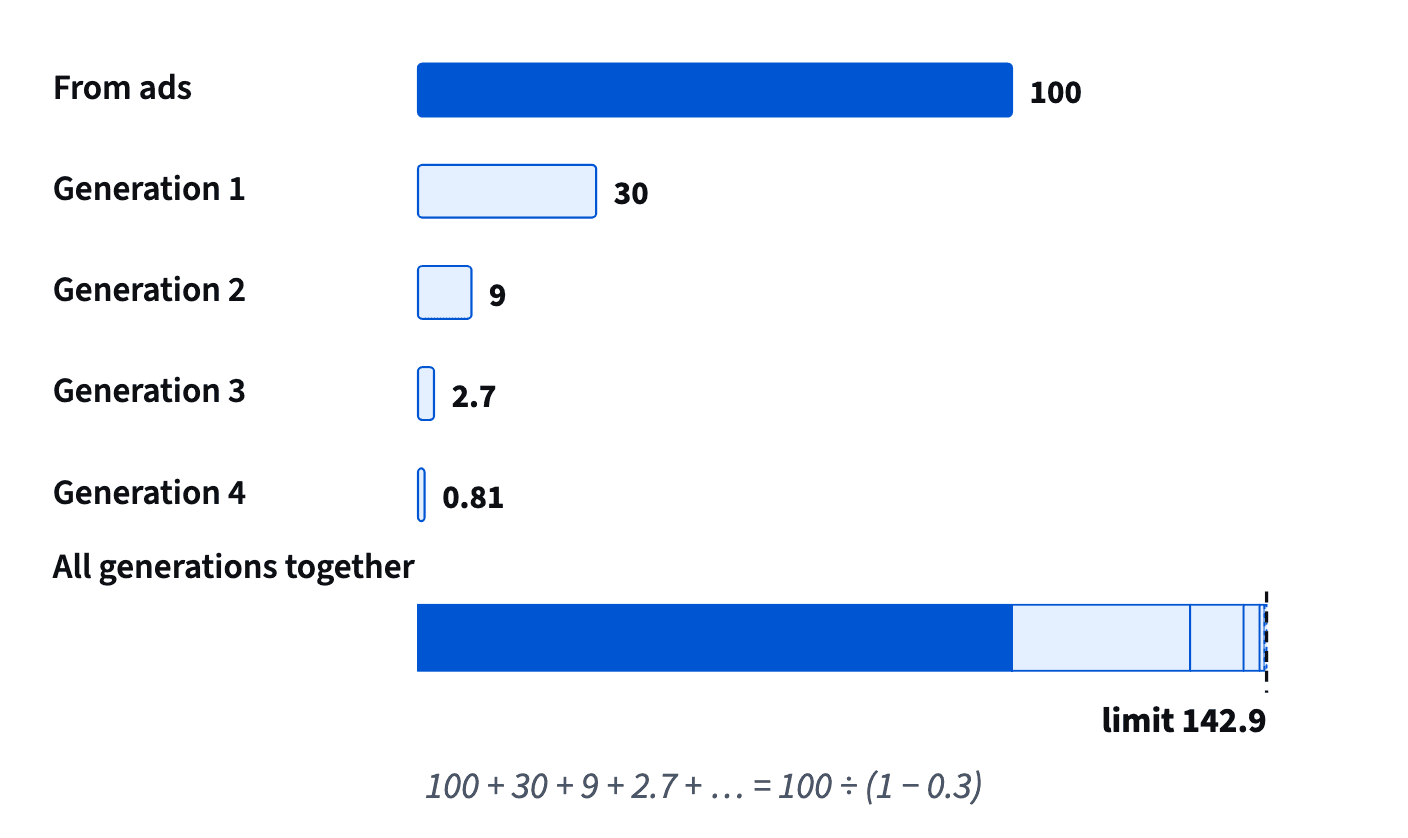
Reading k: it's an average over everyone, including the many who bring nobody. If k reached 1, every family would replace itself and the chain would never stop: self-sustaining growth, which real programmes almost never reach. Plan with k well below 1.
The common slip is counting only the first generation, 100 + 30 = 130, or computing 100 × 1.3. The chain keeps going: the 30 bring 9 more.
- DoSeed 100, k = 0.3: 100 ÷ 0.7 ≈ 143 families in total.
- Don't"k = 0.3 means 30% more families: 130."
The 30 bring 9 more, and so on.
Lifetime and LTV from churn
Lifetime value hides the same series. Say a Klasna Club member leaves 200 UAH of margin a month and 5% of members leave each month. A member surely pays for month 1, is still there in month 2 with a chance of 0.95, in month 3 with 0.95², and so on.
Expected months paid = 1 + 0.95 + 0.95² + … = 1 ÷ (1 − 0.95) = 1 ÷ 0.05 = 20. In general, expected lifetime ≈ 1 ÷ churn and LTV ≈ margin ÷ churn: 200 ÷ 0.05 = 4,000 UAH.
The formula rests on two assumptions: churn is the same every month, and money in month 40 counts as much as money today, with no discounting as in Discounting. Real churn is usually higher in the first months and lower later, so treat m ÷ c as a quick estimate, not a fact.
Use margin, not revenue. An LTV built on revenue overstates what a member is worth, because tutors' pay and payment fees take part of every payment.
- Do200 UAH margin, 5% churn: LTV ≈ 200 ÷ 0.05 = 4,000 UAH.
- Don't"LTV = monthly revenue ÷ churn."
Revenue overstates value; use margin.
Small churn changes, big lifetime changes
Expected lifetime 1 ÷ c isn't a straight line in churn: it gets steep as churn gets small. From 5% to 4% monthly churn the lifetime goes from 20 to 25 months; from 2% to 1%, from 50 to 100 months. Halving churn always doubles the lifetime, and so doubles LTV ≈ m ÷ c.
That's why retention work pays off more than it looks: a one-point drop in churn means a 25% longer life at 5%, and much more when churn is already low.
It's also why the formula is fragile. At low churn most of the value sits years ahead, exactly where "churn stays the same" is weakest. 1% monthly churn implies an average member stays over 8 years; few products have data that long.
Formula: T: expected lifetime in months; c: monthly churn; m: margin per month. Assumes churn stays the same every month and ignores discounting. · shown above
So report a lifetime together with its churn and its horizon: "about 25 months at 4% monthly churn, if churn holds". When churn is tiny, prefer a capped sum over a horizon you trust to 1 ÷ c.
- DoChurn 5% → 4%: lifetime 20 → 25 months, +25%.
- Don't"Churn fell by only one point, so the lifetime barely moves."
1 ÷ c is steep at low churn.
The finite sum and the capped LTV
Often you need only the first n terms: a 12-month horizon, a five-year contract. The finite sum is a + aq + … + aqⁿ⁻¹ = a × (1 − qⁿ) ÷ (1 − q). It is the endless sum a ÷ (1 − q) minus its tail, which starts at aqⁿ and adds up to aqⁿ ÷ (1 − q).
For the Club member, a = 200 and q = 0.95 over 12 months: 0.95¹² ≈ 0.5404, so the expected months paid are (1 − 0.5404) ÷ 0.05 ≈ 9.19, and the 12-month value is 200 × 9.19 ≈ 1,839 UAH, less than half of the endless 4,000.
That's a capped LTV: the value within a horizon you trust. The endless sum keeps adding small amounts for years, and nobody knows whether churn will hold that long. For budgets, a 12- or 24-month capped LTV is the safer number.
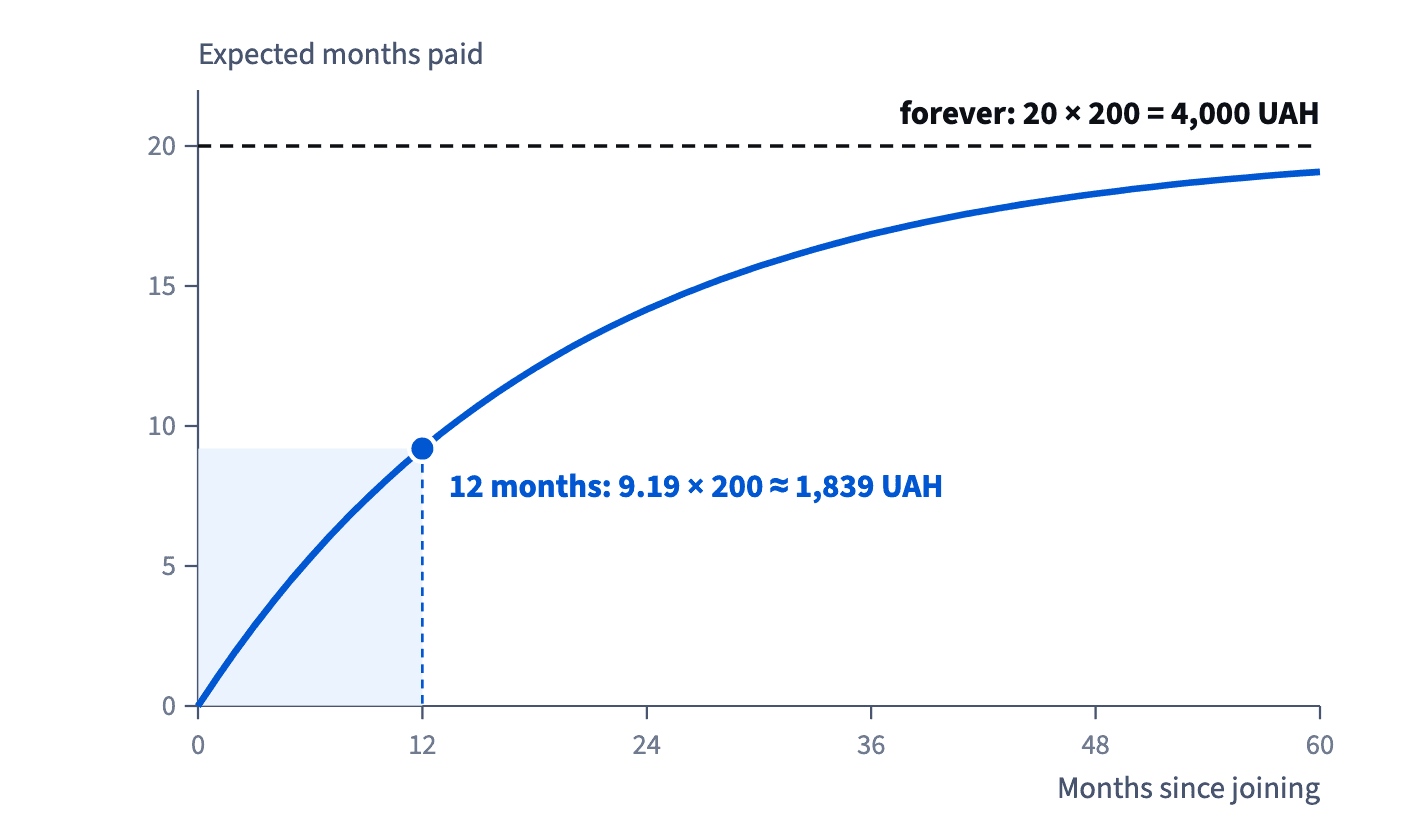
Check by brute force: in a spreadsheet, a column of 200 × 0.95ᵏ for k = 0 to 11 adds up to the same 1,839. n counts terms, starting from k = 0.
- Do200 × (1 − 0.95¹²) ÷ 0.05 ≈ 1,839 UAH within a year.
- Don'tSet the acquisition budget at the endless 4,000.
More than half of it arrives after the first year.
The annuity factor: discounting as a geometric series
Discounting has the same shape. At 25% a year, each year's money is worth 0.8 of the year before, because 1 ÷ 1.25 = 0.8. So five yearly payments of 1, the first in one year, are worth 0.8 + 0.64 + 0.512 + 0.4096 + 0.32768 = 2.68928 today. That sum is the annuity factor.
With the finite-sum formula: a = 0.8, q = 0.8, n = 5, so 0.8 × (1 − 0.8⁵) ÷ (1 − 0.8) = 0.8 × 0.67232 ÷ 0.2 = 2.68928. In general, for a rate r and n payments, the factor is (1 − (1 + r)⁻ⁿ) ÷ r.
Formula: n terms, from a to aqⁿ⁻¹. In a spreadsheet it is also just the sum of a column. · shown above
Multiply by the payment to get the present value of a loan, a lease or a contract: five payments of 50,000 UAH at 25% are worth 50,000 × 2.68928 = 134,464 today, against 250,000 paid in total.
Check the timing. The factor assumes the first payment comes after one period. If the first payment is today, it isn't discounted, and the factor becomes 1 + 0.8 + 0.64 + 0.512 + 0.4096 = 3.3616.
- DoFive payments of 50,000 at 25%: 50,000 × 2.68928 = 134,464 today.
- Don't"Five payments of 50,000 are worth 250,000 today."
Later payments are worth less today.
A savings pot: the series with a factor above 1
Run the factor above 1 and the series becomes a savings pot. Pay P at the end of every year at rate r for n years: the last payment hasn't grown, the one before grew once, the first grew n − 1 times. Read from the last: P + P(1 + r) + … + P(1 + r)ⁿ⁻¹, a finite geometric series with a = P and q = 1 + r.
The sum is S = P × ((1 + r)ⁿ − 1) ÷ r. Check with three years of 10,000 at 10%: 12,100 + 11,000 + 10,000 = 33,100, and 10,000 × (1.331 − 1) ÷ 0.1 = 33,100.
Two shortcuts look plausible and are wrong: P × n × (1 + r) ignores compounding, and P × (1 + r)ⁿ grows only the first payment, as if nothing else had been paid in.
The formula needs a steady payment and a steady rate. Real returns swing, so read a projected pot as a range, not a promise. And the pot is in future money: to compare it with today, discount it back.
- Do10,000 a year for 3 years at 10%: 10,000 × (1.1³ − 1) ÷ 0.1 = 33,100.
- Don't"Three payments of 10,000 at 10% give 10,000 × 1.1³ = 13,310."
That grows only the first payment.
Before you trust a series formula
Every closed formula in this lesson is the sum of a series with fixed parts, so it inherits their assumptions. Before you put one into a plan, check four things:
- |q| < 1 for an endless sum; otherwise there is no total.
- The step factor is constant: the same churn every month, the same k in every referral generation, the same rate every year. Real churn falls after the first months; real returns swing.
- The amount per step is constant: the same margin, the same payment.
- Time is priced in: m ÷ c counts month 60 as fully as month 1; discounting would shrink it.
Formula: T: expected lifetime in months; c: monthly churn; m: margin per month. Assumes churn stays the same every month and ignores discounting. · shown above
When an assumption is shaky, use a capped sum over a horizon you trust, or simply a spreadsheet column with the real numbers per period.
How it fits together: one shape, a + aq + aq² + …, gives referral totals, lifetime and LTV, capped LTV, annuity factors and savings pots. The next lesson adds e and ln, which find the exponent itself.
- Do"LTV ≈ 4,000 if 5% churn holds and without discounting; 1,839 within 12 months."
- Don't"Each member is worth 4,000 UAH."
A number without its assumptions.
Ready to practise?
Answer the lesson's exercises and earn 250 points the first time you finish it.
Start the exercises