

Theory
Notation: indices, bars, hats and Greek letters
How to read x_i, sorted values, x̄ and ŷ, the Greek letters μ, σ, α, β and λ, Δ for a change, and sample vs population.
~8 min read · 9 exercises · 250 points
Before you start
The language of formulas
You're still on Klasna's product team, and the courses on statistics and finance are full of formulas: x with little indices, bars, hats, Greek letters, Σ, ≤ and curly brackets. Module 2 asks one question: can you read any of those formulas aloud, in words, and say what each part does?
This first lesson is the dictionary: indices and sorted values, the bar and the hat, Greek letters for the whole and Latin ones for the sample, Δ for a change, and braces that only label.
Indices: which value you mean
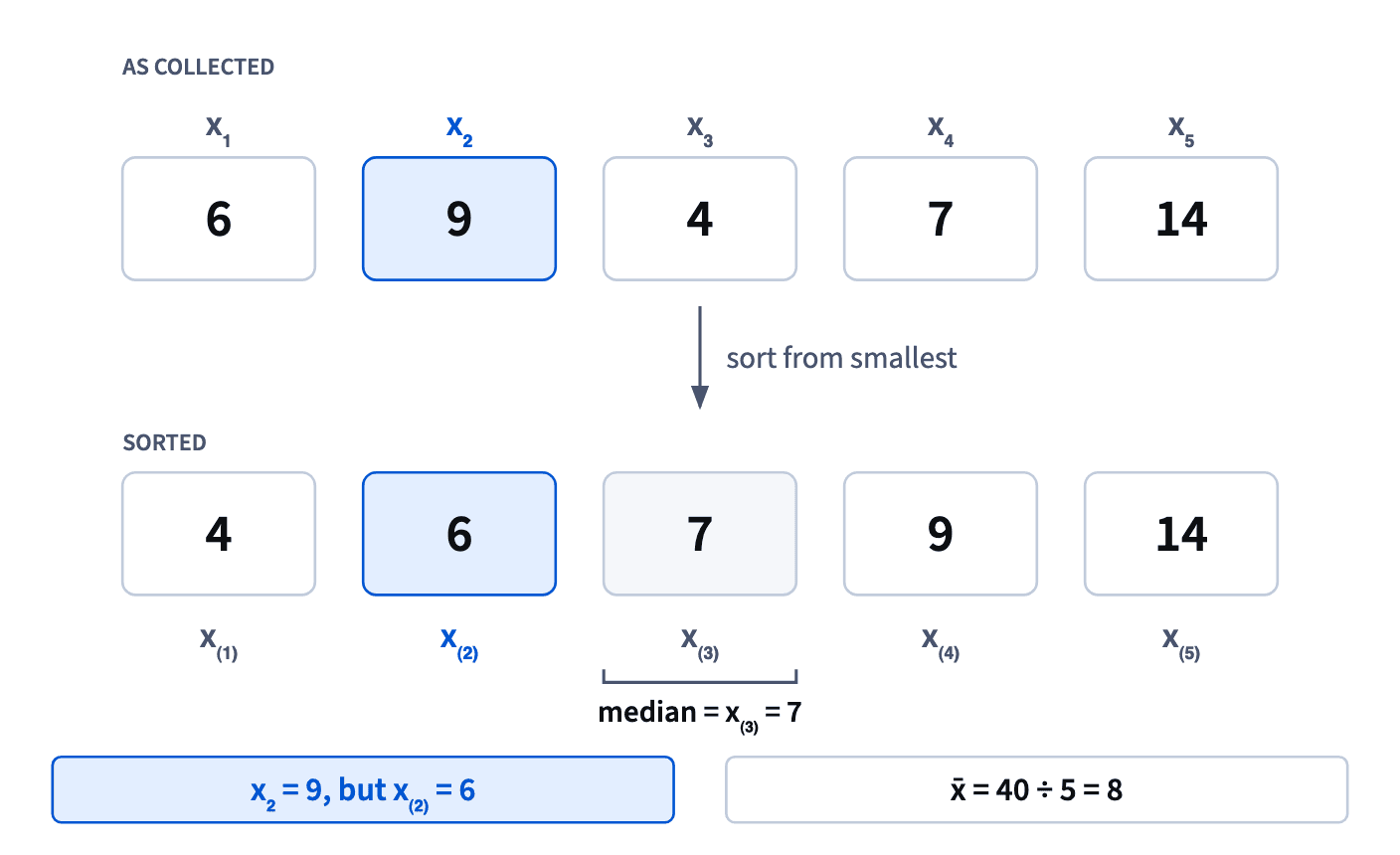
Formulas are written in shorthand, and the first piece of it is the small letter below the line, the index. Take the lessons five Klasna learners took in March: 6, 9, 4, 7 and 14. Call the list x. The index says which value you mean: x₁ = 6, x₂ = 9, x₄ = 7, x₅ = 14.
xᵢ means "the i-th value, any one of them". It lets a formula talk about every value at once without listing them. n is how many values there are, here n = 5, so i runs from 1 to n.
Two habits help. Read the index as a position, not a size: x₄ is the fourth value as collected, not the fourth smallest. And check what n counts: values in the list, not their total. This list adds up to 40; its n is 5.
With xᵢ and n you can already read a lot of statistics: a formula says what to do with each value and how many values there are.
- Dox₂ = 9: the second value collected
- Don'tn = 40 for the list 6, 9, 4, 7, 14
That's the sum; n counts values.
Brackets around the index: sort first
When the index sits in round brackets, the values are sorted first, from smallest to largest. x₍₁₎ is the smallest, x₍ₖ₎ the k-th from the bottom, x₍ₙ₎ the largest.
The list 6, 9, 4, 7, 14 sorted becomes 4, 6, 7, 9, 14. So x₂ = 9, the second value collected, but x₍₂₎ = 6, the second smallest. The two notations look almost the same and give different numbers, which is exactly why the brackets are there.
Sorted indices appear wherever order matters more than the values themselves: the median of five values is the middle one, x₍₃₎ = 7; quartiles and percentiles are read off sorted positions; a trimmed mean drops the lowest and highest x₍ₖ₎.
When you meet x₍ₖ₎, sort on paper before anything else. Most mistakes come from reading off the unsorted list.
- Do11, 4, 9 sorted is 4, 9, 11, so x₍₁₎ = 4
- Don'tReading x₍₂₎ as the second value collected
The brackets ask you to sort first.
Bar for an average, hat for a prediction
Two marks on top of a letter change its meaning.
A bar means "the average of". x̄, read "x bar", is the mean of the list: (6 + 9 + 4 + 7 + 14) ÷ 5 = 40 ÷ 5 = 8 lessons. Other courses use p̄ for an average share.
A hat means "estimated" or "predicted by a model". A trend line said May would bring ŷ = 9,800 lessons; the actual number was y = 9,620. The gap y − ŷ is the model's error for that month, the residual: 9,620 − 9,800 = −180 lessons.
The order matters: actual minus predicted. A negative residual means the model guessed too high, a positive one too low. A residual is in the units of y, lessons here, not in percent.
Memory aid: a bar is an average of something; a hat is a guess about it.
- Doy − ŷ = 9,620 − 9,800 = −180: the model was too optimistic
- Don'tŷ − y = +180, "the model under-predicted"
Flipped order, flipped conclusion.
Greek for the whole, Latin for the sample
Formulas use different letters for the group you looked at and for the whole group you care about.
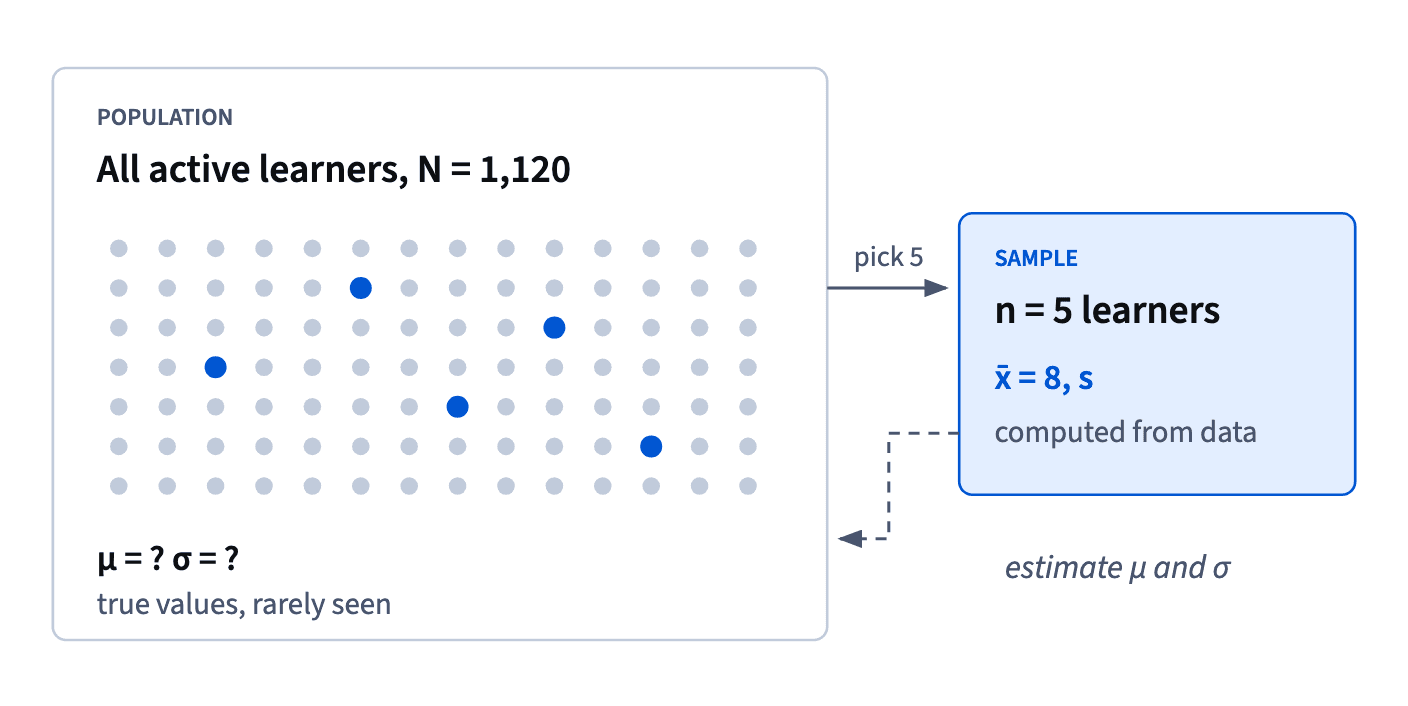
The whole is the population, with N for its size: in March Klasna had N = 1,120 active learners. The part you looked at is a sample, with a small n: five learners, n = 5.
The population's mean is μ (mu) and its spread σ (sigma). We almost never see them. From the sample we compute x̄ and s and use them as estimates: x̄ = 8 is our best guess for μ.
So the letter itself makes a claim. Writing μ = 4.3 next to a survey of 200 learners says you measured everyone; x̄ = 4.3 says you measured 200 and are estimating the rest. Greek letters describe the whole and are usually unknown; Latin letters are computed from data you actually have.
- Dox̄ = 4.3 (n = 200)
- Don'tμ = 4.3 from a 200-person survey
The Greek letter claims you asked everyone.
Five symbols in one table
Most formulas in statistics are built from a handful of symbols. Read them as a small dictionary:
- x̄: the mean of the sample, computed from your data;
- μ: the mean of the whole population, usually unknown;
- ŷ: a value predicted by a model;
- n: the number of values in the sample;
- N: the size of the population.
The pattern behind them: a bar is an average, a hat is a prediction, Greek letters describe the whole and Latin ones the sample, capital N is the whole and small n the part.
When a formula mixes them, say each one out loud in words before you compute. "x̄ minus μ, divided by…" becomes "how far our sample average is from the true average, divided by…", and the meaning of the whole expression usually follows.
- Do"x̄ = 8 lessons (n = 5 of N = 1,120)"
- Don'tSwapping n and N in a report
Then the sample looks bigger than the school.
α, β, λ: the caption is the dictionary
Some Greek letters don't follow the whole-versus-sample rule: their meaning is set by the topic.
- α (alpha) is the false-alarm level you choose for a test before running it, usually 0.05.
- β (beta) is the chance of missing a real effect in a test; in regression the same letter names a model's coefficients.
- λ (lambda) shows a factor's strength in factor analysis; elsewhere it can stand for a rate.
So one letter can mean different things in different lessons, and nobody expects you to memorize every use. The caption under a formula is its dictionary: it says what each letter stands for here. Read it before you compute, and when you write a formula for others, give it a caption too.
When a caption is missing, look at how the letter was introduced in the text around it rather than guessing from another course.
- DoReading "α: false-alarm level, 0.05" in the caption first
- Don'tAssuming β means the same in a test and in a regression
Same letter, different job.
Δ: the change in
Δ (delta) means "the change in". ΔQ = Q_new − Q_old: Klasna delivered 7,840 lessons in March and 9,620 in May, so ΔQ = 9,620 − 7,840 = +1,780 lessons. The finance course also writes Δspend for extra marketing money and ΔAR for the change in what customers owe.
ΔQ% is the same change as a share of the old value, the relative change from module 1: 1,780 ÷ 7,840 = 0.2270, so +22.70%. Divide by the old value, never the new one.
Δ always comes with an order, new minus old, so its sign tells the direction: a negative Δ is a fall. And Δ keeps the units of what changed: lessons, hryvnias or, for rates, percentage points. ΔQ% is the relative version, in percent.
- DoΔspend = 225,000 − 180,000 = +45,000 UAH
- Don'tΔQ% = 1,780 ÷ 9,620 ≈ 18.5%
Divided by the new value.
A brace is only a label
A curly brace drawn under part of a formula, with a few words beneath it, is a label. It names a chunk so the reader can see the structure; it changes nothing in the arithmetic.
CM = (P − 0.025P) − (T + V), with "what Klasna keeps" under the first part and "costs per lesson" under the second, is the same contribution margin as before: 620 − 15.50 − 420 = 184.50 UAH for a 620-UAH lesson. The order of operations still comes from the round brackets, not the braces.
The finance course uses braces to split a plan-versus-actual gap into its volume, mix and price parts. Read each brace as a sentence: "this part is the price effect".
How it fits together: indices say which value, bars and hats say average or prediction, Greek and Latin letters say whole or sample, Δ says change and braces say what a part is. Next lesson: Σ, the shorthand for adding everything up.
- DoReading a brace as "this part is the costs per lesson"
- Don'tTreating a brace as brackets that change the order
Round brackets do that, braces don't.
Ready to practise?
Answer the lesson's exercises and earn 250 points the first time you finish it.
Start the exercises