

Theory
Expected value and scenarios
Weighting outcomes by their probabilities, deal pipelines and earn-outs, expected loss against an insurance premium, and risk exposure in matching units.
~9 min read · 9 exercises · 250 points
Before you start
Three ways the summer can go
Klasna is thinking about a summer intensive course, and Hanna, the head of finance, has sketched three scenarios for its profit: a good summer, a normal one and a bad one with a loss. Which number goes into the plan?
You'll give each scenario a probability, combine them into an expected value, and see what that one number hides: the spread of outcomes and the bad case a small school may not survive.
Expected value: weigh, then add
When a plan has several possible outcomes, no single one belongs in the spreadsheet on its own. The expected value combines them: multiply each outcome by its probability and add, EV = Σ pᵢ·xᵢ. The probabilities must cover every scenario and add up to 1.
Hanna sketched three scenarios for Klasna's summer intensive: +300,000 UAH (probability 0.25), +120,000 (0.50) and −80,000 (0.25). EV = 0.25 × 300,000 + 0.50 × 120,000 + 0.25 × (−80,000) = 75,000 + 60,000 − 20,000 = 115,000 UAH.
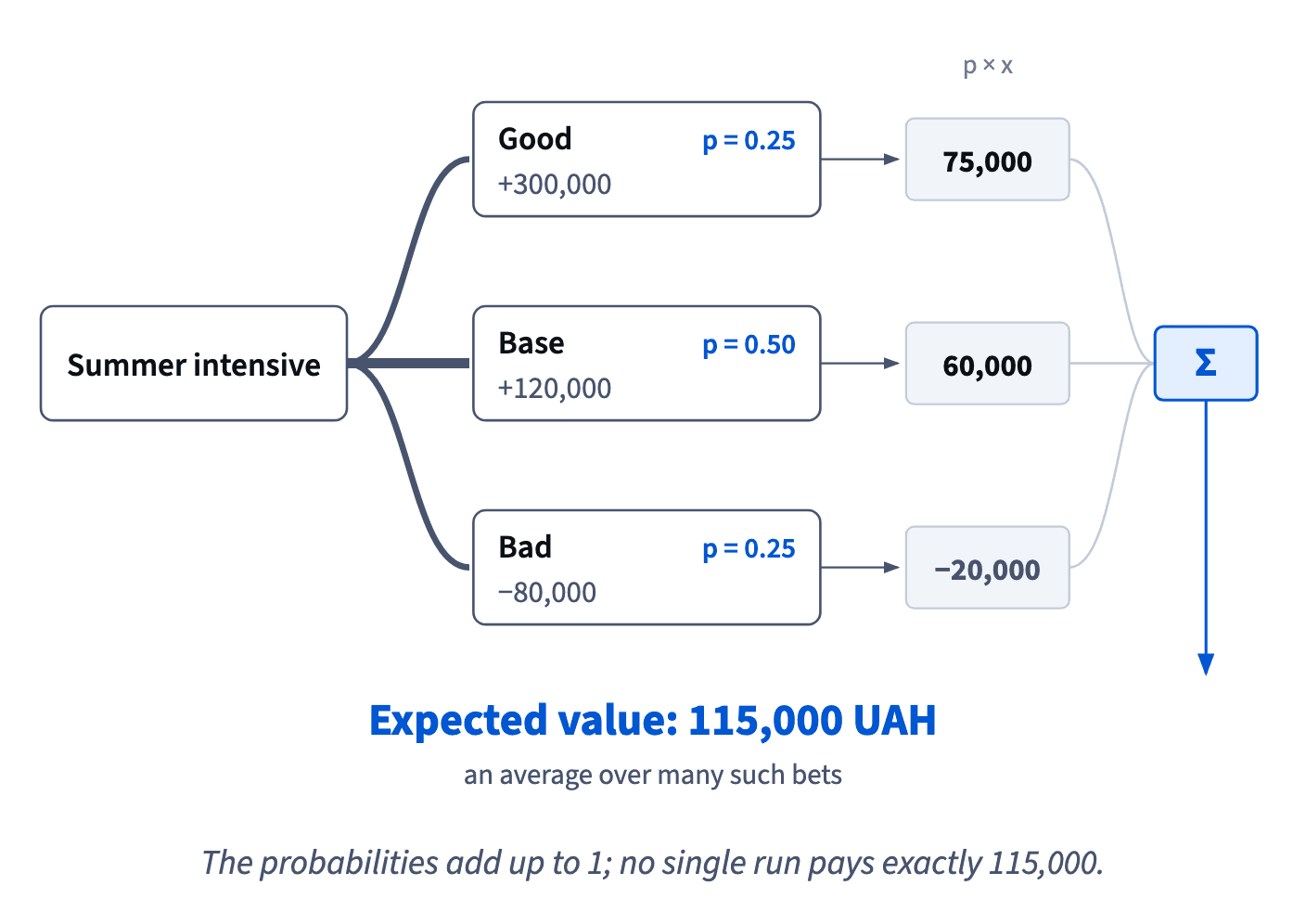
It is the weighted mean from Weighted mean and mix, with probabilities as the weights. Two slips to avoid: dropping the minus sign of a loss, which makes the bad scenario add money, and probabilities that sum to 0.9 or 1.1, which means a scenario is missing or counted twice. Check the sum before you multiply.
- Do0.2 × 90,000 + 0.6 × 30,000 + 0.2 × (−40,000) = 28,000; the probabilities add up to 1.
- Don't0.25 × 300,000 + 0.50 × 120,000 + 0.25 × 80,000 = 155,000.
The loss lost its minus sign.
EV is an average over many bets
An expected value describes what a bet pays on average over many repetitions, not what one repetition will bring. Often it isn't even a possible result.
The summer intensive's EV is 115,000 UAH, yet this summer will bring 300,000, 120,000 or −80,000, nothing in between. The single most likely result is 120,000 (probability 0.50), and there is a 25% chance of losing 80,000. Over many summers like this one, the average would approach 115,000; this summer is one draw.
That is why an EV should never travel alone. Put the range next to it, and the chance of the worst case: "EV 115,000; between −80,000 and +300,000; a 25% chance of a loss". Then the decision can weigh a question the EV can't answer: if the bad case happens, can Klasna absorb it?

- Do"EV 115,000 UAH; outcomes from −80,000 to +300,000, a 1-in-4 chance of a loss."
- Don't"The intensive will make 115,000."
A long-run average presented as this summer's result.
Expected value adds up deal by deal
Expected values add: the EV of a sum is the sum of the EVs. That makes a sales pipeline easy to value. For each deal, multiply the win probability by what the deal is worth, then add the deals.
Klasna for Teams, the school's lessons for companies, values a corporate deal as win probability × lessons a year × contribution per lesson (339 UAH). A logistics company at 0.4 with 600 lessons: 0.4 × 600 × 339 = 81,360 UAH. Two deals, A with a 0.5 chance of 400 lessons and B with a 0.25 chance of 1,200: expected lessons 0.5 × 400 + 0.25 × 1,200 = 200 + 300 = 500, and 500 × 339 = 169,500 UAH. Deal by deal gives the same: 67,800 + 101,700.
Remember what each term means: a 0.4 deal never brings 0.4 of its money. It brings all of it or nothing, and the pipeline's EV is only what such all-or-nothing deals bring on average.
- DoPipeline EV: 0.5 × 400 × 339 + 0.25 × 1,200 × 339 = 169,500 UAH.
- Don't"B is the bigger deal, so the pipeline is worth 1,200 × 339."
Ignores the 0.25 chance of winning it.
Same EV, different risk
Two plans with the same expected value can carry very different risks. What differs is how far the actual result can land from the EV.
Compare two Klasna for Teams pipelines, each with an EV of 100,000 UAH a year. Pipeline A has ten independent deals, each a 0.4 chance of 25,000: 10 × 0.4 × 25,000 = 100,000. Pipeline B has one deal, a 0.4 chance of 250,000: 0.4 × 250,000 = 100,000. B brings either 250,000 or nothing, and nothing is the likelier of the two (0.6). In A, wins and losses among the ten deals tend to cancel out: all ten fail only with probability 0.6¹⁰ ≈ 0.006.
So when you compare plans, report the EV and the spread. A team that leans on one big deal needs a cushion for the year it doesn't land, even though its EV looks the same on paper.
- Do"Same 100,000 EV; pipeline B has a 60% chance of bringing nothing."
- Don't"Both pipelines are worth 100,000, so they are equally safe."
Equal averages say nothing about the spread.
Pricing a payment that may not happen
Some prices depend on the future. An earn-out is a part of a purchase price paid only if the bought business hits a target later. Say Klasna buys a small tutoring platform for 4 million UAH now, plus 2 million more if the platform reaches next year's revenue target.
In the end the price is 4 or 6 million. Today you can price the deal with expected value: the sure part plus the uncertain part times its probability. At a 50% chance of hitting the target, EV = 4 + 0.5 × 2 = 5 million UAH. At 30% it would be 4 + 0.3 × 2 = 4.6 million.
The seller should run the same sum. The promised 2 million is worth 1 million in expectation at 50%, and less if the target depends on decisions the seller no longer controls. Comparing offers by their headline totals, 6 million against a flat 5.5, compares the best case of one with the certainty of the other.
- Do"4 million now + 0.5 × 2 million later = 5 million expected."
- Don't"The platform sells for 6 million."
Counts the earn-out as if it were certain.
Expected loss and the price of insurance
A risk of losing something has an expected loss: probability × loss, p × L. Klasna's recording studio kit is worth 200,000 UAH and has about a 3% chance a year of being lost to fire or theft: 0.03 × 200,000 = 6,000 UAH a year.
An insurer asking 9,000 a year charges more than the expected loss, and always will: the premium covers the claims plus the insurer's costs and profit. On expected value alone, insurance is a losing bet.
People still buy it for a reason the EV hides: the spread. Without cover, most years cost nothing and one bad year costs 200,000. With cover, every year costs 9,000. Hence the rule of thumb: insure the losses you couldn't absorb, and carry the small ones yourself. A tutor's 40,000 UAH laptop at a 5% yearly risk has an expected loss of 2,000; whether a 3,200 premium is worth it depends on whether paying 40,000 from savings would hurt.
- Do"Expected loss 6,000 a year, premium 9,000: we insure because a 200,000 loss would hurt."
- Don't"Insurance pays for itself on average."
The premium is always above the expected loss.
A deductible: when it pays
A deductible is the part of each loss you pay yourself before insurance pays the rest. In return, the premium drops. Expected value tells you when the trade is worth it.
For Klasna's studio kit, full cover costs 9,000 a year; with a 20,000 deductible it costs 6,500. The expected yearly cost with the deductible is 6,500 + 0.03 × 20,000 = 7,100, and the worst year costs 6,500 + 20,000 = 26,500. You save 2,500 every year and pay 20,000 extra only in a year with a claim.
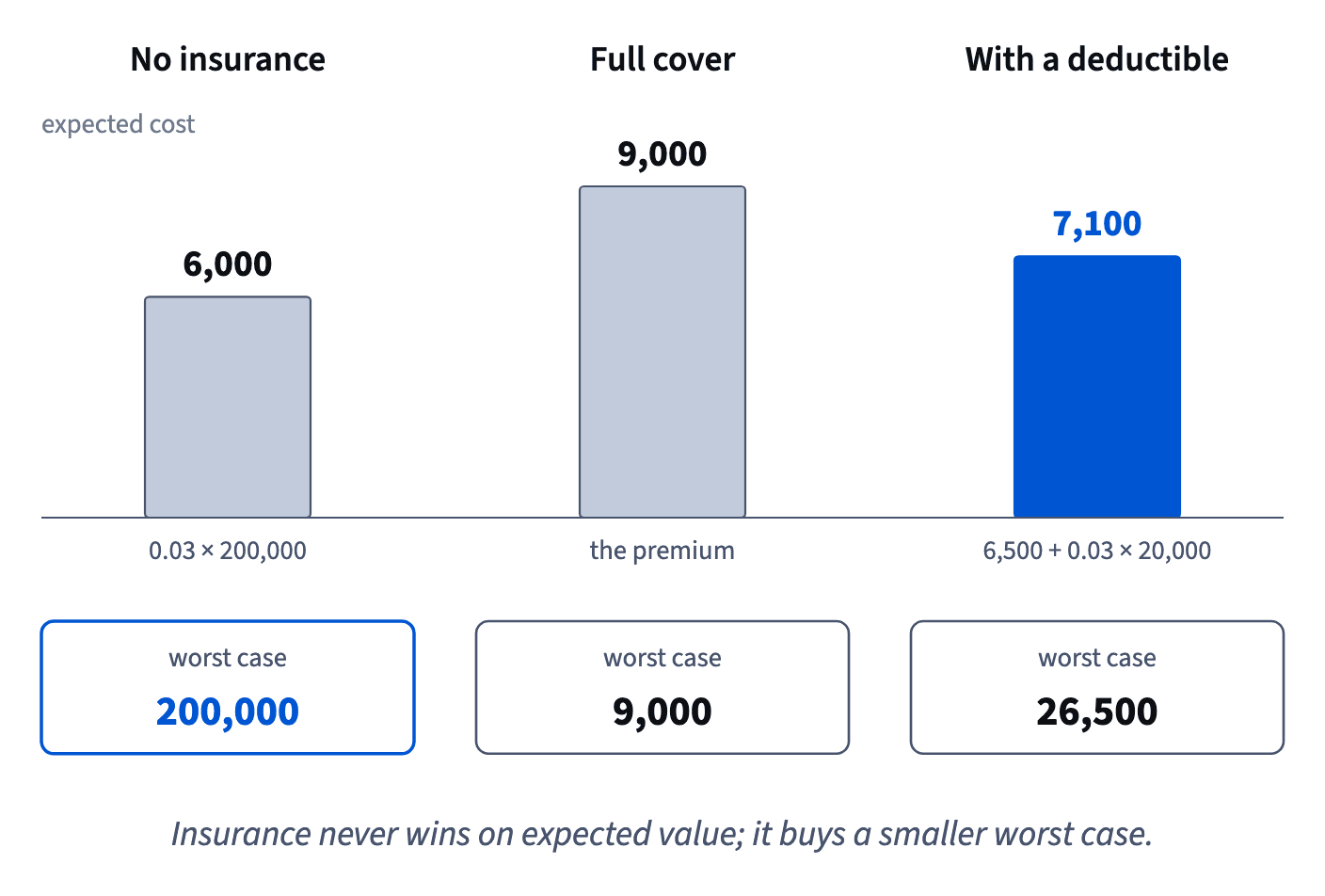
So the deductible pays off while the chance of a claim stays below the saving divided by the deductible: 2,500 ÷ 20,000 = 12.5% a year. At the kit's 3%, it clearly does. The worst case matters too: choose a deductible you could pay from savings without trouble.
- Do"The deductible saves 800 a year and costs 10,000 in a claim year: worth it below an 8% claim chance."
- Don't"Always take the cheapest premium."
Check you could pay the deductible in a bad year.
Risk exposure: units must match
Project teams rank risks with the same product: exposure = probability × impact. A 20% chance of a 10-day delay is an exposure of 0.2 × 10 = 2 days. A 10% chance of a 50,000 UAH overspend is 0.1 × 50,000 = 5,000 UAH.
The result keeps the units of the impact, and only exposures in the same units can be added or compared. 2 days + 5,000 UAH is not 5,002 of anything. Either keep two totals, 2 days and 5,000 UAH, or convert one into the other first, for example by pricing a day of delay. If a day of delay costs Klasna 3,000 UAH in lost lessons, the delay's exposure is 6,000 UAH and the total is 11,000 UAH.
The same check applies to every expected value: all outcomes in one sum must share a unit.
How it fits together: expected value weighs each outcome by its probability, adds up deal by deal, and prices insurance and risks, while a single bet still lands on one outcome. The next lesson runs many tests at once and asks how likely at least one false alarm is.
- Do"Risks: 2 days of delay and 5,000 UAH of overspend."
- Don't"Total risk exposure: 5,002."
Days and hryvnias added together.
Ready to practise?
Answer the lesson's exercises and earn 250 points the first time you finish it.
Start the exercises