

Theory
Compounding
Growth factors, why −50% then +50% loses a quarter, (1 + r)ⁿ, simple vs compound interest, CAGR with a fractional power, and monthly ↔ yearly rates and churn.
~9 min read · 9 exercises · 250 points
Before you start
Module 6: growth and time
This module answers one question: how do money and metrics change over time, and what is money in the future worth today? Growth that repeats multiplies rather than adds, so a few percent a month turn into large numbers over a year, and churn quietly eats a base that keeps shrinking. You'll chain growth factors, compute compound interest and CAGR, discount future cash, sum geometric series for LTV, and meet e, ln, odds and the sigmoid. This lesson starts with compounding, using Klasna, the online tutoring school, and its Klasna Club.
Growth factors: percentage changes multiply
A percentage change is always taken of some base, as in Percent vs percentage points. When changes follow each other, each one starts from a new base, so they can't simply be added.
The fix is the growth factor: a change of r becomes ×(1 + r). +20% is ×1.2, −20% is ×0.8, −50% is ×0.5. Chained changes multiply: the total factor is the product, and the total change is that product minus 1.
Example: Klasna Club lost 50% of its members over the summer and grew 50% in September. 0.5 × 1.5 = 0.75, so the Club is 25% down, not back where it was. From 1,000 members: 500 after the summer, 750 after September.
The order of the changes doesn't matter (1.5 × 0.5 is also 0.75), but the bases do: a fall followed by a rise of the same size always ends below the start, because the rise applies to a smaller number.
The usual slip is adding the percentages (−50% + 50% = 0) or averaging them. Turn every change into a factor first, multiply, and only then convert back to percent.
- Do−10% then +10%: 0.9 × 1.1 = 0.99, a 1% fall overall.
- Don't"We lost 50% and then grew 50%, so we're back where we were."
The rise applies to half the original base.
Big swings: why averaging percentages misleads
With big swings the gap between adding and multiplying becomes dramatic. +300% is a factor of 4 (the value plus three times the value), −75% is a factor of 0.25. Chained: 4 × 0.25 = 1, so the value is exactly back at the start.
Yet the simple average of the two percentages is (300 − 75) ÷ 2 = +112.5% per period. A report that quotes that average describes growth that never happened: anyone who held on through both periods has exactly what they started with.
The asymmetry runs one way. A fall needs a bigger rise to recover: −20% needs +25%, −50% needs +100%, −75% needs +300%. The rise needed after a fall f is 1 ÷ (1 − f) − 1.
So when a sequence of percentages is summarised, ask for the start and end values, or multiply the factors yourself. The honest average per period is the one that compounds to the same end: the CAGR, later in this lesson.
- Do−75% needs +300% to recover: 1 ÷ 0.25 − 1 = 3.
- Don't"+300% and −75% average +112.5% a period, so we grew fast."
The value ended exactly where it started.
Compound vs simple interest
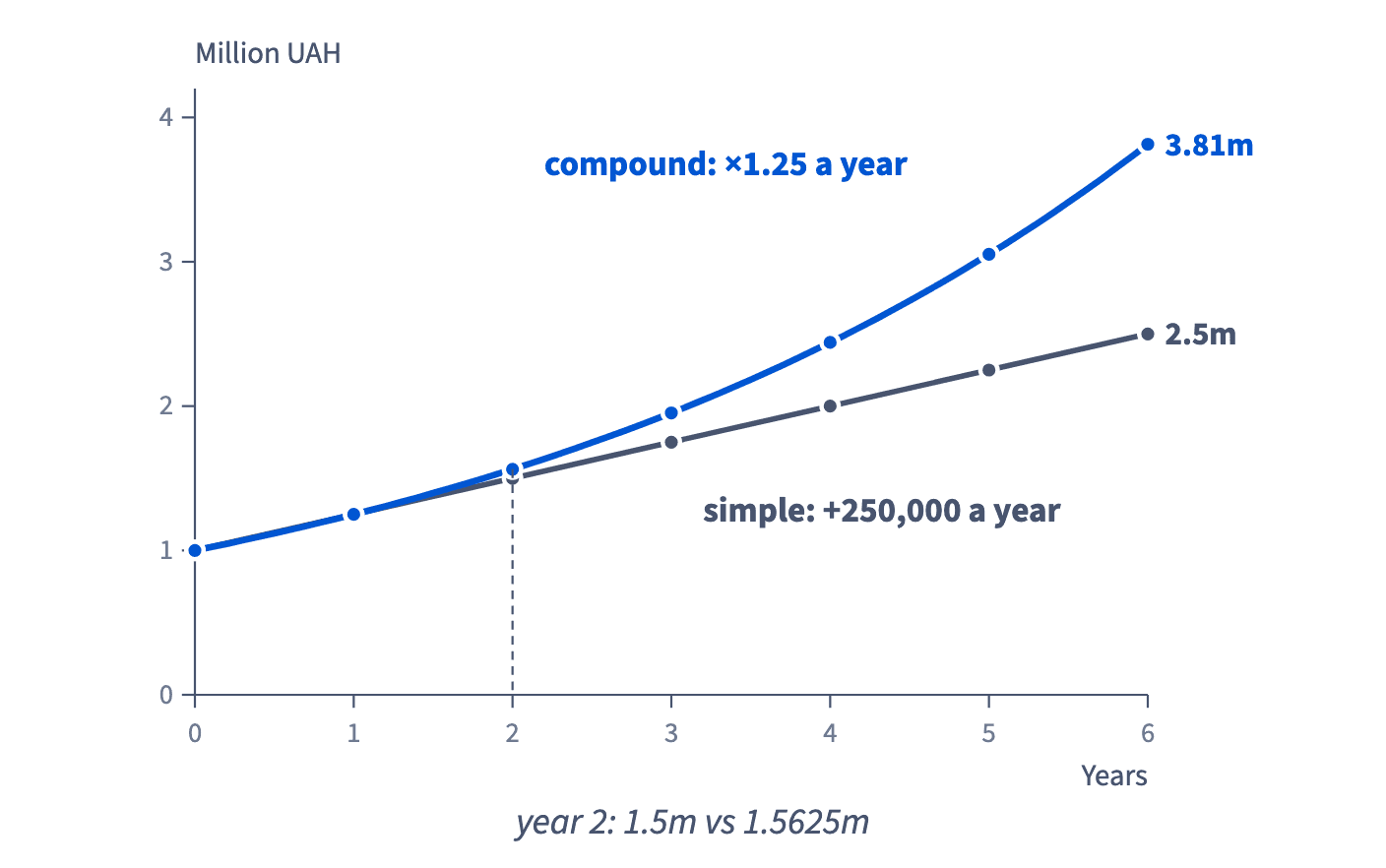
Repeat the same growth factor n times and you get a power: FV = PV × (1 + r)ⁿ, where PV is the amount today, r the rate per period and FV the amount after n periods. That's compound interest: every period earns on the interest already added.
Simple interest pays only on the original amount: FV = PV × (1 + r·n). It adds the same step each period instead of multiplying.
At 25% a year on 1,000,000: after two years simple interest gives 1,000,000 × 1.5 = 1,500,000, compound interest 1,000,000 × 1.25² = 1,562,500. The 62,500 gap is 25% on the first year's 250,000 of interest. After six years the gap is 2,500,000 against 3,814,697: a straight line against a curve that bends up.
Most deposits, investments and metric growth compound; some short loans and late-payment charges use simple interest, as Simple interest, days and annualizing shows. Read the terms before you compute.
- Do1,000,000 × 1.25² = 1,562,500 after two years at 25% compounded.
- Don't"25% for two years is 50%, so 1,500,000."
That's simple interest; compounding adds 62,500.
Monthly growth over a year: (1 + r)¹²
A rate quoted per month compounds over twelve months, so the yearly growth is (1 + r)¹² − 1, not 12 × r.
At 2% a month: 1.02¹² ≈ 1.2682, so a year adds 26.82%. Multiplying by 12 gives 24%, 2.82 percentage points short. Those points are growth on growth: from the second month on, each 2% is taken of a slightly bigger amount.
The gap widens with the rate and with the number of periods. At 1% a month the year gives 12.68% (against 12%); at 5% a month, 79.59% (against 60%). For small rates over a few periods, n × r is a fair quick estimate; for anything you report, compute the power.
How to compute it: in a spreadsheet, =(1+0.02)^12-1; on a phone calculator, 1.02 and the xʸ key. Always say which number you quote: "2% a month, about 26.8% a year compounded".
- Do"2% a month, about 26.8% a year compounded."
- Don't"2% a month is 24% a year."
12 × r ignores growth on growth.
CAGR: compounding run backwards
CAGR, the compound annual growth rate, runs compounding backwards: given a start value V₀, an end value Vₙ and n years, it finds the steady yearly rate that links them. CAGR = (Vₙ ÷ V₀)^(1/n) − 1.
A power of 1/n is the n-th root: x^(1/2) is the square root, x^(1/3) the cube root. It undoes the power: if x³ = 1.4, then x = 1.4^(1/3).
Example: Klasna delivered 8,000 lessons in its first spring and 11,200 three springs later. The total factor is 11,200 ÷ 8,000 = 1.4 (+40%). CAGR = 1.4^(1/3) − 1 ≈ 0.1187, so 11.87% a year. Check: 1.1187³ ≈ 1.40.
The common slip is dividing the total growth by the years: 40% ÷ 3 ≈ 13.3%. Compounded over three years, 13.3% gives 1.133³ ≈ 1.455, too much. Dividing always overstates the yearly rate.
In a spreadsheet: =(end/start)^(1/n)-1. Count n as the number of growth steps between the two values, not the number of values.
- Do=(11200/8000)^(1/3)-1 gives 11.87% a year.
- Don't"+40% over three years is 13.3% a year."
Dividing ignores compounding and overstates the rate.
CAGR vs the average of yearly returns
When yearly results swing, their simple average overstates the growth that actually happened. The honest average is the CAGR: the steady rate that compounds to the same end.
Example: a savings fund rises 50% one year and falls 20% the next. The simple average is (50 − 20) ÷ 2 = 15% a year. The real path: 1.5 × 0.8 = 1.2, so two years gave +20% in total, and the CAGR is 1.2^(1/2) − 1 ≈ 9.54%. 15% a year compounded would have given 1.15² = 1.3225, +32% instead of the real +20%.
The bigger the swings, the bigger the gap, because a loss hits a larger base than the gain that follows it. The same trap appears over twenty years: in an invented series of yearly returns that average 6%, 100,000 grows only to 275,589, a CAGR of 5.2%.
So when someone quotes an "average return", ask whether it's the simple average or the compound one. Only the compound one tells you where the money ends up.
- Do+50% then −20%: √(1.5 × 0.8) − 1 ≈ 9.5% a year.
- Don't"+50% and −20% average 15% a year."
The fund grew 20% in total, not 32%.
Yearly and monthly rates: the 12th root
To turn a yearly rate into a monthly one, ask which monthly factor, repeated twelve times, gives the yearly factor. That's the 12th root: monthly rate = (1 + R)^(1/12) − 1. The other way round, yearly rate = (1 + r)¹² − 1.
Example: 25% a year is equivalent to 1.25^(1/12) − 1 ≈ 1.877% a month, not 25 ÷ 12 ≈ 2.083%. Dividing by 12 overstates the monthly rate, because 2.083% a month compounds to more than 25% a year (1.02083¹² ≈ 1.28).
The same rule works for any period: a quarter is the 4th root, a week the 52nd.
It matters in both directions. A loan at "3% a month" sounds small, yet 1.03¹² ≈ 1.426, about 42.6% a year; lenders know which version sounds better. And a model that needs a monthly rate from a yearly one has to take the root, or every month's figure drifts.
In a spreadsheet: =(1+R)^(1/12)-1.
- Do25% a year = 1.25^(1/12) − 1 ≈ 1.88% a month.
- Don't"25% a year is 25 ÷ 12 ≈ 2.08% a month."
Twelve steps of 2.08% compound to about 28%.
Yearly churn from monthly churn
Churn compounds too, but downwards. If a share c of members leaves every month, each month keeps a factor of (1 − c), and after twelve months (1 − c)¹² remain. Yearly churn = 1 − (1 − c)¹².
Example: Klasna Club loses 5% of its members a month. 0.95¹² ≈ 0.5404, so of 1,000 members about 540 remain after a year, and yearly churn is about 46%, not 12 × 5% = 60%. Each month's 5% is taken of a smaller group.
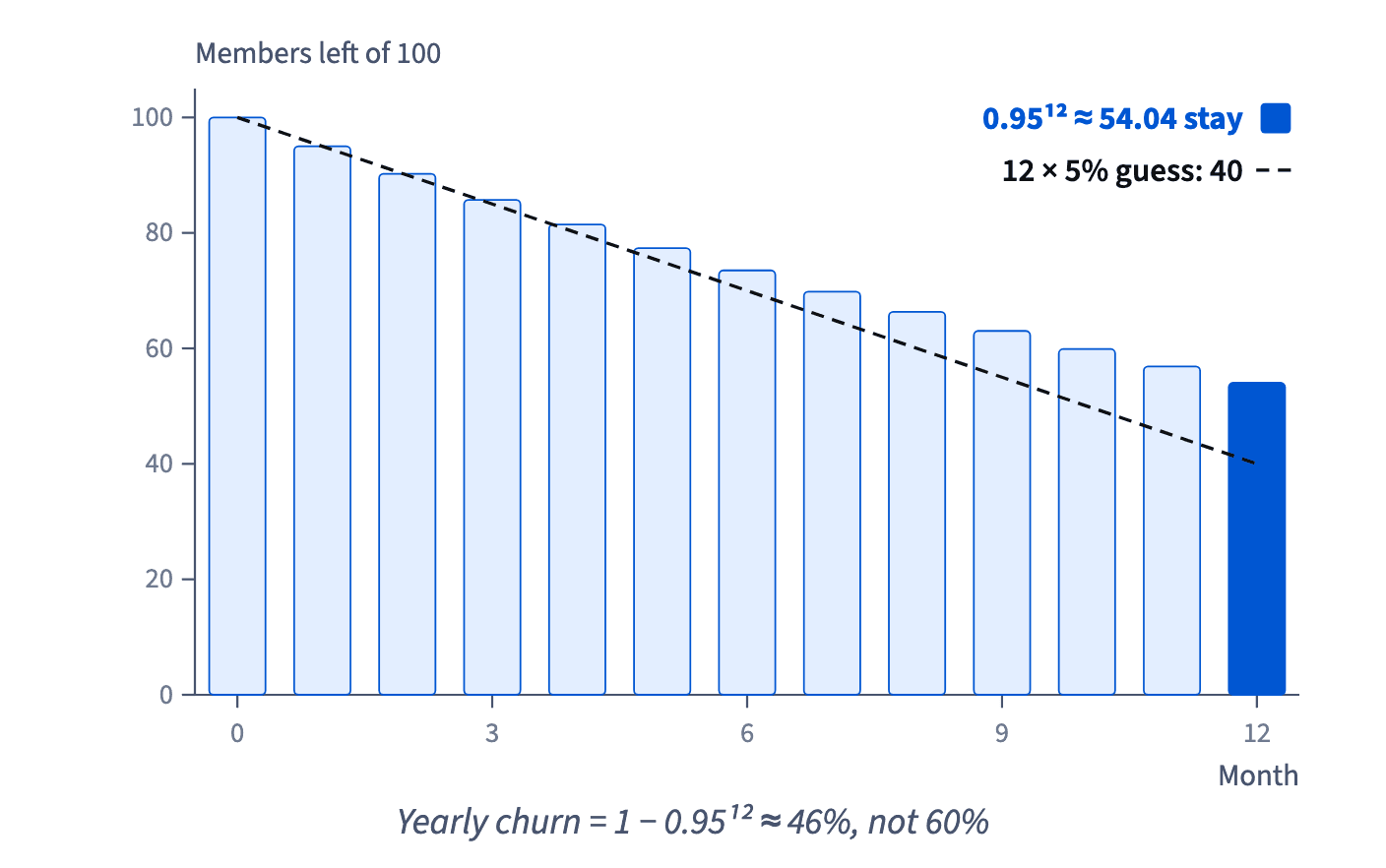
12 × c always overstates yearly churn, and the gap grows with c: at 10% a month, 12 × c says 120%, which is impossible, while 1 − 0.9¹² ≈ 72%.

How it fits together: every change is a growth factor, factors multiply, repeats become powers, and roots undo them for CAGR and monthly rates. The next lesson runs compounding in reverse: what money in the future is worth today.
- Do5% a month: 1 − 0.95¹² ≈ 46% a year.
- Don't"5% a month means we lose 60% a year."
Each month loses 5% of a smaller group.
Ready to practise?
Answer the lesson's exercises and earn 250 points the first time you finish it.
Start the exercises