

Theory
Taxes, declaring income and wartime risks
Tax on investment income, declaring foreign income, currency rules under martial law, and documents and access for your family.
~8 min read · 8 exercises · 250 points
Before you start
Taxes and hard times
Late October at Zapas, two weeks to launch. As the PM you still owe the help centre two pages: taxes, and what happens to a user's money in hard times.
Ethan would like to write "Zapas takes care of taxes", but for income from abroad a Ukrainian tax resident declares and pays it themselves. You'll work out what each kind of income costs in tax, how to explain declaring it, and which wartime risks the page should name plainly.
Tax rates on investment income
For a Ukrainian tax resident, as of October 2027 (check the current rules):
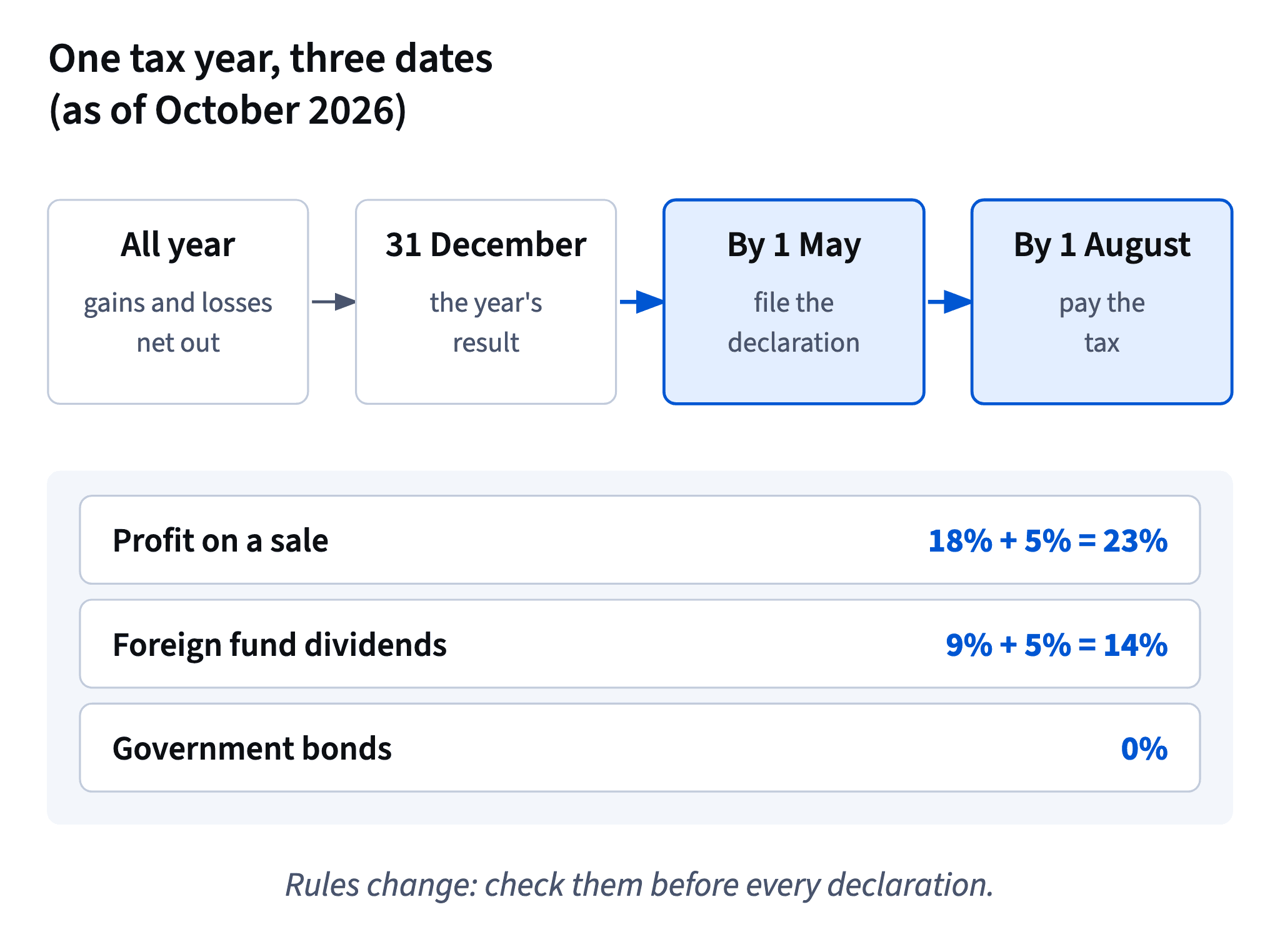
- Investment profit (selling funds, shares or bonds, including foreign ones): 18% + 5% military levy = 23% of the profit. Profit = what you received minus the documented purchase cost.
- Dividends from foreign funds and companies: 9% + 5% = 14%.
- Interest on deposits and corporate bonds: 23%; on deposits the bank withholds it.
- Government bonds (ОВДП): 0% on coupons and on profit from sale or redemption.
So 30,000 UAH of profit on a fund costs 6,900 UAH of tax; the same 30,000 from government bond coupons costs nothing.
A sole proprietor on the single tax isn't covered for this: their investment income is taxed like any individual's. And since December 2024 the levy has been 5%, not 1.5% as older articles say. Rates change: always date them.
Chart data
| Type of income | Tax, UAH |
|---|---|
| Profit on selling a fund | 230 |
| Deposit interest | 230 |
| Foreign fund dividends | 140 |
| Government bond income | 0 |
- Do(130,000 − 100,000) × 23% = 6,900 UAH
- Don't130,000 × 23% = 29,900 UAH
Tax is on the profit, not the sale amount.
Netting, and the hryvnia gain
Two details change how much investment tax a Ukrainian resident pays (as of October 2027; check the current rules):
Netting within the year. All investment operations of the calendar year are combined: gains and losses offset each other, and only a positive yearly result goes into the declaration. 30,000 of gains and 10,000 of losses mean tax on 20,000: 4,600 UAH instead of 6,900.
The hryvnia gain. Foreign-currency income is converted at the National Bank's rate on the day of the operation, and the purchase cost counts in hryvnias as documented when you bought. So a gain in hryvnias can come partly from devaluation, not from the fund's price. Exactly how that part is treated isn't settled: sources disagree. Don't promise users a number; tell them to ask a tax adviser.
Keep every trade confirmation: without documented purchase costs the profit can't be shown correctly.
- Do(30,000 − 10,000) × 23% = 4,600 UAH
- Don't"A loss this year cuts next year's tax."
Netting is within the calendar year.
Dividends, and why the share class matters
A distributing fund pays its dividends out; an accumulating one reinvests them inside the fund.
For a Ukrainian tax resident, as of October 2027 (check the current rules):
- a payout from a distributing foreign fund is taxed as a foreign dividend: 9% + 5% = 14%, for the year it was received, whether you spend it or reinvest it. 2,000 UAH of dividends means 280 UAH of tax and a line in the declaration every year;
- tax withheld abroad may be credited against the 9% income-tax part with a certificate from the foreign tax authority; sources say the 5% levy isn't covered and is paid in full;
- for an accumulating fund, nothing is paid out, so under the general rules there seems to be nothing to tax until you sell. But no official explanation confirms it.
Chart: Tax on 1,000 UAH of income for a Ukrainian tax resident, as of October 2027 · shown above
So the honest product line is: "accumulating funds may defer tax in Ukraine; this isn't settled; ask a tax adviser". Never "no tax until you sell".
- Do2,000 × 14% = 280 UAH, declared for the year received
- Don't"The dividend was reinvested, so it isn't income."
The yearly declaration
Income from a Ukrainian bank deposit is taxed by the bank. Income from a foreign broker (dividends, interest, profit from sales) is the investor's own job. As of October 2027 (check the current rules):
- During the year: keep trade confirmations, dividend statements and any foreign tax certificates.
- After 31 December: net the year's gains and losses; convert each amount into hryvnias at the National Bank's rate on the date of the operation.
- By 1 May of the next year: file the annual property and income declaration.
- By 1 August: pay the tax.
For 2027 income, for example: file by 1 May 2028, pay by 1 August 2028.
Foreign securities bought through a Ukrainian licensed firm may be handled differently; ask the firm what it reports and withholds. And a product can make this easier without "taking care of taxes": a yearly statement per user with every operation, its date and the amounts.
- Do"Your 2027 statement: every sale, dividend and date, ready for the declaration due by 1 May 2028."
- Don't"Small amounts don't need declaring."
Deferral is not exemption
Product pages love the phrase "no tax until you sell". For a Ukrainian tax resident holding an accumulating foreign fund, it's at best half true, and as of October 2027 not even confirmed.
What is known: when you sell, the profit is taxed (23% as of October 2027), counted in hryvnias against your documented purchase cost. Holding longer can postpone that moment; it doesn't erase the bill.
What isn't known: whether nothing is taxable while you hold an accumulating fund. Under the general rules there seems to be no payout to tax, but no official explanation confirms it, and whether every fund payout counts as a dividend isn't confirmed either.
So three honest phrasings: "may defer", "isn't settled", "ask a tax adviser". And one dishonest one to avoid: "tax-free". A deferral, if it holds, is worth something: the tax money keeps compounding inside the fund until the sale.
- Do"May defer tax until you sell; not settled; ask a tax adviser."
- Don't"Accumulating = tax-free."
Wartime risks for a long-term plan
A plan that runs for decades in Ukraine has to survive more than market falls. As of October 2027 (check the current rules):
- Rules can change fast. Currency controls were tightened in 2022 and eased step by step in 2026. Foreign securities bought through Ukrainian firms generally had to stay in Ukraine's depository system. Assume the rules can move in either direction.
- The custody chain. Your securities sit with a chain: broker, then depository or custodian. Segregation protects them if a firm fails; Ukraine had no compensation scheme for securities investors. Know who holds what.
- Country and currency risk. Divide the long-term part between currencies and, where legally possible, countries; keep the safe part for near goals in the spending currency.
- Access for the family. A short note: what exists, where, which firm, where the documents are. Inheritance can take months, and abroad a court process may apply. Sources put Ukrainian inheritance tax at 0% for first-degree family.
Full guide: Documents and access: if something happens.
- Do"Family note: World fund via [licensed firm], statements in the blue folder, contact: support line."
- Don't"They'll figure it out from my phone."
Writing about tax without giving tax advice
A product's tax page has to be useful and still not become personal tax advice. A workable pattern:
- State the general rule with its date: "As of October 2027, a Ukrainian tax resident paid…"
- Say who does what: for foreign income, the user declares and pays; for deposits, the bank withholds.
- Give the deadlines: file by 1 May, pay by 1 August of the next year.
- Mark what isn't settled: the treatment of accumulating funds, the devaluation part of a hryvnia gain.
- Send people onward: "check the current rules or ask a tax adviser".
- Help with records: a yearly statement with every operation, date and amount.
Avoid "tax-free", "tax-efficient", "we handle your taxes" and anything that sounds like a promise about one person's situation.
- Do"As of October 2027… Check the current rules or ask a tax adviser."
- Don't"Zapas is tax-free for you."
The main paragraph of a tax page
The core paragraph of a tax help page should let a user understand their obligations in one read, without pretending to be personal advice. Five elements:
- Rates with their parts: 23% on profit (18% + 5%), 14% on foreign fund dividends (9% + 5%), 0% on government bonds, as of October 2027.
- Netting: gains and losses within the calendar year offset each other; the tax is on the profit, not the sale amount.
- Who and when: the user declares foreign income by 1 May of the next year and pays by 1 August, in hryvnias at the National Bank's rate.
- What isn't settled: accumulating funds and the devaluation part of a gain; ask a tax adviser.
- The date and a pointer: "check the current rules", plus the yearly statement the product provides.
- Do"As of October 2027: 23% on profit, 14% on foreign dividends; you declare by 1 May."
- Don't"The military levy is 1.5%."
Outdated since December 2024.
Ready to practise?
Answer the lesson's exercises and earn 250 points the first time you finish it.
Start the exercises