

Theory
Saving, investing, speculating and the real return
How saving, investing and speculating differ, and how to turn a nominal return into a real one after inflation and devaluation.
~7 min read · 7 exercises · 250 points
Before you start
Welcome to Zapas
Zapas is a Kyiv-founded fintech start-up of about 30 people. Its app helps people invest regularly for the long run: pick a goal, set a monthly amount, get a ready portfolio of broad index funds. It's in closed beta with 2,400 users, and the public launch is set for November 2027.
It's February, and you've just joined the core team as the product manager, next to Ethan, the CEO, and Grace, who runs investments. Over this course you'll take the app to launch: what it may promise, how much users can lose, costs, portfolios and behavior. Today starts with Ethan's new landing page and the bold number on it.
Saving, investing, speculating
Put the same 1,000 dol. into three screens Zapas could build, and it does three different jobs with different rules.
Saving, the cash pocket, is for money you may need within a few years: the emergency cushion, a holiday, next year's tuition. It must not fall, so it sits in cash or a deposit. Its return is usually close to inflation, sometimes below it.
Investing, the goal portfolio, is buying a small share of many businesses (stocks) or lending to them and to governments (bonds) and holding for five years or more. The return comes from real profits and interest, so it can grow over decades, but the price swings a lot on the way.
Speculating, the coins tab, is betting that a price will rise soon because someone else will pay more. Nothing but the next buyer stands behind it. Some people win, many lose, and the loss can be total.
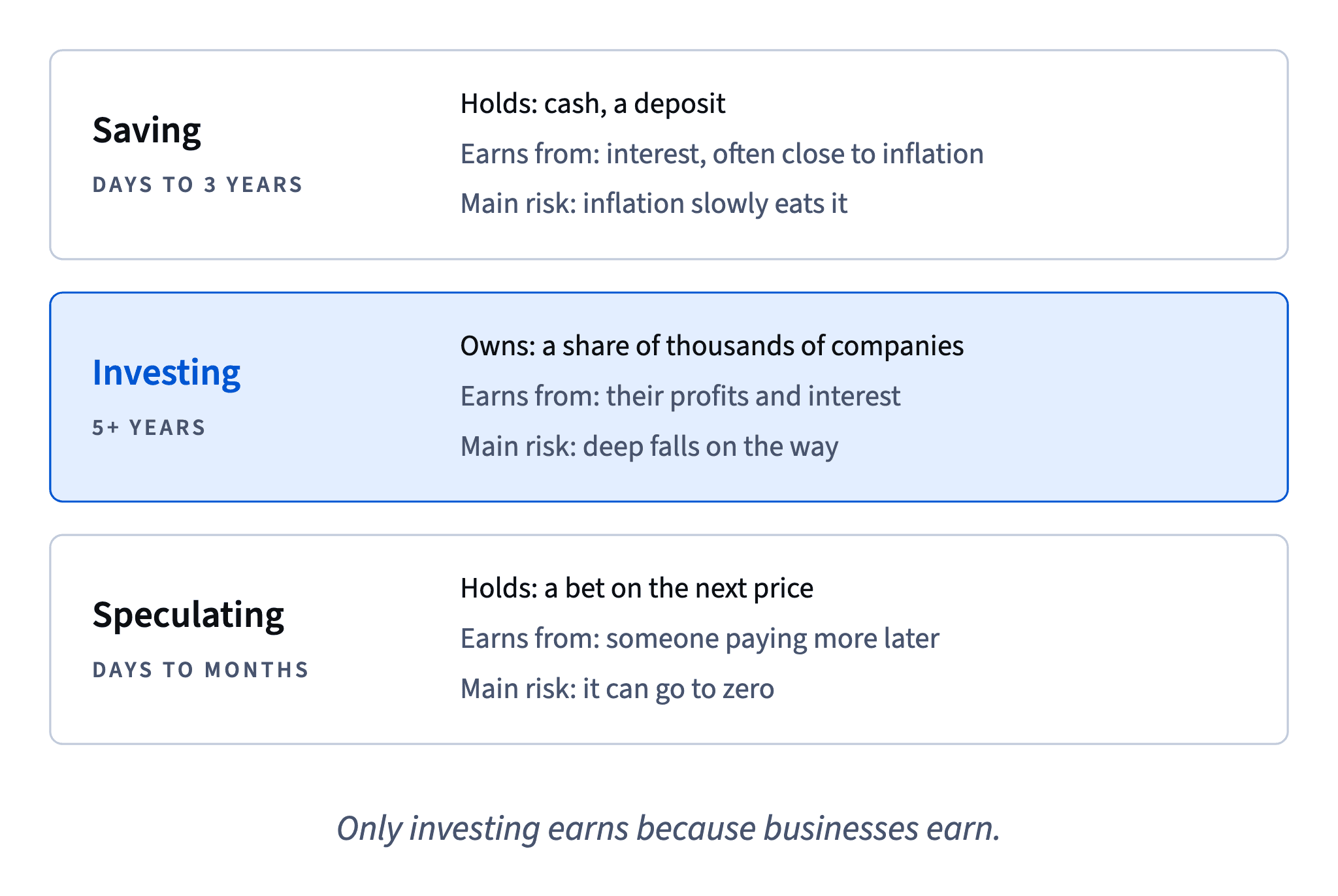
Zapas's job is the goal portfolio. The cushion stays outside the app, and a coins tab would sell speculation under an investing brand. When a new screen is proposed, first decide which of the three it is.
- Do"My cushion stays on a deposit; only money I won't touch for 10 years goes into the fund."
- Don't"I'll put my emergency money in stocks, it grows faster."
Money you may need next month can't wait out a fall.
From nominal to real
A nominal return counts money: 1,000 dol. became 1,120, so +12%. A real return counts what that money buys after prices rose.
Divide one plus the nominal return by one plus inflation, then subtract one: (1 + 0.12) ÷ (1 + 0.03) − 1 = 8.7%. Your dollars grew 12%, your buying power about 8.7%.
The quick shortcut "nominal minus inflation" works for small numbers (12 − 3 = 9%) but drifts further off as inflation rises. At 14% nominal and 10% inflation the shortcut says 4%; the exact answer is 3.6%.
Long-term goals are about buying power, so compare real returns. A product that shows nominal numbers next to real goals quietly overpromises.
One more check: both numbers must cover the same period and the same currency. A yearly dollar return and a hryvnia inflation rate don't belong in one formula.
- Do"12% before inflation; about 8.7% after 3% inflation."
- Don't"12% a year" shown next to a goal priced in today's money.
Mixes nominal growth with a real goal.
Where long-run returns come from
Different assets pay for different reasons, so their long-run real returns differ.
Stocks are shares of company profits. Profits grow with the economy, so over decades stocks earned the most: in our synthetic Tessaro history about 5.9% a year after inflation. The price for that is deep falls along the way.
Bonds are loans. The borrower pays interest, so returns are steadier and lower: about 1.4% real for short bonds and 1.8% for long ones in our data.
Cash barely beats prices: 0.2% real a year.
All these numbers are averages over 40 years, from synthetic data, and not a forecast. A single year can look nothing like them: world stocks had years of +34% and −30% in the same history. The average tells you what patient owners got, not what next year brings, which is why the next lessons talk about ranges and falls.
Chart data
| asset | Real return a year |
|---|---|
| World stocks | 5.9 |
| Long bonds | 1.8 |
| Short bonds | 1.4 |
| Cash rate | 0.2 |
- Do"Over 40 synthetic years, world stocks averaged about 5.9% a year after inflation."
- Don't"Stocks return 12% a year."
Nominal, a single number and no horizon.
Show nominal and real together
Users see the nominal number on their statements, so hiding it would confuse them. But a goal like "a flat in 10 years" lives in future prices, so the real number is what decides whether they get there.
The honest pattern is both, side by side: "14% a year; after 10% inflation, about 3.6% more buying power."
High inflation makes the gap large. At 14% and 10% the shortcut 14 − 10 = 4% is already off; the exact (1.14 ÷ 1.10) − 1 gives 3.6%. With a double-digit rate and double-digit inflation, use the exact form.
Formula: Real return from a nominal return and inflation · shown above
Say which inflation you used: hryvnia inflation for hryvnia goals, dollar inflation for dollar goals. And say it in plain words: "buying power" is clearer to most users than "real return".
- Do"Nominal 14%, real 3.6% at 10% inflation."
- Don't"Beat inflation by 4 points!" when the exact figure is 3.6.
Devaluation is part of the return
When you buy a dollar fund with hryvnias, two things move: the fund in dollars, and the dollar against the hryvnia. Devaluation, the hryvnia losing value, multiplies with the fund's return.
Hryvnia return = (1 + fund return in dollars) × (1 + change in the dollar rate) − 1. With 7% and 5%: 1.07 × 1.05 − 1 = 12.4%.
That looks generous, but your hryvnia prices also rise, often because of the same devaluation. After 10% hryvnia inflation, 12.4% becomes 2.1% real.
Devaluation is not a source of profit you can count on. It can stop, reverse or come in one painful jump, and it helps only while the fund itself holds up. Treat currency as part of the risk, not as a promise.
- Do"In hryvnias: 12.4%; after hryvnia inflation: about 2.1%."
- Don't"The hryvnia always falls, so a dollar fund always wins."
The quiet loss of cash
Money that earns nothing still changes value: every year of inflation shrinks what it buys. To find today's value of money kept for N years, divide by (1 + inflation) to the power N.
100,000 UAH for 5 years at 10%: 100,000 ÷ 1.1^5 = 62,092, a loss of 37.9% in buying power. At 6% it would be 74,726.
The same happens with dollars, just slower. In our synthetic Tessaro history, 1,000 dol. in a drawer for 40 years buys what 286 dol. buy today. Even cash in a deposit can lose: in years 35–37 cash earned +15.2% in dollars, but prices rose faster, so it lost 10% in real terms.
Dataset · 40 rows
Tessaro market, 40 synthetic years (nominal %, inflation %)
First 5 of 40 rows
That's no reason to invest the cushion. It's a reason to keep only the cushion in cash and put long-term money to work.
- Do"Cushion in cash or a deposit; money for 10+ years invested."
- Don't"Cash is risk-free, so I'll keep my retirement savings in it."
Over decades, inflation is the risk.
Explaining a number to a stakeholder
When a colleague proposes a number, don't just say it's wrong. Show what it is, what the honest version is, and where that comes from.
A good short answer has three parts:
- Name the type: nominal or real, yearly or total, average or guaranteed.
- Give the honest figure with its working: 12% nominal at 3% inflation is 8.7% real.
- Anchor it in data: our 40-year synthetic history gave about 9.3% nominal, 5.9% real a year on average.
Keep it to two or three sentences, friendly in tone, so it can be forwarded as is. The goal is a better page, not winning the argument.
Avoid two traps: replacing one bold number with another bold number, and burying the point under a lecture. A busy founder reads the first line; make it the one that matters.
- Do"12% is nominal; after 3% inflation it's 8.7%, and our 40-year average was 5.9% real."
- Don't"That number is made up, please remove it."
No working, no better version.
Ready to practise?
Answer the lesson's exercises and earn 250 points the first time you finish it.
Start the exercises