

Theory
One country or the world: home markets, currency and stagnation
Why one small home market is a concentrated bet, how it can go nowhere for 13 years while the world grows, and how much of a hryvnia investor's gain can come from the currency.
~7 min read · 7 exercises · 250 points
Before you start
Home or the world?
Mid-April at Zapas, seven months before the launch. A third of the beta users have asked for a "home market" option, and Ethan thinks it should be the default: people trust their own country's companies, and Tessaro Home even beat Tessaro World in the first years.
You'll look at the full 40 years of both indexes, and at what currency swings and long flat stretches do to a portfolio tied to one country.
A home market can stand still for years
One country's stock market is a much narrower bet than it feels. It depends on one economy, one currency, one set of laws and often a handful of large companies in a few industries.
In the synthetic Tessaro history the home index ended years 8–20, thirteen years, at +0.5% in real terms. Over the same years the world index grew 179.4%. Someone saving monthly into the home market for those years saw prices on statements rise 41.0% in nominal terms, but bought almost nothing extra with it.
Chart data
| Year | Tessaro World | Tessaro Home |
|---|---|---|
| 0 | 100 | 100 |
| 1 | 122.6 | 116.3 |
| 2 | 110.5 | 105.3 |
| 3 | 122 | 129.2 |
| 4 | 111.1 | 112.8 |
Show 36 more rows
| 5 | 127.4 | 112.3 |
| 6 | 140.1 | 127.2 |
| 7 | 165.3 | 172.5 |
| 8 | 176.2 | 160.9 |
| 9 | 203.6 | 184.7 |
| 10 | 191.3 | 163 |
| 11 | 197.2 | 172.1 |
| 12 | 220 | 144.1 |
| 13 | 240.9 | 156.3 |
| 14 | 274.2 | 164 |
| 15 | 274.7 | 156.1 |
| 16 | 330.9 | 180.2 |
| 17 | 413.8 | 175.7 |
| 18 | 407.3 | 192.5 |
| 19 | 405.3 | 175.7 |
| 20 | 461.9 | 173.3 |
| 21 | 350.8 | 124.8 |
| 22 | 239.1 | 92.4 |
| 23 | 297.7 | 117.3 |
| 24 | 340.7 | 138 |
| 25 | 379.7 | 129.2 |
| 26 | 401.8 | 125.3 |
| 27 | 381.6 | 130.7 |
| 28 | 425.5 | 134.2 |
| 29 | 461.3 | 146.2 |
| 30 | 443.2 | 154 |
| 31 | 524.9 | 175.6 |
| 32 | 526.5 | 161 |
| 33 | 655.1 | 164.5 |
| 34 | 730 | 222.6 |
| 35 | 647.7 | 227.3 |
| 36 | 486.8 | 188.7 |
| 37 | 476 | 161.2 |
| 38 | 609.8 | 204.1 |
| 39 | 784.2 | 280.6 |
| 40 | 987.5 | 397.4 |
Long flat stretches like this are not rare in single markets. A whole country can go through a decade of weak growth, a currency crisis or a war. A global fund still has that country inside it, but as one small piece among many.
- Do"In our synthetic history the home market ended 13 years flat in real terms."
- Don't"Prices rose 41%, so the home market did fine."
Nominal growth hid a real standstill.
Extra swing is not extra pay
It is tempting to think that whatever swings more must pay more. Nothing guarantees it. A single country's market rests on a handful of local industries and one economy, so it can lag for years while the rest of the world grows. In the synthetic Tessaro history:
- home swings 17.3% a year, the world 14.7%;
- home's worst year was −26.0%, the world's −30.0%, so home isn't worse in every way;
- home earned 3.5% real a year, the world 5.9%;
- 100 dol. became 397 in real terms at home and 987 in the world.
The home market still won 17 of the 40 years. That's why it always feels like it might be the smarter bet: there's always a recent winning year to point to.
Chart: 100 dol. in real terms, Tessaro World vs Tessaro Home · shown above
- Do"Home swung more and earned less: 3.5% vs 5.9% real a year in our data."
- Don't"Riskier markets always pay more in the long run."
Home bias
Home bias is the habit of putting far more money into your own country's market than its share of the world. It feels natural: familiar names, familiar news, no currency to think about.
But familiarity is not information about future returns. Knowing a company's products doesn't tell you whether its share price already reflects them. And the home market may be a tiny slice of the world's companies, concentrated in a few industries.
In the synthetic Tessaro history the cost of home bias added up quietly: 3.5% vs 5.9% real a year, which over 40 years means 397 vs 987 for every 100 dol. That's 2.5 times the money.
A global stock fund holds the home country too, at its natural weight, plus thousands of other companies. Tilting toward home is possible, but it is an active bet and should be named as one.
- Do"The global fund includes our country at its share of the world."
- Don't"Invest in what you know: your home market."
Familiar is not the same as better.
Currency risk in a dollar fund
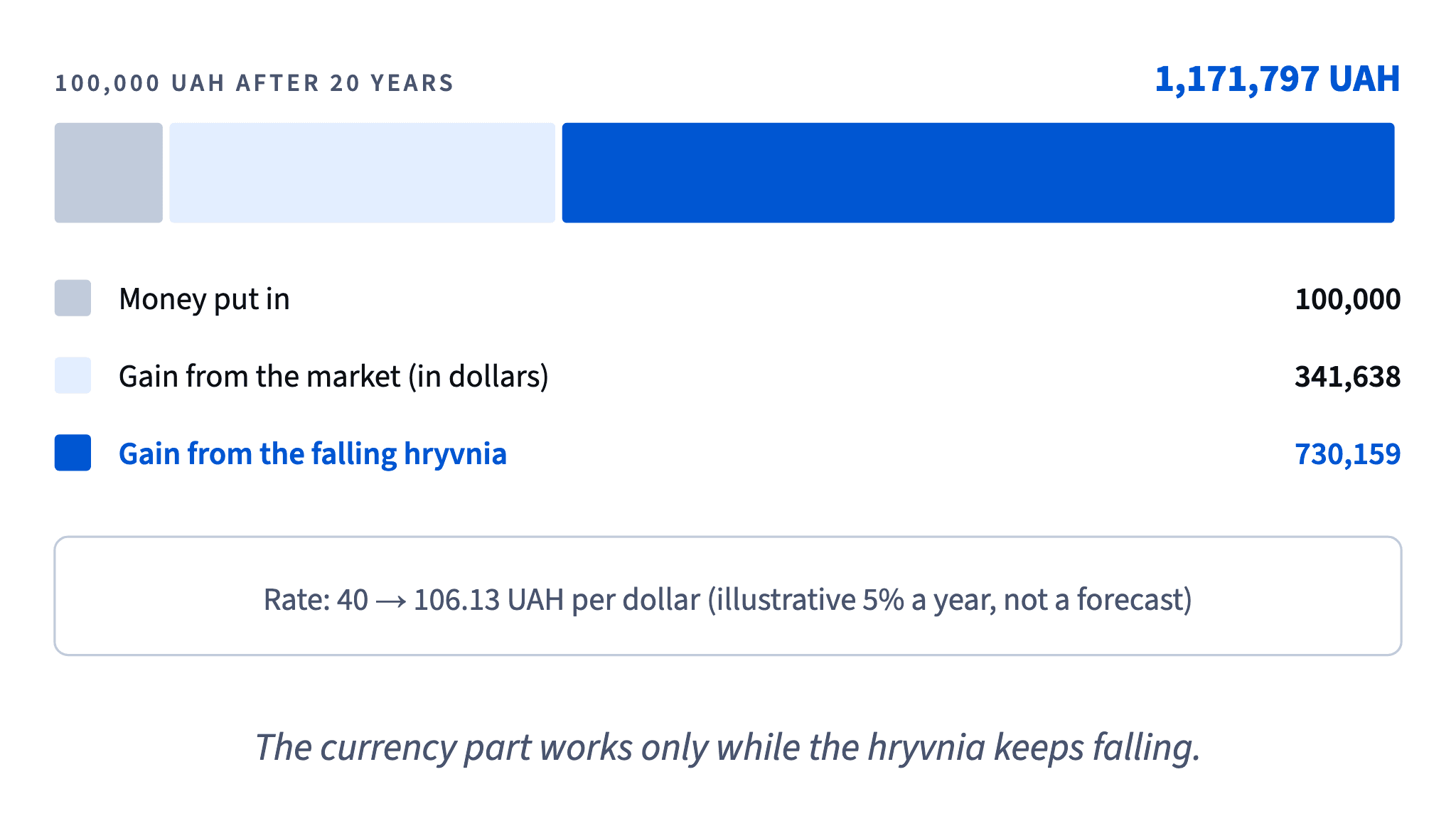
A hryvnia saver who buys a dollar world fund owns two things: the world's companies and the dollar. In hryvnias the return is (1 + fund return in dollars) × (1 + change in the dollar rate) − 1.
Take years 21–40 of the synthetic Tessaro history, when the world fund made 7.7% a year in dollars, and an illustrative 5% a year devaluation for 20 years: 1.077 × 1.05 − 1 = 13.1% a year in hryvnias. The rate goes from 40 to 106.13, and 100,000 UAH becomes 1,171,797. Without devaluation it would be 441,638, so 68.1% of the hryvnia gain came from the currency.
That's comforting while the hryvnia falls, and it's exactly why it's risky. If the hryvnia holds or strengthens, the currency part disappears. The 5% rate here is a round teaching number, not a forecast. Currency risk belongs in the conversation from the start: for goals in hryvnias, part of the money should stay in hryvnias.
- Do"In hryvnias part of your gain may come from the exchange rate, and that part can disappear."
- Don't"A dollar fund always beats a hryvnia deposit."
Only while the market holds and the hryvnia keeps falling.
The default is the world
A product's default is a strong recommendation, because most users never change it. So it should be the choice with the fewest avoidable risks.
For the stock part of a long-term portfolio that is a broad, global, market-weighted fund. It holds every country at its share of world markets, so no single economy's lost decade or crisis can sink it, and it doesn't rely on anyone guessing which country will lead.
A home-only or home-heavy option can exist, but the screen should say what it is: a concentrated bet on one economy, with the numbers to show what that means (in our synthetic history, 13 flat years and 3.5% vs 5.9% real a year).
Currency is a separate question. It is solved by keeping short-term and hryvnia goals in hryvnias, not by buying the home stock market.
- Do"Default: the whole world. Optional: a home tilt, labelled as an extra bet."
- Don't"We picked the home market because it's safer for you."
Real estate is a concentrated, illiquid bet
Many families treat a flat as their main investment. It can make sense as a home or as rental income, but it does not diversify.
Concentration: one property means one building, one city, one country's economy and legal system, one currency. If the area loses value, is damaged or the local economy stalls, all of it is hit at once. A loan makes the swing in the owner's equity bigger still.
Illiquidity: you can't sell a tenth of a flat to cover a bill, and selling the whole flat takes months and costs a lot in fees and taxes.
So for a product the honest framing is: property is one more home-country bet, usually the biggest one a family holds. That makes a global fund for the rest of the long-term money more important, not less.
- Do"A flat can be a good home; it's also a big bet on one city."
- Don't"I have a flat, so I'm diversified."
Answering "I know my own market"
This is one of the most common objections a global product hears, and it comes from a good place: people want to understand what they own.
A respectful answer:
- Acknowledge the instinct: it is natural to trust what you know.
- Separate familiarity from returns: knowing a company's products doesn't make its share price a better bet.
- Show the numbers: in our synthetic history home swung more (17.3% vs 14.7%), stood still for 13 years and turned 100 dol. into 397 vs 987 for the world.
- Reassure: the global fund still holds the home country at its natural weight; a home-only option exists, labelled as an extra bet.
Avoid promising the world will win next time. The case for it is fewer avoidable risks, not a forecast.
- Do"You still own our market inside the global fund, just not only it."
- Don't"The world always beats a single country."
A forecast nobody can promise.
Ready to practise?
Answer the lesson's exercises and earn 250 points the first time you finish it.
Start the exercises