

Theory
The currency of your goals and the safe part at home
A hryvnia goal vs a dollar world fund under devaluation scenarios, and keeping the safe part in the currency you will spend.
~8 min read · 8 exercises · 250 points
Before you start
Goals in hryvnias
October at Zapas: a month to the public launch, and the team turns to its home market. As the PM you're now designing onboarding for users in Ukraine.
Ethan's default is easy: Ukrainians trust dollars, the world fund is in dollars, so every goal gets the world fund. Grace brings a real beta goal, a car in three years paid in hryvnias. You'll compare where such money should live and see why the goal's currency and horizon decide it.
A goal has a currency
Every goal is measured in the currency it will be spent in. A car bought in Kyiv, school fees in Kraków, a flat deposit in Lviv: each has its own currency, and that is the currency the result must be counted in.
The user's goal: 500,000 UAH in 3 years, starting from 400,000 UAH. With round illustrative numbers (40 UAH per dollar today; a hryvnia deposit at 12% a year; taxes ignored), the deposit grows to:
400,000 × 1.12³ = 561,971 UAH,
61,971 above the goal, whatever happens to the dollar.
In real terms, with hryvnia inflation of 8% a year, 1.12 ÷ 1.08 − 1 = 3.7% a year above prices, and the 500,000 goal is worth 500,000 ÷ 1.08³ = 396,916 UAH in today's money. The deposit isn't exciting; it is simply in the right currency for this goal.
- Do"Goal: 500,000 UAH in 3 years. Count every option in UAH."
- Don't"I'll count it in dollars, dollars are the real money."
A foreign fund, counted in your currency
A dollar fund's result in hryvnias has two parts: what the fund did in dollars, and what the dollar did against the hryvnia.
Value in UAH = dollars invested × (1 + fund change) × exchange rate at the end.
With 10,000 dol. bought at 40 UAH:
- hryvnia holds (40): 10,000 × 1.191 × 40 = 476,400, short of the goal;
- loses 5% a year (40 × 1.05³ = 46.31): 10,000 × 1.191 × 46.31 = 551,552;
- loses 10% a year (40 × 1.10³ = 53.24): 10,000 × 1.191 × 53.24 = 634,088.
So the same fund misses or beats the goal depending on the exchange rate, a number nobody can forecast for three years. That's currency risk: exchange-rate moves change what an investment is worth in the currency you'll spend.
For a long goal, currency moves are part of a global fund's return. For a short goal, they are one more source of surprise.
Chart data
| Hryvnia loses per year vs the dollar, % | UAH deposit, 12% | USD cash | USD world fund, normal | USD world fund, crash before the goal |
|---|---|---|---|---|
| 0 | 561,971 | 400,000 | 476,400 | 280,000 |
| 5 | 561,971 | 463,100 | 551,552 | 324,170 |
| 10 | 561,971 | 532,400 | 634,088 | 372,680 |
- Do10,000 × 1.191 × 40 = 476,400 UAH
- Don't"The fund made 19.1%, so the goal is safe."
The goal is in hryvnias.
Devaluation is not insurance
A popular belief in Ukraine is that dollars "protect" savings. Against a falling hryvnia, holding dollars does help. But a dollar stock fund carries two risks at once, and they can hit together.
The ten scenarios show it:
Dataset · 10 rows
A 500,000 UAH goal in 3 years from 400,000 UAH, ten scenarios (illustrative)
Options: UAH deposit at 12%, USD cash, USD world fund (normal +19.1% or crash −30% over 3 years); hryvnia losing 0, 5 or 10% a year; 40 UAH per dollar today. Value in UAH at the end.
First 5 of 10 rows
- Deposit: 561,971, meets the goal in every case.
- USD cash: 400,000 / 463,100 / 532,400; meets the goal only if the hryvnia loses 10% a year.
- Fund, normal market: 476,400 / 551,552 / 634,088; misses it if the hryvnia holds.
- Fund, crash before the goal: 280,000 / 324,170 / 372,680; misses it in every case.
Only 4 of the 10 scenarios reach 500,000, and only one option reaches it every time. Devaluation can lift a fund that already did fine; it can't rescue a fund that fell 30% just before the money is needed.
For a goal three years away, the stock market's bad years are simply too likely to land on the wrong date.
- Do"Crash row: 280,000 / 324,170 / 372,680, all below 500,000."
- Don't"The hryvnia always falls, so a dollar fund always wins."
Two risks that can land together
A dollar stock fund held for a hryvnia goal has two separate risks:
- Market risk: stocks can fall a lot in a year or two. In our synthetic 40-year history, world stocks once fell 45% over two years.
- Currency risk: the hryvnia can hold, weaken slowly or weaken fast.
The two are not linked in any reliable way. Devaluation doesn't wait for good markets, and a crash doesn't wait for a strong hryvnia. Over three years you can get a crash with a stable hryvnia (280,000 UAH from 400,000), or a crash with a weak one (372,680): both miss the 500,000 goal.
Over 15–20 years, the picture changes: there is time for a fall to recover, and if the hryvnia weakens, that adds to a foreign fund's hryvnia result. That's why the same fund can be a poor home for a 3-year car and a reasonable one for retirement.
- Do"3-year goal: a crash can land on the wrong date, whatever the hryvnia does."
- Don't"Dollars plus stocks: double protection."
Where the safe part lives in Ukraine
Money for a goal within a few years needs a home that won't fall when it's needed, in the spending currency. In Ukraine the usual candidates are deposits and government bonds. As of October 2027 (check the current rules):
- Deposits: interest taxed at 23% (18% income tax + 5% military levy), withheld by the bank. During martial law and for three months after it, deposits in Ukrainian banks are guaranteed in full; afterwards the guarantee is UAH 600,000 per person per bank, and currency deposits are paid out in hryvnias.
- Government bonds (ОВДП): issued in UAH, USD and EUR, 1,000 per bond; 0% income tax and levy for individuals. They are not deposits and not covered by the deposit guarantee fund. They can be sold before maturity, at a market price that may be below what you paid.
Always compare after-tax: the 12% deposit becomes 9.24% after tax and turns 400,000 into 521,441 UAH in three years. More on both in personal finance: Deposits and government bonds.
- Do400,000 × 1.0924³ = 521,441 UAH after tax
- Don't"Bonds are covered by the deposit guarantee, like a deposit."
Matching the goal, the horizon and the currency
For each goal, two questions decide where the money lives:
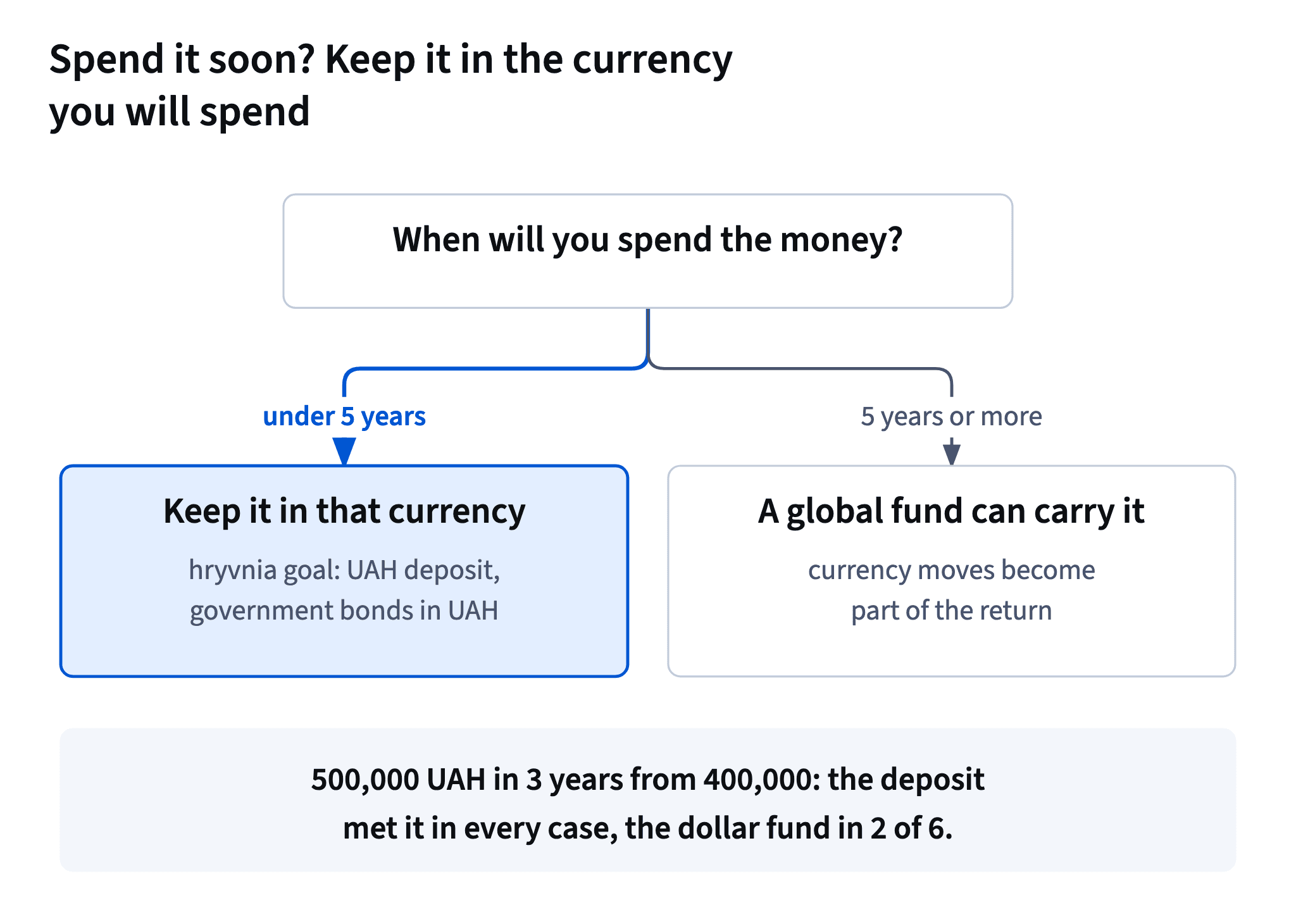
- When will it be spent? Within about five years, the money needs a home that can't fall far: deposits, short government bonds, cash for the cushion. Further away, a global stock fund can carry it, because there is time to wait out a crash.
- In what currency? The safe part sits in the spending currency: hryvnias for a hryvnia goal, euros for euro fees. For a long goal, a global fund's currency moves become part of its return; that's acceptable when there are decades to absorb them.
So one person can sensibly hold a hryvnia deposit (car), euro bonds (studies) and a global fund (retirement) at the same time. That's not inconsistency; each pot matches its own goal.
The rule of thumb "five years" is a trade-off, not a law: a shorter horizon or a goal you can't move means more safety.
- Do"Car in 2030: UAH. Studies in 2029: EUR. Retirement in 2057: global fund."
- Don't"One currency and one fund for all my goals."
When the honest answer is "not us"
An investing app makes money when people invest. That creates a pull to send every goal to the fund. Resisting it is part of designing an honest product.
For short goals, the honest onboarding answer is often: this goal doesn't belong in stocks. Say why, with the numbers: in the ten scenarios, the dollar world fund reached a 3-year hryvnia goal in only 2 of 6 cases, the deposit in every case.
Dataset: A 500,000 UAH goal in 3 years from 400,000 UAH, ten scenarios (illustrative) · shown above
Good onboarding for a short goal:
- names the horizon and the currency back to the user;
- says plainly what can go wrong (a 30% fall just before the date);
- points to the kind of safe home that fits, without naming a bank;
- invites the user to set a longer goal in the app instead.
Users who were told "not this, not now" are more likely to trust the app with the goals that do belong there.
- Do"A 3-year hryvnia goal fits a deposit or UAH bonds better than a stock fund."
- Don't"Any goal, any horizon: one tap to invest!"
Explaining currency risk in ten seconds
A user asking "why not just buy the dollar fund?" needs a short, numeric answer, not a lecture.
- Name the goal's currency and date: hryvnias, three years.
- Show the miss: if the hryvnia holds, the fund ends at about 476,400; if stocks fall 30% before the date, 280,000–372,680 whatever the exchange rate does.
- Show the alternative: a hryvnia deposit at an illustrative 12% reaches about 561,971 before tax and 521,441 after the 23% tax; government bonds were untaxed as of October 2027.
- Point to the right place: short hryvnia goals in hryvnias; the world fund for goals five or more years away.
- Close honestly: illustrative numbers, not advice; check current rates and rules.
Name no bank. The user needs the type of home, not a brand.
- Do"If the hryvnia holds, the fund ends near 476,400, short of 500,000."
- Don't"Dollars always win in Ukraine."
Ready to practise?
Answer the lesson's exercises and earn 250 points the first time you finish it.
Start the exercises