

Theory
Company risk vs market risk: how many holdings are enough
Testing a "Top 10 picks" tab in a model of 200 companies, how fast adding holdings removes company-specific risk, and why market risk never goes away.
~7 min read · 7 exercises · 250 points
Before you start
Ten picks or thousands?
April at Zapas, and you're still the PM steering the app to its November launch. This month asks why one fund should hold thousands of companies.
Ethan finds index funds boring and wants a "Top 10 picks" tab: ten great companies chosen by the team. Grace has built a model of 200 synthetic companies to test the idea. You'll see how a portfolio's risk changes as it holds more companies, and which part of the risk never goes away.
Volatility and the number of holdings
Volatility here means the typical size of a yearly swing (the standard deviation of yearly returns). The bigger it is, the wider the range of outcomes in any single year.
In the Zapas model of 200 synthetic companies, one company alone swings 36.3% a year on average. Hold several in equal amounts and the news of each partly cancels the news of the others:
Chart data
| Companies held | Portfolio volatility |
|---|---|
| 1 | 36.3 |
| 5 | 22 |
| 10 | 19.2 |
| 100 | 16.4 |
| 200 | 16.2 |
- 5 companies: 22.0%
- 10 companies: 19.2%
- 100 companies: 16.4%
- 200 companies: 16.2%
The drop is steep at first and then flattens: from 10 to 100 companies the line falls only 2.8 points. That is why ten shares already feel calmer than one, and why the last hundred companies change little.
The model is synthetic and simple, but the shape is general: each new company adds less, and the curve never reaches zero.
- Do"Ten companies cut the swing from 36.3% to 19.2% in our model."
- Don't"Each extra company removes the same amount of risk."
From 10 to 100 companies the swing falls only 2.8 points.
Two kinds of risk in every share
A share's yearly swing has two sources.
Company-specific risk comes from news about that one firm: a product recall, a data breach, losing a key customer, a factory outage, a launch that takes off. It is different for every company and mostly unrelated across them.
Market risk comes from things that move almost all companies together: recessions, interest-rate jumps, panics. In the Zapas model the market alone swings about 16% a year.
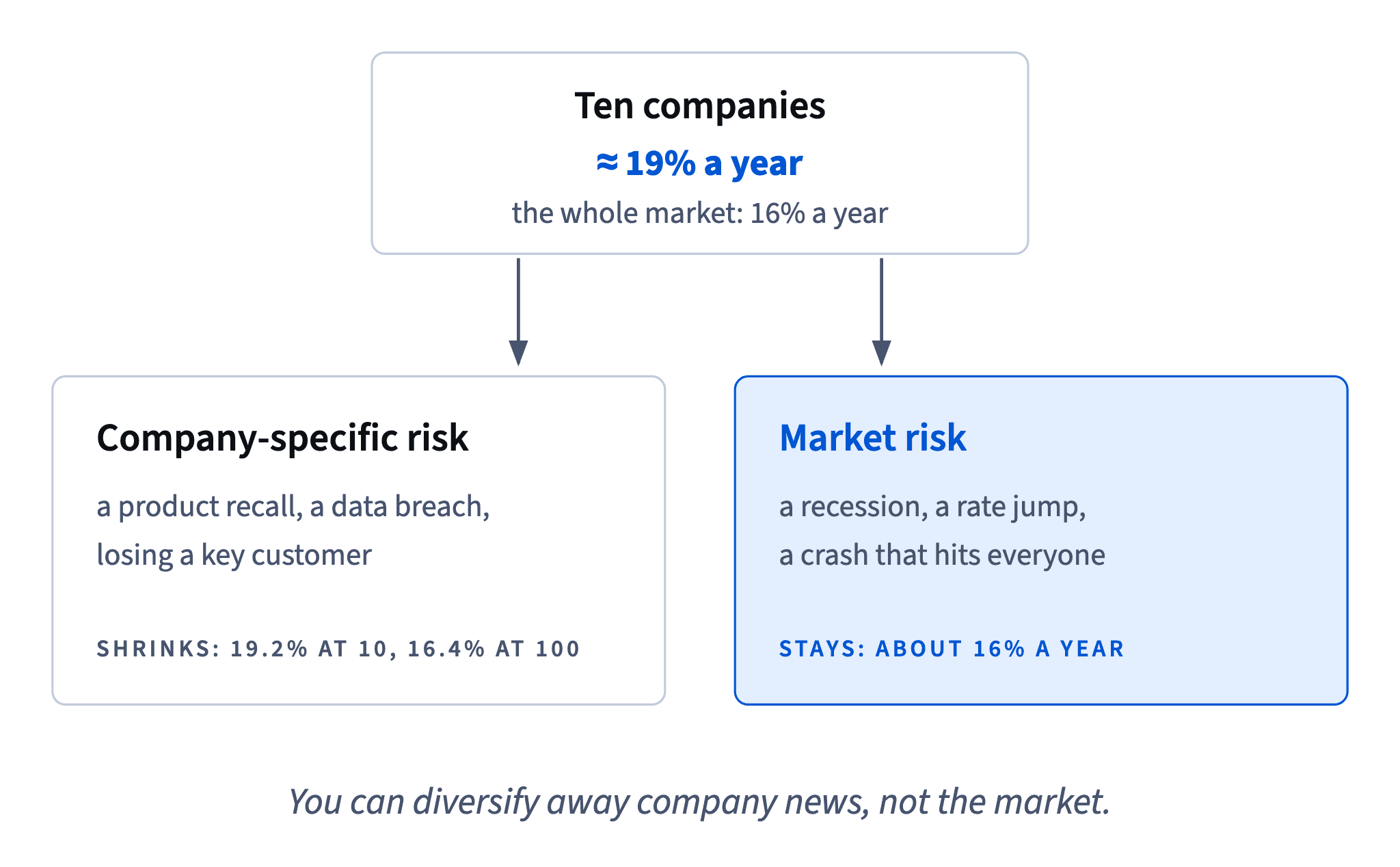
The difference matters because only the first kind can be diluted. When you own many companies, one firm's bad year is a small slice of your money, and another firm's good year offsets it. Market risk stays whatever you add, because every company you add feels the same recession.
So diversification shrinks the swing that comes from company news and does nothing for a market crash.
- Do"Owning 200 companies makes one firm's data breach a tiny loss."
- Don't"With enough companies, a crash can't hurt me."
Market risk stays however many you own.
The floor you can't diversify
Adding companies shrinks only the company-specific part of risk. Under it lies a floor: market risk, which in the Zapas model is 16% a year. With 100 companies the portfolio swings 16.4%, with 200 still 16.2%.
That floor is not a flaw of diversification; it comes with owning businesses at all. In a recession almost every company earns less at once, and their share prices fall together. A broad index fund will fall in a crash too, just not because one company blew up.
For a product the floor is a useful ruler. Any swing above 16% in a portfolio of shares comes from which companies were chosen, not from the market. A ten-company list (19.2%) sits 3.2 points above the floor; one company (36.3%) sits 20.3 points above it.
- Do"A broad fund removes company blow-ups, not market crashes."
- Don't"Our index fund is diversified, so it's safe."
Diminishing returns of diversification
To see how far diversification has gone, compare where you are with the two ends: one company (36.3%) and the most you can get from this universe (200 companies, 16.2%). The gap between them is 20.1 points.
Ten companies swing 19.2%, so they have closed 17.1 of those 20.1 points: about 85%. A hundred companies close about 99%. The other 190 companies after the first ten remove the last 15% between them.
So on volatility alone, ten picks look almost respectable. But volatility measures only how much a portfolio swings, not where it ends up. Tomorrow's lesson follows the same 200 companies over 20 years: the median company returned 11.5% while the index of all 200 rose 235.4%.
Read the 85% as "most of the swing is gone early", not as "a short list is as good as the market".
- Do"10 companies close about 85% of the volatility gap in our model."
- Don't"10 stocks are as good as owning the whole market."
A similar swing is not the same result.
Calling a concentrated product what it is
A short list of companies is a concentrated portfolio. It isn't wrong to offer one, but it is an active bet: you are betting that these companies will do better than the market as a whole, and accepting extra swing to make that bet.
Honest copy for such a feature says three things:
- It swings more than a broad fund (in our model, 19.2% a year for ten companies vs 16.2% for 200).
- Its result depends on which companies were chosen, and single companies' results spread very widely.
- The broad, market-weighted fund stays the default; the list is an optional extra.
Words like "diversified", "safe" or "hand-picked winners" promise a result the data doesn't support. For a regulated product they can also be misleading advertising.
- Do"Optional: a 10-company list. It swings more than the market, and its result depends on our picks."
- Don't"Our experts' Top 10: diversified growth."
A broad fund still falls
Owning the whole market removes one firm's disasters, but it means owning the whole market's ups and downs. In the Zapas model, all 200 companies together still swing 16.2% a year.
In the synthetic Tessaro history the world index fell 30% in its worst year, even though it holds thousands of companies. Diversification didn't stop that fall; it only made sure the fall wasn't worse because one company collapsed.
Users often hear "diversified" as "safe". A product has to correct that early: a broad fund is the sensible way to own stocks, and stocks as a whole still fall hard sometimes. The way to lower the market's swing is a different tool: holding part of the money in bonds or cash, which later modules cover.
- Do"Diversified across thousands of companies; still falls when markets fall."
- Don't"Diversified, so your money is protected."
Answering "just give me the best stocks"
Users who ask for picks usually want two things: excitement and the feeling that someone smart is choosing for them. A good reply respects that and still tells the truth.
A useful structure:
- Agree with the instinct: spreading money over ten firms is better than one.
- Show the numbers: in our model ten companies swing 19.2% a year, 200 swing 16.2%, and the market's own 16% never goes away.
- Name the bet: a short list's result depends on which names are on it, so it is an active bet, not extra safety.
- Point to the default: the broad, market-weighted fund.
Avoid "you're wrong" and avoid promising the broad fund won't fall. It will, with the market.
- Do"Ten is better than one, but in our model it still swings 19% vs 16% for the whole market."
- Don't"Picking stocks is for gamblers."
Lectures the user instead of showing numbers.
Ready to practise?
Answer the lesson's exercises and earn 250 points the first time you finish it.
Start the exercises