

Theory
Case: pick the fund line-up from six factsheets
Choose three funds for the app from six factsheets, comparing them all-in rather than by headline fee.
~5 min read · 7 exercises · 250 points
Before you start
Three slots, six funds
End of June at Zapas. After a month on costs, the fund line-up for November's launch is finally on the agenda. The app has room for three funds, and Ethan already has his shortlist: the cheapest fee on the market, Star Growth for the ambitious, and Robo Theme because tech is hot.
You'll run each candidate through what this month taught you, all-in cost and what the fund actually holds, and decide what each of the three slots is for.
The headline-fee trap
The cheapest-looking fund on a list is the one with the lowest ongoing charge, because that is the number printed largest. For our users it is rarely the cheapest to own.
S2 shows why. Inside the fund it is excellent: it trails its index by only 0.06%. But it pays dividends out, and as a US-domiciled fund 30% of them is withheld for a user like ours: 0.54% a year. It needs a separate foreign broker with a 0.40% platform fee and 1% per conversion. All-in over ten years: 1.20% a year.
S1, on the same index, trails it by 0.25%, but it accumulates, sits in the Zapas app and converts at 0.50%. All-in: 0.61%. The fund with a fee four times higher costs half as much to own.
Dataset · 6 rows
Six fictional fund factsheets
Synthetic. S1 Zapas World Stock, S2 Halden World Index, S3 Zapas Short Bond, S4 Star Growth, S5 Robo Theme, S6 Ledgerline Bank Balanced. Percent columns are % a year except spread, entry fee and FX fee (per trade or conversion).
First 5 of 6 rows
The lesson isn't that S2 is a bad fund. It is that a fund's cost depends on who owns it, where and how.
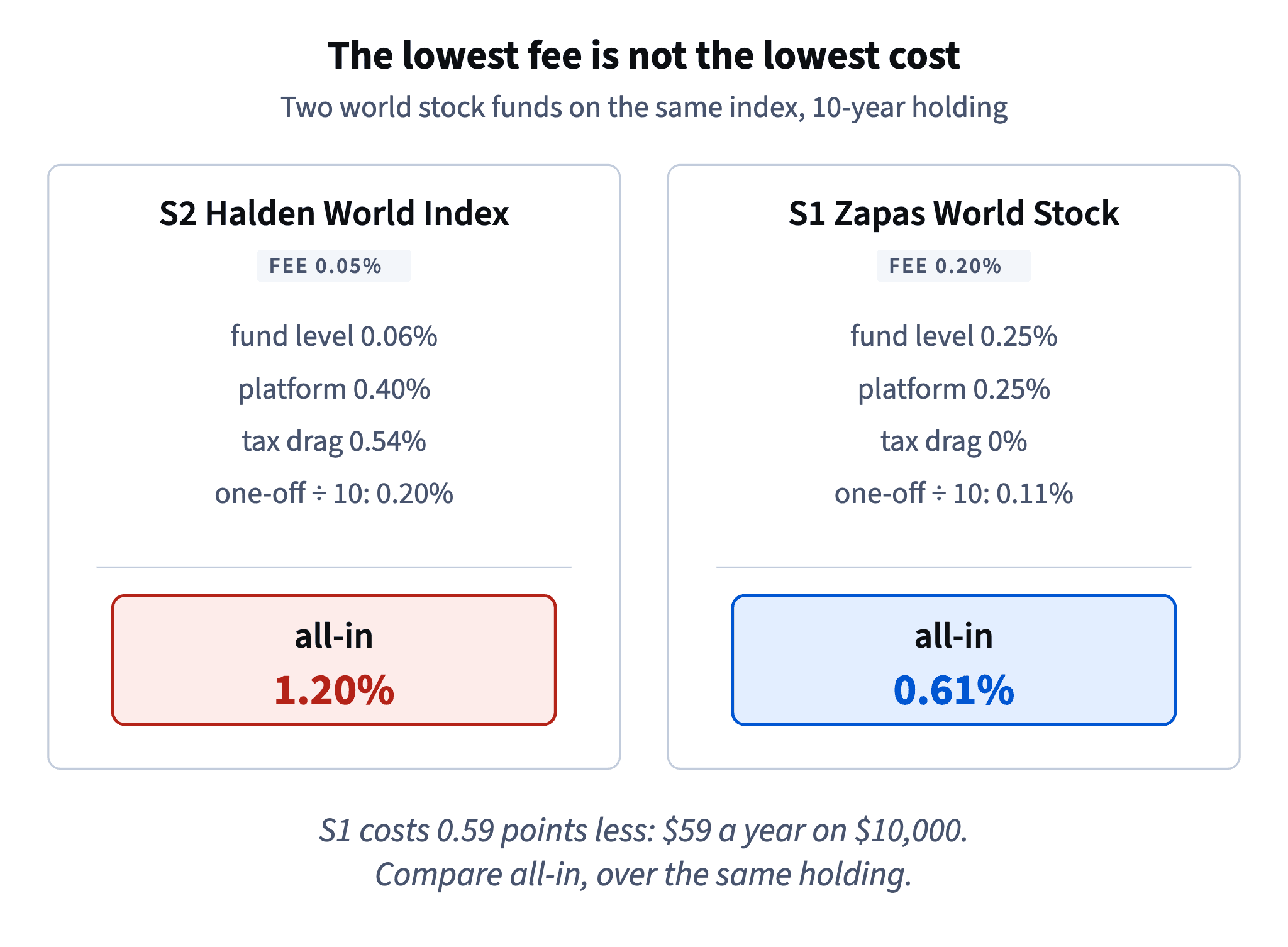
- Do“S2 is 0.05% on the label and 1.20% a year all-in for our users.”
- Don't“0.05% — the cheapest world fund on the market.”
Cheapest by one line, not for the person who owns it.
Turn the gap into money on a real balance
A difference of 0.59 points sounds abstract. On a balance of $10,000 it is $59 a year: S2 costs about $120 and S1 about $61 a year all-in over a ten-year holding.
Two things make that gap bigger than it looks. First, it repeats every year and compounds: money lost to costs also loses everything it would have earned later, which is how a 1.3-point gap grows to $38,011 over 40 years in a $100-a-month plan earning 5% real before costs. Second, balances grow, so the same percentage becomes more dollars each year.
When you present a line-up to a team or to users, show both: the all-in percentage, so funds can be compared, and the yearly dollars on a typical balance, so people can feel it. Keep the holding period and assumptions next to the numbers.
Picture: Same index, opposite ranking once every layer is added. · shown above
- Do“On $10,000: about $61 a year vs $120 a year, all-in over 10 years.”
- Don't“The difference is under 1%, not worth discussing.”
Rank all-in, then check what you ranked
An all-in ranking is the fair starting point: S3 0.54%, S1 0.61%, S5 1.13%, S2 1.20%, S4 2.40%, S6 2.70%. But a cost ranking compares price tags of things that may not do the same job.
S3 is the cheapest overall, but it holds short bonds: a different asset class with a different role, lower expected return and much smaller falls. It doesn't compete with S1; it complements it. S5 is cheap-ish, but it follows one sector with 60 companies, so its risk is nothing like a world fund's.
So use cost to choose within a role (which world stock fund, which bond fund), and use the role to choose which funds belong in the line-up at all. A cheap fund in the wrong role is still the wrong fund.
Chart data
| Fund | Ongoing charge | All-in cost |
|---|---|---|
| S1 Zapas World Stock | 0.2 | 0.61 |
| S2 Halden World Index | 0.05 | 1.2 |
| S3 Zapas Short Bond | 0.15 | 0.54 |
| S4 Star Growth | 1.6 | 2.4 |
| S5 Robo Theme | 0.65 | 1.13 |
Show 1 more row
| S6 Ledgerline Bank Balanced | 2.2 | 2.7 |
- Do“For the world stock slot: S1 at 0.61% beats S2 at 1.20%.”
- Don't“S3 is the cheapest, so put everything in S3.”
Cheapest overall, but a different job.
Role first, then cost
A line-up for long-term investors needs a few clear roles. In our model portfolios that means a broad world stock fund for growth and a bond fund for the part that must not fall much. Each role has a test before cost:
- world stock: thousands of companies, market-weighted, many countries;
- bonds: high quality, short or medium term, in the user's planned spending currency where possible.
Only funds that pass the role test go on to the cost comparison. S5 fails the world-stock test: 60 companies in one sector is a concentrated bet, whatever its price. S4 fails too: 45 picked stocks and 2.40% all-in, with no evidence that its early lead repeats. S6 mixes assets in hryvnias with a 3% entry fee and 2.70% all-in.
Dataset: Six fictional fund factsheets · shown above
This order also protects the product from trends: a theme that is hot this year is a marketing story, not a role.
- Do“World stock slot: broad and cheap. S1 passes both tests.”
- Don't“Add the theme fund, it's cheaper than the index fund.”
Fewer funds can be the better product
It is tempting to fill every slot on a screen. For an investing product, every extra fund is also an extra decision for the user, and extra decisions invite mistakes: chasing last year's winner, piling into a theme, switching often and paying the doors again.
A small line-up works when each fund has a clear job. One broad world stock fund and one high-quality bond fund can build portfolios from careful to growth just by changing the mix. A third fund earns its place only if it does a job the two can't, at a cost that fits.
Ask of any candidate: which role does it fill, does it pass the role test, and what is its all-in cost for our users? If no candidate passes, an empty slot is a decision, not a gap. Later modules may add a fund for the safe part in the user's spending currency.
Chart: Headline fee vs all-in cost, 10-year holding · shown above
- Do“Two funds, two roles, both under 0.65% a year all-in.”
- Don't“Three slots, so we need three funds.”
Ready to practise?
Answer the lesson's exercises and earn 250 points the first time you finish it.
Start the exercises