

Theory
Buying a global fund from Ukraine: domicile, broker, protection, FX
What to check before you invest from Ukraine: a regulated broker, investor protection, fund domicile, withholding tax and conversion costs.
~8 min read · 8 exercises · 250 points
Before you start
How to buy from Ukraine
Mid-October at Zapas, three weeks to launch. As the PM you need the "How to buy from Ukraine" help page, and Grace has the legal team's notes, with a warning that wartime rules change fast.
Ethan would just write "Open a foreign broker account and buy our fund". You'll see why that route doesn't work for most people in Ukraine, which two kinds of users the page has to serve, and what each of them should check before buying a global fund.
Investing from Ukraine, as of October 2027
Under martial law, Ukraine's currency rules limit what individuals can do with money across the border. As of October 2027 (check the current rules):
- Funding a foreign broker from a Ukrainian bank was generally not possible: the pre-war yearly allowance for investing abroad was not available in wartime, even though some websites still quoted it.
- Paying for securities abroad with Ukrainian bank cards had been banned since 2022; check whether that still applies.
- Since 11 August 2026, the monthly limit for buying foreign currency, UAH 200,000 a month, could also be used to buy securities of foreign issuers through Ukrainian licensed firms. The money doesn't leave for a foreign broker: the securities are held in Ukraine's depository system and, as of then, generally couldn't be moved to a foreign custodian.
- Not every foreign fund was actually available this way. Check what a Ukrainian firm really offers.
People whose money is already legally abroad (for example, earned while living there) can use a broker in that country.
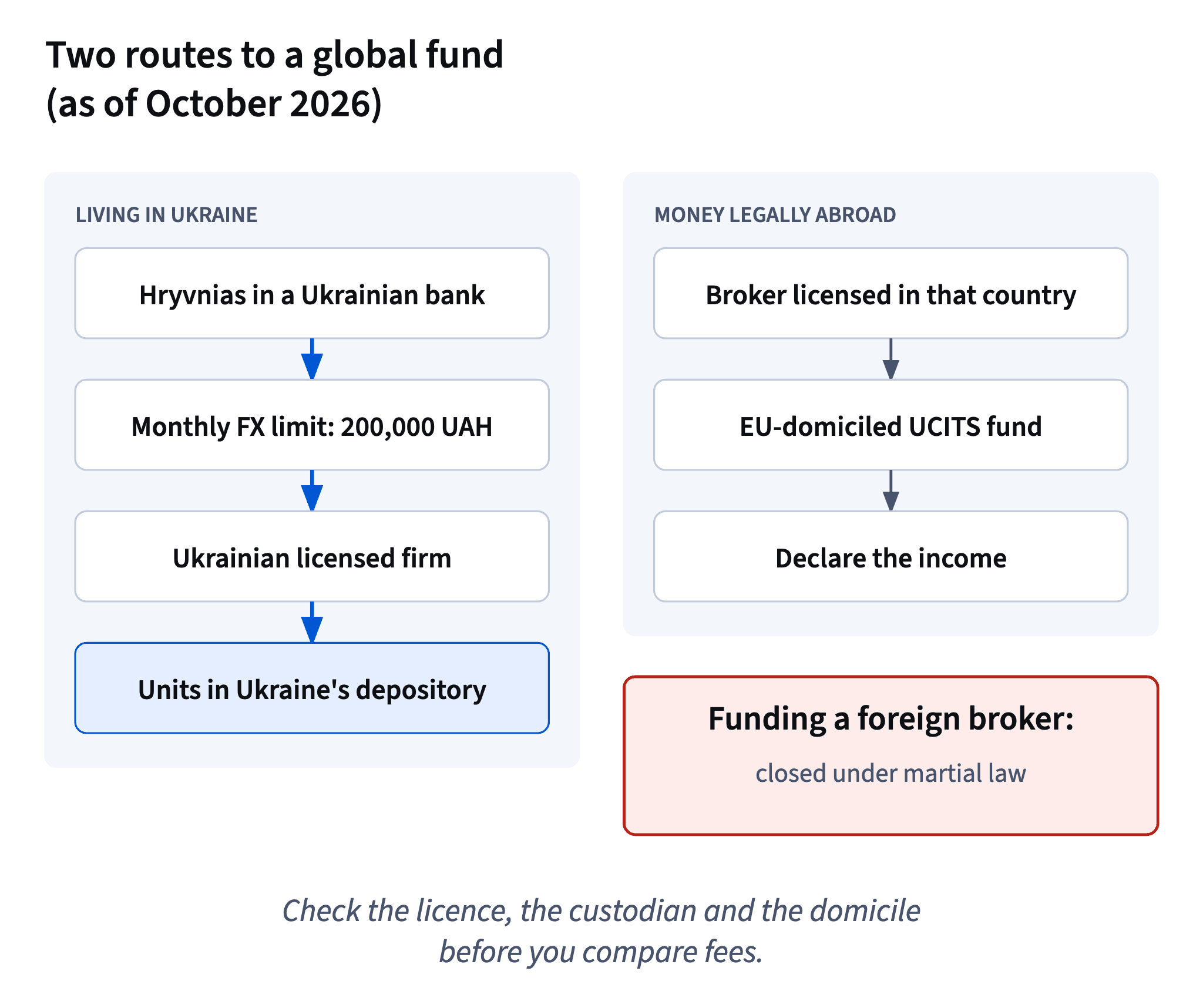
- Do"As of October 2027, from Ukraine: via a Ukrainian licensed firm, within the monthly limit. Check the current rules."
- Don't"Just send dollars to any foreign broker."
FX: often the biggest cost
A hryvnia saver buying a dollar or euro fund pays to convert twice: in on the way in, and out on the way back.
- A snapshot from 9 October 2027: banks sold cash dollars at about 0.65% above the official rate on average; buying and later selling back cost about 1.1% in total. It changes daily.
- Brokers' conversion fees range from tiny to well over that; there's no neutral list, so check the FX fee before comparing fund fees.
For comparison, broad index funds in Europe charged on average about 0.2% a year (as of 2024 data). One round trip of FX can cost as much as five years of that fee.
Two habits keep FX small: convert less often (monthly amounts are fine; daily top-ups are not) and avoid unnecessary round trips, such as converting back to hryvnias for a short pause.
- Do200,000 × 0.65% = 1,300 UAH each way
- Don't"The fund costs 0.2%, so investing costs 0.2%."
What protects you, and from what
"Is my money safe?" has three different answers, depending on the danger.
1. The firm fails. A licensed broker must keep clients' securities separate from its own assets, with a custodian. If the firm fails, those assets aren't its creditors' money. Where segregation fails too, some countries have compensation schemes (as of October 2027):
- EU: at least EUR 20,000 per investor at a failed investment firm;
- US: up to USD 500,000 per customer, of which up to USD 250,000 in cash;
- Ukraine: no operating compensation scheme for securities investors was found; protection relies on segregation. Check the current rules.
2. The fund fails. An EU fund's (UCITS) assets are held by a separate depositary, not on the manager's balance sheet.
3. The market falls. Nothing covers this. It's the risk you're paid to take.
First check the firm is licensed by its country's regulator (in Ukraine, the securities commission's register) and not on its warning list.
- Do"Your securities are held separately from the firm's own money. Market falls are not covered by any scheme."
- Don't"Your investments are 100% protected."
Domicile and tax inside the fund
A fund's domicile is the country where it is legally set up. For non-US investors it changes three things.
Who can buy it. Retail investors in the EU are sold funds with a standard key information document. EU-domiciled UCITS funds have one; US-domiciled funds usually don't, so EU platforms generally don't offer them to retail clients.
Tax that leaks on dividends. As of October 2027:
- US dividends paid to a non-US person: 30% withheld by default;
- a Ukrainian tax resident holding US funds directly can claim the treaty rate of 15% by giving the broker the treaty form;
- an Irish-domiciled fund typically suffers 15% on US dividends, withheld inside the fund. The investor can't reclaim it; it shows up in the fund's tracking difference.
What happens at death: a US-domiciled fund held directly can leave the family a US estate-tax filing. Domicile is not a detail on a factsheet; it's part of the all-in cost and the risk.
Chart data
| Who receives the US dividends | Tax withheld, dol. |
|---|---|
| No treaty | 30 |
| Ukrainian resident, treaty form | 15 |
| Irish fund, inside the fund | 15 |
- Do200 × 15% = 30 dol. with the treaty form; 60 without
- Don't"Domicile doesn't matter; the index is the same."
Estate tax, accumulating funds and what isn't settled
Two more domicile questions matter for a long-term plan (as of October 2027):
US estate tax. When a non-US person dies holding US-situs assets above USD 60,000, the estate must file a US estate-tax return, and the tax can be steep. Shares of US companies, including US-domiciled funds, count as US assets wherever they are held. Shares of a foreign fund, such as an Irish UCITS fund, generally don't, even if that fund owns US shares. Ukraine has no estate-tax treaty with the US.
Accumulating vs distributing. An accumulating fund reinvests dividends instead of paying them out. In Ukraine, a payout from a foreign fund is taxed as a dividend (9% + 5% as of October 2027). Whether holding an accumulating fund defers Ukrainian tax until you sell isn't settled in official guidance. Treat it as "may defer; ask a tax adviser", never as a promise.
Saying "we don't know yet" is part of honest product copy.
- Do"Accumulating funds may defer tax in Ukraine; this isn't settled, so ask a tax adviser."
- Don't"Choose accumulating and pay no tax until you sell."
Writing honest protection copy
Protection copy in an investing product is a legal and ethical minefield, because users read it as a promise. A safe structure:
- Who holds the assets: a licensed custodian, separately from the company's own money.
- What happens if a firm fails: segregation, and a compensation scheme only where one actually exists, with its limits.
- What is never covered: market falls. Say "your investments can lose value" in plain words.
- The date of the rules and "check the current rules", because wartime rules change.
Words to avoid: "safe", "guaranteed", "fully protected", "risk-free". In Ukraine, also avoid comparing an investment account with a bank deposit: deposits had a state guarantee (in full during martial law, as of October 2027); securities accounts had no equivalent scheme.
A user who later sees a 20% fall should find that the help page told them so.
- Do"Your investments can lose value; no scheme covers market falls."
- Don't"As safe as a bank deposit."
A checklist before investing from Ukraine
Before any money moves, four groups of checks (as of October 2027; check the current rules):
- Who you deal with. The firm's exact legal name in the regulator's licence register (in Ukraine, the securities commission), the right licence type, not suspended, and not on the regulator's warning list of unlicensed or scam projects.
- Who holds the assets. The custodian, segregation of client assets, and whether any compensation scheme applies (none for securities in Ukraine was found).
- What you buy. The fund's domicile (EU UCITS or US), accumulating or distributing, and whether it's actually available through this firm.
- What it really costs. FX on the way in and out, platform fees and the fund's tracking difference, all next to each other.
Red flags: guaranteed returns, "managers" in messengers, pressure to decide today, requests for card codes or passwords. Phone and platform scams are covered in personal finance: Phone scams: calls, codes and fake platforms.
- Do"I found the firm in the regulator's register under its exact legal name."
Check the name and code, not the logo.
- Don't"They have a nice app and lots of followers, so they must be licensed."
A checklist box for a help page
A help-page checklist is read quickly and acted on, so every line must be short, true and checkable:
- Access, dated: how investing from Ukraine worked as of October 2027 (no funding of foreign brokers; local licensed firms within the UAH 200,000 monthly limit), plus "check the current rules".
- Licence: the firm's exact name in the regulator's register, and not on its warning list.
- Protection: segregated custody; compensation only for a failed firm and only where a scheme exists; never for market falls.
- The fund: domicile (EU UCITS vs US) and share class, with the open tax question for accumulating funds.
- FX: the cost each way, next to the fund fee.
No brands, no "safe", no promises. A user should be able to tick each line off in ten minutes.
- Do"Find the firm's exact legal name in the regulator's register."
- Don't"Use any app with good reviews."
Ready to practise?
Answer the lesson's exercises and earn 250 points the first time you finish it.
Start the exercises