

Theory
Before and after costs: the arithmetic of the average investor
Why the average active dollar earns the market before costs and lags it by its costs after them.
~7 min read · 7 exercises · 250 points
Before you start
Can anyone beat the market?
May 2027, your fourth month as Zapas's product manager. April's work on diversification is done, and Ethan catches you before the morning stand-up: a partner wants to list an active fund in the app with the line "Why settle for the market when you can beat it?"
This month asks whether anyone can reliably beat the market. Before arguing about one fund, you and Grace will do the arithmetic for all investors at once, before and after costs.
The market is the sum of its owners
Every share in a market belongs to someone. Add up what all the owners earn before costs and you get exactly what the market earned: it is the same money, counted from the owners' side. This holds whatever the investors believe and however often they trade.
Now split the owners into two groups. Passive investors hold the whole market in proportion, through an index fund, so before costs they earn the market's return by construction. Active investors hold everything else. Passive plus active is the whole market, and the passive part earns the market, so the active part as a whole must earn the market too, before costs.
That is why one active investor can beat the market only if other active money trails it by the same number of dollars. Winners exist, but they are paid by other active investors, not by the market.
- Do“One active investor beat a 6% market by 4 points, so other active money trailed it by the same dollars.”
Before costs, active investing is a zero-sum contest among active investors.
- Don't“If stock pickers are skilled, active investors as a group beat the market.”
Skill moves money between active investors; it can't lift the whole group above the market.
After costs: subtract, every year
Costs come off every investor's return, in good years and bad ones. For a single year a simple subtraction is close enough: return after costs = return before costs − costs.
Take a toy market that returns 6% this year. A passive investor pays 0.1% in costs; two active investors pay 1.5% each, and before costs A earned 10% and B 2%. The passive investor keeps 6 − 0.1 = 5.9%. Active A keeps 10 − 1.5 = 8.5%, still well ahead. Active B keeps 2 − 1.5 = 0.5%, almost nothing.
Now average the two actives: (8.5 + 0.5) ÷ 2 = 4.5%. You get the same number in one step as the market minus the active costs: 6 − 1.5 = 4.5%. The gap between the average passive dollar (5.9%) and the average active dollar (4.5%) is 1.4 points, exactly the difference in their costs, 1.5 − 0.1.
No forecast, view or talent went into that gap. It comes from the costs alone, so it is the one part of the result you can know before the year starts.
Chart data
| Investor | Before costs | After costs |
|---|---|---|
| P, passive | 6 | 5.9 |
| A, active | 10 | 8.5 |
| B, active | 2 | 0.5 |
| Active average | 6 | 4.5 |
- Do“10% before costs, 1.5% costs, so 8.5% for the investor.”
- Don't“The fund made 10%, so its investors made 10%.”
A headline return before costs is not what the investor keeps.
Up, down or sideways: the sum still holds
A common claim is that active management "shines in a downturn": managers can sell before the fall and buy back later. Some of them do. But the arithmetic doesn't care about the direction of the market.
In a falling year every share is still owned by someone at the end of the day. If one active investor sells early and sits in cash, the buyer is another investor. The passive investor doesn't trade on views, so the buyer is, on balance, another active investor, who now carries the fall. The active group as a whole still earns the market's return before costs, now a negative one, and then pays its costs on top.
So "active did better in the crash" can only ever be true of some active funds, never of active investors as a group. When you hear it, ask which funds are in the sample and whether the ones that did worse have been left out.
- Do“Some active funds fell less than the market; others must have fallen more.”
- Don't“Active funds protect you in a crash.”
True for some funds, false for active investors as a whole.
Costs are the only certain part
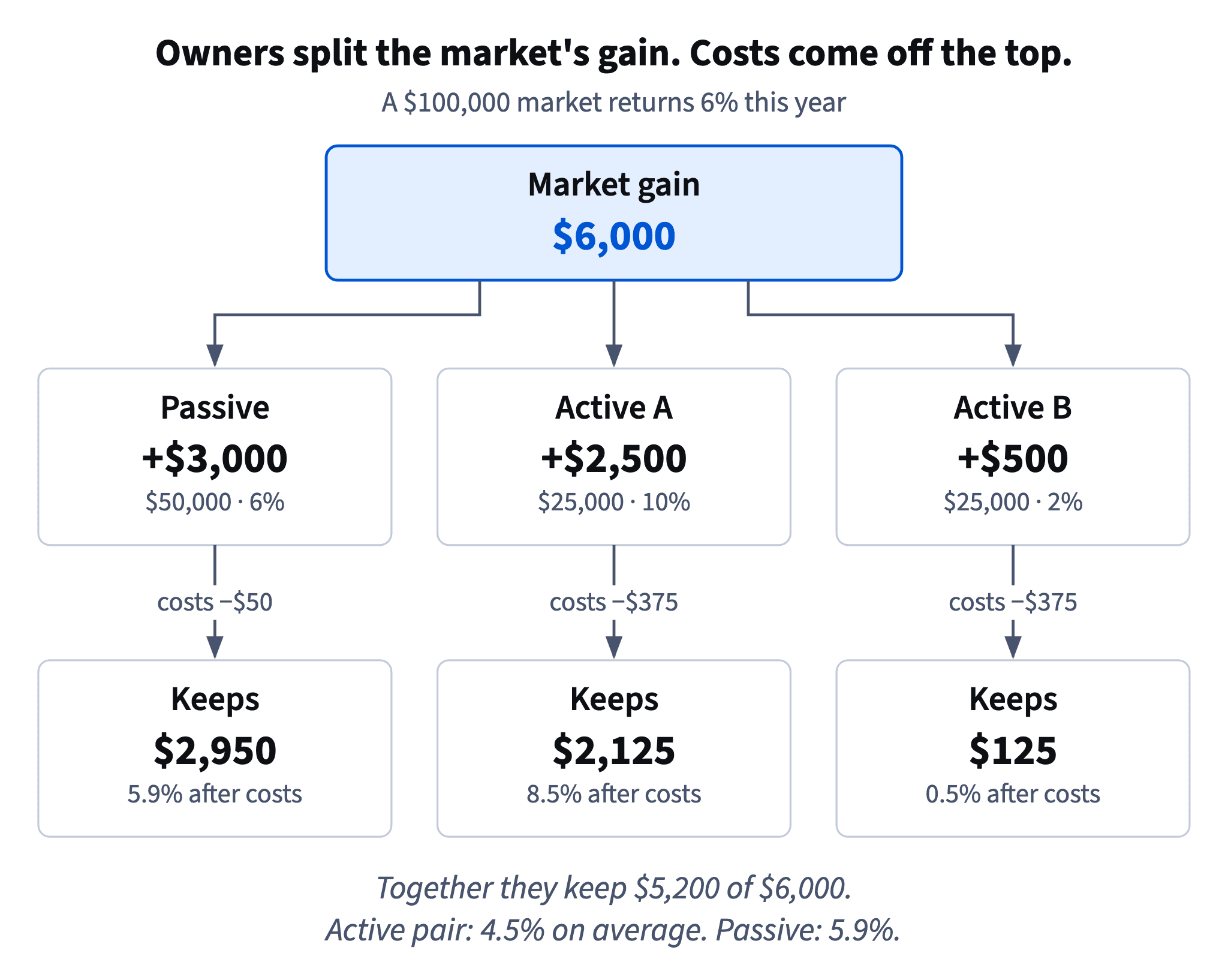
Turn percentages into dollars and the picture gets sharper. The market's gain is fixed by the companies, not by the investors: here $6,000. Trading shares back and forth only decides who gets which slice. Costs are different: they leave the investors altogether and go to fund managers, brokers and platforms.
In the toy market the costs are 50,000 × 0.1% = $50 for the passive investor and 25,000 × 1.5% = $375 for each active one, $800 in total. So the investors as a whole keep $5,200 of the $6,000. The active pair owns half of the market but pays almost all of the costs.
Next year the market may return 20% or −20%; nobody knows. The costs are known in advance and are charged either way. That is why a lower cost is the one improvement an investor can be sure of.
Picture: Before costs the owners split the market; costs come off the top. · shown above
- Do“On $25,000 a 1.5% cost is $375 a year, whatever the market does.”
- Don't“1.5% is a small number, it can't matter much.”
Compare costs with the expected real return, not with 100%.
What you can promise in advance
The arithmetic of the average investor is a statement about a group, not about each member. It says that the average active dollar earns the market minus its costs. It doesn't say that every active fund loses to an index fund: in any year some beat it, by luck or skill, and others trail it by more.
For product copy this matters in both directions. A slogan like "beat the market" promises something the group as a whole can't deliver. But "index funds always win" overclaims too, and a user who sees one active fund ahead will stop trusting the screen.
The honest version names what is certain: owning the whole market gives you the market's return minus small costs, and the average alternative gives you the market minus bigger costs. Whether a particular fund will be one of the winners is the next question, and it needs data over time.
- Do“You get the market's return minus about 0.1–0.2% a year in costs.”
- Don't“Beat the market with our expert picks.”
Promises the group a result the arithmetic rules out.
What the arithmetic says, and what it doesn't
The argument has only two steps: all owners together earn the market, and costs come off the top. From that you can draw a few firm conclusions:
- before costs, the average active dollar earns the market;
- one active investor's extra return is another active investor's shortfall;
- after costs, the average active dollar trails the market by its costs, so every point of cost saved is a point kept.
Formula: Holds for active investors as a group, in any year. Here: 6% − 1.5% = 4.5%. · shown above
It does not say that a higher fee buys a better result, that a skilled manager lifts the whole group, or that any single fund must lose. "Average" here means dollar-weighted: a big fund counts more than a small one, just as each dollar in the market counts the same.
Keep the claims inside those limits and nobody can argue with them, because they need no forecast at all.
- Do“Every 0.1 point we cut from costs is 0.1 point more for users.”
- Don't“It's an expensive fund, so it must be a good one.”
Ready to practise?
Answer the lesson's exercises and earn 250 points the first time you finish it.
Start the exercises