

Theory
Next steps after a discovery call
Why no discovery call “went well”, how to tell a real next step from a polite stall, how to rescue a conversation after a compliment, why you decide what to ask for before you go, and a sample follow-up email after the meeting.
~11 min read · 12 exercises · 250 points
Before you start
How a call should end
Back on CatChow's product team, Sofia has lined up calls again, this time with commitments ready to ask for. She has just finished one with Olivia, and it felt lovely, so lovely that asking for anything felt awkward.
In this lesson you'll learn to tell a real next step from a polite stall, rescue a conversation after a compliment, decide what to ask for before the call, and write a short follow-up afterwards.
Meetings succeed or fail
A discovery call is a short early conversation with a potential customer, before any sale: you learn how they deal with the problem today, what they've tried and who decides, and then you ask for a concrete next step.
Sofia's call with Olivia “went really well”. She had prepared commitments to ask for, but Olivia was so warm that asking felt awkward. The call ended: “This was lovely! I really hope it works out. Let's stay in touch, and tell me when the boxes are ready!”
Here's an uncomfortable rule: no meeting “goes well”. It either succeeds or fails. It succeeds when it ends with a concrete step forward, something agreed with a who, a what and a when. This one ended with a compliment and a “tell me when”.
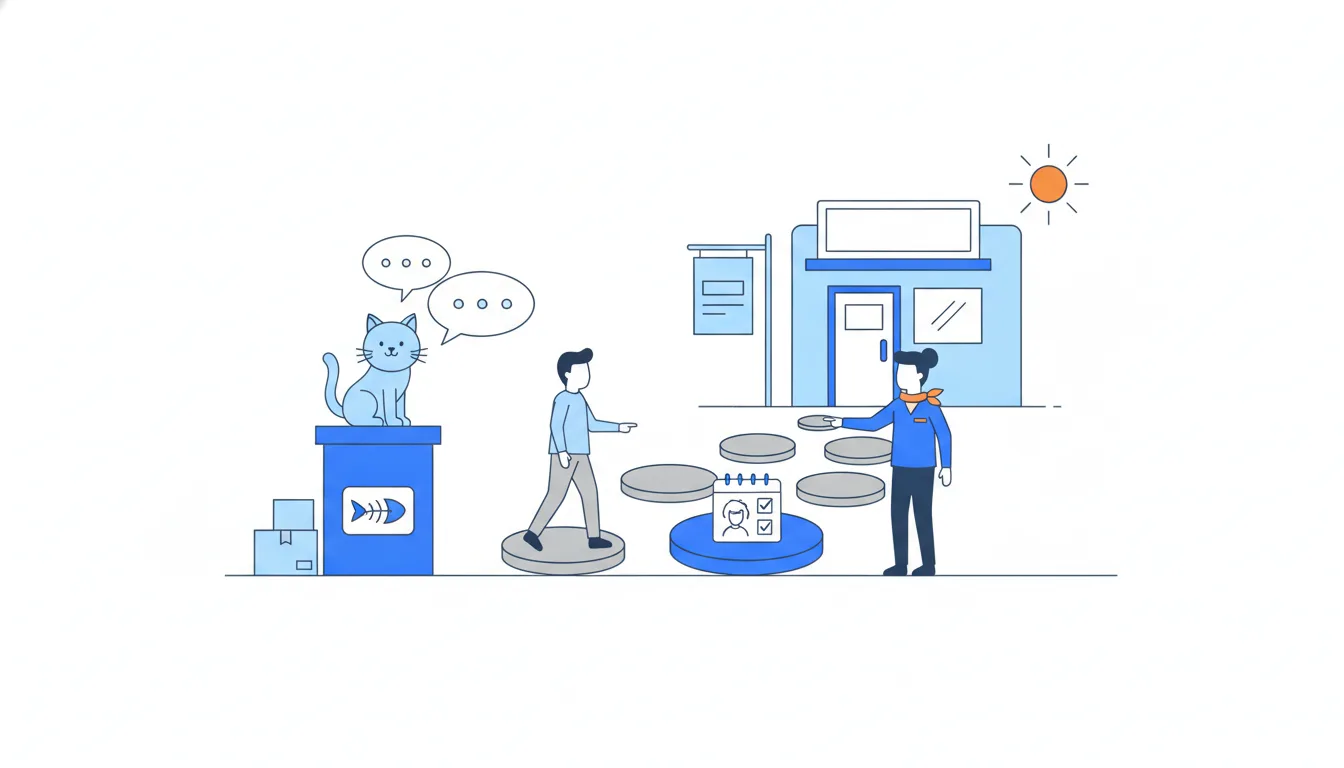
Warmth isn't progress. Nothing was agreed, Olivia gave up nothing, and all the work is left with Sofia. After every conversation, ask yourself: do I know exactly what happens next? If not, it didn't succeed, however nice it felt.
- Don't“This was lovely! Let's stay in touch, and tell me when the boxes are ready.”
Warm, but nothing agreed and nothing given up.
- Do“I'll test the trial box from Monday and send you notes on the 14th.”
A who, a what and a when: the call succeeded.
Advancement vs stalling
“But she did say ‘let's stay in touch’. Isn't that a next step?” It's a polite way to close the door softly. That's stalling, and it comes in many friendly forms: “let's talk after the holidays”, “I'll check with the team”, “send me something to read”, “let's reconnect after the summer”.
What you want instead is advancement: the person moves one step closer to becoming a customer. A trial on a set date, an intro to the budget owner, a pre-order.
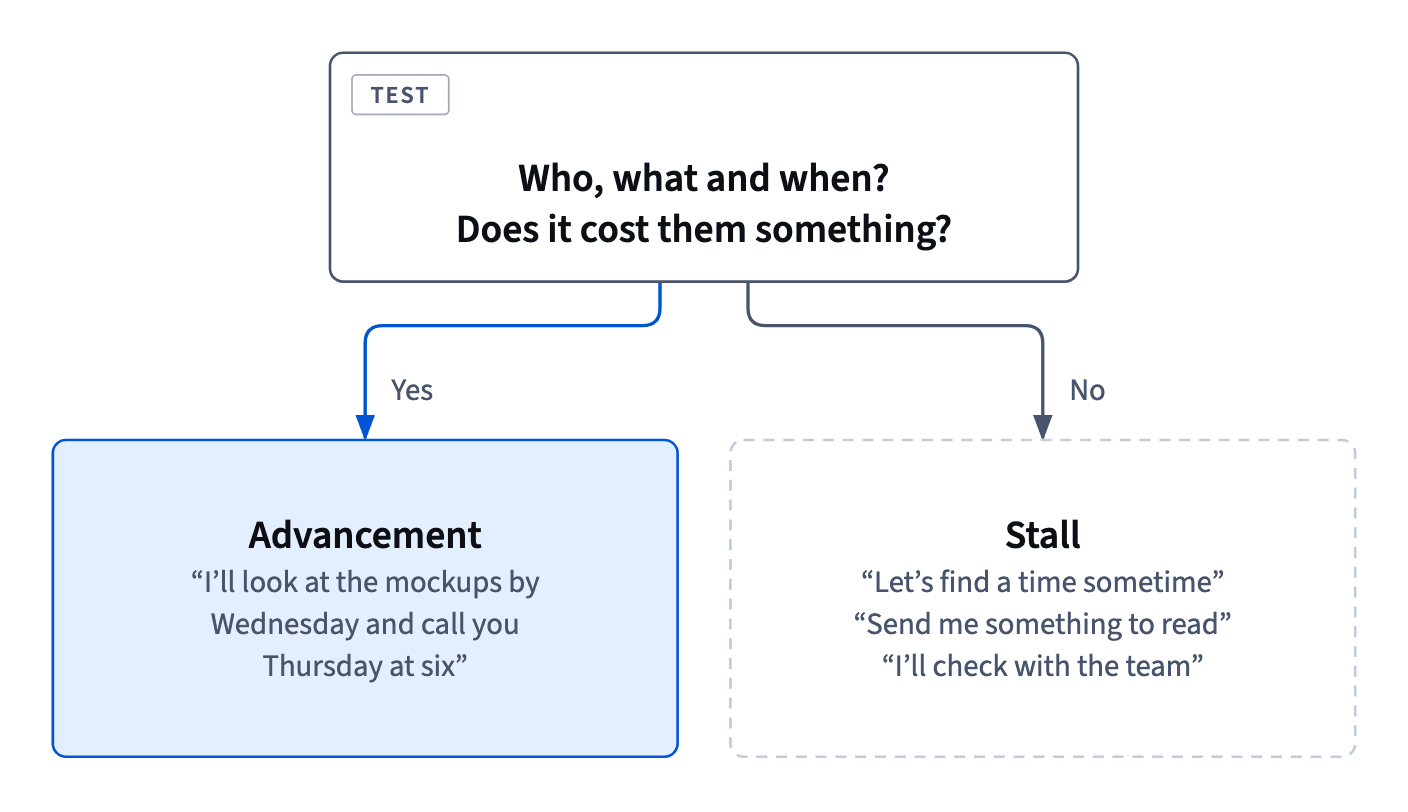
To tell them apart, check two things:
- Does the step have a who, a what and a when?
- Does it cost them something: time, reputation or money?
“I'll look at the mockups by Wednesday and call you Thursday at six” passes both. “I'll test the box with both cats and send notes by the 15th” passes. “Let's find a time sometime” fails both. And “send me a presentation” is a stall dressed up as interest: reading a deck costs nothing and commits to nothing.
- Do“Our CFO is free on Tuesday at 11. Can you come and show her the pilot terms?”
Who, what, when, and it costs the speaker reputation.
- Don't“I'll run it past the team and get back to you.”
No date, no owner, nothing given up.
- Don't“Send me a presentation, I'll have a look.”
A stall dressed up as interest.
A no is a result
Sofia admits it: she didn't ask Olivia for the pre-order because she was scared she'd say no. Almost everyone is. But compare what each outcome gives you.
A clear no today tells you where you stand, and it lets you ask what's in the way: price, timing, trust. That's real information you can act on. A friendly “let's stay in touch” leaves you guessing for months, and you can't plan anything on a guess.
Meetings drift for two reasons, often both at once:
- you asked for opinions about the idea, so you got compliments;
- you never proposed a clear next step, so nothing was decided.
So a no isn't a failed meeting. A no is a result. The meeting that failed is the one where you never asked, and left with a compliment instead. When you hear a no, thank them and ask one more question: “What would have to be different for this to be a yes?” The answer is often the most useful thing you'll hear all week.
- Do“Fair enough. What would have to be different for this to be a yes?”
Turns a no into a named obstacle.
- Don'tNot asking for the pre-order, to avoid hearing no.
The real failure: months of guessing instead of one clear answer.
Grading meeting endings
Megan, CatChow's head of sales, tested the idea on her own month of meetings. When you review how meetings ended, sort each ending by what it actually gives you:
- Compliment and a stall: “Love it! Send me a presentation.” Reading a deck costs nothing and commits to nothing.
- Future promise: a pet shop owner's “We'll definitely stock it once you launch.” It sounds like an order, which is exactly what makes it the most dangerous one: it's easy to put in a forecast, and it costs the shop nothing.
- Advancement: an office manager's “Can you come back and walk our CFO through it?” She's pulling you further in, and bringing in her CFO costs her reputation.
- A clear no with a reason: “Not this year, our budget is frozen until March.” It names a real obstacle and often a date to come back.
Only advancement moves the deal forward, but a clear no is useful too. The first two feel positive and give you nothing to act on, so don't let them into your pipeline as progress.
- Don'tLogging “We'll definitely stock it once you launch” as an order.
A future promise in an order's clothes.
- DoLogging “Can you walk our CFO through it?” as advancement.
They pull you in and spend reputation to do it.
Making a vague offer concrete
Sometimes a customer offers something real but vague. A pet shop owner tells Megan: “I know a few other shop owners I could introduce you to when you're ready.” Good or bad?
Almost good. It's a genuine signal, because an intro puts her reputation at risk. But “a few people” and “when you're ready” are too fuzzy to act on, and fuzzy offers fade.
There are two easy mistakes. Saying “Thank you so much! I'll let you know when we're ready” lets the offer drift away, and you never learn who she meant. Asking for phone numbers on the spot is pushy and skips whatever she needs before vouching for you.
Instead, ask warmly: who exactly does she have in mind, and what would she need to see from you before making the intro? And why not now? Maybe she first wants to see the product working in her own shop. That answer turns a vague offer into a concrete step, and tells you what to do next: perhaps a trial shelf in her shop, then the intros.
- Do“That would really help. Who are you thinking of, and what would you need to see from us first?”
Keeps the offer alive and makes it concrete.
- Don't“Thank you so much! I'll let you know when we're ready.”
Passive waiting: the offer fades.
Rescue the call after a compliment
The moment a customer pays you a compliment is the best moment to ask for something. Interest is at its peak, and the conversation is warm. So treat the compliment as your cue: the instant Olivia says “this is lovely”, propose a concrete step.
That isn't pushy. You're not pressuring her to buy; you're checking whether she's really on the way to becoming a customer. For example: “Glad you like it! We're taking pre-orders for the first hundred boxes, 1,250 UAH, shipping in March. Shall I send you the link?”
Either answer helps. If she means it, she'll say yes, and the compliment has turned into a commitment. If she hesitates, ask what's in the way, and you'll hear something real for the first time in the call: the price, the timing, paying ahead, her loyalty to the shop downstairs.
The same move works in B2B. When an HR director says “What a fun perk, our people would love it!”, that's the moment to propose a pilot or a meeting with whoever approves perks.
- Do“Glad you like it! Pre-orders for the first hundred boxes are 1,250 UAH, shipping in March. Shall I send you the link?”
Uses the compliment as the cue for a concrete step.
- Don't“Thank you so much, I'll let you know when it launches!”
Accepts the compliment and lets the best moment pass.
Learn first, then ask
Megan's first plan for the HR meeting was simple: show the slides, then ask if they want to buy. That gets a yes or a no and nothing else. A sales or discovery meeting has a better natural order:
- Learn first. How do they choose and pay for perks today? What did they try last, and why did it stick or not?
- Show your idea briefly, linked to what you just heard.
- Make the ask you prepared before the meeting.
- Agree who does what by when, and confirm it in writing the same day.
Decide before you walk in what you'll ask for. If you have to say “let me think and get back to you”, you've wasted the best moment in the meeting.
Skip the learning, and a no teaches you nothing, because you don't know what it was a no to. Skip the ask, and the meeting drifts into compliments. Skip the written confirmation, and even a yes can quietly fade once everyone is back at their desks.
- Do“How do you choose perks today? What happened with the last one you tried?”
Learn first, so any answer later means something.
- Don'tOpen with the slides, then ask “So, do you want to buy?”
You get a yes or a no, and nothing to learn from either.
A fallback ask
Go into every meeting with two asks. The main ask is the biggest step that's reasonable at this stage, such as a paid pilot. The fallback is smaller, but it must still cost them something, so that a no to the big step still ends with movement.
Say the HR director tells Megan: “A paid pilot isn't possible this quarter.” Without a fallback, the meeting ends there. With one, Megan can ask: “Could you introduce me to your finance director, or run a two-question poll by Friday on how many staff have cats?” The intro costs reputation, the poll costs time, and both move the deal forward.
What doesn't work as a fallback:
- “Let's stay in touch” and “I'll send the deck” are stalls you hand yourself.
- A discount answers a question nobody has asked: you don't yet know whether price is the reason for the no.
Write both asks down before the meeting, in two lines each: what you'll ask for, and which currency it costs them.
- DoMain: a paid three-month pilot. Fallback: an intro to the finance director by Friday.
The fallback is smaller but still costs reputation.
- Don'tFallback: “No problem, let's stay in touch.”
A stall you hand yourself.
Following up on a stall
Megan's HR meeting went well in the learning part: a wellbeing budget, a yoga perk nobody used, a third of the team with cats. Then it ended: “Send me a presentation, I'll share it with management and we'll get back to you after the quarter closes.” Megan said “Great, thank you!”, accepting the stall.
When a good meeting ends in a stall, the follow-up email after the meeting is your second chance. Keep it short and build it on what they told you: their real problem, what they tried, what it cost them. Megan's version reminds Julia of the cats and the unused yoga perk, proposes a pilot that checks usage first (20 people, three months, 20 × 1,250 × 3 = 75,000 UAH), and asks for 30 minutes with Paul, who approves perks, next Tuesday or Wednesday.
End with one concrete ask that has a who, a what and a when, and make no easy to say. Leave out the deck, the feature list and the “just checking in”. A clear answer next week beats a “maybe” after the quarter.
- Do“You said empty shelves cost you regulars. Shall we try a two-week trial shelf from 13 January? Or just tell me if the timing's wrong.”
Built on his problem, one dated ask, and an easy no.
- Don't“Just checking in: any thoughts yet?”
Asks for nothing specific, so it keeps the stall going.
Ready to practise?
Answer the lesson's exercises and earn 250 points the first time you finish it.
Start the exercises